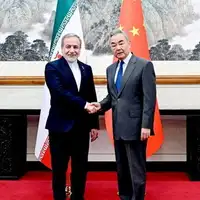
File photo shows the front page of Iranian daily Etemad which features Iranian and US chief negotiators Abbas Araghchi and Steve Witkoff
As Iran and the United States reshuffle the format and venue of their talks amid military threats, deep mistrust, and hardline red lines, skepticism over a breakthrough appears widespread.
The talks, originally scheduled for Friday in Istanbul with several regional countries expected to attend, were moved to Oman at Iran’s request and narrowed to bilateral discussions between Tehran and Washington.
Tehran had also reiterated its insistence on indirect negotiations, with Foreign Minister Abbas Araghchi sitting in a separate room from Steve Witkoff and Jared Kushner, relying on Omani mediators to shuttle messages between the two sides.
State media further reported that the talks would focus exclusively on the nuclear issue, as in previous rounds.
However, The New York Times reported on Thursday that while Iran’s nuclear program would be the main focus, the two sides agreed that negotiations would also cover missiles and Tehran’s support for militant groups.
The newspaper cited three Iranian officials and one Arab official as saying the US agreed to hold the talks in Oman and exclude regional actors, while Iranian officials agreed to face their American counterparts.
Negotiations to avoid war—or merely delay it?
While diplomats maneuver, hardliners continue to float threats of preemptive strikes on Israel and closing the Strait of Hormuz, while claiming that Iran’s military posture has forced Trump to reconsider his repeated threats of military action.
Former foreign minister and lawmaker Manouchehr Mottaki said the likelihood of a US attack has dropped “from 100 percent to around 50 percent,” attributing the change to Washington’s doubts about achieving victory.
Journalist Hossein Yazdi, however, cited three developments over the past few days—the IRGC’s harassment of a US vessel in the Persian Gulf, the US downing of an IRGC Shahed-139 surveillance drone in the Arabian Sea, and Iran’s insistence on moving talks to Oman without Arab observers—as evidence that negotiations are not serious.
“Both sides have their hands on the trigger,” he wrote.
Iran’s red lines remain intact
It remains unclear whether Iran, facing Trump’s threats and the risk of war, is willing to reconsider positions that contributed to the collapse of previous negotiations.
“Any decision regarding these stockpiles must be designed with maximum distrust toward the other side’s intentions,” he wrote. “Handing them over in one go—under any title—is not goodwill or strategic rationality. It is voluntary disarmament under military threat.”
Others echoed familiar red lines. Esmail Kowsari, a member of parliament’s national security committee, said Iran’s missile capabilities and regional activities are “absolutely none of America’s business.”
Former deputy speaker Ali Motahari likewise cited enrichment rights, missile range, support for the so-called Axis of Resistance, and refusal to recognize Israel as all non-negotiable.
Few expect a breakthrough
Given Iran’s insistence on these red lines, its past negotiating record, and recent mass killings of protesters that have plunged the Islamic Republic into a severe legitimacy crisis, few analysts express optimism.
Political analyst Ruhollah Rahimpour told Iran International that the Islamic Republic is, for the first time, confronting both a real external threat and a profound internal legitimacy crisis. “This combination is deadly,” he said, adding that Tehran can no longer assume it can cross Trump’s red lines and face only rhetorical consequences.
Former diplomat Nosratollah Tajik was blunt: “It is unlikely this round of mediation will go anywhere due to structural issues, the gap between goals and expectations, and the unfinished business of the previous two stages of Iran–US conflict.”
Mottaki also expressed doubt, saying: “These talks will not produce tangible results, but they may deter the US from imposing war.”
Yazdi argued there are no signs of serious negotiations, noting that Iran wants to resume narrow nuclear talks in Oman, while Trump and Israel seek far broader concessions. “From their perspective, destroyed nuclear facilities are no longer the top priority,” he wrote.
A user on X warned that failed talks would only make a Trump-led war against Iran appear more justified in the eyes of the international community.
Who really decides?
President Masoud Pezeshkian weighed in with a rare post on X on Tuesday, saying he had instructed the foreign minister to pursue talks “if there is a suitable, threat-free atmosphere.”
The wording sparked controversy, as few doubt that foreign policy is ultimately controlled by Supreme Leader Ali Khamenei. A community note was even added to the post.
"The person who makes the decisions in Iran is the Supreme Leader. The President doesn't really matter," US Vice-President J.D. Vance said on Wednesday.
"The Foreign Minister seems to talk to the Supreme Leader and that's mainly the person that we've communicated with. But it's a very weird country to conduct diplomacy with when you can't even talk to the person who's in charge of the country."
Researcher Abbas Gheidari interpreted Pezeshkian’s phrase “I instructed” as an attempt to preemptively assume responsibility for a potential nuclear concession to protect Khamenei.
Vice President Jafar Ghaempanah tried to soften the debate, writing: “No war is good, and not every peace is surrender.” Some conservatives such as Abdolreza Davari read this as a sign of an imminent deal. Ultra-hardline lawmaker Mehdi Koochakzadeh, however, warned that “the peace imposed by the architects of the JCPOA will bring humiliation worse than surrender.”
Protesters’ anger and pressure on Trump
Some Iranian activists and social media users have reacted angrily to what they describe as Trump’s flexibility, saying Tehran is once again buying time.
“This is what they’ve done for nearly 30 years,” one user wrote. “Trump prioritizes extracting concessions, not regime change—otherwise he wouldn’t have stopped Israel in the 12-day war.”
One image sent by a citizen to Iran International showed graffiti reading: “President Trump: Don’t negotiate with the killers of the Iranian people.”
A day of confusion, warnings and behind-the-scenes maneuvering ended with a fresh announcement that US–Iran talks were back on track, underscoring how fragile and contested the diplomatic process remains on the eve of a possible meeting.
Throughout the day, senior officials on both sides issued sharply conflicting messages about whether talks would happen at all, where they might be held and what they would cover.
Reports citing Iranian and Western officials alternated between suggesting the process had collapsed and hinting that negotiations were imminent, reflecting what one diplomat described as “negotiations about negotiations.”
In Washington, Marco Rubio sought to project readiness while acknowledging deep skepticism.
“I think in order for talks to actually lead to something meaningful, they will have to include certain things,” Rubio said, casting doubt on whether diplomacy would succeed at all.
“I’m not sure you can reach a deal with these guys,” he added. “But we’re going to try to find out.”
Rubio’s Iranian counterpart, Abbas Araghchi, said Tehran was “fully ready” for talks, but only within a narrow framework focused on Iran’s nuclear program.
As officials sparred in public, reports surfaced of intense behind-the-scenes haggling over venue and format.
Turkey was first cited as a possible location, then ruled out, before Oman re-emerged — with Araghchi posting on X that talks would be held in Muscat on Friday at 10 a.m. local time.
Hovering over the diplomatic back-and-forth were stark warnings from President Donald Trump, who adopted an increasingly explicit tone in remarks to NBC News.
Asked whether Iran’s Supreme Leader, Ali Khamenei, should be concerned, Trump replied: “I would say he should be very worried, yeah. He should be.”
Trump also claimed that the United States had uncovered plans for a new Iranian nuclear facility and had issued a direct threat in response.
Iran was “thinking about starting a new site in a different part of the country,” he said. “We found out about it. I said, you do that, we’re gonna do really bad things to you.”
As hopes for talks with the United States flicker and fade, Iran’s chronic factional infighting once again appears to have torpedoed a diplomatic opening—even before it properly began.
With negotiations now hanging in the balance, conflicting signals from Tehran have reinforced a familiar pattern: internal rivalries routinely overwhelm coherence at moments requiring discipline.
On Wednesday, Axios reported that the planned talks were no longer expected to go ahead, while Israel’s Channel 12 went further, citing officials as saying the process had been cancelled altogether.
Iranian and US officials have not publicly confirmed that account, but the drift has been unmistakable.
The unraveling followed days of public discord inside Iran’s political establishment.
After President Masoud Pezeshkian said he had “ordered” Foreign Minister Abbas Araghchi to travel to Turkey to discuss arrangements for talks, ultraconservative MP Amir Hossein Sabeti attacked the move in a post on X.
“Mr. Araghchi, our people are waiting for a pre-emptive action against the enemy, not negotiations. And you got up and went to Turkey?!”
The remarks ignored—or deliberately blurred—the fact that decisions on negotiations with the United States rest with the Supreme Leader, not the president. They also illustrated how calls for escalation are often deployed less as strategy than as factional positioning, regardless of the risks such rhetoric may invite.
A second episode followed when ultraconservative MP Hamid Rasai targeted Vice President Jafar Ghaempanah over an X post responding to Pezeshkian’s message about Araghchi’s trip.
After Ghaempanah wrote, “No war is good, and no peace necessarily means surrender,” Rasai questioned his loyalty and invoked his U.S.-based son, escalating the attack with religious language.
Such exchanges are not aberrations. Factional conflict has been embedded in the Islamic Republic since its inception.
Early struggles between Islamic liberals and religious fundamentalists gave way to rivalries among clerical factions, later morphing into competition between reformists and conservatives, and, since the mid-2000s, a sharper divide between hardliners and moderates.
For years, the Supreme Leader functioned as a broker among these camps, preserving a degree of political coherence. As power has become more centralized and alignments more rigid, that balancing role has weakened.
Vested interests across the system have repeatedly shown a willingness to obstruct—and at times actively sabotage—diplomatic processes rather than allow rivals to claim credit for engagement with Washington.
As many commentators, including former President Hassan Rouhani, have long observed, the fiercest resistance to talks has often come not from principled opposition to diplomacy itself, but from fear of who might benefit politically if diplomacy succeeds.
The result is a recurring pattern in which negotiations collapse not only under external pressure, but under the weight of Iran’s own internal rivalries.
US Secretary of State Marco Rubio doubled down on Washington’s demand that any talks with Iran extend well beyond its nuclear program, while expressing doubt that negotiations would ultimately succeed.
“I think in order for talks to actually lead to something meaningful, they will have to include certain things,” Rubio said, listing Iran’s ballistic missile program, its support for armed groups across the region and its treatment of its own citizens, alongside the nuclear issue.
“I’m not sure you can reach a deal with these guys,” he added. “But we’re going to try to find out.”
That position has been widely criticized by Iranian opposition figures and activists, who say engaging Tehran so soon after a deadly nationwide crackdown risks normalizing mass violence.
More than 36,000 protesters were killed during the January crackdown, according to Iran International’s Editorial Board, with many more detained and facing harsh punishment, including lengthy prison sentences and possible executions.
Rubio appeared to respond to that criticism by emphasizing what he described as President Donald Trump’s willingness to engage diplomatically without conferring legitimacy.
“President Trump is willing to talk to and meet with and engage with anyone in the world,” Rubio said. “We don’t view meetings as even a little legitimization.”
The talks are expected to begin on Friday, but confusion continues to surround their scope, format and even location.
Rubio said US officials believed a forum in Turkey had been agreed upon, only to see Iranian statements disputing that account. “That’s still being worked through,” he said.
An Iranian official quoted by Reuters on Wednesday appeared to suggest that a shift in venue to Oman had been confirmed.
The official also contradicted Washington’s position on the scope of talks, insisting they would be limited strictly to Iran’s nuclear program and exclude its missile capabilities.
President Trump said earlier this week that “bad things will probably happen” if no deal is reached.
The killing of thousands of protesters in Iran last month was followed by a near-total internet and phone blackout, leaving millions of Iranians abroad trapped in prolonged fear, trauma, and emotional paralysis.
For nearly three weeks, millions inside Iran were cut off from the outside world as authorities imposed sweeping restrictions on internet access and international phone lines after the violent suppression of protests. For Iranians in the diaspora, the silence was devastating.
Many describe days and nights spent refreshing news feeds, replaying worst-case scenarios, and bracing for phone calls that never came. Even when limited connections were restored, the anxiety did not ease.
“Psychologically, not knowing what is happening—or whether family members are safe—keeps the body and mind in a prolonged state of stress,” Canadian-Iranian clinical counsellor Farnaz Farrokhi told Iran International.
A state of constant alarm
Farrokhi says many in the diaspora are experiencing “constant anxiety, compulsive news checking, feelings of helplessness and guilt, and emotional disconnection from loved ones.”
“What I’m seeing is the continuation of collective trauma, layered on top of long-standing emotional wounds from years of instability, loss, and fear,” she said, adding that many are also grappling with survivor’s guilt—being physically safe while loved ones are not.
For Narges, an IT specialist living in the Netherlands, the days of disconnection were unbearable.
“At work, my colleagues’ laughter and jokes were painful,” she said. “But I couldn’t—and didn’t have the right to—transfer my anxiety to them. I couldn’t interact the way I normally do.”
She took two days off, hoping rest would help. It did not.
“At home it was no better. Every time the phone rang, the doorbell sounded, or even a small object fell, I jumped. My heart would start racing.”
Trauma spilling into family life
For Taraneh, an Iranian living in Italy, the emotional toll extended to her six-year-old son.
“I try very hard not to let my son see the painful images—bodies piled together in black bags,” she said. “But sometimes I can’t hide my grief or my tears.”
Her son keeps asking why she is crying.
“I don’t have an answer that makes sense to him,” she said. “And not being able to explain my feelings makes me feel even worse.”
Even after limited international calls were allowed, communication remained fragile. Calls were brief, unstable, and often cut off without warning. Some families waited days for a single connection.
Fear of surveillance shaped many conversations. Families resorted to coded language, wary that saying too much could endanger loved ones.
“When my parents finally called, we could only cry. We didn’t know what to say to each other,” said Leila, a London-based Iranian expat. “We both knew about the massacre, but we couldn’t talk about it because there was every reason to believe our conversation wouldn’t stay private.”
“My mum said it had rained a lot there,” Leila recalled. “I knew she meant the bloodshed—not rain. It hadn’t rained at all.”
An open wound
For some, reconnection brought devastating news: learning days—or even weeks—later that relatives or friends had been killed, injured, or arrested.
“Today I saw the father of one of my child’s classmates at the school gate,” Germany-based mother Neda Soltani wrote on X. “He looked stunned. He burst into tears and said his cousin in Tehran had been killed—and he had only found out this morning.”
“Two Iranians stood there crying at the school gate,” she added. “Others just walked past.”
Farrokhi warns that without acknowledgement, safety, and the restoration of trust and communication, the psychological toll on the diaspora will continue to deepen.
“This is not just about grief,” she said. “It’s about living in a constant state of alarm—never knowing when the next rupture will come.”
Monday’s cautious optimism about renewed US–Iran diplomacy took several blows on Tuesday, as Tehran reportedly signaled fresh conditions for talks and Iranian and American forces clashed at sea.
US officials said American forces shot down an Iranian drone after it approached a US Navy aircraft carrier in the Arabian Sea, and later intervened when armed Iranian boats harassed a US-flagged merchant vessel transiting the Strait of Hormuz.
The incidents underscored the fragility of a diplomatic process that Washington and Tehran had suggested was back on track only a day earlier.
Iran’s foreign ministry sought to downplay growing uncertainty around talks expected later this week, saying discussions over the venue and timing were ongoing and should not be “turned into a media issue.”
Esmail Baghaei, the ministry’s spokesman, said Turkey, Oman and other regional countries had offered to host the talks, and thanked “friendly countries” for helping create conditions for diplomacy.
“In principle, the venue and timing of talks are not complicated issues and should not be used as a pretext for media games,” Baghaei said, adding that details would be announced once finalized.
Behind the scenes, however, Iranian officials appeared to be revisiting earlier understandings. Reuters and Axios reported that Tehran was seeking to move the talks from Istanbul to Oman and to limit discussions strictly to the nuclear file, excluding missiles and support for regional armed groups—issues that Washington and regional allies have said must be addressed.
Axios cited informed sources saying Iran was “walking back” agreements reached in recent days after other countries had already been invited to participate.
The Wall Street Journal reported that Iranian officials had also threatened to pull out of talks altogether, though it was not immediately clear what prompted the warning.
At sea, the confrontations continued. US Central Command said Iranian Revolutionary Guard forces harassed a US-flagged, US-crewed merchant vessel in the Strait of Hormuz, while a US fighter jet downed an Iranian drone that had approached a carrier strike group.
Iranian state-linked media said the drone was conducting a “routine and lawful mission” in international waters and that data had been transmitted successfully before contact was lost.
White House press secretary Karoline Leavitt said talks with US envoy Steve Witkoff were still scheduled, but stressed that military options remained on the table. “For diplomacy to work, of course, it takes two to tango,” she said.
Israeli Prime Minister Benjamin Netanyahu struck a harsher note, saying Iran “has repeatedly proven it cannot be trusted to keep its promises.”