• العربية
  • فارسی
Brand
  • Iran Insight
  • Politics
  • Economy
  • Analysis
  • Special Report
  • Opinion
  • Podcast
  • Iran Insight
  • Politics
  • Economy
  • Analysis
  • Special Report
  • Opinion
  • Podcast
  • Theme
  • Language
    • العربية
    • فارسی
  • Iran Insight
  • Politics
  • Economy
  • Analysis
  • Special Report
  • Opinion
  • Podcast
All rights reserved for Volant Media UK Limited
volant media logo

US–Iran talks stagger back on after a day of threats and denials

Feb 5, 2026, 00:35 GMT+0

A day of confusion, warnings and behind-the-scenes maneuvering ended with a fresh announcement that US–Iran talks were back on track, underscoring how fragile and contested the diplomatic process remains on the eve of a possible meeting.

Throughout the day, senior officials on both sides issued sharply conflicting messages about whether talks would happen at all, where they might be held and what they would cover.

Reports citing Iranian and Western officials alternated between suggesting the process had collapsed and hinting that negotiations were imminent, reflecting what one diplomat described as “negotiations about negotiations.”

In Washington, Marco Rubio sought to project readiness while acknowledging deep skepticism.

“I think in order for talks to actually lead to something meaningful, they will have to include certain things,” Rubio said, casting doubt on whether diplomacy would succeed at all.

“I’m not sure you can reach a deal with these guys,” he added. “But we’re going to try to find out.”

Rubio’s Iranian counterpart, Abbas Araghchi, said Tehran was “fully ready” for talks, but only within a narrow framework focused on Iran’s nuclear program.

As officials sparred in public, reports surfaced of intense behind-the-scenes haggling over venue and format.

Turkey was first cited as a possible location, then ruled out, before Oman re-emerged — with Araghchi posting on X that talks would be held in Muscat on Friday at 10 a.m. local time.

Hovering over the diplomatic back-and-forth were stark warnings from President Donald Trump, who adopted an increasingly explicit tone in remarks to NBC News.

Asked whether Iran’s Supreme Leader, Ali Khamenei, should be concerned, Trump replied: “I would say he should be very worried, yeah. He should be.”

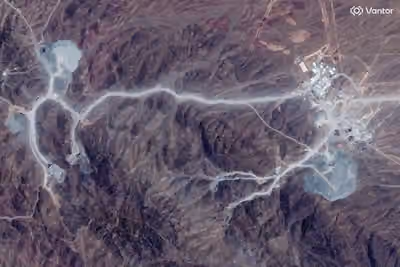
Trump also claimed that the United States had uncovered plans for a new Iranian nuclear facility and had issued a direct threat in response.

Iran was “thinking about starting a new site in a different part of the country,” he said. “We found out about it. I said, you do that, we’re gonna do really bad things to you.”

Most Viewed

Khamenei fills six top military posts as key intelligence gaps persist
1

Khamenei fills six top military posts as key intelligence gaps persist

2

Mojtaba Khamenei orders integration of Iran’s top military command bodies

3
INSIGHT

Iran plays down Mecca Pact as regional security order shifts

4

Iran parliament advances Hormuz bill targeting US, Israeli transit

5
INSIGHT

All Mojtaba's men: Old guard shapes Iran’s new order

Banner
Banner
Banner

Spotlight

  • Iran hardliners tout offensive posture as Khamenei reshapes military command
    INSIGHT

    Iran hardliners tout offensive posture as Khamenei reshapes military command

  • The Kinglet’s rookie mistake: how an Iranian hacker was caught at US request
    SPECIAL REPORT

    The Kinglet’s rookie mistake: how an Iranian hacker was caught at US request

  • Rising costs leave Iranians 'nothing' for a coffee
    VOICES FROM IRAN

    Rising costs leave Iranians 'nothing' for a coffee

  • Two years on, Pezeshkian’s presidency is a tale of survival
    INSIGHT

    Two years on, Pezeshkian’s presidency is a tale of survival

  • From Karbala-4 to AMIA: Mohsen Rezaei returns to Iran’s security helm
    INSIGHT

    From Karbala-4 to AMIA: Mohsen Rezaei returns to Iran’s security helm

  • The strange power of Iran’s absent supreme leader
    ANALYSIS

    The strange power of Iran’s absent supreme leader