• العربية
  • فارسی
Brand
  • Iran Insight
  • Politics
  • Economy
  • Analysis
  • Special Report
  • Opinion
  • Podcast
  • Iran Insight
  • Politics
  • Economy
  • Analysis
  • Special Report
  • Opinion
  • Podcast
  • Theme
  • Language
    • العربية
    • فارسی
  • Iran Insight
  • Politics
  • Economy
  • Analysis
  • Special Report
  • Opinion
  • Podcast
All rights reserved for Volant Media UK Limited
volant media logo

Iranian Lawyer Opposes Idea Of 'Absolute Obedience' To Khamenei
Iran International Newsroom
Nov 25, 2023, 13:03 GMT+0Updated: 11:27 GMT+0
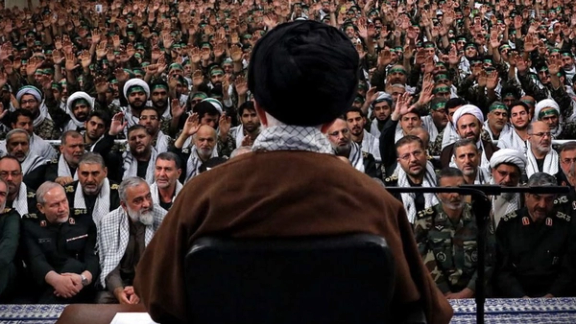
Iran's ruler Ali Khamenei speaking to loyal clergy and IRGC officers. Undated

A prominent Iranian lawyer has argued that the dominating role of the hardliner Paydari Party is likely to hinder the legislative system and the Constitution.

In a recent commentary, Iranian lawyer Kambiz Nowrouzi referred to a statement made by hardline cleric Morteza Aqa-Tehrani, the chairman of the central council of Paydari Party. Aqa-Tehrani recently quoted the party's founding father, Ayatollah Mohammad Taqi Mesbah-Yazdi as having called for the nation's absolute obedience to Supreme Leader Ali Khamenei.

Aqa-Tehrani had quoted Mesbah as saying, "The absolute rule of the jurisconsult (Velayat-e Faqih) is not enough as the theory of government under the Islamic Republic. The system also needs absolute obedience of the people to the supreme leader."

The statement effectively renders the legislative system in Iran meaningless. According to the ultraconservative party, Khamenei can make any decision, and the people will have no choice other than obeying what he decrees.

Practically, during the past decade, Khamenei has been running the country in the same way, without elaborating on the underlying principle of the system. He effectively made the parliament obsolete by handing over key decisions on issues such as the annual budget to the heads of the legislative, executive and judiciary powers.

Iranian attorney Kambiz Nowruzi. Undated
100%
Iranian attorney Kambiz Nowruzi

In 2019, when a fuel price rise led to a nationwide uprising, the parliament said that it was not consulted, and Khamenei had handed over decision-making on the matter to the heads of the three powers of the government. However, at least one of the trio, former President Hassan Rouhani said he was not involved in the price rise decision either and that he learned about it like everyone else, in the morning after the decision was implemented.

The idea of absolute obedience is based on another verdict by late Ayatollah Mesbah, a Muslim fundamentalist, which maintains that the Supreme Leader, currently Khamenei, is not elected by the people. He is appointed by God almighty!

Elsewhere, Mesbah said, "If there have been elections in Iran so far, that is because that is because the leader has so decided. However, the leader can announce another form of government that does not need people's input." He added that "The people's vote has no impact on the legitimacy of the government." He even said: "Who are the people to decide on the affairs of the state?" Nonetheless, his followers later tried in vain to interpret his words differently.

In his commentary, Nowrouzi pointed out that the Iranian Constitutional Law has stressed on the importance of the people's vote in several instances, including in Article 56 which stipulates that "The absolute ruler of the world and man is God, however, God has decided that man should be in charge of determining his own fate." The article adds that "No one can deprive man of this divine right or take advantage of that right in the interest of a certain group or individual."

Nowruzi further pointed out that "This article makes man unconditionally in charge of determining his own fate," adding that "This article is the foundation of national sovereignty.”

The lawyer also pointed out that Article 6 of the Iranian Constitution also says very clearly that "In the Islamic Republic the affairs of the state should be run based on public votes by electing the President, members of the parliament, members of city councils and so on, or based on referendum in other cases."

He further pointed out that this means the people are free to run the affairs of the state based on their free will and votes, and this is in sharp contrast to the idea of absolute obedience. The lawyer also claimed that both Khamenei and his predecessor Ruhollah Khomeini publicly opposed the idea of absolute obedience to the leader.

Nowruzi argued that the Islamic Republic is based on the two pillars of Islamism and Republicanism. If you do away with one of the two pillars, the system will collapse.


Most Viewed

Iran negotiators ordered to return after internal rift over Islamabad talks
1
EXCLUSIVE

Iran negotiators ordered to return after internal rift over Islamabad talks

2
ANALYSIS

US blockade enters murky phase as tankers spoof signals and buyers hesitate

3
ANALYSIS

Why the $100 billion Hormuz toll revenue is a myth

4

US tightens financial squeeze on Iran, warns banks over oil money flows

5
ANALYSIS

US blockade targets Iran oil boom amid regional disruption

Banner
Banner

Spotlight

  • Hardliners push Hormuz ‘red line’ as US blockade tests Iran’s leverage
    INSIGHT

    Hardliners push Hormuz ‘red line’ as US blockade tests Iran’s leverage

  • Ideology may be fading in Iran, but not in Kashmir's ‘Mini Iran'
    INSIGHT

    Ideology may be fading in Iran, but not in Kashmir's ‘Mini Iran'

  • War damage amounts to $3,000 per Iranian, with blockade set to add to losses
    INSIGHT

    War damage amounts to $3,000 per Iranian, with blockade set to add to losses

  • Why the $100 billion Hormuz toll revenue is a myth
    ANALYSIS

    Why the $100 billion Hormuz toll revenue is a myth

  • US blockade targets Iran oil boom amid regional disruption
    ANALYSIS

    US blockade targets Iran oil boom amid regional disruption

  • Iran's digital economy battered by prolonged blackout
    INSIGHT

    Iran's digital economy battered by prolonged blackout

•
•
•

More Stories

Iran-backed Militia Leaders In Iraq Demand Withdrawal Of US Troops

Nov 25, 2023, 11:52 GMT+0

The Secretary-General of the Iran-backed Asaib Ahl al-Haq militia in Iraq, has once again strongly criticized the presence of US combat forces in the country.

In a televised statement, Qais al-Khazali said the Iraqi government is not legally authorized to approve the establishment of foreign bases in the country.

Al-Khazali emphasized that any government granting such approval should be held accountable for violating the Iraqi constitution.

On the heels of his statement, Akram Al-Kaabi, Secretary-General of Harakat Hezbollah al-Nujaba (HHN) in Iraq and another Iran-backed group, echoed the sentiments and went a step further by calling for a "declaration of war" against the United States and its expulsion from Iraq. Al-Kaabi asserted that any form of American presence, whether as combat forces, advisors, or technicians, is considered hostile and unacceptable.

The remarks come in response to recent US airstrikes targeting Iranian-backed militants in Iraq, including a strike in Jurf al Saqr that resulted in casualties. US officials confirmed the strikes as a direct response to attacks against US and Coalition forces by Iran and its proxies.

The United States had until earlier this week limited its response to more than 60 attacks against its forces in Iraq and neighboring Syria, claimed by Iran-aligned Iraqi militia groups, to three separate sets of strikes in Syria.

At least 62 US personnel have suffered minor injuries or traumatic brain injuries in the attacks.

Republicans and others criticized the Biden administration for its lack of determination to respond more forcefully against Iranian proxies.

Sunni Cleric In Iran Asserts His Anti-Islamist Worldview

Nov 25, 2023, 11:12 GMT+0
•
Majid Mohammadi

What if a Sunni imam plays a central role in advocating for freedom in a Shia-majority country ruled by Shiite clerics and gains significant traction.

It may seem unlikely, especially in a country like Iran with a hostile regime. While suspicions about Iranian imams being conservative and reactionary are understandable, Mowlavi Abdolhamid (Abd ul-Hamid), a Sunni cleric in southeastern Iran, challenges these stereotypes. Contrary to the image of a radical jihadist, Abdolhamid seeks peace, an end to bloodshed, and has attracted fellow Iranians with his message.

If Iran’s ongoing revolution leads to the establishment of a secular government, promoting religious freedom, women’s rights, and ending the murderous mistreatment of religious and ethnic minorities, one of its influential figures could be Sunni Muslim Abdolhamid. In fact, a Sunni Muslim is playing a central role in undoing the catastrophe of the 1979 Islamic revolution in Iran.

Thousands of Iranians of diverse backgrounds flocked to his mosque, Makki, in Zahedan (capital of Sistan-Baluchestan province, southeast of Iran) in March 2023 to celebrate the Iranian new year (a secular celebration) and to hear his message of hope and resistance. Abdolhamid stands out as a cleric who is both hated by the current ruler Ali Khamenei and immensely popular among the Iranian people. Despite being a member of the Sunni minority, he is increasingly more popular and has become a symbol of an Iranian renaissance. Despite efforts to tarnish his reputation, leaked documents reveal Khamenei's advice to ruin Abdolhamid's standing has not diminished his popularity. 

Makki mosque in Zahedan (file photo)
100%
Makki mosque in Zahedan

According to Abdolhamid's office, the security forces of the Islamic Republic have been pursuing the assassination plot of this staunch mowlavi who has been defending of the rights of all Iranian citizens. Abdolhamid was one of the many Iranian Sunni imams in Shia-governed Iran who supported the ongoing uprising that began with the death of Masha Amini in September 2022. Abdolhamid has been repeatedly attacked by the authorities and the propaganda horns of the government, his assistants were prosecuted and jailed, and his loyalists were shot at.

Abdolhamid has notably broken traditional Shiite clerical taboos, such as welcoming women without hijab to his mosque during Iranian New Year travels and advocating for the equal rights of Baha'is and non-believers. His outspoken criticism extends to blaming Khamenei for the deaths of approximately 100 protesters in Zahedan on September 30, 2022, condemning the shooting of protesters, executing dissidents, and addressing issues of torture and rape in prisons.

A noteworthy outcome of the 2022 revolution is the participation of Iranian Sunni clerics in the national, secular, and freedom-oriented movement alongside the people. Unlike adherents of the Shiite political theory of governance and its sectarianism, Sunni clerics, particularly those aligning with the religious sentiments of their regions, swiftly joined the protesting masses. Abdolhamid, the imam of Zahedan's Makki Mosque, stands out due to his clear articulation of the general demands of the people in Sistan-Baluchestan and across Iran.

Abdolhamid's consistency in his positions, including abandoning previous stances, has garnered him popularity among protesters and regime opponents. Notably, he revisited past positions like congratulating the Taliban and supporting Ebrahim Raisi in the contested elections of 2021. Every Friday, during his leadership of prayers in Zahedan, Abdolhamid aligns himself with the positions of the protesters.

Anti-government protests in Zahedan in 2022
100%
Anti-government protests in Zahedan in 2022

Paths to a world without Islamism

Following the onset of the Mahsa Revolution, Abdolhamid emerged as a staunch opponent of sectarianism and Islamism within the government. He guides Muslim believers toward the separation of religion and state. One path is to normalize and recognize intellectual and ethnic diversity in the Iranian public arena. "Religious views cannot create equality in this intellectual and ethnic diversity. The religious view in the country will eventually fail," he says.

Focusing on government efficiency, he rightly points out the ineffectiveness of the Islamist government due to Islamist politics. He clearly identifies Islamism as responsible for the current failed state of governance: "What happened in Iran was due to a denominational view; denomination is a branch of religion. Denomination means a narrow perception and religion has a wider circle. The denominational view became dominant in Iran, and limited the view and opinion and limited the plans.” In this speech, he refers to Islamism as a [political] religion. 

Abdolhamid highlights the contradiction between Islamism and meritocracy. He is well familiar with the dimensions and results of the anti-secular government in this area. From his point of view, the root of this ideological selection is the idea that the government represents God. "No one can claim to be God's representative," he argues.

He firmly opposes the involvement of clerics in governmental affairs and decision-making processes. Abdolhamid contends that the country's challenges and protests cannot be addressed solely through lectures and sermons by preachers, or eulogists. Instead, he emphasizes the necessity of thoughtful minds, and experienced and compassionate individuals to tackle these issues.

Abdolhamid advocates for the legal equality of all citizens, rejecting notions of "insiders" and "outsiders," as well as ideological and political supremacy within a patriarchal system. He underscores the idea that all Iranians are citizens of Iran, united as brothers and sisters, transcending sectarian distinctions. Abdolhamid dismisses concerns about differences between Shiites and Sunnis, asserting that there are no such distinctions, and emphasizes that all Iranians, regardless of ethnicity, aspire to enjoy equal rights.

Public education about secularism

Similar ideas have been articulated by Iranian political activists and analysts, both within and outside the country, for years. However, hearing these sentiments from a Sunni Friday Imam, who enjoys popularity not only among the Baluchis but also among Sunni Kurds, and others is particularly noteworthy. Abdolhamid's influence extends to religious individuals opposed to the government. Since the Mahsa Revolution, he has skillfully primed the minds of millions of Sunni believers to embrace secularism. While he may not explicitly use the term "secularism," he has gradually preached and elucidated the dimensions of this concept.


Failure of Shiite Reformist clerics

No Shiite cleric in the social and religious position that Abdolhamid enjoys has defended secularism to such an extent, including former ‘reformist’ president Mohammad Khatami and other “progressive” clerics. 

These reformists do not believe in the separation of religion and state because they want reforms for the survival of Islamist government and religious rule and their own return to power, and not for a secular system of government.

Abdolhamid, a thorn in the government's throat

The government faces significant challenges in attempting to remove Abdolhamid, and such an action would come at a high cost for several reasons: 1) it would be difficult to close Friday prayers for a government claiming religious legitimacy, 2) he enjoys support from Baluch believers and leaders of Baluch clans and tribes, 3) the potential for a high cost in terms of security and potential backlash, as witnessed in the September 30, 2022, massacre, and 4) the resilience of the Baluch people for more than year of opposing the regime, gaining solidarity with other Iranians.

Today, Abdolhamid has garnered popularity among Iranians due to his ability to understand and echo the sentiments and demands of the majority of freedom-loving and secularist Iranians, despite being a traditionalist cleric. Any attempt to impose house arrest, terror, or exile, as used against opposition leaders in border regions, would pose considerable risks for the regime, especially when public sentiment is largely against the government.

The opinions expressed by the author do not necessarily reflect the views of Iran International.

Hospital Visits Have Doubled In Tehran Due To Rising Pollution

Nov 25, 2023, 10:11 GMT+0

Visits to hospital emergency rooms in Tehran has doubled due to air pollution in the capital, causing shortness of breath, chest pain, headaches, and dizziness.

The head of Tehran province's emergency department confirmed an increase in public calls to the emergency department on cold and polluted days, saying that more than twenty-six thousand people with respiratory and heart problems have called Tehran Emergency in recent days.

The head of Tehran Emergency has explained that most calls in this regard are about five-year-old children and people over 55 years old with underlying health problems such as asthma.

The volume of calls is also higher in busy urban areas, Tehran's Grand Bazaar area, and the city center.

Air pollution in Iran is not limited to the capital, and many cities have been grappling with this problem for years.

The private and public vehicle fleets in Iran are mostly old and inefficient, producing air pollution. Gasoline in Iran is the second cheapest in the world and cities experience traffic jams with 20-30 year old cars, buses and trucks on the roads. Iran also uses diesel in power generation in large cities, which adds to air pollution.

According to Etemad newspaper in Tehran, there were only two clean days in the capital in 2022, and according to statistics from previous years, the number of clean days has been decreasing.

This newspaper predicted that in the not too distant future, having healthy air will be an impossible dream and at the same time emphasized that government agencies make no effort to enforce clean-air regulations.

As a result of persistent pollution, more than twenty thousand Iranians lose their lives each year.

Human Rights Group Says World Reactions Needed To Iran Executions

Nov 25, 2023, 09:34 GMT+0

The Human Rights Organization of Iran has raised alarm over the recent execution of Iranian protester, Milad Zohrevand, and its potential repercussions.

Director Mahmoud Amiry-Moghaddam emphasized on Friday that the global community's response plays a crucial role in influencing the cost of executions for the Islamic Republic.

Zohrevand, a 20-year-old protester from Malayer in western Iran, was arrested on October 27, 2022, marking the 40-day anniversary of Mahsa Amini's death, which had triggered widespread protests across the country.

He was secretly executed in Hamedan Central Prison on November 22.

The Oslo-based Human Rights Organization of Iran contends that his execution, like those of other protesters, lacked due process and a fair trial, constituting a criminal act. Amiry-Moghaddam held the Islamic Republic authorities accountable, noting that “the international community’s relative silence toward the extraordinary wave of executions over the past months has prompted the Islamic Republic to resume protester executions.”

Expressing grave concern for the lives of numerous protesters currently on death row or awaiting execution in Iranian prisons, the organization warned that an inadequate response to Zohrevand’s execution could lead to more protester hangings.

According to state media, Zohrevand was accused of killing an IRGC officer named Ali Nazari on the day of his arrest. He was sentenced to qisas (retribution-in-kind) for murder, a decision upheld by the Supreme Court on November 15.

Zohrevand becomes the eighth protester associated with the Women, Life, Freedom movement to be executed since December 2022.

An Israeli-Owned Container Ship Was Reportedly Attacked In Sea Of Oman

Nov 25, 2023, 08:29 GMT+0

An Israeli commercial ship was reportedly attacked in the Sea of Oman or northern Indian Ocean on Thursday or Friday and caught fire, according to Al Mayadeen TV and a US official.

This is the first time that such an incident has been reported following the seizure of a commercial vessel in the Red Sea by Yemen’s Houthis earlier this week. The Iranian government news agency IRNA and Fars news agency affiliated with the Revolutionary Guard both published identical texts relaying what Al Mayadeen, a network affiliated with Iran has reported.

The Associated Press also quoted an unnamed American official as saying that a suspected Iranian Shahed-136 drone was used to attack the container ship owned by an Israeli billionaire. The report said the incident happened on Friday in international waters.

According to IRNA and Fars, there are no details available. The exact location of the alleged attack in the vast area was also not mentioned. The Sea of Oman lies to the southeastern shores of Iran and straddles its border with Pakistan.

They both also published the same photo with their reports showing a vessel on fire on open seas, but it is not clear if the photo is related to the incident claimed by Al Mayadeen.

Houthis are part of Iran’s network of proxy forces in the region that have launched attacks against Israel since the start of the Gaza war in October.