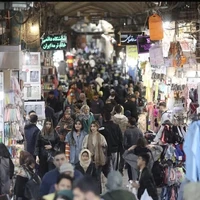
A woman walks across the street, with a banner of all three leaders of Iran, late Ruhollah Khomeini, late Ayatollah Ali Khamenei, and Mojtaba Khamenei in the background, amid the US-Israeli conflict with Iran, in Tehran, Iran, March 15, 2026.
War damage to Iran’s economy has reached $270 billion in 40 days, equivalent to roughly $3,000 per person, according to official figures, with losses expected to grow as trade disruptions deepen under a US blockade of Iranian ports.
Fatemeh Mohajerani, the spokesperson for the Iranian government, said on Tuesday losses from the US-Israeli military campaign are estimated at around $270 billion.
The New York Times, citing three Iranian officials and two economists, reported that early estimates broadly align with that figure, placing the damage at roughly $300 billion or higher.
Preliminary estimates by the US-based think tank Foundation for Defense of Democracies also suggest Iran absorbed roughly $150–$300 billion in economic damage.
Using a population of about 92 million, the lower estimate of $150 billion translates to roughly $1,600 per person, rising to nearly $3,250 per person under the higher estimate.
These figures reflect national wealth lost through destruction, halted production and disrupted trade.
Iran’s central bank has warned President Masoud Pezeshkian that rebuilding the country’s war-damaged economy could take more than a decade, sources familiar with internal deliberations told Iran International.
In a stark assessment delivered to the president in recent days, senior economic officials said the damage inflicted during the 40-day war with the United States and Israel—combined with Iran’s already fragile economic situation—could take up to 12 years to repair.
Industrial sectors bear largest losses
Petrochemicals account for the largest share of damage. Iran’s petrochemical sector, with annual sales of $29.1 billion, has seen about 85% of export capacity disrupted following strikes on major hubs including Mahshahr and South Pars. Estimated losses range from $30 billion to $50 billion.
Energy infrastructure has also been heavily affected. Refineries, storage depots and gas facilities have been struck, weakening a sector that generated about $78 billion in exports in 2024. Losses are estimated at $15 billion to $25 billion.
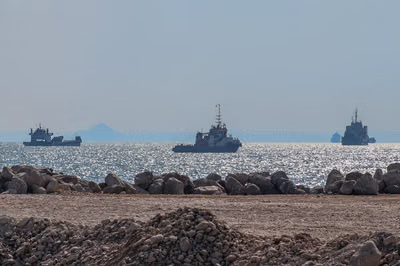
Explosion at Iran's Mahshahr petrochemical complex during US-Israeli strikes
Steel production, which underpins both industrial output and reconstruction, has been severely reduced, with about 70% of capacity disrupted. Losses are estimated at $5 billion to $10 billion.
Beyond physical losses, the war has triggered a sharp contraction in output.
Experts estimated a decline of more than 10% in GDP, equivalent to $34 billion to $44 billion in lost economic activity, affecting an economy that was already under strain before the conflict.
Beyond physical damage, policy-driven disruptions have compounded the losses.
Internet shutdown
A nationwide internet blackout beginning Feb. 28 has imposed additional costs.
Direct losses are estimated at $37 million to $42 million per day, totaling $1.5 billion to $2.5 billion over more than five weeks.
Afshin Kolahi, a member of Iran’s Chamber of Commerce, said Monday indirect losses could raise the daily figure to $70 million to $80 million due to disruption to online businesses.
Online sales fell by about 80% during the shutdown, while the Tehran Stock Exchange lost 450,000 points within four days.
The shutdown is affecting multiple layers of the economy simultaneously, according to economic analyst Masoumeh Taherkhani.
“The Iranian economy is damaged at three levels by internet disruption, starting with the digital core, which employs between four and five million people,” Taherkhani told Iran International. “Then the platform layer collapses, and finally the broader economy is affected in a way that spreads across production and services.”
Taherkhani said the combined effect leads to widespread job losses. “When the economy is fully stagnant, the outcome is unemployment for workers, and that is not something that can easily be reversed,” she said.
Trade disruption and self-inflicted losses
Disruptions linked to the Strait of Hormuz have added further pressure, with estimated losses of $5 billion to $15 billion.
The restrictions have affected imports of essential goods and weakened non-oil exports, contributing to supply chain disruptions across the economy.
A US naval blockade targeting Iran’s maritime trade routes is expected to deepen losses.
Sanctions strategist and former US Treasury official Miad Maleki estimated that cutting off seaborne trade could eliminate about $435 million in daily economic activity, equivalent to roughly $13 billion per month.
Iran relies on the Persian Gulf for more than 90% of its trade, leaving it highly exposed to sustained disruption.
Oil exports of about 1.5 million barrels per day – generating roughly $139 million daily – could be halted almost entirely, removing the country’s main source of foreign currency.
What the losses could have funded
The scale of damage corresponds to investment levels that could have reshaped core sectors of the economy.
A large combined-cycle power plant with capacity of around 1,000 to 1,500 megawatts typically costs between $600 million and $1 billion to build, depending on technology and fuel infrastructure.
At the lower estimate of $150 billion in losses, Iran could have financed roughly 150 to 250 such plants. At the upper estimate of $300 billion, that rises to between 300 and 500 plants, enough to eliminate electricity shortages and significantly expand export capacity.
In housing, average construction costs for a modest apartment unit range between $30,000 and $50,000. With $150 billion, between 3 million and 5 million housing units could have been built. At $300 billion, that increases to roughly 6 million to 10 million units, enough to address shortages across major urban areas.
High-speed rail construction typically costs between $20 million and $40 million per kilometer. The lower estimate of losses could have funded approximately 3,750 to 7,500 kilometers of rail, while the higher estimate could support up to 15,000 kilometers, connecting major cities nationwide.
A modern hospital costs between $200 million and $500 million to construct and equip. The lower-end losses could have built 300 to 750 hospitals, while the higher estimate could fund up to 1,500 facilities, expanding healthcare access across the country.
What it means for individual Iranians
The per capita loss of up to $3,250 represents a substantial share of annual income for many households.
With average monthly earnings between $150 and $200, an individual earns roughly $1,800 to $2,400 per year, meaning a $3,250 equivalent exceeds a full year of income for many citizens.
If such an amount were available, it could cover between 12 and 20 months of living expenses for an average worker. Families could use it toward housing costs, including down payments or completing home purchases in smaller cities.
Small businesses could be launched with startup capital of $2,000 to $5,000, enabling self-employment in sectors such as retail, services or online commerce. Households could also afford private healthcare, education or relocation costs that are otherwise beyond reach.
Even the lower estimate per person represents several months of income, providing a buffer against inflation, job loss or unexpected expenses.
The overall range reflects damage already incurred, with additional losses building as trade, production and financial flows remain disrupted.
At up to $3,250 per person and rising, the economic toll underscores the scale of damage to Iran’s productive capacity, with long-term implications for recovery and growth.
Outside the building of the General Directorate of Prisons of Semnan Province
A Swiss citizen Iran says died by suicide in prison was a 64-year-old tourist, a Swiss foreign ministry spokesman told Iran International, adding that Switzerland is seeking more details on his arrest and death from Tehran.
The foreign ministry added on Friday that the individual had been living in South Africa for the past 20 years and was traveling in Iran as a tourist.
The email response from the ministry said that the Swiss embassy in Iran was earlier denied access to the prisoner and now wants Tehran to provide full information about his arrest and death.
"Since Switzerland was informed of the arrest, the Swiss Embassy in Tehran has been in daily contact with the Iranian authorities to obtain more information about the circumstances of the arrest and to gain access to the detained Swiss citizen," the foreign ministry said.
"However, due to the accusations (espionage – national security), the requested consular access was not granted," it added. "Switzerland is demanding that the Iranian authorities provide detailed information."
The Swiss citizen who allegedly committed suicide in Semnan Prison on Thursday had been arrested while collecting soil samples in Iran’s central desert during an Israeli airstrike, media affiliated with Islamic Revolutionary Guard Corps reported.
Meanwhile, local media quoted unnamed Iranian official as saying that person was conducting espionage when he was arrested. The name of the Swiss citizen and the circumstances of his arrest and death remain unclear.
“This individual used prior intelligence training to take their own life during a specific opportunity,” Mashregh News, a publication affiliated with the Islamic Revolutionary Guard Corps (IRGC), reported late Thursday, citing an unnamed security official.
"Switzerland is demanding that the Iranian authorities provide detailed information on the reasons for his arrest and a full investigation into the circumstances of his death," the Swiss foreign ministry said.
The individual, detained by the IRGC Intelligence Organization, was accused of gathering information in a sensitive area during Israel's October air attack. The media report specifically said that this occurred during the Shahroud attack, which targeted an IRGC missile facility. Satellite imagery from Planet Labs later revealed significant damage to the site, known for building ballistic missiles and launching rockets as part of Iran’s space program.
After their arrest, the person was transferred to Semnan Prison, where they allegedly revealed information about their network and communication links, according to the outlet.
A local judiciary official confirmed the death on Thursday, saying that the Swiss national, facing espionage charges, had committed suicide in their cell.
Switzerland has also confirmed the death. "The FDFA confirms the death of a Swiss citizen in Iran," spokesperson Pierre-Alain Eltschinger told Iran International. "The Swiss Embassy in Tehran is in contact with the local authorities to clarify the circumstances of the death in an Iranian prison," he added.
According to Mizan, Iran's judiciary news website, the detainee asked their cellmate on Thursday morning to purchase food from the prison canteen. While alone in the suite, the detainee reportedly took their own life. "Prison officials immediately intervened to save the individual, but their efforts were unsuccessful," Mohammad Sadegh Akbari, a local judiciary official, was quoted as saying. “Suicide has been definitively confirmed.”
Iran has arrested dozens of dual nationals and foreigners in recent years, often on charges of espionage or security-related offenses. Some of these detainees have been released in exchange for deals involving Iranians held in foreign prisons.