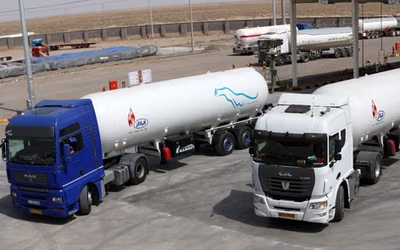
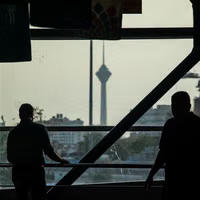
A huge billboard in Tehran shows a clenched hand gripping a blue cloth shaped like the Strait of Hormuz, symbolizing Iran’s hold over the strategic waterway, with Persian text reading “Forever in Iran’s hands,” displayed above a busy intersection in the capital.
The US naval blockade of Iran is entering an opaque phase, with early signs of impact emerging through both buyer hesitation and deceptive shipping practices, rather than direct naval confrontations.
In the first 24 hours after the blockade took effect at 10 a.m. ET on April 13, US Central Command said “no ships made it past the US blockade” and that “6 merchant vessels complied with direction from US forces to turn around to re-enter an Iranian port on the Gulf of Oman.”
But shipping data, satellite imagery and industry monitoring suggest the real contest may be unfolding more quietly — and more ambiguously.
Maritime analysts have observed early shifts in tanker behavior near the Strait of Hormuz, with some vessels reversing course shortly after the blockade began.
Mike Schuler, managing editor of gCaptain, wrote on X that “Tankers may already be turning away from Hormuz,” citing AIS data showing “two vessels reversing course minutes after the US blockade began.”
Other vessels appear to be adapting more creatively.
TankerTrackers reported spotting a tanker departing Kharg Island while spoofing its AIS signal to suggest it had left Saudi Arabia instead.
AIS, or Automatic Identification System, is designed to broadcast a ship’s identity, location and route. But the practice of manipulating these signals has become a hallmark of so-called “dark fleet” operations, allowing sanctioned vessels to obscure their origins and evade scrutiny.
TankerTrackers noted separately that “Dark Fleet tankers in particular may change names and flags,” urging journalists to rely on IMO numbers to track vessels more reliably.
Taken together, these patterns suggest the blockade’s early phase is being defined less by visible interdictions and more by a cat-and-mouse dynamic at sea, with tankers probing the limits of surveillance and compliance.
Enforcement gaps and shadow fleet
At the same time, enforcement itself remains uneven.
Reuters reported that a sanctioned, Chinese-owned tanker — identified as Rich Starry — transited the Strait of Hormuz during the blockade period, alongside other vessels including Murlikishan and Peace Gulf.
According to TankerTrackers, Rich Starry is “a serial AIS spoofer and a designated sanctions violator with a history of transporting Iranian refined products.”
The vessel later turned back after reaching the Gulf of Oman, while other ships stopped transmitting AIS signals altogether after entering international waters, according to ship tracking data.
These movements underscore a central challenge for US enforcement: vessels can spoof tracking data, switch flags, change names and operate in legal gray zones that complicate interdiction.
Even as Washington signals control over access to Iranian ports, the persistence of such activity suggests enforcement may be partial, contested and dependent on constant monitoring.
Buyer hesitation
Beyond shipping itself, early signs indicate the blockade may be influencing buyer behavior — potentially a more decisive factor.
TankerTrackers reported that “two million barrels of Iranian crude turned up unannounced today in India,” adding later that “India won't be accepting this oil.”
That hesitation points to a broader risk for Tehran: even if cargoes can leave Iranian waters, they may struggle to find willing buyers.
Jason Brodsky, policy director at United Against Nuclear Iran, said Washington is “trying to flip the script on Iran” after Tehran sought to tighten control over Hormuz traffic earlier this month.
By signaling it can restrict Iranian access to the same waterway, he said, the United States is effectively telling Tehran, “not so fast, we have the ability to prevent you and your vessels from using the Strait of Hormuz.”
Why this may be different from sanctions
Some analysts say the blockade could alter the underlying economics of Iran’s oil trade in ways sanctions did not.
“The blockade is doing something that 20 years of sanctions couldn't actually do,” said Mohammad Machine-Chian, a senior journalist covering economic affairs at Iran International.
He said sanctions often created opportunities for regime-connected middlemen and black-market networks to profit.
By contrast, “blockade is making that business model unfeasible,” he said, suggesting pressure may now fall more directly on the networks that previously benefited from sanctions evasion.
Pressure builds over time
Still, experts caution against expecting immediate economic collapse.
Former Royal Navy commander Tom Sharpe described the blockade as “a lever of persuasion of coercion” designed to “make Iran more susceptible to negotiations.”
“The blockade on the blockade is a strong-arm tactic to make Iran more susceptible,” he said. “In other words, as a lever, this might be a good one.”
Brodsky also said the effects are likely to build over “weeks and months,” rather than producing an instant shock.
Miad Maleki, a former US Treasury official, estimated the blockade could inflict roughly $435 million in daily economic damage, underscoring the potential scale of pressure even as its early effects remain uneven.
For now, the blockade’s first real test may be less about whether ships can pass through Hormuz, and more about whether they can do so undetected — and whether buyers are still willing to take the risk once they arrive.