Iran-backed Militia Leaders In Iraq Demand Withdrawal Of US Troops

The Secretary-General of the Iran-backed Asaib Ahl al-Haq militia in Iraq, has once again strongly criticized the presence of US combat forces in the country.

The Secretary-General of the Iran-backed Asaib Ahl al-Haq militia in Iraq, has once again strongly criticized the presence of US combat forces in the country.
In a televised statement, Qais al-Khazali said the Iraqi government is not legally authorized to approve the establishment of foreign bases in the country.
Al-Khazali emphasized that any government granting such approval should be held accountable for violating the Iraqi constitution.
On the heels of his statement, Akram Al-Kaabi, Secretary-General of Harakat Hezbollah al-Nujaba (HHN) in Iraq and another Iran-backed group, echoed the sentiments and went a step further by calling for a "declaration of war" against the United States and its expulsion from Iraq. Al-Kaabi asserted that any form of American presence, whether as combat forces, advisors, or technicians, is considered hostile and unacceptable.
The remarks come in response to recent US airstrikes targeting Iranian-backed militants in Iraq, including a strike in Jurf al Saqr that resulted in casualties. US officials confirmed the strikes as a direct response to attacks against US and Coalition forces by Iran and its proxies.
The United States had until earlier this week limited its response to more than 60 attacks against its forces in Iraq and neighboring Syria, claimed by Iran-aligned Iraqi militia groups, to three separate sets of strikes in Syria.
At least 62 US personnel have suffered minor injuries or traumatic brain injuries in the attacks.
Republicans and others criticized the Biden administration for its lack of determination to respond more forcefully against Iranian proxies.

Visits to hospital emergency rooms in Tehran has doubled due to air pollution in the capital, causing shortness of breath, chest pain, headaches, and dizziness.
The head of Tehran province's emergency department confirmed an increase in public calls to the emergency department on cold and polluted days, saying that more than twenty-six thousand people with respiratory and heart problems have called Tehran Emergency in recent days.
The head of Tehran Emergency has explained that most calls in this regard are about five-year-old children and people over 55 years old with underlying health problems such as asthma.
The volume of calls is also higher in busy urban areas, Tehran's Grand Bazaar area, and the city center.
Air pollution in Iran is not limited to the capital, and many cities have been grappling with this problem for years.
The private and public vehicle fleets in Iran are mostly old and inefficient, producing air pollution. Gasoline in Iran is the second cheapest in the world and cities experience traffic jams with 20-30 year old cars, buses and trucks on the roads. Iran also uses diesel in power generation in large cities, which adds to air pollution.
According to Etemad newspaper in Tehran, there were only two clean days in the capital in 2022, and according to statistics from previous years, the number of clean days has been decreasing.
This newspaper predicted that in the not too distant future, having healthy air will be an impossible dream and at the same time emphasized that government agencies make no effort to enforce clean-air regulations.
As a result of persistent pollution, more than twenty thousand Iranians lose their lives each year.

The Human Rights Organization of Iran has raised alarm over the recent execution of Iranian protester, Milad Zohrevand, and its potential repercussions.
Director Mahmoud Amiry-Moghaddam emphasized on Friday that the global community's response plays a crucial role in influencing the cost of executions for the Islamic Republic.
Zohrevand, a 20-year-old protester from Malayer in western Iran, was arrested on October 27, 2022, marking the 40-day anniversary of Mahsa Amini's death, which had triggered widespread protests across the country.
He was secretly executed in Hamedan Central Prison on November 22.
The Oslo-based Human Rights Organization of Iran contends that his execution, like those of other protesters, lacked due process and a fair trial, constituting a criminal act. Amiry-Moghaddam held the Islamic Republic authorities accountable, noting that “the international community’s relative silence toward the extraordinary wave of executions over the past months has prompted the Islamic Republic to resume protester executions.”
Expressing grave concern for the lives of numerous protesters currently on death row or awaiting execution in Iranian prisons, the organization warned that an inadequate response to Zohrevand’s execution could lead to more protester hangings.
According to state media, Zohrevand was accused of killing an IRGC officer named Ali Nazari on the day of his arrest. He was sentenced to qisas (retribution-in-kind) for murder, a decision upheld by the Supreme Court on November 15.
Zohrevand becomes the eighth protester associated with the Women, Life, Freedom movement to be executed since December 2022.

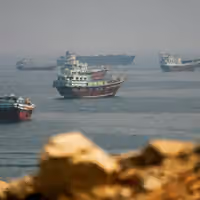
An Israeli commercial ship was reportedly attacked in the Sea of Oman or northern Indian Ocean on Thursday or Friday and caught fire, according to Al Mayadeen TV and a US official.
This is the first time that such an incident has been reported following the seizure of a commercial vessel in the Red Sea by Yemen’s Houthis earlier this week. The Iranian government news agency IRNA and Fars news agency affiliated with the Revolutionary Guard both published identical texts relaying what Al Mayadeen, a network affiliated with Iran has reported.
The Associated Press also quoted an unnamed American official as saying that a suspected Iranian Shahed-136 drone was used to attack the container ship owned by an Israeli billionaire. The report said the incident happened on Friday in international waters.
According to IRNA and Fars, there are no details available. The exact location of the alleged attack in the vast area was also not mentioned. The Sea of Oman lies to the southeastern shores of Iran and straddles its border with Pakistan.
They both also published the same photo with their reports showing a vessel on fire on open seas, but it is not clear if the photo is related to the incident claimed by Al Mayadeen.
Houthis are part of Iran’s network of proxy forces in the region that have launched attacks against Israel since the start of the Gaza war in October.

Iran's interior minister denies having authorized hijab enforcers at the capital’s subway stations, claiming they are “citizens’ groups” carrying out a religious duty.
Photos emerged on social media on Saturday that showed black-veiled women forming a human tunnel, which many now refer to as ‘tunnel of horrors’, at one of Tehran’s main subway stations to make sure women wear proper hijab. Similar surveillance and enforcement have also been reported at other stations.
Since May, the capital’s subway stations have been the battleground of women who are against compulsory hijab and various hijab enforcers as well as some ordinary citizens who consider it their duty to force others to abide by the rules.
The women who wore green shoulder sashes with the words “guidance ambassadors” written on them stopped women who were not wearing headscarves to admonish them for breaking the compulsory hijab rules.
Responding to reporters’ questions on the topic after the weekly cabinet meeting on Wednesday, Interior Minister Ahmad Vahidi declared that citizens’ groups were only carrying out ‘amr-e be marouf' for which everyone is responsible.

The phrase refers to a pious Muslim’s duty to urge others to avoid forbidden deeds and carry out what conforms with religious rules.
“We have not issued any particular permits for [their work],” Vahidi who is second in command of the police force after Supreme Leader Ali Khamenei, claimed while insisting that that all citizens have a religious duty to carry out ‘amr-e be marouf’ but this can only involve “nicely worded” verbal exhortation.
“Interesting! So, this tunnel of horrors at the metro is a citizens’ [initiative]!” Mostafa Faghihi, the managing director of the moderate conservative Entekhab news website tweeted Wednesday in reaction to Vahidi’s claim.
“Do people also pay their monthly salary? Are they also hired and organized under citizens’ supervision? No authorization required? How democratic and free!” Faghihi wrote referring to reports in August that Tehran municipality was planning to hire 400 uniformed hijab enforcers to deploy at subway stations of the capital.
Speaking to Faraz Daily news website, an official of the Tehran Metro Company had also earlier denied that that hijab enforcers are officially active in Tehran subway. Hadi Zand, head of international affairs and communications of Tehran Metro Company, told Faraz Daily that the company only has uniformed security personnel who are responsible for dealing with various issues including peddlers and ensuring the security of the subway system.
Many, including prominent reformist commentator Abbas Abdi, have raised objections to the deployment of ‘Hijab Patrols’ in Tehran’s subway stations, the police force’s use of CCTV to identify hijab infringers and recording their images.
In a commentary written for the reformist Etemad newspaper Tuesday, Abdi warned the authorities that that measures such as creating hijab enforcers “tunnels” in the subway corridors would only deepen the gap between the people and the authorities and increases public anger and hatred.
He also argued that introducing hijab enforcers as “guidance ambassadors” is unjustified because governments in the modern world are not mandated to guide people and the police is only responsible for establishing order. Hijab enforcers are municipality employees or police who act based on the orders they receive and get paid for their work like other employees, he said.

Persepolis football club's charter flight to Riyadh was denied permission from the Riyadh airport due to the airline's links on “military and security institutions," Iran International has learned.
The team was scheduled to departFridaymorning for their match against Al Nassr on Monday as part of the Asian Champions League, but it was announced on the Iranian football club's website that the flight had been canceled.
Lateron Friday, Iranian state news outlets blamed the airline for the cancellation. IRGC-affiliated Fars News reported that “according to Saudi Arabia’s laws, only a few Iranian airlines that usually fly Hajj pilgrims can land at Riyadh airport.”However, this particular airliner, which remains unnamed, was not among the authorized companies.
Moreover, Fars News said it was possible that the flight was chosen because it was “cheaper,” a questionable motive for one of the wealthiest clubs in the country.
According to other sources, Persepolis' private jet, owned by Chabahar Airlines, is barred from entering Saudi Arabia. This restriction is based on a policy prohibiting the entry of aircraft over 25 years old to Jeddah and Riyadh airports.
Several Iranian airlines, including Mahan Air -- affiliated with the Islamic Revolutionary Guard Corps (IRGC), have been banned by countries such as the US and France on the grounds that they transport military equipment and personnel to Syria and other areas in the Middle East.
Relations between Iran and Saudi Arabia have long been strained and this year's Asian football Champions League is the first since 2016 in which clubs from both nations have been permitted to play one another home and away. Matches between clubs from the two nations were previously played on neutral territory due to security concerns.