• العربية
  • فارسی
Brand
  • Iran Insight
  • Politics
  • Economy
  • Analysis
  • Special Report
  • Opinion
  • Podcast
  • Iran Insight
  • Politics
  • Economy
  • Analysis
  • Special Report
  • Opinion
  • Podcast
  • Theme
  • Language
    • العربية
    • فارسی
  • Iran Insight
  • Politics
  • Economy
  • Analysis
  • Special Report
  • Opinion
  • Podcast
All rights reserved for Volant Media UK Limited
volant media logo

UN Calls To Abolish Death Penalty In Iran, Repeal Hijab Laws

Iran International Newsroom
Aug 9, 2023, 07:52 GMT+1Updated: 17:56 GMT+1
A public execution in Iran

A report submitted to the UN High Commissioner for Human Rights and the Secretary General has called for Iran to halt surging executions and rollback mandatory veiling. 

It was among a long list of recommendations in a report submitted last month pursuant to General Assembly resolution 77/228, in which the UN General Assembly requested the Secretary-General to submit an interim report on the situation of human rights in Iran to the Human Rights Council at its fifty-third session.

The report calls for the regime to “immediately halt the execution of all individuals, including those sentenced to death in the context of protests and for drug-related offences, and to refrain from further application of the death penalty”.

This year alone, more than 350 Iranians have been hanged, according to Norway-based Iran Human Rights. The rights group noted it is a 36% increase on the same period last year, likely exacerbated by the ongoing uprising since the death in morality police custody of Mahsa Amini and the subsequent unrest sweeping the country.
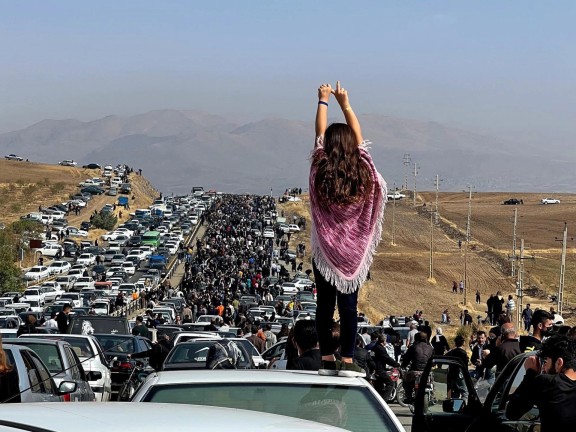
People making their way towards Aychi cemetery in Saqqez, the hometown of Mahsa Amini, to take part in a memorial service to mark 40 days since her death
100%
People making their way towards Aychi cemetery in Saqqez, the hometown of Mahsa Amini, to take part in a memorial service to mark 40 days since her death

As the trend sees no sign of halting, the UN calls on the regime to “abolish the death penalty and introduce an immediate moratorium on its use and prohibit the execution of child offenders in all circumstances and commute their sentences”.

Referring to the innumerable cases of prisoners detained arbitrarily, including women and girls, human rights defenders, lawyers, and journalists, for legitimately exercising their rights to freedoms of opinion and expression, association and of peaceful assembly, the UN calls on their release. In the 2023 Freedom House report, Iran ranked 12 out of 100 countries for its being “not free”, moving up from 14 in 2022.

Additionally, the UN urged the regime to “guarantee the right of peaceful assembly” and called on the regime to “uphold the full respect for due process and fair trial rights in line with international standards”, including access to legal counsel. Iran refuted the allegations made in the report of a disproportionate response by security forces to the protests.

As internet shutdowns and censorship continue to blight millions across the country, including decimating small businesses which rely on e-commerce, the UN asked that “internet shutdowns are never applied as they inherently impose unacceptable consequences for human rights”.

Addressing the mandatory hijab laws which have most recently seen the return of the morality police to the streets, high level surveillance of the population, brutality and the banning of women from many public places, the UN called on Iran to “take further steps to eliminate all forms of gender-based discrimination and violence against women and girls in law and in practice, including thorough revision and repeal of laws and policies which criminalize non-compliance with compulsory veiling”.

Two Iranian women without the mandatory hijab in a street in Tehran  (July 2023)
100%
Two Iranian women without the mandatory hijab in a street in Tehran

While the hundreds of mystery school poisonings which began last November in Qom and spread nationwide have still got no clearer answers as to the culprits, the UN reiterated the need for an “independent, impartial, prompt, thorough and effective investigation into reported poison attacks on girls’ schools with a view to hold the perpetrators to account; provide full reparations to the victims and guarantee the right to education without discrimination”.

Last month, Viviana Krsticevic, a member of the Fact-Finding Mission on Iran, speaking at a press conference in Geneva said the team, established by the Human Rights Council in November 2022, said: “We have identified major risks of further erosion of women's and girls’ rights in Iran. We have expressed concern about the continuous repression of women and girls opposing forced veiling and their reported use of facial recognition technologies to identify and arrest them.” 

The team is also investigating whether alleged poisonings of girls in schools have been orchestrated as a way to punish or deter girls for their involvement in the protests. “Just two months after the protests occurred, a series of alleged poisonings started in dozens of schools in 28 provinces”, added Krsticevic. “Reports said this may have been orchestrated to punish girls or to turn them from involvement in the protests and are being duly investigated in the framework of our mandate.”

Echoing concerns about the proposed use of flogging for those defying compulsory veiling rules, Sara Hossein, Chair of the Fact-Finding Mission, said some of the penalties were “clearly what would constitute inhuman punishment under international law”.

Alongside gender discrimination, the UN also addressed the regime’s continued campaign of repression against minority groups, including the Baha’i community and Iran’s Kurdish population.

The report points out that the regime has still not agreed to join several UN conventions including the Convention on the Elimination of All Forms of Discrimination against Women and the Convention against Torture and Other Cruel, Inhuman or Degrading Treatment or Punishment, emphasizing the need for Iran to conform to international practice.

The Fact-Finding Mission is preparing a comprehensive report on its findings to the Human Rights Council for its 55th session in March 2024.

Most Viewed

Iran negotiators ordered to return after internal rift over Islamabad talks
1
EXCLUSIVE

Iran negotiators ordered to return after internal rift over Islamabad talks

2
ANALYSIS

US blockade enters murky phase as tankers spoof signals and buyers hesitate

3
ANALYSIS

Why the $100 billion Hormuz toll revenue is a myth

4

US tightens financial squeeze on Iran, warns banks over oil money flows

5
ANALYSIS

US blockade targets Iran oil boom amid regional disruption

Banner
Banner

Spotlight

  • Hardliners push Hormuz ‘red line’ as US blockade tests Iran’s leverage
    INSIGHT

    Hardliners push Hormuz ‘red line’ as US blockade tests Iran’s leverage

  • Ideology may be fading in Iran, but not in Kashmir's ‘Mini Iran'
    INSIGHT

    Ideology may be fading in Iran, but not in Kashmir's ‘Mini Iran'

  • War damage amounts to $3,000 per Iranian, with blockade set to add to losses
    INSIGHT

    War damage amounts to $3,000 per Iranian, with blockade set to add to losses

  • Why the $100 billion Hormuz toll revenue is a myth
    ANALYSIS

    Why the $100 billion Hormuz toll revenue is a myth

  • US blockade targets Iran oil boom amid regional disruption
    ANALYSIS

    US blockade targets Iran oil boom amid regional disruption

  • Iran's digital economy battered by prolonged blackout
    INSIGHT

    Iran's digital economy battered by prolonged blackout

•
•
•

More Stories

Russia Slams Western Pressure On Iran Over Nuclear Issue

Aug 8, 2023, 18:30 GMT+1
•
Iran International Newsroom

Russia on Tuesday aligned itself with its ally Iran in rejecting Western attempts to maintain sanctions on Iran despite the collapse of the 2015 JCPOA nuclear deal.

After a meeting between respective deputy foreign ministers in Tehran, Russia's foreign ministry said Moscow and Tehran were unanimous in believing that the failure to implement the deal stemmed from the "erroneous policy of 'maximum pressure' pursued by the United States and those who think similarly".

Russia is one of the participants in the Joint Comprehensive Plan of Action (JCPOA), the accord signed between world powers and Iran to restrict Tehran’s controversial nuclear program, especially limiting its uranium enrichment.

Then-US president Donald Trump quit the deal in 2018, imposing economic sanctions, and Iran's relations with the West have been deteriorating ever since, as it has accelerated its nuclear program. Tehran has been enriching uranium to 60-percent purity since 2021 and has accumulated enough fissile material for at least two nuclear weapons.

But Russia, which signed the deal alongside the US, China, Britain, France, Germany and the European Union, has been deepening ties with Iran since its invasion of Ukraine. Iran has supplied hundreds of kamikaze Shahed drones to Russia that have been widely used to attack civilian and infrastructure targets in Ukraine.

The war, which Russia calls a "special military operation", has driven its own relations with the West to their lowest level in decades, bringing on Western sanctions that has isolated Russia economically and politically. Iran is in a similar if not worse situation.

Reports in June indicated that European diplomats had informed Iran they planned to join the US in retaining sanctions on Iran's ballistic missile program that are set to expire in October under the nuclear deal.

They gave three reasons: Russia's use of Iranian drones against Ukraine; the possibility that Iran might transfer ballistic missiles to Russia; and depriving Iran of the benefits of the nuclear deal, which it violated after the US withdrew.

Russian Deputy Foreign Minister Sergei Ryabkov met Iranian counterparts Ali Bagheri-Kani and Reza Najafi.

Russia's foreign ministry said the meeting had emphasized "the unacceptability of any attempts on the part of the West to impose some new schemes and approaches to solving problems related to the JCPOA, which imply damage to legitimate and mutually beneficial Russian-Iranian cooperation in various fields".

It said there was still "no reasonable alternative" to implementing the JCPOA, as approved by the UN Security Council.

In recent months, many media reports have spoken of secret diplomatic efforts to control the tensions with Iran, including releasing Tehran’s frozen funds from countries such as Iraq and South Korea in return for a pledge by Iran not to further increase its uranium enrichment to weapons grade levels, which is 90-percent purity.

So far, except a US sanctions waiver to Iraq for a partial release of funds, no developments have taken place signaling an agreement. Parallel to discussions about Iran’s nuclear program, the US is also trying to secure the release of several American dual-nationals held hostage in Iran. Apparently, the release of $7 billion held in South Korea is the price for releasing the prisoners. But a new complication has emerged with reports that while talks were taking place, Tehran arrested two more individuals, bringing the total to five hostages.

Observers and media in Iran have accused Russia of using the nuclear issue for its own leverage with the West. Multilateral talks that began in Vienna in April 2021, with the Biden administration’s new policy of reviving the JCPOA, failed immediately after Russia’s attack on Ukraine.

In Fear Of Backlash, Iran Hijab Bill Moves To Secret Talks

Aug 8, 2023, 16:26 GMT+1
•
Iran International Newsroom

Iran’s new hijab bill is becoming murkier still as the parliament has moved to approve it without an open session in fear of further backlash. 

The fate of the hijab bill, which legal experts claim is against the Iranian Constitution and not practical to implement due to the government's limited means, took an obscure turn last week after months of heated debate on how to translate it into society. 

During a closed-door session on Sunday, Iranian lawmakers voted – 171 for versus 40 against -- that the bill can be considered under Article 85 of the constitution which greenlights the parliament to discuss the bill only in an internal committee and not on the parliament floor, practically sidelining any opposition. The decision was a straw poll and is not yet final, to be discussed and put to a final vote in the coming days. The result of the final vote is clear because the parliamentary party that holds the majority has backed the move. 

Normally, the parliament cannot delegate its legislative authority but in necessary cases, it can assign an internal committee to formulate certain laws. The determination of the committee is then sent to the Guardian Council and if it deems the decisions do not go against the Constitution, they can be piloted in the country for a time span determined by the parliament. 

A session of the Iranian parliament  (undated)
100%
A session of the Iranian parliament

Regime lawmaker Moineddin Saeedi, representing the city of Chabahar in the underprivileged province of Sistan and Baluchestan, said “This bill will be discussed in a joint committee without the public being informed of its details, much like the Siyanat (Protection) plan." Ironically titled Legislation to Protect Cyberspace Users’ Rights, the Siyanat plan is a draft bill by ultra-hardliners approved by an ad hoc parliamentary committee in February that led to stricter restrictions on social messaging platforms and access to the global net. 

Expressing worries about the repercussions of disregarding the people’s views on the measure, Saeedi said that implementing the bill this way would only, contrary to the regime's plans, exacerbate popular concerns. 

According to lawmaker Ahmad Naderi, a member of the parliament's presidium, “A joint committee consisting of members from three committees, namely the Judicial and Legal Committee, the Cultural Committee, and possibly the Social Committee, will be formed to discuss the details of this bill and its enactment.” He added that “the decision on the bill's passage into law will be made discreetly and without being presented in the open session of the parliament.”

The uprising that was sparked by the death in police custody of Mahsa Amini in September has made it increasingly difficult for the clerical regime to enforce the mandatory Islamic dress code. Since the beginning of the ‘Women, Life, Freedom’ movement, tens of thousands of girls and women have shed their compulsory hijab. To avoid the public backlash over the violent enforcement of hijab laws, the Islamic Republic has recently begun implementing a wide range of measures from public humiliation tactics to using traffic cameras to identify women without hijab.

An Iranian woman and her daughter without mandatory hijab on the streets of capital Tehran
100%
An Iranian woman and her daughter without mandatory hijab on the streets of capital Tehran

The regime seeks to criminalize hijab defiance but no branch of government wants to be solely responsible for the complications of such an action in society. As debate over how to deal with women who refuse to observe compulsory hijab continues among the authorities, even the hijab or so-called morality police faces a similar reaction by the authorities as they refuse to take responsibility, perhaps due to concern over the upcoming elections.

Political sociologist Mohammad Rahbari says discussing the hijab bill behind closed doors means that “no one will take responsibility for this bill, neither the judiciary, nor the government, and not even the parliament.”

He believes that the fate of such “a law that none of its decision-making entities is willing to take responsibility for” will either not lead to tangible actions or its implementation will be as opaque as the internet protection law. “The common point of both these bills is that many people oppose them, and that’s why members of the parliament do not have the courage to openly discuss them,” he noted. 

Lawmaker Hassan Norouzi, a member of the Judicial and Legal Committee, was questioned by a reporter on Tuesday as to whether or not it was better that the people were aware of the details and processes of the hijab bill. He replied, “It has been transparent enough. This law is a matter of governance, and what concerns the people is to abide by it.”

He was asked again if the joint committee will share its final decisions with the public, to which he replied frankly, “No. It's possible that media outlets may say something and the whole plan gets obliterated,” further undermining the credibility of the media in a country deemed one of the world's worst for press freedom.

The "Hijab and Chastity" bill, which was sent to the Islamic Consultative Assembly by the administration of Ebrahim Raisi, initially comprised of only 15 articles. Now in its final days, it has 70 articles with its fate still in limbo.

Fears Grow Over Missing Iranian Satirist

Aug 8, 2023, 15:59 GMT+1

A week after the arrest and forced disappearance of prominent satirist Shaker Bouri, concerns are growing over his safety and whereabouts.

For as yet unknown reasons, the Abadan Intelligence Department to which he was summoned, has asked his family to declare him a missing person while the Dadban Legal Education and Counseling Center reported that the family's efforts to locate their son have so far been unsuccessful.

Bouri, a native of Khuzestan in southern Iran, was summoned to the Abadan Intelligence Department last Tuesday and has since been unaccounted for. Despite the presence of at least two witnesses who confirmed his entry into the building, the authorities have failed to provide any updates on his status.

Prior to his disappearance, plainclothes forces had raided Bouri's residence, confiscating his mobile phone before taking him into custody. It is believed to be related to his popularity on social media platforms for his lighthearted yet incisive critiques of Iranian officials and pressing societal issues.

Twitter users have expressed their mounting anxiety and frustration over the lack of information regarding his current whereabouts and wellbeing, echoing the sentiment with the hashtag #WhereIsShakerBouri. Many are drawing parallels to the tragic case of Amin Bazargar, a wrestler, whose remains were discovered over a year after his arrest.

Bouri's case is emblematic of a broader crackdown on social media activists, artists, and comedians in recent months by Iranian authorities.


Germany Intensifies Efforts To Release Death Row Prisoner In Iran

Aug 8, 2023, 14:02 GMT+1

The case of Jamshid Sharmahd, a German citizen, who was sentenced to death by Iran's regime, has become a "top priority" for the German Foreign Ministry.

In a statement to Iran International, a spokesperson for the ministry affirmed their active campaign to secure Sharmahd's release.

"The case of Jamshid Sharmahd is our top priority," the spokesperson stated, underscoring the significance of the matter. "We are actively campaigning for Sharmahd with the utmost effort at a high level, through all available channels and at every opportunity. We are making it clear to the Iranian side that the execution of the death sentence would have serious consequences. Preventing the enforcement of the decision is of the utmost importance to us."

However, the German Foreign Ministry has refrained from disclosing whether diplomatic relations with Tehran or its substantial export business with Iran, amounting to over $1.2 billion, would be severed as part of efforts to secure Sharmahd's release.

Sharmahd was sentenced to death in April by Iran's judiciary on charges of alleged terrorism. He was accused of leading the pro-monarchist group Kingdom Assembly of Iran, believed to be responsible for a fatal 2008 bombing and plotting additional attacks within the country. The group, operating from Los Angeles, advocates for the restoration of Iran's monarchy and operates opposition media platforms.

His case is emblematic of what human rights organizations term "hostage diplomacy," where Western prisoners are held on charges of espionage or alleged crimes. Iran maintains that the prisoners are being held for legitimate reasons, despite international concerns and objections. 


Iranian MP Blames Regime For Medicine Shortages

Aug 8, 2023, 12:04 GMT+1

An Iranian MP has decried the government's neglect of the dire medicine shortages rocking the country.

Salman Es’haghi, Spokesperson of the Parliament’s Health Commission, highlighted the detrimental consequences, including an alarming rise in patient mortality rates.

He asserted that “despite the critical shortages, the Central Bank has refused to allocate the necessary currency for drugs,” placing domestic pharmaceutical producers in a challenging situation regarding pricing and currency allocation.

The parliament had approved the government's decision to discontinue an annual subsidy of $9-14 billion for essential food and medicines in March last year, despite concerns about heightened inflation and hardships.

The subsequent shortages have severely affected Iran's pharmaceutical industry, which heavily relies on government funding for importing raw materials.

Shortages of imported ingredients have disrupted medicine production, leaving approximately 200 types of common medicines and hospital drugs scarce or unavailable, according to local media reports.

Es’haghi underscored that repeated warnings about the drug crisis have been issued to the government by the health commission. Nevertheless, the government's lack of attention has exacerbated the situation.

In the previous Iranian year, the medicine crisis intensified, driving people to the black market for smuggled medicines due to soaring prices and unavailability of many essential items.

While Iranian officials often attribute medicine shortages to United States sanctions, Washington maintains that humanitarian aid is exempt from sanctions. Iran annually imports over $1.5 billion worth of medicines, including substantial quantities from Europe, China, and India.

There are also speculations that the Iranian government may exploit the psychological effects of these shortages to influence foreign perceptions and further exhaust a populace already fatigued by months of revolutionary fervor.