• العربية
  • فارسی
Brand
  • Iran Insight
  • Politics
  • Economy
  • Analysis
  • Special Report
  • Opinion
  • Podcast
  • Iran Insight
  • Politics
  • Economy
  • Analysis
  • Special Report
  • Opinion
  • Podcast
  • Theme
  • Language
    • العربية
    • فارسی
  • Iran Insight
  • Politics
  • Economy
  • Analysis
  • Special Report
  • Opinion
  • Podcast
All rights reserved for Volant Media UK Limited
volant media logo

Russia Slams Western Pressure On Iran Over Nuclear Issue
Iran International Newsroom
Aug 8, 2023, 18:30 GMT+1Updated: 18:12 GMT+1
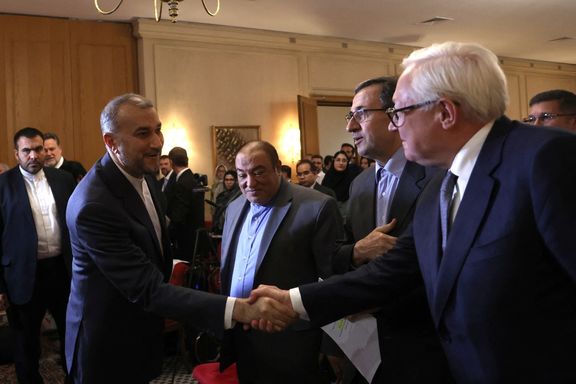
Iran's Foreign Minister Hossein Amir-Abdollahian meets with Deputy Foreign Minister of Russia Sergei Ryabkov during the Iran and BRICS summit in Tehran, Iran, August 8, 2023.

Russia on Tuesday aligned itself with its ally Iran in rejecting Western attempts to maintain sanctions on Iran despite the collapse of the 2015 JCPOA nuclear deal.

After a meeting between respective deputy foreign ministers in Tehran, Russia's foreign ministry said Moscow and Tehran were unanimous in believing that the failure to implement the deal stemmed from the "erroneous policy of 'maximum pressure' pursued by the United States and those who think similarly".

Russia is one of the participants in the Joint Comprehensive Plan of Action (JCPOA), the accord signed between world powers and Iran to restrict Tehran’s controversial nuclear program, especially limiting its uranium enrichment.

Then-US president Donald Trump quit the deal in 2018, imposing economic sanctions, and Iran's relations with the West have been deteriorating ever since, as it has accelerated its nuclear program. Tehran has been enriching uranium to 60-percent purity since 2021 and has accumulated enough fissile material for at least two nuclear weapons.

But Russia, which signed the deal alongside the US, China, Britain, France, Germany and the European Union, has been deepening ties with Iran since its invasion of Ukraine. Iran has supplied hundreds of kamikaze Shahed drones to Russia that have been widely used to attack civilian and infrastructure targets in Ukraine.

The war, which Russia calls a "special military operation", has driven its own relations with the West to their lowest level in decades, bringing on Western sanctions that has isolated Russia economically and politically. Iran is in a similar if not worse situation.

Reports in June indicated that European diplomats had informed Iran they planned to join the US in retaining sanctions on Iran's ballistic missile program that are set to expire in October under the nuclear deal.

They gave three reasons: Russia's use of Iranian drones against Ukraine; the possibility that Iran might transfer ballistic missiles to Russia; and depriving Iran of the benefits of the nuclear deal, which it violated after the US withdrew.

Russian Deputy Foreign Minister Sergei Ryabkov met Iranian counterparts Ali Bagheri-Kani and Reza Najafi.

Russia's foreign ministry said the meeting had emphasized "the unacceptability of any attempts on the part of the West to impose some new schemes and approaches to solving problems related to the JCPOA, which imply damage to legitimate and mutually beneficial Russian-Iranian cooperation in various fields".

It said there was still "no reasonable alternative" to implementing the JCPOA, as approved by the UN Security Council.

In recent months, many media reports have spoken of secret diplomatic efforts to control the tensions with Iran, including releasing Tehran’s frozen funds from countries such as Iraq and South Korea in return for a pledge by Iran not to further increase its uranium enrichment to weapons grade levels, which is 90-percent purity.

So far, except a US sanctions waiver to Iraq for a partial release of funds, no developments have taken place signaling an agreement. Parallel to discussions about Iran’s nuclear program, the US is also trying to secure the release of several American dual-nationals held hostage in Iran. Apparently, the release of $7 billion held in South Korea is the price for releasing the prisoners. But a new complication has emerged with reports that while talks were taking place, Tehran arrested two more individuals, bringing the total to five hostages.

Observers and media in Iran have accused Russia of using the nuclear issue for its own leverage with the West. Multilateral talks that began in Vienna in April 2021, with the Biden administration’s new policy of reviving the JCPOA, failed immediately after Russia’s attack on Ukraine.


Most Viewed

Iran negotiators ordered to return after internal rift over Islamabad talks
1
EXCLUSIVE

Iran negotiators ordered to return after internal rift over Islamabad talks

2
ANALYSIS

US blockade enters murky phase as tankers spoof signals and buyers hesitate

3
ANALYSIS

Why the $100 billion Hormuz toll revenue is a myth

4

US tightens financial squeeze on Iran, warns banks over oil money flows

5
ANALYSIS

US blockade targets Iran oil boom amid regional disruption

Banner
Banner

Spotlight

  • Hardliners push Hormuz ‘red line’ as US blockade tests Iran’s leverage
    INSIGHT

    Hardliners push Hormuz ‘red line’ as US blockade tests Iran’s leverage

  • Ideology may be fading in Iran, but not in Kashmir's ‘Mini Iran'
    INSIGHT

    Ideology may be fading in Iran, but not in Kashmir's ‘Mini Iran'

  • War damage amounts to $3,000 per Iranian, with blockade set to add to losses
    INSIGHT

    War damage amounts to $3,000 per Iranian, with blockade set to add to losses

  • Why the $100 billion Hormuz toll revenue is a myth
    ANALYSIS

    Why the $100 billion Hormuz toll revenue is a myth

  • US blockade targets Iran oil boom amid regional disruption
    ANALYSIS

    US blockade targets Iran oil boom amid regional disruption

  • Iran's digital economy battered by prolonged blackout
    INSIGHT

    Iran's digital economy battered by prolonged blackout

•
•
•

More Stories

Germany Intensifies Efforts To Release Death Row Prisoner In Iran

Aug 8, 2023, 14:02 GMT+1

The case of Jamshid Sharmahd, a German citizen, who was sentenced to death by Iran's regime, has become a "top priority" for the German Foreign Ministry.

In a statement to Iran International, a spokesperson for the ministry affirmed their active campaign to secure Sharmahd's release.

"The case of Jamshid Sharmahd is our top priority," the spokesperson stated, underscoring the significance of the matter. "We are actively campaigning for Sharmahd with the utmost effort at a high level, through all available channels and at every opportunity. We are making it clear to the Iranian side that the execution of the death sentence would have serious consequences. Preventing the enforcement of the decision is of the utmost importance to us."

However, the German Foreign Ministry has refrained from disclosing whether diplomatic relations with Tehran or its substantial export business with Iran, amounting to over $1.2 billion, would be severed as part of efforts to secure Sharmahd's release.

Sharmahd was sentenced to death in April by Iran's judiciary on charges of alleged terrorism. He was accused of leading the pro-monarchist group Kingdom Assembly of Iran, believed to be responsible for a fatal 2008 bombing and plotting additional attacks within the country. The group, operating from Los Angeles, advocates for the restoration of Iran's monarchy and operates opposition media platforms.

His case is emblematic of what human rights organizations term "hostage diplomacy," where Western prisoners are held on charges of espionage or alleged crimes. Iran maintains that the prisoners are being held for legitimate reasons, despite international concerns and objections. 


Iranian MP Blames Regime For Medicine Shortages

Aug 8, 2023, 12:04 GMT+1

An Iranian MP has decried the government's neglect of the dire medicine shortages rocking the country.

Salman Es’haghi, Spokesperson of the Parliament’s Health Commission, highlighted the detrimental consequences, including an alarming rise in patient mortality rates.

He asserted that “despite the critical shortages, the Central Bank has refused to allocate the necessary currency for drugs,” placing domestic pharmaceutical producers in a challenging situation regarding pricing and currency allocation.

The parliament had approved the government's decision to discontinue an annual subsidy of $9-14 billion for essential food and medicines in March last year, despite concerns about heightened inflation and hardships.

The subsequent shortages have severely affected Iran's pharmaceutical industry, which heavily relies on government funding for importing raw materials.

Shortages of imported ingredients have disrupted medicine production, leaving approximately 200 types of common medicines and hospital drugs scarce or unavailable, according to local media reports.

Es’haghi underscored that repeated warnings about the drug crisis have been issued to the government by the health commission. Nevertheless, the government's lack of attention has exacerbated the situation.

In the previous Iranian year, the medicine crisis intensified, driving people to the black market for smuggled medicines due to soaring prices and unavailability of many essential items.

While Iranian officials often attribute medicine shortages to United States sanctions, Washington maintains that humanitarian aid is exempt from sanctions. Iran annually imports over $1.5 billion worth of medicines, including substantial quantities from Europe, China, and India.

There are also speculations that the Iranian government may exploit the psychological effects of these shortages to influence foreign perceptions and further exhaust a populace already fatigued by months of revolutionary fervor.


Iran Bought Spy Tech From German, Chinese And Other Firms

Aug 8, 2023, 12:04 GMT+1
•
Benjamin Weinthal

The scandal surrounding the German corporation Bosch’s delivery of surveillance technology to Iran has expanded to include Denmark, Sweden, the Netherlands and China.

Germany’s government and the country’s Bosch corporation are facing heavy criticism after Iran International reported on Monday that the engineering giant Bosch sold surveillance equipment to Iran. Germany’s ARD first revealed the alleged Bosch impropriety. 

The United States sanctioned the Chinese company Tiandy last December for supplying video surveillance equipment to Iran and in January the European Union imposed sanctions on a firm that represents Tiandy in Iran.

Iranian activists told the German news outlet that the Danish security company Milestone Systems delivered video analysis software to Iran. Milestone told the outlet that it sold its software to Iran until 2019. The German news organization said Milestone Systems provided the video management software XProtect, an open platform that can be used for various purposes, to Iran. 

The Danish company’s website states that XProtect can also be used to compare faces. ARD wrote “Milestone’s software can be combined with surveillance cameras from different manufacturers -- including cameras from Bosch.”

Surveillance cameras in Tehran  (April 2023)
100%
Surveillance cameras in Tehran

According to Iranian activists, the clerical regime also uses cameras from Sweden and the Netherlands. The companies from Sweden and Holland were not named.

Iran International has learned that Germany’s foreign ministry is referring press queries to Bosch. According to a Bosch statement to ARD, the engineering company sold 8,000 security cameras between 2016 and 2018 to Iran. However, Bosch claims its cameras cannot be used for fully automatic facial recognition.

Germany’s foreign ministry remains mum on the controversial sale of Bosch security cameras to Iran’s regime that can be used to track protesters and women who defy the mandatory hijab.

According to sources, Germany’s foreign ministry is punting media questions to government website information about its export sanctions imposed on Iran and to information about German trade with Iran’s regime being at a historic law.

It is unclear why Germany’s export control agency green-lighted the Bosch sale of mass surveillance technology to Iran’s regime.

Iran International reached out to numerous Bosch spokespeople, including its communication head, Christof Ehrhart, and Natalie Kuzhim, who is responsible for the Middle East. Bosch refused to answer a detailed Iran International press query about the corporation’s alleged misconduct.

Iran International learned that Germany’s foreign ministry has pointed to a diplomatic statement on X, formerly known as Twitter, about Iran’s new crackdown on women. 

An Iranian woman walks without hijab under a surveillance camera in Tehran  (April 2023)
100%
An Iranian woman walks without hijab under a surveillance camera in Tehran

Tobias Tunkel, Director of Middle East and North Africa for the German foreign ministry,wrote on August 1 on X: “Iran’s new so-called ‘hijab-and-chastity’ legal draft effectively aims to ban unveiled women from public life. If passed into law, it would further exacerbate the systemic oppression against women and girls in Iran. #WomensRightsAreHumanRights.”

Tunkel’s message on X received a mere 3 retweets and 5 likes as of Monday evening. Germany’s foreign minister, Annalena Baerbock, claims she is promoting a “feminist foreign policy.” Baerbock has refused to classify Iran’s Islamic Revolutionary Guard Corps (IRGC) as a foreign terrorist organization.

Iranian Health Ministry Calls For Crackdown On Bootleg Alcohol

Aug 8, 2023, 11:02 GMT+1

Amid surging cases of alcohol poisonings, Iran’s deputy health minister has urged a crackdown on counterfeit alcohol distributors.

Saeed Karimi said, "We request the judiciary to deal with those who intentionally distribute fake alcoholic beverages, as equivalent to murder."

Demonstrating the extent of the problem spiraling across the country, he said, "There have been so many alcohol poisonings that numerical statistics are no longer important, and it is important to prevent them from happening."

For decades, alcohol poisoning caused by the consumption of counterfeit alcoholic beverages has plagued Iran, leading to fatalities, blindness, and serious injuries. Despite the Islamic regime's prohibition on alcohol, a recent survey by Iran Open Data revealed that half of all adults continue to regularly consume alcohol, often turning to homemade beverages to circumvent the ban.

Over the past three months, Iranian cities have experienced a distressing wave of alcohol poisonings, resulting in an average of around 10 hospitalizations and deaths per day, as reported by local news outlets. Methanol, a toxic compound found in homemade distilled alcohol and counterfeit brand bottles, is the primary culprit behind the alarming increase in poisonings.

These incidents have shed light on the complex relationship between Iran's religious regulations and the personal lives of its citizens. Many Iranians view these deaths as emblematic of the intrusion of religious rules into their daily routines and freedoms.

A 2018 report by the World Health Organization (WHO) placed Iran ninth out of 189 countries in terms of alcohol consumption per capita, underscoring the persistence of alcohol consumption despite the state's ban.


IRGC Threatens Retaliation If US Seizes Iranian Vessels

Aug 8, 2023, 08:33 GMT+1
•
Iran International Newsroom

The Revolutionary Guard (IRGC) has threatened to respond in kind if the United States seizes Iranian vessels, as the US has augmented its forces in the Persian Gulf.

Speaking at a ceremony on Monday, spokesperson of the Guards, Ramazan Sharif claimed that Iran’s military power is at a level to confront the United States.

“The enemies of the Iranian nation are well aware of its power, especially its military capabilities to confront all threats and plots. We remind once again that mischiefs by America will be met with reciprocal action of the Islamic Republic,” Sharif said.

Iran attempted to seize two commercial vessels in early July in the Persian Gulf but was met with a US response and withdrew, according to the Pentagon. Tehran has harassed or seized more than 15 commercial ships in the past two years in the general area of the Persian Gulf.

Anticipating more Iranian action, the White House announced in May that the Biden administration would be making moves in the region, but at the time did not say what they would include.

Later, the Pentagon began to augment the US military presence in the region by deploying F-16 and F-35 warplanes in July and also dispatching three additional naval vessels carrying more than 3,000 sailors, including Marines.

The forces from the Bataan Amphibious Ready Group (ARG) and 26th Marine Expeditionary Unit (MEU) that sailed in mid-July from bases in the US reached the Red Sea on Monday.

Last week, the Pentagon said it is ready to offer onboard armed protection to commercial vessels in the region. Media in Tehran characterized this move as unprecedented and headlines appeared flagging higher chances of a military clash.

Ramazan Sharif in his speech underlined that “We thank the Almighty that Islamic Iran has reached such a degree of power that it is capable of confronting every American mischief, such as responding in kind and seizing their vessels.”

In April, US seized an Iranian oil tanker and in the past it has also confiscated cargos from tankers carrying sanctioned Iranian oil.

In recent months, many media reports have spoken of secret diplomatic efforts to control the tensions with Iran, including releasing Tehran’s frozen funds from countries such as Iraq and South Korea in return for a pledge by Iran not to further increase its uranium enrichment to weapons grade levels.

So far, except a US sanctions waiver to Iraq for a partial release of funds no changes have taken place. Parallel to discussions about Iran’s nuclear program, the US is also trying to secure the release of several American dual-nationals held hostage in Iran. Apparently, the release of $7 billion held in South Korea is the price for releasing the prisoners. But a new complication has emerged with reports that while talks were taking place, Tehran arrested two more individuals, bringing the total to five hostages.

Reporters on Monday pressed the State Department spokesperson Matt Miller for clarification if a fifth person has been seized, but he refused to confirm the news, which was reported by a local newspaper in Iran.

After more than two years of attempting diplomacy with the Islamic Republic, the Biden administration is coming under pressure by its critics, who demand a tougher posture toward Iran and a more vigorous enforcement of economic sanctions.