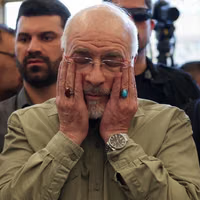
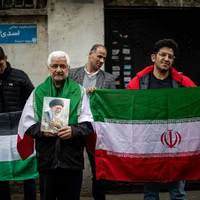
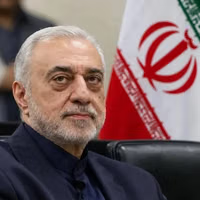
Hardline lawmaker Hamid Rassaei and Parliament Speaker Mohammad-Bagher Ghalibaf
Hardline Iranian lawmaker Hamid Rasaei has sparked intense controversy after publishing a social media post that many interpreted as an indirect swipe at Mojtaba Khamenei, drawing sharp criticism from supporters of the Islamic Republic.
The backlash began after Rasaei shared a post titled "Who is Qualified for Leadership?" on his Telegram channel on Thursday. Many observers interpreted the post as a veiled reference to Mojtaba Khamenei, Iran's new Supreme Leader.
In the post, Rasaei highlighted a verse from Surah Hud containing God's direct response to Noah regarding his drowned son. In the verse, God states that the son is not truly part of Noah’s family due to his disbelief and unrighteous conduct, warning Noah against questioning divine matters beyond his knowledge.
Because this religious story is widely known among Iranians, the idiom “Noah’s son” is frequently used in Iranian culture to describe a wicked or rebellious child who falls into bad company despite having pious parents.
Allegations of disrespecting the Leader
Some media outlets, several political figures from various factions, and many social media users said that in this post, he had implicitly characterized Mojtaba Khamenei as an unrighteous, wayward son of his father.
"What is the relevance of bringing up the issue of leadership under the current circumstances—when the late martyr-leader's righteous son has succeeded him, and especially at a time when enemies are manufacturing rumors about this every single day—and then referencing the verse about Noah’s son? What on earth was Rasaei’s motive for spinning such a ridiculous, convoluted narrative?,” Asr-e Iran website wrote.
Ruhollah Jomei, a journalist and official under the Rouhani administration, suggested that Rasaei’s post effectively revealed plans by Saeed Jalili's camp and the Paydari Front to undermine Mojtaba Khamenei's leadership.
Mohammad-Hossein Chavoshi, a conservative political activist, also wrote in a post: "What is the meaning of Mr. Rasaei’s message? No matter how we look at it, it leaves a bad impression," and he demanded accountability from him.
Attacking Ghalibaf despite Khamenei's praise
Rasaei’s post was notably published on the exact same day that Mojtaba Khamenei issued a written message to Parliament. In his statement, Khamenei expressed appreciation for Speaker Mohammad Bagher Ghalibaf’s leadership, while emphasizing the need to avoid factional disputes and maintain national unity.
“Why did he post the note right after the Leader’s message thanking Ghalibaf?” one social media user questioned.
Ghalibaf, recently appointed as the head of Iran's nuclear negotiating team, is widely considered to be Khamenei's right-hand man. Nevertheless, Rasaei—who remains fiercely critical of the parliament speaker—warned him in a separate Saturday post against "repeating the mistakes" of Hassan Rouhani and Mohammad-Javad Zarif by relying on nuclear diplomacy and "pinning hopes on talks."
Who is Hamid Rasaei?
Hamid Rasaei was one of the key members of the Paydari (Steadfastness) Front, but by his own account—left the party because of differences with other members of the party's central council over a decade ago.
By his own admission, however, he feels a strong ideological closeness to the hardline party.
The Paydari Party and like-minded groups, often referred to as “super-revolutionaries”, are vehemently opposed to any negotiation or compromise with the United States, viewing it as a betrayal of the 'ideals of the Islamic Revolution' as well as the viewpoints of Ali Khamenei.
Rasaei’s defense
Rasaei defended himself by publishing another note, saying he had simply reshared an older piece of his writing and that it was published several hours before Mojtaba Khamenei’s message.
He insisted that he was among the very first to vouch for Mojtaba’s personal qualifications for leadership, even introducing him as a suitable option for leadership two days after the news of Ali Khamenei's killing was announced.
Mehdi Ghasemzadeh, a social media activist, wrote that based on the Leader's recommendation, it might be better to accept Rasaei's explanations and avoid fueling disputes.
However, he noted that if someone from another political group had written such a note, it would have triggered protests by Rasaei's like-minded allies at nightly gatherings of government supporters.
People ride past an anti-US billboard depicting Donald Trump and the Strait of Hormuz, in Tehran. May 25, 2026
The prospect of an interim agreement between Tehran and Washington has exposed deep divisions in Iran, with some officials presenting it as diplomatic progress while hardliners warn it could cross the Islamic Republic’s red lines.
US President Donald Trump said on Friday he was heading to the White House's Situation Room to make a final decision on an emerging deal with Iran, after saying parts of the arrangement had been agreed.
The remarks came one day after the US military struck an Iranian drone facility near the Strait of Hormuz. Iran’s Revolutionary Guards reportedly responded by targeting an American base in the region, believed to be located in Kuwait.
In Tehran, lawmakers aligned with Parliament Speaker Mohammad Bagher Ghalibaf — who is also leading Iran’s negotiating team — reacted positively to reports of progress, while hardline factions sharply criticized the negotiations.
Fada-Hossein Maleki, a member of parliament’s National Security Commission, spoke of “significant quantitative and qualitative progress” in the talks and claimed that “most proposals of the Islamic Republic have been accepted.”
According to Maleki, Iran’s main concern is “Trump’s unpredictability.” He also said Ghalibaf’s recent trip to Qatar focused on frozen Iranian assets and had produced positive results for Tehran.
By contrast, National Security Committee spokesman Ebrahim Rezaei criticized concessions in the negotiations during a televised interview. “Why should we even commit to the United States not to build a nuclear weapon?” he said.
Another lawmaker, Ruhollah Izadkhah, accused Ghalibaf of sidelining parliament. “Apparently, they intend to keep parliament shut so they can reopen the strait,” he said, adding: “The people will not allow it.”
Abolfazl Aboutorabi, another lawmaker, claimed that Supreme Leader Mojtaba Khamenei’s “red lines” regarding the Strait of Hormuz, the nuclear issue and compensation demands had been violated in the talks.
He accused Washington of trying to deceive Iran by offering “a lollipop” — referring to a proposed $300 billion reconstruction fund without binding guarantees — in exchange for reopening the Strait of Hormuz. He also predicted that the United States would attack Iran again after the World Cup and US congressional elections.
Parisa Nasr, a market specialist, accused the negotiators of “surrenderism”. Writing online, she said: “First they turn Iran’s strategic assets into bargaining chips; then they effectively transform these into burned cards and worthless leverage; and finally, by arguing that ‘we have no winning cards left,’ they drag the country from one pit into another colonial surrender agreement.”
Doubts about a lasting agreement
Some Iranian social media users argue that even a signed agreement would not prevent future war. Others fear that if a temporary arrangement evolves into a durable settlement, hopes for political change inside Iran will fade significantly. Many in this camp believe Trump has abandoned the Iranian people and left them alone.
Saeed Mohammadi-Jazi, a trader and financial analyst, wrote on X that within a few months either a comprehensive agreement would be reached — ensuring the survival of the current system — or the region would face a “big and final” war that would determine the fate of the Islamic Republic.
Another user wrote: “A real nuclear agreement seems unlikely. Both sides will use this temporary calm to prepare for the next round of conflict — a conflict that may resume within months.”
Some ordinary users have also criticized Washington for negotiating with the Islamic Republic.
One user wrote on X: “A temporary Iran-US agreement — if it is signed — will not end Iran’s crisis. A regime emerging from this war will be weaker externally but stronger internally, and financially integrated into the global economy without the slightest accountability for what it has done.”
“The people who came into the streets in January and were killed were used as bargaining chips in this equation and then discarded once the deal was completed,” the user added.
A nation suspended between war and peace
Many Iranians are following developments minute by minute with growing anxiety. Ordinary citizens say the prolonged atmosphere of uncertainty has become more exhausting than anything else.
Sima, a Tehran resident, said the feeling of living in a “neither war nor peace” situation has affected every aspect of her life and the lives of those around her.
“So many times we thought a deal was close, and then within hours everything suddenly changed, and the threat of war escalated again — like last night’s clashes in the Persian Gulf and Bandar Abbas,” she said. “I truly felt again as if I could hear planes and missiles above my head. Fortunately, so far, neither side has said these clashes mean the ceasefire has collapsed.”
On Iranian news websites, reports on gold and currency prices continue to dominate headlines. Amid soaring inflation and political instability that have weakened the national currency, many Iranians have turned to buying foreign currency and gold. Yet a temporary agreement could sharply reduce the value of those investments if markets suddenly fall.
Morteza, a Tehran-based engineer, said he converted all of his savings intended for buying a home into US dollars several months ago. Although he believes an agreement — especially one leading to sanctions relief — could improve the economy, he says the uncertainty keeps him awake at night.
“When I was a child, after the end of the Iran-Iraq war, many people — including my father — suffered huge losses when Iran accepted the ceasefire resolution,” he said.
The symbolic chair and a picture of the late Supreme Leader of Iran, Ayatollah Ali Khamenei, are displayed near his office in Tehran, Iran, May 6, 2026.
Names on a memorial poster for four relatives and in-laws of Ali Khamenei offer a rare snapshot of how family ties link Iran’s ruling household to parliament, elite universities and the Supreme Leader’s office.
The poster, announcing a memorial ceremony at the Abdol-Azim shrine in Rey, south of Tehran, lists Zahra Sadat Haddad-Adel, Boshra Hosseini Khamenei, Mesbah al-Hoda Bagheri and Zahra Mohammadi Golpayegani as among the dead.
Each name connects the Khamenei household to one of the families or institutions that have shaped the Islamic Republic’s political, cultural and administrative elite for decades: the parliament, the Supreme Leader’s office, the Supreme Council of the Cultural Revolution, Imam Sadegh University and the network of institutions around the leader’s office.
The ceremony itself is religious and familial. But the names on the poster point to something larger: a closed circle of family relationships through which access, influence and institutional power have long moved inside the Islamic Republic.
The poster of the ceremony
The Haddad-Adel connection
One of the most recognizable names is Zahra Sadat Haddad-Adel, wife of Mojtaba Khamenei and daughter of Gholam-Ali Haddad-Adel.
Haddad-Adel served as speaker of Iran’s seventh parliament from 2004 to 2008 and is known as the first non-clerical speaker of the Islamic Republic’s parliament. He also served as a lawmaker in several parliamentary terms and remains head of the Academy of Persian Language and Literature.
His influence extends beyond parliament. He is a member of the Supreme Council of the Cultural Revolution, an adviser to the slain Supreme Leader and founder of the private Farhang school, which critics have described as one of the symbols of special educational access for families close to the ruling system.
For critics, Haddad-Adel’s presence across political, cultural and educational institutions, combined with his family tie to the Khamenei household, reflects the concentration of power within a limited circle of families close to the state.
His name also appears on the US Treasury Department’s sanctions list.
Imam Sadegh University and the Bagheri Kani family
The name Mesbah al-Hoda Bagheri draws attention to another powerful network: the Bagheri Kani family and the institutions around Imam Sadegh University.
Mesbah al-Hoda Bagheri Kani was the husband of Hoda Khamenei, Ali Khamenei’s daughter, and the son of Mohammad-Bagher Bagheri Kani, an influential cleric who served in the Assembly of Experts and headed Imam Sadegh University.
The same family also includes Ali Bagheri Kani, a senior diplomat who has held key posts in Iran’s foreign policy establishment, including political deputy foreign minister, acting foreign minister, senior nuclear negotiator and senior positions in the Supreme National Security Council.
Their uncle, Mohammad-Reza Mahdavi Kani, was one of the Islamic Republic’s most influential clerics. He served as head of the Assembly of Experts, secretary-general of the Combatant Clergy Association, briefly as prime minister in 1981, and for decades as head of Imam Sadegh University.
Imam Sadegh University expanded after the 1979 revolution and became one of the main training grounds for state managers. Many officials in Iran’s political, security, media and diplomatic institutions are graduates of Imam Sadegh University.
Through these links, the Bagheri Kani family connects the Khamenei household to one of the Islamic Republic’s most important pipelines for training and placing loyal officials in diplomacy, security, politics and state administration.
The Supreme Leader’s office
Another name on the poster, Zahra Mohammadi Golpayegani, points directly to the Supreme Leader’s office.
The 14-month-old child was connected to two of the most influential families in the Islamic Republic. On one side, she was the granddaughter of Mohammad Mohammadi Golpayegani, the longtime head of Ali Khamenei’s office. On the other, she was a granddaughter of Ali Khamenei.
Mohammad Mohammadi Golpayegani headed the Supreme Leader’s office since 1989, the year Khamenei became leader. He is one of the most influential but least publicly visible figures in the Islamic Republic’s power structure.
Because of his position, Golpayegani has played a central role in the messages, decisions and administrative machinery of the leader’s office. The US Treasury sanctioned him in 2019 over his role acting on behalf of that office.
His family link to Khamenei, as reflected in the name of Zahra Mohammadi Golpayegani, shows how the leader’s office is not only an institution but also part of a wider web of personal and familial ties.
Boshra Khamenei
The poster also lists Boshra Hosseini Khamenei, Ali Khamenei’s eldest daughter.
Unlike some other members of the Khamenei family, Boshra Khamenei has rarely appeared in public, and little information has been published about her personal life or activities.
In recent weeks, state media have referred to her as “martyr Boshra Khamenei.” Some reports have mentioned her educational background and interest in literature.
Tabnak, in a report framed as a student’s note for “martyr Boshra Khamenei,” referred to her as “Ms. Hosseini” and described her connection to education and literature.
Her presence on the poster alongside the other names brings the focus back to the Khamenei family itself, a household that has remained mostly shielded from public life while remaining central to the structure of power.
A compressed image of power
The memorial poster is striking because it brings together four names that would otherwise appear in different corners of the Islamic Republic’s elite: the Haddad-Adel family, the Bagheri Kani family, the Mohammadi Golpayegani family and the Khamenei household.
Together, they form a compressed image of how power has been organized around the leader’s family and its closest allies.
For critics of the Islamic Republic, the connections point to a familiar pattern: influence concentrated among a small circle of trusted families whose proximity to the leader’s office can open paths across the state.
The memorial in Rey is therefore more than a family or religious ceremony. It offers a glimpse of how, at the top of the Islamic Republic, family names often double as signs of political access, institutional reach and long-standing power.
An Islamic Republic supporter holds an anti-Israel and pro-Palestine placard during a 2026 Quds Day rally in Karaj.
As Washington says a deal with Tehran is drawing closer, Iran’s supreme leader on Tuesday echoed his slain father’s call for Israel’s destruction while Hezbollah intensified drone attacks on northern Israel, raising questions over the timing.
In a fiery Hajj message, Mojtaba Khamenei described Israel as a “cancerous tumor” nearing the “final stages” of its existence, praised the October 7 attacks and repeated his father’s prediction that Israel would not survive beyond 2040.
The statement came as Hezbollah sharply increased attacks on Israel’s northern border, including explosive drone strikes near civilian communities, and as the Trump administration signaled progress toward a possible deal with Tehran.
The parallel escalation has raised questions over whether Tehran may be trying to strengthen its hand in talks with Washington, using Hezbollah as leverage while publicly hardening its posture toward Israel.
On X, Iran analyst Arash Azizi described Mojtaba Khamenei’s statement as “remarkable for how extremely eliminationist it is toward Israel, even by the regime’s standards.”
Israeli Foreign Minister Gideon Sa’ar responded to Mojtaba Khamenei's remarks by invoking the fate of his slain father and pointing to the new supreme leader’s absence from public view since the February 28 attack, which killed several members of his family and left him injured.
“Sounds familiar. I remember someone with a similar surname who used to say it. BTW, where are you?” Sa’ar wrote.
Hezbollah as leverage against US
Reuters reported Tuesday that Israeli troops had expanded ground operations beyond a demarcation line established after the April ceasefire, while Hezbollah claimed attacks on Israeli forces using explosive drones, rockets and artillery.
For Sarit Zehavi, founder of the Alma Research and Education Center, the timing of Hezbollah’s escalation is no coincidence.
“There is no doubt they are doing that under the order of Tehran,” Zehavi told Iran International.
“They intensify the attacks while there is a lot of pressure on Iran to get a deal and the gaps between the Americans and the Iranians are really big,” she said.
Zehavi argued that Iran is using Hezbollah as leverage against Washington, either to pressure the United States into concessions or to prolong negotiations while the Islamic Republic rebuilds.
“They are using Hezbollah as a leverage of pressure on the Americans."
The escalation is already having deadly consequences inside Israel. Zehavi’s cousin’s son, Staff Sgt. Noam Hamburger, 23, was killed last week by a Hezbollah drone strike near the northern border, weeks before he was due to complete his military service.
The IDF announced on Saturday evening that Staff Sgt. Noam Hamburger was killed by an explosive drone strike near the Lebanese border.
“In the process people are being killed,” Zehavi said.
Zehavi said Hezbollah’s escalation may also be intended to provoke a wider Israeli response in Lebanon, allowing Tehran to blame Israel if the diplomatic track collapses.
“They are dragging Israel to attack in Beirut at this specific time,” she said, “and that way blame Israel for any dead-end in the negotiations.”
A computer engineer checks equipment at an internet service provider in Tehran February 15, 2011.
Iran largely restored internet access on Tuesday after 88 days of near-total isolation, NetBlocks said, while major social media platforms remained blocked and a court challenge cast uncertainty over the government's restoration order.
"Welcome back Iran! Metrics show a further rise in connectivity as mobile networks and other segments are reconnected to the global internet," the internet observatory Netblocks said in a Tuesday post on X.
"Filternet remains in place but can be worked around. WhatsApp now restricted, requiring circumvention. Some users still offline," it added, as it put the connectivity rate at 86 percent.
The restoration followed a Monday vote by a special cyberspace body created by President Masoud Pezeshkian to return international internet access to its pre-January 2026 status.
However, state media reported Tuesday that an administrative court had temporarily suspended implementation of the order that established the body, raising questions over the legal future of the reopening process.
ICT Minister Sattar Hashemi said the restoration decision was approved by nine votes to two at the body’s first official meeting, while his deputy said the reopening of fixed-line internet had begun nationwide.
On Monday, the IRGC-affiliated Fars News agency first questioned whether the administration had the authority to issue such an order, arguing that because the restrictions were imposed by the Supreme National Security Council, only the same body could formally reverse them.
Hours later, however, Fars appeared to soften its position in an editorial describing the reopening as a necessary “technical and security” decision that would have happened “sooner or later” as cyber conditions improved.
The outlet said the restrictions had originally been imposed to prevent cyber espionage and protect critical infrastructure during wartime conditions and an unprecedented wave of cyberattacks.
While acknowledging criticism over the legal process behind the decision, Fars dismissed efforts to turn the issue into a political dispute and accused some reformist media outlets of exploiting the shutdown to deepen internal divisions during what it described as a “full-scale war.”
The meeting of the Special Task Force on Cyberspace Management ended with nine votes in favor and three against reconnecting Iran to the global internet, according to reports.
Peyman Jebelli, head of Iran’s state broadcaster, and Mohammad-Amin Aghamiri, secretary of the Supreme Council of Cyberspace, were among the strongest opponents of restoring international internet access, Faraz reported citing informed sources.
According to Faraz, both men remained firmly opposed to reconnecting the country to the global internet until the end of the meeting.
The report said Aghamiri’s position was particularly notable because the secretary of the Supreme Council of Cyberspace is appointed by the president. Although Aghamiri was first appointed under the previous administration, Pezeshkian later retained him in the post.
Faraz said Aghamiri’s opposition had placed him at odds with the government at a time when Pezeshkian has publicly identified restoring internet access as one of his priorities.
US and Qatar flags are seen on a lamppost ahead of the arrival of U.S. President Donald Trump in Doha, Qatar May 13, 2025.
The release of frozen Iranian assets has emerged as the main sticking point in talks between Iran and the United States, with officials in Tehran insisting that guaranteed access to funds must come before any preliminary agreement can move forward.
Several commentators and state-linked outlets have suggested Qatar may be exploring financial mechanisms that would give Tehran access to some of its frozen assets without requiring direct US cash transfers to Iran.
Parliament Speaker Mohammad Bagher Ghalibaf, Foreign Minister Abbas Araghchi and Central Bank Governor Abdolnaser Hemmati paid a highly publicized visit to Doha on Monday, fueling speculation that talks focused heavily on the frozen assets issue.
Iranian media widely linked Hemmati’s presence to negotiations over financial guarantees, though no official details of the discussions have been released.
CNN reported on Monday that Intense talks were ongoing in Doha in coordination with the United States, focusing on the Strait of Hormuz, Iran’s highly enriched uranium and frozen funds.
A day earlier, an informed source with direct knowledge of the negotiations told Iran International that Tehran has demanded guaranteed access to $12 billion in frozen assets during the first phase of any arrangement.
Iranian officials continue to insist that the country’s nuclear program and stockpile of highly enriched uranium should only be addressed in later stages of a broader agreement.
The current focus appears to center on roughly $6 billion in Iranian assets transferred from South Korea to Qatar in 2023 under a US-Iran prisoner exchange deal.
The funds were later re-frozen following the October 7 Hamas attack on Israel and the subsequent deterioration in relations between Tehran and Washington.
Mohammad Marandi, a commentator close to the Iranian government, suggested in a televised interview Sunday that Qatar could initially transfer the money to Iran before later being reimbursed by the United States.
Political analyst Shahir Shahidsaless wrote on X that such an arrangement would allow Washington to avoid directly paying Tehran while still meeting one of Iran’s principal demands.
Reuters previously reported, citing senior Iranian sources, that Washington had agreed in principle to release some frozen Iranian assets as part of efforts to secure safe passage through the Strait of Hormuz, though US officials later denied that any final agreement had been reached.
The IRGC-linked Tasnim news agency, citing what it described as an informed source, reported Sunday that Tehran had made clear it would reject any preliminary arrangement lacking a concrete first step by Washington on the assets issue.
“Iran has emphasized that without the release of a specific portion of the blocked assets in the very first step, and without a clear and guaranteed mechanism for the release of all frozen assets, no agreement will be possible,” the source told Tasnim.
Tasnim also claimed US officials were backtracking on earlier signals delivered through intermediaries regarding the funds.
“Based on past experiences of repeated American violations and obstruction,” the source said, “Iran will not allow the issue of asset release to be reduced to vague and unreal promises.”
Despite the tensions, Mashallah Shamsolvaezin, a member of President Masoud Pezeshkian’s Media Council, expressed cautious optimism, describing the frozen-assets dispute as “a small problem” in remarks to Fars News Agency.
He said the disagreement could be resolved within 48 hours and suggested future negotiations might move from Doha to Geneva or another location more accessible to the American delegation.
At the same time, hardline figures continue to insist on preserving what they describe as “Iran’s management” of the Strait of Hormuz.
Foreign Ministry spokesperson Esmaeil Baghaei denied Monday that Tehran was seeking to impose tolls on ships passing through the waterway, but said providing navigation and environmental protection services would require fees.
Hossein Shariatmadari, editor-in-chief of the hardline Kayhan newspaper, criticized reports suggesting Iran could agree to reopen the Strait of Hormuz under a broader understanding with Washington.
“If this news is true,” he wrote, “the real meaning of opening the Strait of Hormuz is the disarmament of Iran against military, economic and political attacks by enemies.”
The comments highlighted the enduring influence of hardliners advocating maximalist demands, a dynamic critics say has repeatedly helped sink fragile diplomatic openings between Tehran and Washington.