Female Athletes Arrested During Morning Workout In Iran

In a shocking move, morality police in Iran detained female athletes in the southern port city of Bandar Abbas on the Persian Gulf during their morning workout.
In a shocking move, morality police in Iran detained female athletes in the southern port city of Bandar Abbas on the Persian Gulf during their morning workout.
The news was brought to light by Mohammad Hossein Ajorlou, a reporter, and husband of Niloofar Hamedi, a journalist who is in prison for covering the death of Mahsa Amini in 2022 after her arrest for violating hijab rules.
According to Ajorlou, the incident took place Thursday, at approximately 5:30 in the morning. The morality police patrol intervened during the female athletes' routine workout session at the popular coastal boulevard.
Some local runners present at the scene have expressed their dismay over the incident. One of the runners described the scene: "In the mornings, when we go to the coastal boulevard to run, there are all kinds of crowds. Some have not collected their hookahs from the night before, some of them are still drunk and are speeding past us in their cars. A number of addicts are looking for a piece of bread in the garbage bins, but the police arrest athletes.”
The incident has sparked outrage among the community, as the female athletes were merely engaged in a peaceful morning workout.
The names and identities of the arrested female athletes have not been disclosed at this time, and it remains uncertain under what charges they were detained.
In the aftermath of the nationwide protests following the tragic death of Mahsa Amini, the Islamic Republic has intensified its efforts to enforce mandatory hijab.
However, a resilient wave of Iranian women and girls has chosen to defy these restrictive measures by appearing in public places without hijab.





Saman Yasin jailed on charges of participating in protests has released an audio message from behind bars emphatically asserting his innocence.
The singer, who has been in detention for ten months, denies any involvement in criminal activities and expresses his desire for a better life for all citizens.
In the audio file, Yasin, 27, and a resident of Tehran, refutes allegations of being a political figure or a member of any political group. He addresses his supporters and fellow citizens, seeking their understanding and support during his challenging ordeal.
One of the significant points raised by Yasin is a government ban for him and other political detainees to choose their own defense attorneys. A notorious judge, Abolqasem Salavati, has denied him the right to select his preferred lawyer, leaving him with an assigned attorney.
Yasin says that his attempts to communicate with the lawyer have remained unanswered, as the lawyer is unable to proceed without the judge's approval.
Earlier reports by government media claimed that Yasin faced charges in Branch 15 of the Revolutionary Court for allegedly participating in protests and supporting gatherings and singing revolutionary songs. Additionally, he was accused of being involved in activities intending to undermine the country's security.
Rejecting these accusations, Saman Yasin's family says that he made confessions under duress and torture. In his audio message, Yasin vehemently denies all charges and describes them as baseless lies orchestrated to harass him.
A former president of Iran's football federation has slammed the regime's policies, saying that Iran has become “an Islamic North Korea.”
In a critical interview with the newspaper Arman-e Melli, Mohammad Dadkan raised concerns about various aspects of governance in Iran, including the regime’s crackdown on voices of dissent.
"With pressure and force, what do you expect to achieve? You boast about arresting 92,000 people. You claim that 20 million people have legal cases, which means 60 million people are affected when considering their families. By forcing everything to appear right, what will be the outcome in the end?" he said.
Dadkan quipped that the regime sought to become an Islamic Japan but has become an Islamic North Korea, claiming that "If the leader of North Korea says in the morning that the border is open, he himself won't stay either. If they open the bridge between the two Koreas, not a single person will remain in North Korea.
Dadkan has served in several positions related to sports in Iran, including as a physical education advisor at the ministries of Foreign Affairs and Industry, Mine and Trade. He was the president of Iran’s Football Federation from 2002 until 2006, during which Iran’s national squad finished third in the 2004 AFC Asian Cup and ranked 15 in the FIFA standing, its best so far. In the past two decades, Iran's Team Melli has not achieved a better title.
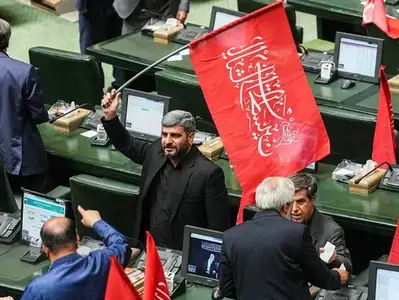
The number of politicians who once held important positions in the Islamic Republic but are now critical of the regime has been growing, especially since people revolted against the Islamic autocracy after the death of 22-year-old Mahsa Amini in police custody. Iranian analysts and politicians continue criticizing the ruling establishment for the country’s multiple crises within the limits of controlled media.
Hossein Marashi, a leading centrist politician in Tehran, said earlier in the week that the governance and politics in Iran have reached a deadlock and people need to take the lead to help themselves. "I have no hope in Iranian politicians. The elites in society should come forward with determination and make their point, and whatever they need to do. I have hope that the people will change the scene."
Last week, prominent economist Mehdi Pazouki told Didban Iran website that government officials have humiliated the nation in the name of their revolutionary approach. Pazouki said, in an unprecedented and daring statement, "One of Khomeini's mistakes was allowing clerics to intervene in the country's social and executive affairs."
He was referring to the founder of the Islamic Republic, Ayatollah Ruhollah Khomeini who after the 1979 revolution gradually expelled independent-minded people from the government and increasingly relied on clerics that he knew had no experience in running a country.
Regime insiders, pressed hard by serious economic crises and popular rejection, try to blame everything on invisible enemies.
Ahmad Alamolhoda, the representative of Supreme Leader Ali Khamenei in Khorasan Razavi province, whose financial corruption case within one of Iran's biggest charities was recently revealed, said Friday that "The enemy wants to undermine the clergy in the eyes of the people.”
Dadkan elsewhere in his extensive two-hour interview drew a comparison between the responses of the Iranian and French governments to popular protests. He pointed out that while the French government took action against the police officer who shot and killed a 17-year-old boy of Algerian descent, Iran's approach was markedly different. He emphasized that in Iran, officers who harm or kill protesters are often praised instead of being held accountable for their actions.
Ahmad Alirezabeigi, a member of the Iranian parliament who was sentenced to imprisonment this week for disclosing a major bribery case involving at least 75 other lawmakers and a former Industry Minister, accused officials of evading their responsibility and adding insult to injury by making statements that blame the people for the government's shortcomings.
Masih Mohajeri, a conservative newspaper editor, said in a strongly worded article earlier this week that, "People refuse to accept that in a country with such wealth and resources, a few individuals amass fortunes while millions of families are in poverty.
Dadkan echoed these sentiments saying that the ruling power places its incompetent supporters in crucial positions and manipulates information to distort the true state of affairs in the country. "The state-controlled television is biased, and spreads lies,” he emphasized.
These regime supporters he said pretend to be religious and the "have made a business out of it,” asking why is it that “out of 72,000 mosques across the country, "50,000 are dormant.”
Iranian media reported the death of Hassan Sanei, an 89-year-old Expediency Council member known for announcing a reward for Salman Rushdie's murder in the 1980s.
Hassan Sanei had a prominent role in Iranian society, having been appointed as the head of the Khordad 15 Foundation in 1983 by the directive of Ayatollah Khomeini, the ruler of Iran at the time. He continued to serve in this capacity until 2020.
The Khordad 15 Foundation was established shortly after the 1979 Islamic Revolution by taking over a collection of confiscated property and factories. Over the years, it grew to become one of Iran's major economic entities, with interests spanning various sectors such as steel, medicine, petrochemicals, food, detergents, investments, and travel quasi-public companies.
Notably, during his tenure as the foundation's head, Hassan Sanei was involved in the decision to offer a reward for the assassination of Salman Rushdie, a prominent writer who faced significant controversy following the publication of his book The Satanic Verses in 1988. This literary work caused protests among some Muslims, resulting in Ayatollah Khomeini issuing a fatwa calling for Rushdie's death in 1989.
The United States Treasury imposed sanctions on the 15 Khordad Foundation on October 28 last year, following an assassination attempt on Rushdie during a speech in New York.
Subsequently, the foundation further increased the reward amount for Salman Rushdie's murder by half a million dollars, bringing the total sum to 3.3 million, just weeks after the knife attack.
Amid talks of a prisoner swap deal with the United States, the Iranian regime has detained another American citizen, further complicating efforts to lower tensions.
Semafor news website in Washington DC cited three people briefed on the case as saying that the new arrest is now a crucial part of stepped-up negotiations between the two countries.
The article, published on Friday, did not disclose the identity of the American, saying that it withheld the name to avoid jeopardizing negotiations over his/her release. Previously, the US has prioritized securing the release of three Iranian Americans, businessmen Siamak Namazi and Emad Sharqi, as well as environmentalist Morad Tahbaz, held by Iran on trumped-up charges of espionage. Two individuals with US permanent residency -- Jamshid Sharmahd and Shahab Dalili -- are also imprisoned in Iran.
The negotiations -- which have taken place without public announcements in Oman as well as other countries -- are geared towards facilitating the exchange of Iranians convicted of crimes in Western countries for the release of US nationals held hostage in Iran, as well as the release of billions of dollars of Iran’s funds frozen in overseas banks.
While Iran has around $20 billion frozen in Iraqi, South Korean and Japanese banks due to US sanctions, what has often been mentioned as being discussed is $7 billion in two Seoul banks.
Despite claims by several Iranian officials who have for months publicly suggested that a deal was in the making, the Biden administration said in June that it continues contacts with Tehran, but no nuclear or prisoner release agreement is imminent.
According to Semafor’s sources, the inclusion of the fourth American in the talks may prompt Tehran to raise its demands.
The Biden administration has so far declined to reply to Semafor’s inquiry about the case of the fourth American citizen, but National Security Advisor Jake Sullivan implicitly confirmed it last week during an interview on Face the Nation. “We have tried very hard to secure the release of the four unjustly detained Americans in Iran, we have done so since the day that President Biden took office,” he said on Sunday.
A person directly briefed on the case and close to one of three Iranian American families told Semafor on Thursday that “Multiple senior officials at the State Department in the last few weeks have privately emphasized that the US and Iran have already agreed the fourth American will be part of any deal and there are no delays being caused by [the person’s] inclusion.”
In the past decade, Iran's Revolutionary Guard have arrested dozens of dual nationals and foreigners, mostly on unproven allegations of espionage and breach of security, in what human rights organizations have said is essentially hostage taking to extract concessions from Western governments.
In November 1979, a group of leftist students backed by the new revolutionary government occupied the US embassy in Tehran and took 54 Americans hostage for 444 days. Later, the same strategy was used in Lebanon where multiple Westerners were taken hostage in the 1980s by militant groups linked to Tehran.
Tehran denies any policy of hostage taking and insists all foreigners are tried legally. However, it has frequently shown readiness for prisoner exchanges and receiving monetary payments and participated in swaps in the past.
In March 2022, Nazanin Zaghari-Ratcliffe, an Iranian-British citizen held in Iran for nearly six years, was freed along with British-Iranian businessman Anoosheh Ashoori after the UK paid a four-decade-old £400m ($522 million) debt to Iran. Iran's foreign minister Hossein Amir-Abdollahian claimed at the time that the payment by Britain had nothing to do with the release of the Zaghari-Ratcliffe and Ashoori.
The latest case was in June when two Iranian-Austrian citizens named Kamran Qaderi and Masoud Mosaheb and a Danish individual were released in the framework of a recent prisoner exchange agreement with Belgium mediated by Oman. A week earlier, Olivier Vandecasteele, a Belgian aid worker, returned to his country in exchange for the release of Assadollah Asadi, an Iranian agent disguised as a diplomat in Europe who was convicted of a terror plot in France in 2018.
Days after Iran’s notorious hijab or ‘morality’ returned to streets, top officials refuse to take responsibility due to “concern over the upcoming elections".
A public disagreement has arisen regarding who ordered the return of the 'morality' police, which vanished from the streets following nationwide protests sparked by the death of Mahsa Amini in the custody of hijab patrols last September.
According to Tehran's leading reformist daily, Etemad, President Ebrahim Raisi's aides have advised him against implementing any plan that could provoke people until after the next presidential election in 2025 to secure his re-election. They have even suggested indirect criticism of negative reactions to hijab violations to make a positive impression on public opinion.
However, Etemad cited an unnamed senior official of the police as saying that the hijab patrols have returned by the direct order of the president as the head of the Supreme National Security Council. The interior minister is only tasked with implementing the plan as the representative of the Supreme Leader Ali Khamenei in Law Enforcement Command.
The police official emphasized their role as the sole executor of orders from higher authorities within the government and the Interior Ministry, adding that officials shifted responsibility to the police force to shield themselves from potential criticism.
As the police blamed the presidential administration, several government officials claimed that the decision was not made by the president himself.
Ali Bahadori Jahormi, the government's spokesperson, emphasized in a twitter post that the judiciary is responsible for dealing with “social abnormalities," including civil disobedience acts like women defying the Islamic Republic's strict dress code. He stated, "It is the responsibility of the judiciary to decide how to implement the law." Vice President for Women and Family Affairs Ensieh Khazali also denied that the hijab patrols returned upon the president's order.
Tasnim news agency, affiliated with the Revolutionary Guard, claimed that after the publication of the official order by the president and the chief justice to reinstate the hijab police, certain government officials contacted the agency and asked them to remove the part mentioning the president.
The ultra-hardliner daily Kayhan expressed support for the police's approach in enforcing hijab regulations, warning officials against backing down from their stance merely in fear of losing “a handful of votes.”
The morality or hijab police returned to the streets of Tehran and other cities ahead of the first anniversary of Mahsa Amini's death, immediately leading to online uproar as well as a few bouts of street protests, the biggest of which broke out in the northern city of Rasht.
A video which went viral on Saturday shows Tehran's morality police arresting a teenage girl without compulsory hijab, while the girl was screaming “I’m not coming with you” as they tried to push her into their unmarked van.
People on social media have reacted to the incident saying if Iranians do not pour into the streets on the death anniversary of Amini in mid-September, the regime will tighten the noose.
Iran’s former president Mohammad Khatami also warned that the return of morality police may lead to the regime's “overthrow by itself and social collapse”. “It seems that the danger of self-overthrow, which has been talked about many times, stands out more than ever with the return of morality police."
In addition to street patrols, the regime has intensified its crackdown on celebrities who have published photos of themselves without mandatory hijab or appeared in public without head covering as an indirect threat against ordinary people.
Only this week, several actresses as well as TV and radio personalities have been given odd sentences, such as washing corpses for burial and attending counseling sessions as well as bans, as a humiliation and intimidation tactic.
Dadban, a group of pro-bono lawyers in Iran defending political prisoners and rights activists, also revealed that one of the regime’s judges in the capital Tehran – identified as Ali Omidi – has taken a prominent role in issuing heavy sentences against those who protest mandatory hijab.