Indonesia Seizes Iranian Tanker During Illicit Oil Transfer
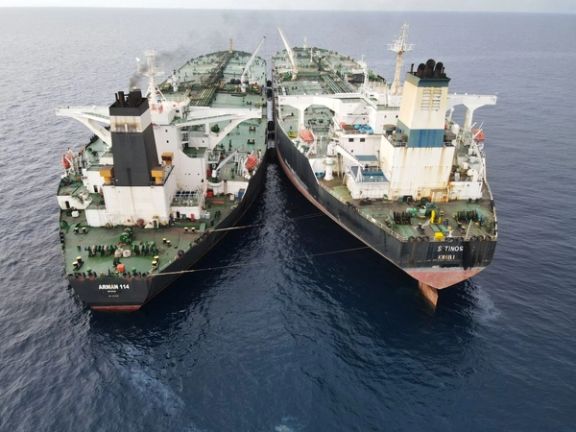
The Iranian-flagged MT Arman 114, and the Cameroon-flagged MT S Tinos, as they were spotted conducting a ship-to-ship oil transfer without a permit, near Indonesia's North Natuna Sea, Indonesia, July 7, 2023
Indonesia’s coast guard said Tuesday it has seized an Iranian-flagged tanker suspected of involvement in the illegal transshipment of crude oil.
The vessel, MT Arman 114, was carrying 272,569 metric tons, or nearly two million barrels of light crude oil and was suspected of transferring the oil to another vessel without a permit, the coast guard said in a statement. Such a large tanker is considered Very Large Crude Carrier (VLCC).
The vessel was captured after being spotted in Indonesia's North Natuna Sea, carrying out a ship-to-ship oil transfer with the Cameroon-flagged MT S Tinos, the agency's chief, Aan Kurnia, said.
"MT Arman was spoofing their automatic identification system (AIS) to show its position was in the Red Sea but in reality it is here," Aan told reporters.
Iran has been shipping its oil by illicit methods since the US imposed full third-party oil sanctions in May 2019, one year after pulling out of the 2015 JCPOA nuclear deal.
It is daily exports of more than 2 million barrels per day in 2017, dropped to less than 250,000 in 2019 and 2020.
Patrol vessel KN. Pulau Marore-322, owned by Indonesia's Maritime Security Agency (Bakamla) patrols to inspect the Iranian-flagged Very Large Crude Carrier (VLCC), MT Arman 114, and the Cameroon-flagged MT S Tinos, as they were spotted conducting a ship-to-ship oil transfer without a permit, according to Indonesia's Maritime Security Agency (Bakamla), near Indonesia's North Natuna Sea, Indonesia, July 7, 2023 in this handout picture released July 11, 2023.
Exports picked up again at the end of 2020, as the newly elected US President Joe Biden signaled his readiness to negotiate with Iran to restore the JCPOA.
Since then, Iran’s illicit exports, mostly to China, have reached 1.5 million barrels per day, with critics accusing the Biden administration of lax sanctions enforcement.
The common method for Iran to hide its oil exports is ship-to-ship transfers outside ports, when cargos on its tankers are pumped into other vessels, which then carry it to destination as oil from other countries, such as Oman or the United Arab Emirates with forged documentation.
A man and a woman walking in front of a mural of a 5,000-rial banknote (now worth about one cent) in Tehran. Unlike the original design, the bowl in the mural is full of nuts whose price ranges between 5,000,000 to 100,000,000 rials (about $10 to $20) in the market.
Iran’s Parliament Research Center says the limbo in the regime’s economic policies will lead to further poverty and inflation in the country.
In its latest report released this week, the research arm of the Iranian parliament said that if the economic trends of the last decade continue, no policies in the country's seventh national development plan would help curb the growing poverty.
“In order to realize high growth and improve productivity, policymakers should stop price suppression policies to control inflation and solve the inflation problem in a more fundamental way," read the report. The regime tends to put a cap on prices of certain goods and services, but there is little enforcement.
According to the report by the parliament’s research center, which had said late in May that the population below the absolute poverty line in the country increased to 30.4% in 2021, the household income has not improved in the past decade and is set to become worse. Economist Farshad Momeni said a few days ago that the population of the poor has doubled in less than three years since in comparison with the average poverty in the 2010s. At that same time, the regime set a target of 116-percent growth until 2020 but the economy only grew about nine percent.
Central building of Majlis (parliament) Research Center
Since the 1940s Iran has launched 11 plans to build infrastructure, establish key industries, expand public services and education. Five plans were launched under the monarchy until 1979, and six during the Islamic Republic. Nevertheless, Iran is still considered a developing country, due to anemic growth in the past 44 years.
Annual growth since 1979 has barely averaged 2.5 percent, and it past decade growth has been zero, impacted by international and US sanctions related to Iran's nuclear program.
According to a report published by ILNA in January, one-third of the country’s population is now living in extreme poverty, after the number almost doubled in one year from 2020 to 2021. However, it is believed that the number could in reality be far higher. According to official figures released by the interior ministry, around 60 percent of the 84 million Iranians live under the relative poverty line of whom between 20 to 30 million live in "absolute poverty".
There have been several factors hindering Iran's economic development dating back decades. The revolutionary chaos of the early 1980s, immediately followed by the eight-year Iran-Iraq war that caused hundreds of thousands of casualties, derailed Iran from its modernization trajectory. The Islamic government, built on an anti-Western ideology engaged in hostage taking and supporting militant groups from its very inception, has left the country isolated.
The inefficiency of successive clerical governments during the past four decades, and many years of international sanctions that have crippled the country's economy, were acknowledged in the report to have contributed as adverse factors against growth.
The parliament’s research center also admitted that “foreign exchange resources have become the Achilles heel of Iran's economy, and the realization of sustainable growth depends on the provision of new foreign exchange resources for the country.”
Crushed by numerous rounds of sanctions by the US, EU, UK, and several others, the Islamic Republic faces crippling obstacles to cash its oil and gas revenues in foreign currencies, leading to tens of billions of dollars of assets frozen in foreign banks.
Fire in the Aftab Oil Refining company in Iran's southern port city of Bandar Abbas on July 10, 2023
Three petroleum product reservoirs belonging to the Aftab Oil Refining company have caught fire in Iran's southern port city of Bandar Abbas, state media reported on Monday.
"According to statements by local sources, efforts have been started to extinguish the fire, but there is a possibility of fire spreading and nearby reservoirs exploding," the official IRNA news agency said.
Bandar Abbas is located on the Persian Gulf coast and is one of the hubs for export of oil and oil products.
The official government news agency IRNA reported that six firefighters have been injured in trying to extinguish the blaze. Footage of a large black smoke coming out of an industrial compound was shared by IRNA.
The cause of the incident is still unknown, but similar industrial accidents in the past have usually led to speculations of domestic or foreign sabotage.
People work to put out a fire at an oil refinery in Bandar Abbas, Iran, July 10, 2023. Firefighters put out a fire at an oil refinery in Bandar Abbas, Iran, July 10, 2023.
Iran’s communications minister says he welcomes the satellite internet service providers, especially Starlink, but they have to comply with the country’s territorial rules.
In an interview with semi-official Mehr news agency on Monday, Issa Zarepour claimed the objective is to open up connections to remote areas.
“Although over 4,000 villages have been connected to high-speed internet since the start of the Raisi administration, we still have about 3,500 villages that are not connected to high-speed internet, so satellite internet service providers can operate in these regions,” he said.
However, he admitted there will be strict compliance rules for any company the regime agrees to work with, meaning technical cooperation for censorship of Internet content.
Iran has made the same demand from Western social media platforms for not blocking their access.
Starlink, part of the US-owned SpaceX, is already providing internet to almost 60 countries, but for its connection to work everywhere in a large country, ground stations are needed.
The regime has for years been severely restricting internet access as well as access to popular social media platforms, such as Instagram, in particular that play a key role in supporting anti-regime sentiment and protester communications.
It has meant devastation for the millions who rely on social media to promote their businesses and hugely damaged e-commerce.
Recently, an Iranian official stated around 800 Starlink satellite internet receivers have been imported to Iran, but did not specify how, given the current sanctions imposed on the country.
Kuwait and Saudi Arabia have "exclusive rights" in a gas field in the Persian Gulf disputed with Iran, Kuwait Oil Minister Saad Al Barrak reiterated on Sunday.
He also repeated earlier calls on Iran to validate its claim to the field by demarcating its own maritime borders first.
Iran has previously said it has a stake in the field and called a Saudi-Kuwaiti agreement signed last year to develop it "illegal".
"Until this moment, this is an exclusive right of Kuwait and Saudi Arabia in the Durra field, and whoever has a claim must start demarcating the borders. And if it has a right, it will take it according to the rules of international law," Al Barrak said in an interview with Saudi state-run Al Ekhbariya television.
"The other side has claims that are not based on a clear demarcation of the maritime borders," he added, referring to Iran.
Iran claims any development without its consent breaks international laws, and insists that 40 percent of the field is located in its territorial waters.
Al Barrak's comments echo those of Saudi Arabia, which said last week that the kingdom and Kuwait exclusively own natural wealth in the Gulf's maritime "Divided Area".
Saudi Arabia also renewed its call to Iran to start negotiations with Riyadh and Kuwait on the demarcation of the eastern border of the area, Saudi state news agency SPA said.
Called Arash in Iran and Durra or Dorra by Saudi Arabia and Kuwait -- the offshore field was discovered in 1967 and is estimated to have a total proven reserves of around 310 million barrels of oil and 20 trillion cubic feet of gas.
Members of the European Parliament in Brussels, Belgium February 2, 2023
Two members of the European Parliament have again raised the issue of designating Iran’s IRGC as a terrorist group, demanding action by the EU authorities.
In a letter addressed to Spanish Foreign Minister José Manuel Albares, the new head of the EU Council, European Parliament members Evin Incir and Thijs Reuten have urged the council to initiate the procedure to add Iran’s Revolutionary Guards to the EU terrorist list.
The letter, a copy of which was also sent to Josef Borrell, High Representative of the European Union for Foreign Affairs and Security Policy, read, “In spite of the European Parliament's unequivocal demand, the Foreign Affairs Council has yet to reach agreement about adding the Islamic Revolutionary Guard Corps (IRGC) and its subsidiary forces to the EU terrorist list.”
Unlike the United States which in 2019 put the IRGC on its Foreign Terrorist Organizations (FTO) list, European countries have avoided the designation and prioritized diplomacy with the Islamic Republic in the hope of concluding a nuclear deal. The IRGC has been operating for decades across the EU. Most recently, a plot to murder Iran International journalistsin London made the channel to relocate its studios to the US.
Many politicians in France, Germany, and other European countries have been keen to pursue the IRGC’s designation by the EU and say that it has been long overdue. In January, the European Parliament approved a resolution with absolute majority to designatetheoutfit as a terrorist organization. However, the EU executives refused to do so, with Borrell saying the move needs a ruling by a European court.
In their letter, Incir – a Swedish politician of Kurdish descent – and Reuten – a Dutch politician – responded that according to the “Common Position 2001/931/CFSP, Article 1(4) which sets out the parameters for the inclusion of persons and entities on the EU terrorist list,” the IRGC can listed without any legal barriers.
Among these parameters is “the instigation of investigations regarding, the prosecution for, or the condemnation of perpetrated, attempted, or facilitated terrorist acts,” reads the letter, adding that “The Council has further clarified that decisions by the competent authorities of third States may also serve as the basis of a listing proposal.”
They concluded that “a conviction by a Member State Court is therefore not a requirement to initiate the listing procedure of the IRGC.”
In June, a similar line of arguments was put forth by Iran’s exiled prince Reza Pahlavi, citing a group of French-Iranian lawyers who reasoned that here are no legal obstacles for the EU to blacklist the Revolutionary Guards.
“Listing this entity, which is dedicated not to protecting Iran or Iranians but instead the power of the dictatorship, would be a strong and long-awaited recognition of reality and a show of support to my compatriots who are fighting for freedom and democracy in our country,” Prince Pahlavi said in June.
Revolutionary Guard's commander-in-chief Hossein Salami (in green) during a war game in 2022
“The IRC's link with terrorism is unquestionable,” Incir and Reuten stated, noting that the IRGC and its proxies have a “well-established record of terrorist activity inside Iran, across the wider region, and within the EU.”
Calling on the Council to hold the Revolutionary Guard to account, they said, “As the IRGC doubles down on its terrorist activity with impunity and continues to wage terror on the people of Iran by way of hundreds of executions this year alone, we urge you to explore all legal avenues to initiate IRGC proscription without delay.”
“Your support for strong measures against the Islamic Republic will be indispensable for the people of Iran,” they concluded.
The UN Human Rights Council discussed a fact-finding report July 6 that said the regime continues its crackdown on dissent to stifle the nationwide protests ignited by death in custody of 22-year-old Mahsa Amini last September.
The E3 countries – France, Germany and the United Kingdom - have announced that they will keep in place sanctions imposed on the regime over its ballistic missile program beyond the October expiration date. They argue that they have ample evidence that the regime is violating its commitments under the deal both with weapons supplies to Russia and its clandestine uranium enrichment.