Eight More Iranians, One Entity Sanctioned By EU Over Human Rights Violations

The European Council has imposed sanctions on eight more Iranians and one Iranian entity, citing human rights abuses.

The European Council has imposed sanctions on eight more Iranians and one Iranian entity, citing human rights abuses.
In a press release on Monday the Council announced it will sanction Ariantel, an Iranian mobile carrier that contributed to the Iranian regime’s efforts to suppress critical voices and dissent.
Also included in the latest listings are lawmakers in the Iranian Parliament, members of the Islamic Revolutionary Guard Corps (IRGC) and the IRCG Cooperative Foundation, which manages the IRGC's investments and funnels money into the regime's brutal repression.
211 individuals and 35 entities are now subject to restrictions under the Council, including an asset freeze, a travel ban to the EU and a prohibition to make funds or economic resources available to those listed.
It is also forbidden to export equipment to Iran that could be used for internal repression or to monitor telecommunications.
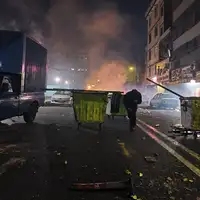
The European Union has actively opposed Iran's violent crackdowns on peaceful protests which includes the use of arbitrary detentions as a means of silencing critical voices and has seen several protesters sentenced to death.
Other countries to have imposed sanctions on Iran following the crackdown on protesters since the uprising began in September following the death in custody of Mahsa Amini, include Australia, the UK and Canada.
In a retaliatory move on Monday, the Islamic Republic’s Foreign Ministry issued a statement, announcing sanctions on more than 20 individuals and entities from the EU and the UK.

The US Treasury Department on Monday imposed sanctions on four senior Iranian law enforcement and military officials involved in crushing protests.
Nationwide unrest erupted last year after Mahsa Amini, a 22-year-old Iranian woman died in the custody of the morality police who enforce strict dress codes.
The department said in a statement it was also taking action against the new secretary of Iran's Supreme Council of Cyberspace (SCC), the authority responsible for Iran's cyberspace policy and blockage of popular websites.
"The Iranian people deserve freedom of expression without the threat of violent retaliation and censorship from those in power," Brian Nelson, the department's undersecretary for terrorism and financial intelligence, said in the statement.
Earlier in the day Britain and the European Union also announced fresh sanctions on Iranian officials for human rights violation.
The Treasury said it was placing sanctions on three senior officials of the Islamic Revolutionary Guard Corps (IRGC): Parviz Absalan, the deputy commander of the IRGC Salman Corps of Sistan and Baluchistan Province; Amanollah Goshtasbi, deputy inspector of the IRGC's ground forces; and Ahmad Khadem Seyedoshohada, a brigadier general in the IRGC's ground forces.
It also imposed sanctions on Salman Adinehvand, the commander of the Tehran Police Relief Unit of Iran's LEF, the primary security organization in charge of crowd control and protest suppression.
Also targeted was Seyyed Mohammad Amin Aghamiri, the new secretary of the SCC, the centralized authority regarding policymaking in the realm of cyberspace. The SCC is responsible for Iran's blockage of popular online news and communications platforms and has also used digital technology to spy on and harass journalists and regime dissidents, the Treasury said.
Reporting by Reuters

Britain has announced further sanctions on Islamic Republic officials, including commanders of the IRGC,for their role in the regime’s bloodshed at home and abroad.
Britain has announced further sanctions on Islamic Republic officials, including commanders of the IRGC, for their role in the regime’s bloodshed at home and abroad.
Announcing the sanctions on Monday in coordination with the United States and the European Union, the British government said those sanctioned included four regional commanders of the Revolutionary Guards.
“The Iranian regime is responsible for the brutal repression of the Iranian people and for exporting bloodshed around the world. That’s why we have more than 300 sanctions in place on Iran, including on the IRGC in its entirety,” Foreign Secretary James Cleverly said in a statement.
Despite his claim about sanctions on the entire IRGC, the British government has so far failed to proscribe the outfit as a terrorist organization despite several rounds of rallies by the Iranian diaspora as well as calls by activists.
Dual British-Iranian citizen Vahid Beheshti is on his 61st day of hunger strike outside the UK Foreign Office, calling on the UK government to designate the IRGC, a terror group responsible for the deaths of hundreds of Iranian citizens since September 2022, when Iranians revolted against the regime after the death in custody of 22-year-old Mahsa Amini. His campaign has proven so successful that his name has been frequently mentioned during the sessions of the UK House of Commons, but London has not officially blacklisted the IRGC.
“The UK and our international partners are again making clear today that we will not overlook the regime’s brutal oppression. We will continue to take a range of actions to hold the regime to account for its actions,” Cleverly added.
The UK’s current list of 78 proscribed terrorist organizations includes Hamas, Hezbollah, and the Kurdistan Workers Party (PKK) but not the IRGC. The Revolutionary Guard is the Islamic Republic’s leading military, intelligence and internal security juggernaut, responsible for cracking down on dissent inside Iran and managing the proxy militias throughout the region including the Houthis in Yemen which have caused devastation to the country.
Several countries including the US, UK and EU have been cautious to designate the IRGC for fear it will further alienate the regime and in turn, limit negotiating capacity regarding its nuclear program.
In December, members of the UK House of Commons unanimously voted for a motion that urges the government to proscribe the IRGC, but it has split the House.

According to the British government, the US and EU are also set to announce further sanctions on Iranian regime officials responsible for human rights violations, but two of the newly sanctioned IRGC commanders are already blacklistedby the US and the EU as well as Canada and Australia, and the other two already sanctioned by the EU.
“The latest UK sanctions are against four IRGC Commanders, under whose leadership IRGC forces have opened fire on unarmed protestors resulting in numerous deaths, including of children, and have arbitrarily detained and tortured protestors,” added the Monday statement.

Mohammad Nazar Azimi is the Commander of Najaf Ashraf West Headquarters, and according to the British government responsible for the violent repression of protests in the Kurdish-majority Kermanshah Province, with IRGC forces using machine guns against unarmed protestors resulting in multiple deaths.
The other blacklisted IRGC commander is Habib Shahsavari, who leads the Shohada ground troops of the West Azarbaijan province, andis responsible for repression of protestors in Mahabad and Piranshahr, where the regime’s crackdown resulted in multiple deaths.

Mohsen Karimi – the IRGC commander of Markazi province – and Ahmad Kadem (Khadem) – the commander of the Operational Base Karbala, which commands IRGC troops in the provinces of Khuzestan, Lorestan and Kohgiluyeh and Boyer-Ahmad, are the other two guards sanctioned for their role in the repression of protests.
Karimi was announced as responsible for the violent repression of protests, including 19-year-old protestor Mehrshad Shahidi who was reportedly beaten to death in an IRGC detention center. And Khadem was responsible for the repression of protests in the town of Izeh, in Khuzestan Province, during which 10-year old Kian Pirfalak was shot and killed.


An Iranian official says the export of some petrochemical products has considerably fallen due to natural gas shortage since the beginning of new Iranian year.
Secretary General of the Petrochemical Industry Employers Association, Ahmad Mahdavi Abhari, told ILNA news agency that the export of urea and methanol has decreased by 2.5 million tons since March 21, due to lack of natural gas needed at plants.
He said this will lead to a $700 million drop in exports because compared to last year the figure has decreased by 20-25%.
Iran has been facing a serious gas shortage since last year, and even the volume of country’s gas shortage reached 300 million cubic meters per day in winter.
The Islamic Republic’s petrochemical sector needs natural gas to operate, and producers sustain losses because of shortages.
The other export-oriented sector, the steel industry, needs a lot of electricity generated by gas-based power plants and some plants have been intermittently idle in the past months.
Iran has the second largest natural gas reserves in the world, holding more than 17 percent of global discovered gas fields. However, without foreign investment and technology, it will become a natural gas importer while the US sanctions do not allow Western companies to have any business dealings with the country.
Iran’s gas production is gradually falling as natural pressure in its South Pars fields is dropping and it needs technological help from Western energy giants to build larger platforms with stronger pumps to get the gas out. This in turn needs either partnership deals or Iranian cash investments to the tune of $80 billion.

Official Chinese customs data show imports from Iran were $2.9 billion in the first quarter of 2023, which is a decline of more than 41% compared to the first quarter of 2022.
However, according to the Chinese Customs Office, China exported more than four billion dollars of goods to Iran in the mentioned period which is 52% more compared to the same period last year.
The reasons for the significant drop in Iran's exports to China are not clear, but during the past months, Iranian economic experts and businessmen had said that the Russian products are winning the Chinese market.
Earlier, Amin Ebrahimi, CEO of Iran’s Khuzestan Steel Company, stated in an interview that by supplying steel below world prices, Russia has captured the markets that Iran had created for itself during four decades of sanctions.
The figures do not include Iran's illicit oil exports to China, which are registered as cargoes from other countries by the Chinese customs. Iran ships an estimated 800,000 barrels of oil through indirect methods to China, because of US sanctions.
Meanwhile, evidence shows that Russia is taking Iran's oil market share in China as well. Hellenic Shipping News cited data from shipbroker Xclusiv in March saying that Russian crude oil imports into China have reduced the country’s intake of Iranian crude.
The report added that as a result of Chinese appetite for discounted Russian crude, Russian imports have increased sharply, but at the expense of Iranian oil shipments.
In an earlier report, Reuters cited cargo-tracking data as suggesting Chinese imports of Russian crude could hit a record in March.

US lawmakers have moved to hold the Islamic Republic accountable over its crackdown on dissent and possible role in chemical attacks on girls’ schools across Iran.
A group of nearly 20 Republican and Democratic members of the US House has formed the Iranian Women Congressional Caucus, condemning the Iranian government over the recent poisoning of schoolgirls.
Amplifying the growing criticism in Washington against the Islamic Republic and its disregard for human rights, Rep. Sheila Jackson Lee (D-TX) and Rep. Nancy Mace (R-SC) -- who cochair the caucus – said Thursday that they are working on a resolution that condemns the Iranian government over the recent poisoning of schoolgirls.
The resolution, already backed by over a dozen lawmakers from both parties, calls on the State Department and the UN to investigate the attacks.
“So many Iranian women are showing their bravery and resiliency in the face of challenges in their fight for equality and human rights. We will be on the side of freedom and oppose the oppression of women, in the United States, Iran, and around the globe,” said founding co-chair Mace.
The caucus is the latest move by US lawmakers to denounce the treatment of women in Iran, especially since the death of 22-year-old Mahsa Amini in custody of hijab police in September 2022, which led to the boldest revolt against the clerical regime since its establishment in 1979.
More than 500 people have been killed in the nationwide rallies, nearly 20,000 have been detained, and several were executed on trumped up charges.
Moreover, a series of suspected chemical attacks at girls’ schools began in November and sending hundreds of schoolgirls to hospital, fueling claims about the violation of women’s and girls’ rights and prompting demonstrations in protest to the regime’s inaction and possible involvement.
In January, the House overwhelmingly approved a resolution expressing solidarity with the protesters. The 420-1 vote voiced support for the people in Iran who have been risking imprisonment and even death to protest against the country’s theocracy, which has engaged in a brutal crackdown of its citizenry.
Advocates and human rights groups have called on the US and other Western democracies to cut ties with the Islamic Republic and impose harsher sanctions on the top officials, including Supreme Leader Ali Khamenei and President Ebrahim Raisi.
The House Foreign Affairs Committee has finally scheduled the Mahsa Amini Human rights and Security Accountability Act -- or the MAHSA Act -- for a markup on April 26.
Late in January, House Armed Services Committee Member Rep. Jim Banks (R-IN) introduced the bipartisan MAHSA Act to sanction Iran’s ruler and his inner circle, saying “Regular Iranians like Mahsa Amini are being murdered and persecuted by the Iranian regime, but the Biden administration is still trying to cozy up to Iran’s senior officials so he can cut an even more disastrous nuclear deal.”
The markup session will be held by efforts of members of the Iranian-American community as well as more than 80 Democrat and Republican co-sponsors of the Act and Representative Michael McCaul (R-TX), the chairman of the committee.
The National Union for Democracy in Iran (NUFDI) announced in January that “NUFDI as a grassroots Iranian-American organization, is proud to support the re-introduction of the MAHSA Act in the 118th Congress,” urging “all members of Congress, regardless of their political affiliation, to support the MAHSA Act.”
Another advocacy group United Against a Nuclear Iran said, "The MAHSA Act provides a critical pillar in holding Iran's regime accountable for its crimes against the Iranian people and the international community. The supreme leader has evaded US counterterrorism and human rights abuse sanctions for years.”
However, some lobbyists and a few lawmakers try to dilute the act, describing it as “Islamophobic” or “not leading to any increased sanctions.”
NIAC, advocating non-confrontational policies toward the Islamic Republic, said in a statement that “the bill would make it more difficult for a President to lift sanctions on these officials as part of any diplomatic agreement... This bill does not include a sunset and would target the offices themselves, rather than individuals. As a result, it would remain in effect indefinitely and be applied to any future Supreme Leader or President of Iran until its repeal."