• Iran Insight
  • Politics
  • Economy
  • Analysis
  • Special Report
  • Opinion
  • Podcast
All rights reserved for Volant Media UK Limited
volant media logo
  • العربية
  • فارسی
Brand
  • Iran Insight
  • Politics
  • Economy
  • Analysis
  • Special Report
  • Opinion
  • Podcast
  • Iran Insight
  • Politics
  • Economy
  • Analysis
  • Special Report
  • Opinion
  • Podcast
  • Theme
  • Language
    • العربية
    • فارسی
ANALYSIS

Iran raises ‘human shield’ fears by rallying supporters to the streets

Maryam Sinaiee
Maryam Sinaiee

Iran International

Mar 13, 2026, 20:23 GMT
A checkpoint in Tehran

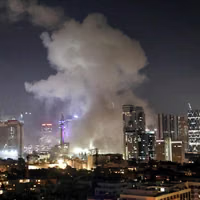
Iranian officials are urging citizens to fill the streets as Israeli strikes hit security sites, while opposition figures warn the calls aim to create civilian “human shields” around security forces under attack.

On Friday, several Iranian officials including the judiciary chief, the top security official, the foreign minister and many others demonstrated alongside Islamic Republic supporters in anti-Israel Quds Day rallies.

In one video from the rallies, Judiciary Chief Gholamhossein Mohseni Ejei was seen surrounded by a large number of bodyguards and participants forming what critics call a human shield as an airstrike hit an area nearby.

In an apparent move to avoid airstrikes, Ejei decided not to sit on the officials’ podium during Friday prayers, instead sitting among ordinary worshippers.

Before the Quds Day rallies, Iranian authorities had urged supporters of the Islamic Republic to pour into the streets despite the threat of airstrikes.

“This smallest soldier of yours has three requests from you: street, street, street,” parliament speaker Mohammad-Bagher Ghalibaf posted on X on Wednesday. “Your children in the armed forces have put their lives in their hands to defend Iran. Strengthen them by keeping the streets.”

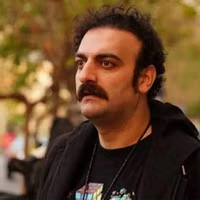
A video circulating on social media also shows pro-government religious singer Meysam Motiee, speaking after several checkpoints were targeted in Tehran the same night, urging civilians to help protect security forces. “The US and Zionists have serious plans to take back the streets from the faithful forces.”

However, critics argue that such calls expose civilians to danger. The diaspora-based Dadban volunteer lawyers group warned against encouraging civilians to gather near security installations.

“Encouraging civilians to gather near security centers or checkpoints that may become targets effectively turns them into human shields,” the group wrote in a statement. “Such actions knowingly expose civilians to danger and place direct responsibility on those issuing the calls.”

Online users say that after some of these strikes, checkpoint personnel have moved their positions to busier streets. Some posts allege that instead of conducting vehicle searches as thoroughly as before, members of the Basij militia now stop cars primarily to create congestion around these checkpoints.

People urged to stay home

In contrast to these calls for street presence, opposition figures and foreign leaders have urged Iranians to stay indoors for the time being.

Iran's exiled prince Reza Pahlavi, who has said he is prepared to lead a transitional period after the Islamic Republic, warned that the coming days would be decisive and that people need to stay home.

In a video message on Thursday, he urged citizens not to approach “government, military and law-enforcement centers, or housing complexes affiliated with the repression apparatus.”

“The Islamic Republic is using schools, mosques, and other public locations to hide its forces and create human shields,” he said.

Addressing state employees directly, Pahlavi urged them not to risk their lives for the survival of the government. Instead, he called on them to “use your access and capabilities to disrupt repression and help the people.”

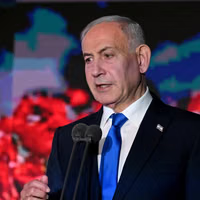
Similar appeals have come from abroad. Israeli Prime Minister Benjamin Netanyahu addressed Iranians in a Persian-language message published by an official Israeli account.

“We are delivering heavy blows to the Revolutionary Guards and Basij forces, both in the streets and at checkpoints,” he said, promising that the attacks would continue.

“I say to the people of Iran: the moment you can begin a new path of freedom is getting closer every day. We stand with you, we help you, but ultimately everything depends on you.”

Police commander Ahmad-Reza Radan had warned in a televised interview earlier this week that anyone taking to the streets would be treated as an “enemy” and said security forces had their “fingers on the trigger” and were ready to shoot.

In a mass text message reportedly sent to mobile phones across the country on Thursday, the intelligence arm of the Revolutionary Guards (IRGC) also threatened harsh consequences for street protests.

The message warned that if those it described as “domestic traitors” or “neo-ISIS elements” attempted demonstrations, they would face a response “stronger than January 7.”

The IRGC's statement effectively acknowledged the Islamic Republic's role in the massacre of at least 36,500 protesters during the brutal crackdown in January.

"The IRGC intelligence organization forgot that before the war, they used to deny the killing of people and say it was the work of terrorists. Today, they threatened people that if they come out to the streets, we'll give you a harsher response than on January 7," one user posted on X.

A statement attributed to the new supreme leader Mojtaba Khamenei on Thursday signaled no change in the government’s approach. Many Iranians on social media widely interpreted the message as confirmation that the policy of suppressing dissent would continue.

The confrontation has spilled onto social media as well, where supporters of the establishment and critics exchange threats and mockery.

One pro-establishment user wrote on X: “This time we are waiting even more than the Prince and Netanyahu for you to come to the streets… If you really want an uprising, don’t delay. Come to the streets.”

Some critics responded to the visible participation of pro-establishment citizens in rallies, including the annual Quds Day rally, with historical comparisons. “Hitler, Mussolini, Saddam, and Gaddafi could bring crowds many times larger than this to the streets,” one user wrote. “We all know how that ended.”

Others used sarcasm to encourage militia members to remain at checkpoints despite the risk of Israeli drone strikes.

“We wish you well,” one user wrote mockingly. “Please do not leave your posts under any circumstances. Your strong presence at checkpoints lets millions of Iranians smile with relief. They can watch and wave to you from afar.”

Most Viewed

Iran keeps oil flowing to China as Hormuz pressure forces reserve release
1
INSIGHT

Iran keeps oil flowing to China as Hormuz pressure forces reserve release

2
EXCLUSIVE

Desertions, shortages and army-IRGC rift strain Iran’s military

3
INSIGHT

Checkpoint attacks open new front in Iran war

4

Iran’s unseen new leader issues first message in writing

5
EXCLUSIVE

Iran women’s football team kept under tight security in Kuala Lumpur

Banner
Banner
•
•
•

Spotlight

  • Iran raises ‘human shield’ fears by rallying supporters to the streets
    ANALYSIS

    Iran raises ‘human shield’ fears by rallying supporters to the streets

  • Russia gains from Iran war but risks more if it drags on
    OPINION

    Russia gains from Iran war but risks more if it drags on

  • Allies rally, rivals brace after Mojtaba Khamenei’s rise
    INSIGHT

    Allies rally, rivals brace after Mojtaba Khamenei’s rise

  • Checkpoint attacks open new front in Iran war
    INSIGHT

    Checkpoint attacks open new front in Iran war

  • Power vs piety: Khamenei Jr inherits legitimacy dilemma of Iran's theocracy
    ANALYSIS

    Power vs piety: Khamenei Jr inherits legitimacy dilemma of Iran's theocracy

  • Can widening the war save Iran’s rulers?
    ANALYSIS

    Can widening the war save Iran’s rulers?

More Stories

After first message, Iranian media cast Khamenei Jr as wartime leader

Mar 13, 2026, 14:06 GMT
•
Behrouz Turani

As Mojtaba Khamenei’s first public message was delivered Thursday following days of absence, Iranian newspapers and semi-independent websites moved to reinforce his image as a wartime leader.

The statement, read aloud by a state television anchor over a still photograph of the new leader, called for continued military resistance and said the Strait of Hormuz should remain a tool of pressure.

“The demand of the masses of the people is the continuation of effective and regret-inducing defense,” the message said. Khamenei has remained largely absent from public view amid persistent questions about his health and whereabouts and unconfirmed reports he was hospitalized with injuries.

In their Wednesday, March 11 editions, newspapers and websites had already begun shifting their focus from the mechanics of succession to projecting authority during an active conflict. The pivot came despite the information blackout inside Iran and Mojtaba’s continued silence at the time.

In the first two days after Ali Khamenei’s death on February 28, coverage largely emphasized Mojtaba’s religious credentials and lineage. By midweek, however, newspapers and websites had turned toward portraying him primarily as a wartime commander.

Continuity and defiance

Kayhan, closely linked to the former leader’s office, referred to him as “the general of the revolution,” highlighting his long-standing but largely hidden ties to the IRGC.

Conservative outlets and several mainstream websites dropped the respectful title ‘Agha’ (sir/master) traditionally used for the son of an ayatollah. Some instead adopted ‘Imam’ or ‘Ayatollah’, reflecting his rapid elevation to the highest clerical and political rank.

Front pages were dominated by pledges of allegiance from military commanders, clerics, bureaucrats and cultural figures.

The Tehran Times reinforced the continuity narrative with its headline, “Trump is gone, Khamenei remains,” responding to Donald Trump’s earlier remark that the new leader “would not last long.”

Moderate and reformist outlets such as Etemad offered cautious backing, framing the hereditary succession as a stabilizing step that prevented a dangerous power vacuum during wartime.

Mentions of dissent or possible unrest were absent, with coverage unfolding inside a tightly controlled information environment.

Manufactured unity

Hardline outlets such as Kayhan and Tasnim framed the succession as a strategic defeat for the United States and Israel, arguing that Ali Khamenei’s killing was meant to trigger systemic collapse and that Mojtaba’s swift appointment demonstrated the system’s resilience.

Some columnists also sought to recast Mojtaba as a capable executive, describing him as a “silent reformer” suited to confront corruption inside the state.

Official websites and IRGC-affiliated Telegram channels amplified the message with pledges of loyalty from generals, clerics and even former political rivals such as Ali Larijani.

Wartime iconography—including posters merging the faces of Khomeini, Ali Khamenei and Mojtaba—reinforced a narrative of continuity and unity.

State media repeatedly warned that public skepticism at this stage could amount to collaboration with the “Zionist enemy,” underscoring the narrow space for dissent as the new leadership consolidates power.

War leaves its mark on Iran's cultural heritage

Mar 13, 2026, 02:15 GMT
•
Maryam Sinaiee

Airstrikes in Iran have damaged several historic landmarks, including UNESCO-listed sites, raising concern among cultural experts and officials about the protection of heritage during the conflict.

UNESCO’s World Heritage Centre has confirmed damage to several sites on its global heritage list, though the full extent remains unclear, its director Lazare Eloundou Assomo said.

Several of the affected buildings carried the Blue Shield emblem, an international symbol used to identify protected cultural heritage sites under international law and often described as the “Red Cross for cultural heritage.”

Iran’s Foreign Minister Abbas Araghchi later criticized UNESCO’s response. “It's natural that a regime that won't last a century hates nations with ancient pasts. But where's UNESCO? Its silence is unacceptable,” he wrote on X.

Among the sites affected is the historic Golestan Palace, a Qajar-era complex in central Tehran added to the UNESCO list in 2013.

According to Afarin Emami, director of the Golestan Palace World Heritage complex, blast waves from airstrikes on March 1 shattered windows and damaged delicate mirrorwork in several halls.

Debris spread around in a hall at Tehran's historic Golestan Palace, after a US-Israeli strike, March 1, 2026

Images published by Iranian media show damaged crystal chandeliers and wooden doors and windows torn from their frames.

Emami said museum objects inside the palace were not harmed because they had been moved to secure storage after earlier tensions raised concerns about possible escalation.

The nearby Grand Bazaar of Tehran, a vast network of corridors forming a key part of the capital’s historic fabric, also sustained damage. Other buildings affected in Tehran include the former Senate Palace and the historic former Police Headquarters.

Several days later, further blast waves reportedly caused damage in Isfahan, one of Iran’s most important historic cities.

Images circulating online show shattered windows, cracked walls and fallen mirrorwork at multiple sites, including the Safavid-era Chehel Sotoun Palace and the Ali Qapu Palace in the Naqsh-e Jahan area.

The primary target appeared to be the provincial governor’s office building in the nearby Rashk-e Jahan complex, which was reportedly directly bombed. Ashraf Hall, a Safavid structure known for its gold-decorated ceilings, sustained significant damage, with photographs showing fallen tiles scattered among office furniture.

Governor's office (Rashk-e Janan Palace) in Isfahan after bombing

Elsewhere, Iranian media reported damage in Sanandaj, where several historic mansions lost sections of plaster decoration, mirrorwork and wooden doors. In northern Iran, reports suggest the Safavid-era Safi Abad Palace in Behshahr may have been affected by nearby strikes targeting a military radar facility, though no confirmed photographs have been released.

Near the historic Falak-ol-Aflak Castle in western Iran, the provincial cultural heritage office located within the castle’s protected zone was destroyed and five staff members and heritage protection personnel were reportedly injured. The fortress itself was not damaged.

The incidents have triggered heated debate among Iranian social media users, with some criticizing the government’s own handling of cultural heritage protection.

One user wrote on X: “At least write that the Islamic Republic should not build military bases next to heritage sites when you write that a historic monument was damaged by Israeli or US attacks.”

Others argued the destruction must be viewed in the broader context of the conflict. “We can rebuild buildings,” one commenter wrote. “Save your tears for the 40,000 people who were killed.”

Some groups, including the Jurists’ Council for a Democratic Iran, have called on all sides to respect international conventions protecting cultural heritage during armed conflict.

Allies rally, rivals brace after Mojtaba Khamenei’s rise

Mar 12, 2026, 18:23 GMT
•
Behrouz Turani

Regional reactions to the appointment of Mojtaba Khamenei as Iran’s new Supreme Leader have revealed growing anxiety about stability, with Tehran’s allies condemning the killing of his father and adversaries hardening their military posture.

Khamenei Jr’s continued absence from public view has fueled speculation among analysts and diplomats about how power is being exercised during the transition.

The message read on his behalf on state television on Thursday was viewed by some observers as closely aligned with the Revolutionary Guards (IRGC) messaging, prompting questions about the balance between formal leadership and the IRGC.

As expected, Tehran’s regional non-state allies in Iraq, Yemen and Lebanon have rallied around the new leader, calling him the “Leader of the blessed Islamic Revolution.” His ascendence to power is perceived by these armed groups as continuity in funding and weapons transfers.

Not many share this view in the region and beyond.

Arab neighbors

Across the Persian Gulf, Mojtaba’s appointment has been met with a mix of defensive military posturing, criticism, and calls for closer security coordination.

Tensions with Saudi Arabia rose sharply after his appointment when an Iranian strike hit a Saudi residential area. Prior reporting in US media, including The Washington Post, indicated Riyadh had privately urged Washington to use significant military force to prevent Iran from emerging stronger after the transition.

Elsewhere in the region, Tehran and its proxies have been blamed for strikes on civilian infrastructure—including a desalination plant in Bahrain.

Arab League Secretary-General Ahmed Aboul Gheit denounced Iran’s “reckless policy,” reflecting broader anxieties among smaller Gulf states.

Reactions from Qatar, Kuwait and the United Arab Emirates have reflected concern about escalation, as the leadership transition coincided with direct attacks on regional infrastructure.

Turkey

In Turkey, President Recep Tayyip Erdogan struck a supportive tone, calling Iranian officials “brothers” and expressing hope they would “get through this trap-filled period.”

Ankara has also criticized US strikes and appears likely to maintain pragmatic engagement with Iran’s leadership to avoid instability along its borders.

Russia, China and the EU

Russia’s President Vladimir Putin was among the first to respond, calling Ali Khamenei’s death a “cynical murder” and describing him as an “outstanding statesman.” His message to President Massoud Pezeshkian emphasized solidarity with Iran during the transition.

China adopted a more cautious tone, stressing respect for Iran’s sovereignty and opposing regime change. Chinese officials framed the succession as a constitutional matter and an internal Iranian process.

The European Union’s reaction has been more fragmented. Diplomats say some member states quietly hope the transition could open space for political change, while others fear instability could widen the conflict. Publicly, EU officials have emphasized de-escalation regardless of who leads Iran.

None of the three powers aligned with Tehran as the United Nations condemned IRGC-linked attacks on regional targets this week.

Israel

Israel was the only country in the region to explicitly question the legitimacy of Mojtaba’s appointment, describing it as a continuation of what it called the IRGC’s “terror regime.”

Even before the appointment, Defense Minister Israel Katz wrote on X that “any leader appointed to continue the plan to destroy Israel will be an unequivocal target for elimination.”

Public reactions across Iran and parts of the Arab world have been mixed. Some early expressions of relief at Ali Khamenei’s death gave way to concern about escalation as Mojtaba’s ties to the IRGC came into focus.

Across the region, officials and analysts say the leadership transition has reinforced fears that an already volatile conflict could widen further in the weeks ahead.

Tehran steps up threats against critics at home and abroad

Mar 12, 2026, 00:31 GMT
•
Maryam Sinaiee

Threatening rhetoric on Iranian state television has intensified fears of renewed repression, as presenters and officials warn critics at home and abroad they could face confiscation of property, prison or even death.

On Tuesday, Reza Molaei, a presenter on Iran’s state-run Channel 3, delivered a sharply worded message directed at government opponents living abroad. “When the dust of sedition settles, we will grab you by the collar,” he said during the broadcast.

Footage widely shared online showed him going further, referring to an earlier warning from Iran’s prosecutor general and suggesting critics could face deadly consequences so that “their mothers would sit in mourning.”

The broadcast followed a statement Monday by Iran’s Office of the Prosecutor General warning Iranian citizens abroad they could face severe penalties—including confiscation of assets and even the death penalty—if they engage in what authorities describe as “cooperation with the enemy.”

Although framed in terms of espionage or intelligence activity, the warning has raised alarm among members of the Iranian diaspora who regularly organize anti-government protests in major cities worldwide.

Participants in those rallies say authorities could identify them through social media posts or videos from demonstrations and target them or their families inside Iran.

Inside the country, officials have issued similarly stark warnings.

Ahmadreza Radan, Iran’s police chief, said in a televised interview on March 9 that individuals who take to the streets “at the enemy’s behest” would be treated not as protesters but as hostile actors.

“If someone comes to the streets at the enemy’s behest, we do not see them as a protester—we see them as an enemy, and we will deal with them accordingly,” he said. “All our forces have their fingers on the trigger and are ready.”

The phrase appeared to reference calls by US and Israeli leaders urging Iranians to challenge the government.

The climate of intimidation has also extended to Iranian athletes abroad.

Several members of Iran’s women’s national football team sought asylum in Australia after declining to sing the national anthem before a match against South Korea, two days after the killing of Supreme Leader Ali Khamenei—a gesture many observers interpreted as protest against the crackdown.

During a television program, presenter Mohammad Reza Shahbazi denounced the players as “traitors in a time of war,” accusing them of disrespecting the country and calling for harsh punishment.

Legal advocacy group Dadban—run by volunteer lawyers in the Iranian diaspora—warned the rhetoric appearing on state media could legitimize violence against civilians.

“When such threats are aired by official media, it sends the message that deadly force against protesters may be considered legitimate,” the group said. “This seriously increases the risk of escalating violence against citizens.”

The threats come two months after the deadly suppression of nationwide protests in January, which left many in Iranian society still shaken and wary of renewed confrontation.

Some activists say the warnings will not deter them from opposing the government, while others have used the moment to highlight what they describe as decades of pressure on Iranian citizens both inside and outside the country.

Power vs piety: Khamenei Jr inherits legitimacy dilemma of Iran's theocracy

Mar 11, 2026, 17:54 GMT
•
Shahram Kholdi

Iran’s new supreme leader Mojtaba Khamenei inherits not merely his father’s office but also the constitutional ambiguities and political compromises that accompanied Ali Khamenei’s own controversial elevation nearly four decades earlier.

The death of Khamenei in the February 2026 US–Israeli airstrikes on Tehran has triggered the most consequential constitutional transition in the Islamic Republic since 1989—and revived a question that has long shadowed the system since its founding: whether supreme authority rests primarily on religious legitimacy or political power.

Within days, Iranian state media announced that the Assembly of Experts had selected his son, Mojtaba Khamenei, a figure long powerful behind the scenes but lacking broad clerical standing, as the new Supreme Leader.

The office of Supreme Leader is defined primarily by Articles 5, 107, 109 and 110 of the Constitution of the Islamic Republic of Iran.

Article 5 establishes the principle of velayat-e faqih, entrusting governance during the occultation of the Twelfth Imam to a qualified jurist combining religious authority with political competence. Article 107 assigns the Assembly of Experts the responsibility of selecting the Supreme Leader, while Article 109 sets out the required qualifications, including justice, political insight and administrative ability.

The precedent of 1989

When Khomeini died in June 1989, the Islamic Republic faced an immediate leadership vacuum. No obvious successor possessed comparable clerical stature.

The Assembly of Experts ultimately chose Ali Khamenei, then president, despite his limited standing as a senior jurist; the constitution was soon revised to accommodate the decision, stating that the leader need not possess the full recognition as a grand ayatollah.

The amendment reflected political calculation rather than abstract principle.

The episode established an enduring precedent: constitutional interpretation could adapt to political necessity. In practice, legitimacy rested not only on religious authority but also on institutional alignment and security power.

Mojtaba Khamenei now confronts a similar dilemma. Like his father in 1989, he is not widely recognised within the traditional hierarchy of Shiʿi scholarship as a senior jurist.

Wartime succession

Under Article 107, the Assembly of Experts must deliberate and appoint the Supreme Leader, ordinarily implying a formal session. Yet Mojtaba’s selection occurred amid ongoing war and severe disruption following the airstrikes that killed Ali Khamenei.

Public information about the process remains sparse. It is unclear whether the assembly gathered physically, voted remotely or reached its decision through emergency consultation. Iranian state media confirmed his appointment but provided few procedural details.

Such ambiguity does not necessarily invalidate the decision within the Islamic Republic’s flexible constitutional practice. Still, the opacity surrounding the process has intensified debate over the legitimacy of the succession.

For more than a decade Mojtaba sought to strengthen his clerical credentials. Beginning in 2009, he taught dars-e kharej—advanced jurisprudence seminars traditionally led by senior clerics aspiring to marjaʿ status. Observers widely interpreted the move as preparation for a possible future succession.

Reports from Persian-language sources suggest some senior grand ayatollahs objected to what they saw as a politically engineered effort to manufacture clerical authority. Attempts were reportedly made to obtain written attestations of Mojtaba’s ijtihad, though evidence of broad clerical recognition remains limited.

After roughly thirteen years, Mojtaba suspended the classes in September 2024 as succession speculation intensified.

Power without office

Power in the Islamic Republic has rarely flowed through formal titles alone. It often moves through the networks surrounding the Supreme Leader.

Over two decades Mojtaba emerged as one of the most influential yet least publicly visible figures in the Iranian state. His authority derived not from elected office but from his role inside Beit-e Rahbari, where he functioned as a gatekeeper to his father—managing access, filtering political actors and coordinating with security institutions.

In practice this amounted to a tightly controlled security network of clerical aides, intelligence officials and Revolutionary Guard commanders whose influence depended less on formal office than on proximity to the Leader.

This informal authority allowed Mojtaba to cultivate a patronage base closely tied to the IRGC. The United States Treasury sanctioned him in 2019, stating that he acted on behalf of the Supreme Leader while maintaining close relationships with IRGC elements and the Basij militia.

The Guards connection

The relationship between the Supreme Leader and the Revolutionary Guards deepened decisively during the 2009 post-election unrest.

Following the disputed presidential vote that returned Mahmoud Ahmadinejad to power, mass protests erupted across Iran. The Revolutionary Guards and Basij militia ultimately played the decisive role in suppressing the demonstrations.

The events of 2009 reaffirmed the supremacy of the Supreme Leader while strengthening the alliance between the leadership and the security apparatus. Many analysts argue Mojtaba played a coordinating role inside the Leader’s office during the crisis.

One figure embodied the partnership between the Supreme Leader and the Revolutionary Guards more fully than any other: General Qasem Soleimani, commander of the Quds Force.

Soleimani maintained unusually direct access to Ali Khamenei and operated with a degree of autonomy rare within the Islamic Republic’s formal hierarchy, shaping Tehran’s regional military strategy across Iraq, Syria and beyond.

His killing by a United States drone strike in January 2020 removed a central node in the system that linked the Leader to the Guards’ external operations.

Although the IRGC remained institutionally powerful, no successor fully replicated Soleimani’s combination of battlefield authority, political influence and personal access to the Supreme Leader..

Continuity and uncertainty

Another turning point came with the death of President Ebrahim Raisi in a helicopter crash in 2024.

Long viewed as a plausible successor with stronger clerical credentials, Raisi’s absence narrowed the field and sharpened attention on Mojtaba Khamenei, whose embedded position within Beit-e Rahbari and longstanding ties to the security apparatus left him uniquely placed when wartime succession arrived.

Mojtaba Khamenei’s accession does not resolve the deeper tensions within the Islamic Republic. Like his father in 1989, he assumes power without universally recognised clerical authority. His legitimacy rests instead on political coalition, institutional continuity and the support of the Revolutionary Guards.

At the same time, the war that accompanied his elevation has destabilised the very networks that sustained his rise. The destruction of Beit-e Rahbari and the deaths within the leadership circle have left the inner workings of the system partially obscured.

Mojtaba inherits the same contradiction that shaped his father’s rise: a system that claims religious authority yet repeatedly turns to political necessity in moments of crisis.

In 1989, that necessity elevated Ali Khamenei as the republic emerged from the long shadow of the Iran–Iraq War. In 2026, it has elevated his son amid war once again—leaving the durability of Iran’s constitutional order dependent, as before, less on theology than on power.