Iranian Filmmaker Panahi Begins Hunger Strike In Prison

Famous Iranian filmmaker Jafar Panahi has gone on a hunger strike to protest his detention in Tehran while his sentence has been declared void by the country’s Supreme Court.

Famous Iranian filmmaker Jafar Panahi has gone on a hunger strike to protest his detention in Tehran while his sentence has been declared void by the country’s Supreme Court.
Tahereh Saeidi, Panahi’s wife, announced his hunger strike Wednesday publishing Panahi’s on her Instagram sent from the notorious Evin Prison where most political prisoners are kept.
“I firmly declare that in protest against the illegal and inhumane behavior of the judicial and security apparatus and their hostage-taking, I have started a hunger strike since the morning of February 1… I will refuse to eat and drink any food and take medicine until the time of my release,” reads his statement.
The director was imprisoned in early July after going to Evin prison to enquire about the whereabouts of his other renowned filmmakers Mohammad Rasoulof and Mostafa Al-Ahmad following their arrest a few days earlier.
Later, it was announced the Iranian authorities had decided to reactivate a six-year sentence originally meted out to Panahi in 2010 alongside a 20-year filmmaking and travel ban.
The charges were connected to his attendance at the funeral of a student who was shot dead in 2009 during the Green Movement protests and his later attempt to shoot a feature about the uprising.
In October, Iran’s Supreme Court announced that Panahi’s sentence had passed the country’s ten-year statute of limitations. Accordingly, this should have granted Panahi immediate release, but he is still behind bars.

The US military says it played a role in an operation last month that intercepted an Iranian shipment of weapons to Yemen’s Houthi rebels.
The US military announced Wednesday that the US Navy assisted the French military in seizing thousands of assault rifles and half a million rounds of ammunition that were being transferred from Iran to Yemen in January.
US Central Command confirmed over 3,000 assault rifles, 578,000 rounds of ammunition, and 23 anti-tank guided missiles were confiscated.
It also added that the seizure is “one of four significant illicit cargo interdictions over the past two months,” which has prevented the transfer of more than 5,000 weapons and 1.6 million rounds of ammo to Yemen. Another seizure of arms was announced earlier in January.
In a separate release on Wednesday, CENTCOM also announced that Yemeni security forces recently seized 100 unmanned aerial vehicle engines “bound for Houthi militants,” but it did not specify when the seizure happened.
The seizure came just five days after CENTCOM announced that the US had intercepted a shipment of 2,116 Iranian assault rifles heading for Yemen.
Yemen has been the scene of a civil war since 2015. Tehran has supported the Houthis, a rebel group that overthrew the government at the beginning of the war, against a Saudi-led coalition. The war has caused widespread poverty and left tens of thousands of civilian casualties, creating one of the world’s worst humanitarian crises as aid workers say.

Iran has blamed Israel for a drone attack on a military factory in the central city of Esfahan, vowing revenge for the latest episode in a long-running covert war.
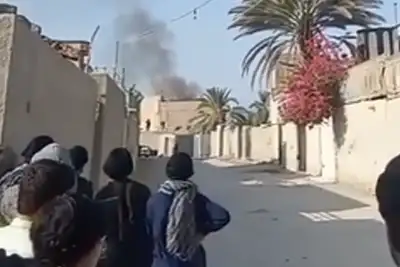
The attack on midnight, January 28 was filmed by the city’s residents showing explosions at a weapons development facility that is said to be involved in missile technology and munitions production.
The drone strike was yet another episode exposing Iran’s weaknesses in a covert war with Israel and a public embarrassment for its military and intelligence apparatus that have not been able to protect vital targets hundreds of kilometers inside Iran.
The attack came amid tension between Iran and the West over Tehran's nuclear activity and its supply of arms - including long-range "suicide drones" - for Russia's war in Ukraine, as well as months of antigovernment demonstrations at home.
In a letter to the UN chief, Iran's UN envoy, Amir Saeid Iravani, said "primary investigation suggested Israel was responsible" for Saturday night's attack, which Tehran had said caused no casualties or serious damage.
"Iran reserves its legitimate and inherent right to defend its national security and firmly respond to any threat or wrongdoing of the Zionist regime (Israel) wherever and whenever it deems necessary," Iravani said in the letter.
"This action undertaken by the Zionist regime (Israel) goes against international law."
Arch-foe Israel has long said it is willing to strike Iranian targets if diplomacy fails to curb Tehran's nuclear or missile programs but does not comment on specific incidents.
Many see the latest attack as a warning by Israel after years of threats that it will not tolerate a nuclear Iran.
Talks between Iran and world powers to revive a 2015 nuclear deal have stalled since September. The negotiations initiated by the Biden Administration in April 2021 lasted 18 months and failed to produce an agreement. In the meantime, Iran enriched enough uranium for up to four nuclear bombs and sharply reduced monitoring access for the UN nuclear watchdog, the IAEA.
Iran has accused Israel in the past of planning attacks using agents inside Iranian territory.
On Wednesday a semi-official website said "equipment" used in the drone attack on the Ministry of Defense complex was procured by Kurdish groups based in Iraqi Kurdistan region.
Nour News Agency, affiliated with the Iranian Supreme National Security Council (SNSC), claimed that parts of a micro aerial vehicle and explosive materials were ordered by a foreign intelligence service and smuggled into Iran from the Kurdistan region through difficult mountain passes and were handed to an intermediary in a border city in the northwestern part of the country.
The report added that the drone parts and explosives were then assembled at a modern workshop by a group of specialists and were used in the attack.
In July, Tehran claimed it had arrested a sabotage team of Kurdish militants working for Israel who planned to blow up a "sensitive" defense industry center in Esfahan.
Iran has become more isolated in the world after the break in nuclear talks and international reaction to its deadly crackdown on popular protests. The supply of drones to Russia has also soured already weak relations with Europe.
Several nuclear sites are located in Isfahan province, including Natanz, the centerpiece of Iran’s uranium enrichment program, which Iran accuses Israel of sabotaging in 2020 and 2021. There have been a number of explosions and fires around Iranian military, nuclear and industrial sites since July 2020.

Islamic Republic says "equipment" used in the drone attack on the Ministry of Defense complex in central Iran last week was procured by Kurdish groups based in Iraqi Kurdistan region.
Nour News Agency, affiliated with the Iranian Supreme National Security Council (SNSC), claimed on Wednesday that parts of a micro aerial vehicle and explosive materials were ordered by a foreign intelligence service and smuggled into Iran from the Kurdistan region through difficult mountain passes and were handed to an intermediary in a border city in the northwestern part of the country.
The report added that the drone parts and explosives were then assembled at a modern workshop by a group of specialists and were used in the attack.
Nour News had earlier claimed that several members of a "Kurdish group" were trained by Israel for sabotage operations on the industrial facilities of Esfahan but were "arrested by the Ministry of Intelligence," a claim vehemently rejected by Kurdish groups.
The late-January attack targeted Material and Energy Laboratory of Esfahan with what the defense ministry called “small drones.” Videos citizens sent to Iran International showed an explosion, although the government claimed its air defenses had fended off the attack. Small or quadcopter drones, however, cannot fly hundreds of kilometers to reach Esfahan, located in central Iran. If indeed the attack was carried out with small drones, it would mean operators were present on the ground, in Iran.
According to the Israeli weblog Intellitimes, the target of the drone attack was the "Iranian Space Research Institute" affiliated with the ministry of defense. The Jerusalem Post, citing Western and foreign intelligence sources, also wrote that contrary to Iran’s claim the attack on "advanced weapons development" facility was a "tremendous success".

While mass arrests and heavy sentences against protesters continue in Iran, reports say some detainees are being tortured behind bars.
According to information received by Iran International, Ashkan Baluch, a kickboxing athlete, who was sentenced to five years in prison, attempted suicide in a prison in Tehran and been taken to hospital, where he jumped off the third floor in a second attempt to kill himself. He remains in hospital in serious condition.
Jalal Pirdayeh, a master's student at Sharif University, has been sentenced by a revolutionary court to two years of imprisonment, two years of a ban on leaving the country, and two years of ban on activities in cyberspace.
Maryam Shokrani, a journalist at Shargh newspaper, also announced in a tweet Tuesday that after she was charged with "propaganda against the regime" she has been set free on bail, but she received another notice from the revolutionary court that her charge is changed to "acting against national security".
Meanwhile, Hengaw Human Rights Organization said Mohammad Abbaszadeh, an artist from southwestern Ilam province, has received a two-year prison sentence, a two-year ban on leaving the country, and the payment of a fine.
The US-based Human Rights Activists News Agency (HRANA) reported that Saman Seidi, a rapper arrested during recent protests, was transferred from a prison in Karaj to an unknown location on January 28.

In the meantime, the case of Shiva Musazadeh, a master's student in dramatic literature at Tehran University of Arts, who was arrested twice during the nationwide uprising has been referred to the Khorramabad Criminal Court.
The campaign of Baluch activists also announced the arrest of eight students of Badr al-Uloom seminary in Zahedan saying that at least six of them are from Afghanistan.
In another development, Abdol-Mahdi Mousavi, the Chief Justice of Markazi Province, said several people have been detained and five others were summoned as they planned to "cut off the Internet and electronic surveillance after obtaining weapons."
Iranian intelligence and security agencies often bring unsubstantiated charges against dissidents, who are then tried behind closed doors without a lawyer.
Information received by Iran International also indicatess that Hawri Qaderi, a 22-year-old from Marivan in Kordestan province, was arrested on January 2 by security agents and taken to an unknown location. Since his arrest, he has talked only once to his family, and efforts to find out his whereabouts have failed.
More details have also emerged about regime security forces resorting to violence against citizens.
Mahmoud Alizadeh Tabatabai, a lawyer, told Jamaran website that "doctors at an eye Hospital in Tehran have said that they had removed several hundred eyeballs."
Security forces use shotguns to fire shells filled with small steel balls at protesters. The shells are known as ‘bird shots’ and are indiscriminate in nature as they spread among a crowd and often injure eyes.
The lawyer added that heavy sentences have also been handed out to teenage students and high school girls.
Furthermore, Ashkan Marovati, an Iranian Kurdish boxer, who was shot during a fight with security agents, told the CNN that there were about 200 birdshots in his body and the officers fired at him from a close range.
The Kurdish boxer also added that the officers took him to the hospital because they were sure he would die.

Azerbaijan’s foreign ministry has announced that 39 people were arrested in connection to an Iranian "espionage network" after previous reports saying that seven suspects were detained.
The Azerbaijani news agency APAquoted the ministry on Wednesday that 39 people have been detained as part of a special operation to uncover subversive activities in the country “under the guise of religion”.
According to the ministry, the detainees, "posing as believers, made propaganda for Iran on social networks and abused the freedom of religion in the country, carrying out the assignments of the Iranian special services."
Meanwhile, ministry also said Wednesday that "it will use all relevant international platforms to widely condemn the terror act against its embassy and punish the perpetrators."
Tensions between the countries haveincreased following an armed attack last week on Azerbaijan’s embassy in Tehran that left an Azerbaijani security official dead and wounded two others.
The ministry also stated that the Islamic Republic has tried to prevent the terror attack from being widely exposed at the international level.
Azerbaijan says the armed attack on its embassy was a "terrorist" act, but the Islamic Republic says the gunman appeared to have had a personal, not a political, motive.
On Tuesday, the Republic of Azerbaijan asked its citizens not to travel to Iran.