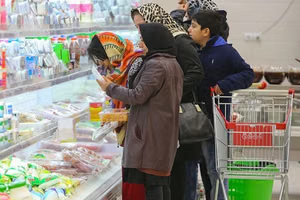
Students and parents walk through a snow-covered schoolyard outside a school in Iran.
Students across Iran are attending classes without adequate heating despite freezing temperatures and heavy rainfall, as the government warns of possible gas shortages but insists on keeping schools open, according to accounts received by Iran International.
Government spokesperson Fatemeh Mohajerani warned on November 10 of possible gas cuts in Tehran and other parts of the country but said the government's policy remained focused on maintaining in-person education.
The warnings come as families face growing school expenses, including demands to cover utility bills, while unreliable internet access and the cost of online learning complicate alternatives to classroom teaching.
Students bring blankets to freezing classrooms
Students and parents from several cities told Iran International that schools had refused to turn on heating systems despite falling temperatures.
"We are shivering from the cold at school, but they tell us they need an Education Ministry directive before turning on the heaters," one student said.
A student in the northwestern city of Ardebil said radiators remained off despite snowfall on November 9, with school officials citing energy shortages.
"Things have reached the point where some students are bringing travel blankets with them," the student said.
In Tabriz, northwestern Iran, where temperatures fell to minus five degrees Celsius, students said school officials refused to switch on radiators and told them to warm classrooms with their breath.
Students in the northern city of Chalus, northwestern Miandoab and Abyek near Tehran described similar conditions, including heavy rainfall, flooding and unheated classrooms.
A parent in the northern city of Amol said students at a private school had fallen ill after attending classes in severe cold.
"If these children catch a cold, how can we afford to treat even a simple cold at these prices?" the parent asked.
Broken heating systems and school fees
Accounts from students suggest the problem extends beyond restrictions on heating use to deteriorating infrastructure and insufficient funding.
A student in Gilan province, northern Iran, said radiators at their high school had remained broken since last year, except in the principal's office.
In Tehran, students described classrooms without heating, while one said their school lacked both electricity and gas. Another said officials blamed budget shortages for keeping radiators off.
A student in Karaj said the school, attended by approximately 500 students, had no classroom heating despite collecting substantial enrollment fees.
In Borujerd, Lorestan province, a student questioned spending priorities after the school installed two surveillance cameras in every classroom without providing adequate heating or cooling.
More than 500 schools in Chaharmahal and Bakhtiari province were undergoing heating upgrades and other repairs, Tabnak reported on November 6, citing earlier comments by a provincial school infrastructure official.
Heating problems had also delayed the opening of five or six educational projects.
Families face rising education costs
School closures offer no straightforward solution for families struggling with internet disruptions, expensive data packages and limited access to equipment for online education.
An Iran International Instagram poll published on August 27 found that 61 percent of approximately 55,500 respondents preferred online learning, citing concerns including student safety and financial pressures.
The remaining 39 percent favored classroom education, pointing to poor internet connectivity, electricity outages and declining educational quality online.
Financial demands from schools have added to families' difficulties.
Iran International reported on November 1 that some public schools were asking parents to contribute toward electricity, water and gas bills, maintenance and classroom equipment.
A student in Ahvaz said school officials demanded 1000,000 rials per pupil for examination papers and warned that those who failed to pay would receive a minus grade.
Another parent said a public elementary school in Tehran demanded 2,500,000 rials for a routine examination.
The charges add to the financial burden on families in a country where the minimum monthly wage stands at about 166 million rials, equivalent to roughly $61 at the current exchange rate.
Argentine Air Force planes fly over during the National Flag Day ceremony in Buenos Aires, Argentina June 20, 2025.
Iran designated Argentina’s navy and air force as terrorist organizations on Wednesday, invoking a 2019 law on reciprocal action after Buenos Aires designated Iran’s Islamic Revolutionary Guards (IRGC) as a terrorist organization.
Iran’s Foreign Ministry said Argentina’s move was hostile and violated fundamental principles of international law. It said the 2019 law, adopted after the United States designated the IRGC as a terrorist organization, applies to countries that follow or support that US decision.
“All countries that in any way follow or support the US decision to designate the IRGC as a terrorist organization will be subject to reciprocal action,” the ministry quoted the law as saying.
Iran’s Foreign Ministry said the Argentine government would bear responsibility for “all consequences arising from this action.”
Argentina designated the Islamic Revolutionary Guards a terrorist organization on March 31, broadening a years-long effort by Buenos Aires to hold Tehran and its proxies responsible for the deadliest attacks in the country’s history.
President Javier Milei’s office said Argentina had added the IRGC to its public registry of individuals and entities linked to terrorism and its financing, a move that allows financial sanctions and operational restrictions.
The United States was the first to designate the IRGC as a terrorist organization, adding it to its Foreign Terrorist Organizations list in 2019. Canada listed the entire corps as a terrorist entity under its Criminal Code in 2024. The European Union also added it to its terrorist list in February 2026.
Other governments have used different legal categories. Australia listed the IRGC as a “state sponsor of terrorism” in November 2025, while Britain designated it as a threat to national security in July 2026 under its State Threats Act.
Argentina tied its decision directly to the 1992 bombing of the Israeli Embassy in Buenos Aires, which killed 29 people and wounded more than 200, and the 1994 bombing of the AMIA Jewish community center, which killed 85 people and wounded more than 300.
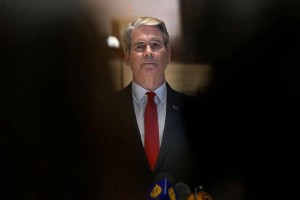
The announcement also renewed attention on Ahmad Vahidi, the IRGC chief commander and former Iranian defense minister, who has long been sought by Argentine authorities over the AMIA case.
At the time, Vahidi was the head of the Quds Force, the external operations branch of Iran's sprawling paramilitary organization the Islamic Revolutionary Guards.
Following an international arrest warrant issued by Argentine judicial authorities in 2006, Interpol placed him on its wanted list the following year.
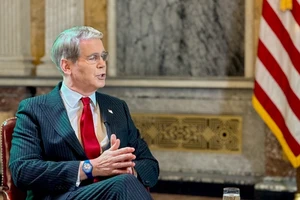
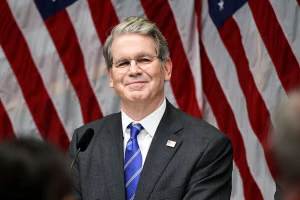
US Treasury Secretary Scott Bessent attends a bilateral meeting between US President Donald Trump and Britain's Prime Minister Andy Burnham during the 81st United Nations General Assembly (UNGA) in New York City, US, September 22, 2026.
The US Treasury Department confirmed on Tuesday that Secretary Scott Bessent had relocated from his Washington home to a military base following threats against his life from Iran.
"Threats against Sec. Bessent reached more than an advanced stage, which is why he and his family made the move," a senior Trump administration official told Fox News Digital.
The New York Times first reported the relocation, citing three people familiar with the matter. Reuters subsequently confirmed the move through two sources, while Fox News Digital obtained confirmation from the Treasury Department.
Security concerns intensified after photo of residence published
A person familiar with the matter told Reuters that concerns about Bessent's safety intensified after The Wall Street Journal published an aerial photograph of his residence in Washington's Georgetown neighborhood.
The photograph made it possible to identify the property's location, the source said, heightening security concerns amid the threats attributed to Iran.
"The news media has an obligation to act responsibly amid growing threats against public officials," the person told Reuters.
The military base where Bessent and his family relocated has not been publicly identified.
A senior administration official told Fox News Digital that the threats reflected the effectiveness of Washington's economic pressure campaign against Tehran, arguing that Iran was targeting the official responsible for the strategy.
A Treasury spokesperson told Fox News Digital that Bessent would "not be deterred by the Iranian regime's threats."
Bessent has overseen Operation Economic Outcast since August, a campaign combining financial sanctions and restrictions on trade to pressure Tehran over its military activities and the disruption of shipping through the Strait of Hormuz.
US intelligence warns Iranian plots have advanced
The reported threats follow a warning from a senior US intelligence official that Iranian plots targeting American personnel and citizens had reached an advanced stage.
Reuters said it reviewed a memorandum containing the warning late last month.
The New York Times also reported that US officials had identified specific threats they considered serious.
The newspaper said US officials assessed Iran's ability to carry out large-scale attacks in the United States and other overseas locations as limited.
Iran has previously denied involvement in plots to attack officials or other individuals on American soil.
Bessent oversees US blockade and sanctions on Iran
The Treasury Department's economic pressure campaign has targeted Middle Eastern bank branches and financial services companies that Washington says facilitate transactions involving Iran.
The measures operate alongside a US naval blockade of Iranian ports, intended to restrict Tehran's oil revenue and pressure it to halt attacks on commercial shipping and reopen the Strait of Hormuz.
The waterway, a major route for global energy exports, has faced severe disruptions since the United States and Israel launched their military campaign against Iran on February 28.
Washington has also expanded its efforts beyond maritime routes. On November 7, US Central Command announced Task Force Iron Gate, a new initiative to disrupt shipments of advanced weapons, dual-use technologies and sanctioned materials across Iran's land borders and the Caspian Sea.
US President Donald Trump says the Iran war is effectively over militarily, but his plan to maintain a naval blockade raises questions about how long the standoff can last and whether it serves the interests of the Arab neighbors he says support it.
“Most importantly, Qatar, Saudi Arabia, UAE, Bahrain, Kuwait and others would prefer the status quo, that we remain as is,” Trump told reporters at the White House on Monday after meeting Qatar’s prime minister.
He described that approach as continuing the US naval blockade, while keeping American forces ready for renewed military action.
Speaking to reporters in Paris after meetings with G7 counterparts on Tuesday, Secretary of State Marco Rubio said US sanctions and the naval blockade were inflicting growing economic damage on Iran, reducing the need for further major combat operations.
Regional analysts disagree over whether that policy offers Arab states across the Persian Gulf their safest option or prolongs a confrontation that threatens their security and economies.
Pressure without stability
Ghaith al-Omari, a senior fellow at the Washington Institute and former executive director of the American Task Force on Palestine, offered the opposite assessment to Trump’s. Regional governments want a weaker Islamic Republic, he said, but that does not mean they favor an indefinite blockade.
“They would like to see the regime weakened, but they don't believe that the blockade serves their interests,” he told Iran International.
Even where oil continues to flow, insurance costs and the risk of further attacks weigh on regional economies. Prolonged uncertainty also threatens the stability underpinning investment, tourism, finance and logistics, he said.
“No war, no peace equals uncertainty, equals instability,” al-Omari said.
He argued that Arab governments across the Persian Gulf doubt Washington’s willingness to sustain the policy.Trump’s midterm setback has intensified concerns that domestic pressure could prompt an abrupt change, leaving neighboring countries to manage the consequences.
Without an agreement reopening the Strait of Hormuz and ending the conflict, some governments could seek separate arrangements with Tehran to reduce their exposure, he said.
Between a rock and a hard place
Dalia Ziada of the Institute for the Study of Global Antisemitism and Policy (ISGAP) described the Arab states of the Persian Gulf as caught “between a rock and a hard place”: fearful of a resurgent Islamic Republic, yet harmed by the instability of a prolonged standoff.
“They don't want the Iranian regime to get strong again,” she told Iran International.
But continued insecurity carries its own economic consequences, threatening the region’s appeal to investors and confidence in its future.
“The biggest loss for the wealthy Gulf states is the lack of stability,” Ziada said.
She argued that differences among regional governments, combined with doubts about the reliability of American protection, complicate their choices. Their concerns cannot be reduced to a simple preference for war or continued restraint, she said.
One incident could break the standoff
Mohamed Fahmy, a journalist and Middle East political analyst, also sees significant differences among Iran’s Arab neighbors.
“There is no unified Gulf position on how long the blockade should continue,” he told Iran International.
Saudi Arabia and the UAE see value in maintaining American pressure until Tehran makes meaningful concessions, Fahmy said, while Qatar and Oman place greater emphasis on mediation.
Their shared interest in reducing the Iranian military threat does not eliminate the costs of prolonged confrontation.
“The UAE, Saudi Arabia and Qatar have invested heavily in presenting themselves as stable international hubs for business, tourism, finance and logistics. Prolonged confrontation threatens those ambitions,” he said.
Those concerns reflect damage already sustained. An October 15 Reuters investigation documented at least 135 missile and drone attacks by Iran and allied groups against at least 84 infrastructure sites across seven Arab countries since US-Israeli attacks on Iran began on February 28. The tally covered infrastructure attacks, rather than every launch or attempted strike.
Fahmy said the standoff could continue for some time because Washington and Tehran both appear to believe waiting will improve their negotiating positions. But an attack killing American personnel or seriously damaging Persian Gulf energy infrastructure could trigger renewed military action.
“It takes only one serious incident involving American forces, a commercial tanker or a Gulf energy installation to undermine the current restraint,” he said.
Growing pressure in Washington over financial costs, military commitments and the absence of a clear exit strategy could instead encourage a negotiated settlement, he argued.
The case for staying the course
Saad bin Tefla Al-Ajmi, Kuwait’s former information minister, argues that maintaining the status quo remains the least harmful choice.
“The solution is to keep the status quo as is. That’s the best solution,” he told Iran International, referring to an article he supplied outlining his position.
Renewed war could bring further Iranian attacks on neighboring countries, he argues, while American withdrawal could leave them exposed.
“The third option is the safest and best for us, for the region and for the beleaguered peoples of Iran,” he wrote in the article.
Al-Ajmi advocates sustained naval and economic pressure alongside efforts to constrain Tehran’s regional armed allies. He predicts that pressure could eventually bring down the regime, although that outcome remains uncertain.
He acknowledges the costs to neighboring states.
“The Gulf states are indeed paying a price under this scenario. Their trade is disrupted, tensions persist in their airspace and their projects are delayed,” he wrote.
His support for maintaining that pressure rests on the judgment that the alternatives would be worse. The question is whether Washington and its regional partners can sustain it without an escalation that forces them back into war.
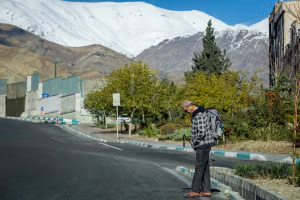
An Iranian man looks at a butcher shop window in Tehran, Iran, October 27, 2026.
A prolonged confrontation with Washington risks eroding Iran’s economy and impoverishing its people even without a sudden collapse, an Iranian economist warned, as Washington appears intent on maintaining economic pressure without renewed major combat operations.
In an interview with Shargh newspaper published Monday, Mohammad Tabibian, a former deputy director of Iran’s Planning and Budget Organization, questioned the strategy of measuring success through the country’s capacity to endure economic suffering.
His warning came as President Donald Trump said Monday that Qatar, Saudi Arabia, the UAE and other regional countries favored maintaining the “status quo,” which he described as the continuation of the US naval blockade and Operation Iron Gate, a new US task force to restrict Iran’s overland trade.
Trump also said US forces remained “locked and loaded,” keeping renewed military action an option.
Tabibian cautioned that Iran’s ability to adapt to sustained pressure did not mean an end to the damage.
“Adapting to sanctions does not mean eliminating their harm,” he said. Alternative trade routes, discounted sales, difficulties transferring money and uncertainty about the future continue to impose costs, reflected in reduced investment, declining productive capacity and weaker purchasing power.
The government’s ability to pay salaries was not, by itself, a measure of economic health, he argued. Payments could continue while their real value fell and families lost access to adequate food, healthcare, education or housing.
“A society can therefore gradually become poorer without experiencing a sudden halt to all economic activity,” he said.
“If investment declines in the meantime, human capital deteriorates and people suffer more, we cannot call the mere continuation of economic activity a success.”
Tabibian also cautioned that economic pressure would not necessarily produce Washington’s desired political outcome. Its effects would depend on decisions by both governments and the response of the economy and society, he said.
Mohammad Tabibian served under the administration of Ali Akbar Hashemi Rafsanjani as deputy director of the Planning and Budget Organization.
Who bears the cost of endurance?
Tabibian challenged Iranian authorities over decisions about the conflict and the economic burden imposed on society.
“My fundamental question is who bears responsibility for the decisive decisions about war and peace, and what mechanisms exist to hold them accountable? How can imposing this much pain and suffering on a nation be justified?” he said.
“People endure hardships within their homes that usually go unseen. There are families whose university-educated children remain unemployed at around age 40 and financially dependent on their parents. Many young people cannot establish independent lives. Retired parents, too, must support several people on limited incomes.”
He also rejected the assumption that disrupting the Strait of Hormuz and raising energy prices would necessarily force Washington to abandon its confrontation with Tehran.
“Why should we consider the suffering of our own people a success, simply in the hope that the other side suffers more?” Tabibian asked, arguing that government policies should instead be judged by their effects on people’s security and living standards.
He distinguished household resilience, government finances, the capacity to rebuild infrastructure and society’s political tolerance, warning against treating them as a single measure of national endurance.
The United States was better equipped to absorb economic shocks because of its large, diversified economy, financial resources and capacity for innovation, he said. Betting that higher energy prices or disruptions in the Strait of Hormuz would cripple the American economy or compel Washington to change course was therefore an unreliable strategy.
Washington backs economic pressure
Tabibian’s warning coincided with statements from US leaders favoring continued economic pressure without a resumption of large-scale combat operations.
Following a meeting with Qatar’s prime minister on Monday, President Donald Trump said several Arab governments favored keeping the present arrangements in place.
“Qatar, Saudi Arabia, UAE, Bahrain, Kuwait, and others, would prefer the status quo,” Trump wrote on Truth Social, describing that arrangement as the continuation of the US naval blockade and Operation Iron Gate, an initiative targeting weapons shipments and other illicit flows across Iran’s land borders and the Caspian Sea.
Secretary of State Marco Rubio made the economic argument more explicitly on Tuesday.
“The economic pain that is being inflicted on Iran right now is extraordinary, and it compounds. It’s growing every day,” Rubio told reporters in Paris.
“We don’t need to conduct military strikes if we’re achieving the same objective through economic means and economic pressure,” he added.
The economic campaign combines the naval blockade with sanctions against Iranian financial institutions, oil exports and businesses involved in sanctions evasion.
Reuters reported in September that three senior Iranian sources described Washington’s efforts to obstruct Iranian oil exports and access to international financial networks as increasingly difficult to withstand.
The sources warned that Tehran had fewer remaining avenues to obtain foreign currency and finance essential imports, raising concerns within the leadership about the consequences of a prolonged economic crisis.
The World Bank has also warned that the conflict, intensified sanctions and disruptions to trade are pushing Iran’s economy into a deeper contraction, with falling real incomes, weakened investment and growing poverty.
Economic grievances and the risk of renewed unrest
US intelligence officials and researchers have also examined the possible political consequences of prolonged economic pressure.
In March, Director of National Intelligence Tulsi Gabbard told Congress that sanctions and economic deterioration had contributed to the conditions behind Iran’s nationwide protests in January.
Iranian demonstrators gather in a street during nationwide protests, in Tehran, Iran, January 8, 2026.
She said US intelligence assessed that internal tensions were likely to increase as the Iranian economy worsened, even if the Islamic Republic remained in power.
A more recent study by Eric Lob, a political scientist at Florida International University and scholar at the Carnegie Endowment for International Peace, examined how economic grievances in Iran have repeatedly developed into broader political protests.
Published in October, his research argued that the war and US naval blockade had intensified the economic problems that initially drove those demonstrations, including inflation and currency depreciation.
He warned that prolonged deterioration would increase the likelihood of renewed social unrest, while the authorities’ reliance on repression could deepen the underlying grievances.
Tabibian, however, cautioned against assuming that economic suffering would automatically translate into political collapse. Political upheavals depended on the interaction of economic, institutional and social conditions, he said.
Nor could the timing, form or likelihood of protests be predicted simply from rising prices.
“Policymakers should not mistake people’s silence for satisfaction or an unlimited capacity to endure,” he said.
The limits of economic pressure
Other researchers have highlighted the risks of relying on prolonged pressure to constrain a government’s military capabilities or change its decisions.
In a November 2 assessment, Benjamin Jensen, director of the Futures Lab at the Center for Strategic and International Studies, examined possible US options ranging from continued pressure to attacks on military installations or sensitive nuclear facilities.
His assessment assumed that the existing sanctions and blockade would remain in place. Jensen described continued pressure as the lowest-risk option, but warned that Tehran could use the time to rearm, seek to divide Washington from its allies or launch attacks of its own.
He also cautioned that military gains did not guarantee sustained political results.
Tabibian said Iran might find ways to reduce the effects of some restrictions over time, but questioned the cost of doing so if investment declined and people endured further hardship.
He called for efforts to resolve disputes and reduce the risk of war, while cautioning that negotiations alone would not guarantee a solution. The outcome would depend on the decisions, conditions and actions of both sides.
“At the end of the tunnel of war and attrition, no clear light is visible for Iran or the United States,” he said.
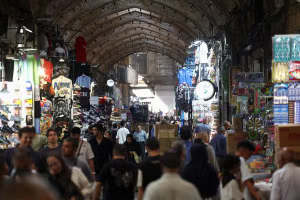
Shoppers walk through a market in Iran, where rising living costs and shrinking purchasing power reflect the economic toll of 47 years of Islamic Republic rule.
Nearly 47 years after Iran's 1979 revolution, a former football chief has asked what Iranians got for its promises, pointing to officials’ children living abroad, oil wealth that never reached wages and a state that answered protests with bullets.
“You haven’t done anything for 47 years. All you talk about is dignity, dignity, dignity. What dignity?” Mohammad Dadkan, former president of Iran’s Football Federation, said in an interview on the Persian-language podcast Tak be Tak.
The cost of confronting US
"What would we have to talk about if it weren't for 'Death to America'? What would we use to keep people occupied?" Dadkan asked.
The slogan has been at the heart of the Islamic Republic’s identity since 1979, when students loyal to Ayatollah Khomeini seized the US embassy and held its diplomats hostage.
Decades of confrontation, and the dispute over the nuclear program, brought broad US sanctions on oil, banking and trade.
They have deterred investment and raised the cost of imports, and the state’s own mismanagement has done the rest. Iranian households live with high inflation, falling purchasing power and few jobs.
Officials call resistance to Washington the measure of national independence. Iranians have paid for it in prices.
Shoppers crowd a bazaar in Iran, where decades of economic hardship, rising prices and declining purchasing power have taken a toll on everyday life.
Privilege at home, children abroad
"What have you done other than fill your own pockets, send your children abroad and take all the privileges for yourselves?" Dadkan said.
The children of senior officials living in the countries their parents denounce have long drawn anger.
Fatemeh Ardeshir Larijani, daughter of Ali Larijani, the former secretary of the Supreme National Security Council killed in an Israeli strike in March, worked as a cancer specialist at Emory University in the United States until January, when Emory said her employment had ended after protests by Iranian Americans. A government spokesman said she had already returned to Iran.
Issa Hashemi is the son of Masoumeh Ebtekar, a former vice president who was spokeswoman for the students who seized the US embassy in 1979.
He lived in Los Angeles with his wife and son until April, when US immigration authorities detained the family and Secretary of State Marco Rubio revoked their permanent residency over their connection to Ebtekar.
For most Iranians, a falling currency and closing visa doors have made studying or settling abroad ever harder.
Oil wealth and shrinking wages
"We have stone, gold, oil, the best resources and an excellent geographical position for attracting tourists. We haven't done anything," Dadkan said.
Iran has some of the world’s largest oil and gas reserves. Its people have not seen the benefit.
Annual inflation reached 76.8 percent in October, according to the Statistical Center of Iran, and prices were 88.7 percent higher than a year earlier.
The dollar traded at about 2.63 million rials in November, against about 1.6 million in early April: the rial lost nearly 40 percent of its value in seven months.
The base minimum wage for the Iranian year that began in March was set at about 166 million rials a month. At today’s rate that is about $63.
'National dignity’
Dadkan also turned the officials’ favorite word back on them, pointing to Iranian women driven into prostitution in neighboring countries.
The US State Department’s 2019 Trafficking in Persons Report cited growing numbers of young Iranian women in prostitution in Dubai, some controlled by networks that took their passports and threatened violence, and possible links between traffickers and members of the police, the Revolutionary Guards and the Basij militia.
Its 2022 report identified Iranian women as vulnerable to sex trafficking in Turkey, especially near the border.
Resilience, salaries and missiles
"They've come up with something new, and apparently they all say the same thing," Dadkan said, criticizing officials' repeated use of the term resilience.
The Persian term tabavari, meaning resilience or the ability to withstand hardship, has increasingly featured in speeches by Iranian officials urging the public to cope with economic and social pressures.
Shoppers browse fresh produce at a market in Iran.
The appeals have come as households struggle with persistent inflation, declining purchasing power, electricity outages and water shortages. Power cuts have disrupted businesses and industrial production, while water shortages have affected daily life in several provinces.
Dadkan's criticism focused on the expectation that citizens should repeatedly adjust to worsening conditions, with officials emphasizing their capacity to endure hardship rather than explaining how the underlying problems would be addressed.
Dadkan also challenged demands for higher parliamentary salaries.
"Why should your salary get increased? What have you done?" he asked.
He contrasted lawmakers' benefits with the struggles of retirees who have repeatedly demonstrated for pensions that keep pace with inflation.
Military priorities drew similar criticism.
"You come on television in the morning and say the missiles' range should be increased. Why is that your concern? Go take care of people's lives, their welfare and their security," Dadkan said.
Iranian officials have made expanding the country's missile capabilities a priority, even as power cuts disrupt homes and factories, water shortages worsen and basic infrastructure falls into disrepair.
The right to protest
"Now tell those who don't agree with your policies to come out. See if you can contain the crowds. Then you'll find out whether people want you," Dadkan said.
His challenge followed years of anti-government demonstrations, including protests in 2017–18 and 2019, the Woman, Life, Freedom uprising of 2022 and the nationwide protests of January 2026.
The January crackdown, particularly the killings on January 8 and 9, became central to questions about the system's treatment of dissent.
On January 25, Iran International's editorial board announced that more than 36,500 people had been killed during those two days, citing confidential security documents, field reports and testimony from medical workers, witnesses and victims' families.
One generation lived through revolution, war and one economic crisis after another. The next grew up with falling incomes and few prospects, and many left. Others buried relatives killed in the streets.
Forty-seven years is a chapter in a state’s history. For Iranians it is a lifetime of youth spent getting by, futures abandoned and families split by emigration or death. None of it can be given back.