US Treasury says Iran's oil revenue, trade hit hard by pressure campaign
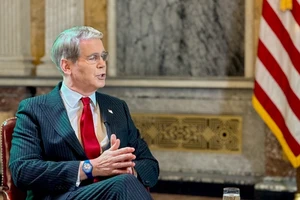
US Treasury Secretary Scott Bessent attends a press conference at government quarters Rosenbad after the trade talks between the U.S. and China concluded, in Stockholm, Sweden, July 29, 2025. Magnus Lejhall/TT News Agency/via REUTERS
The US Treasury says a pressure campaign launched against Iran two months ago has sharply reduced its oil revenue and access to international trade and financial channels, deepening the country’s economic isolation.
Treasury said Iran has loaded no oil onto vessels since August 25, while overland trade has faced border bottlenecks and restrictions have expanded across aviation and banking.
The assessment, titled Operation Economic Outcast: Iran’s Isolation by the Numbers, also points to a roughly 25% fall in the rial since the operation began on August 24 and rising inflation as signs of broader economic pressure.
The report said the rial reached 2,687,000 to the US dollar on the unofficial market in October, while year-on-year inflation rose to about 90% in September, citing data from the Statistical Center of Iran.
President Masoud Pezeshkian has also acknowledged the economic impact of sanctions.
“Some say sanctions have no effect at all; to those people, I really don’t know what to say,” he told state television in August.
Oil and trade routes come under pressure
Oil has been a central focus of Operation Economic Outcast, which Treasury launched on August 24 as part of a broader effort to cut Iran off from sources of revenue and foreign currency.
Iran has loaded no oil onto vessels since August 25, Treasury said, adding that the country had reportedly sold its remaining oil stranded at sea.
Separate data on deliveries shows the decline in Iranian oil reaching overseas destinations. Kpler data and Treasury staff calculations show the 30-day moving average of Iranian or suspected Iranian-origin oil unloaded at known locations falling to about 400,000 barrels per day by October 19, from more than 1 million barrels per day around the launch of the operation.
Treasury attributed the disruption to the US naval blockade and targeted economic sanctions.
With maritime routes restricted, the report says Iran has sought to reroute more trade overland, encountering bottlenecks at its borders with Turkey, Pakistan, Afghanistan and Turkmenistan.
Thousands of trucks were reportedly stranded at the Turkish crossing, with delays of up to 20 days, while hundreds were waiting at the Pakistani border, according to the Treasury assessment.
Restrictions extend to aviation
The pressure campaign has also affected Iran's international aviation links, according to the Treasury, which said it had sent teams abroad to coordinate enforcement with foreign governments.
The UAE, Oman, Iraq (with certain religious-travel exemptions for Najaf), Georgia and Azerbaijan have barred all Iranian airlines and canceled all flights to Iran, the report said. Turkey has stopped all Mahan Air flights.
Foreign carriers including Qatar Airways, Emirates, Turkish Airlines and Pegasus have also extended suspensions of routes to Iran.
Treasury said Iran Air, the country's flag carrier, was struggling to cover operating costs with a limited fleet. It added that the restrictions have had wider consequences for industries that rely on air cargo.
An Iranian Chamber of Commerce official told Donya-e-Eqtesad that “the circle of containment is tightening day by day,” warning that supply disruptions could affect production and access to essential goods.
Financial pressure shifts to alternative channels
As trade and transport links have narrowed, Washington has also stepped up efforts to restrict the financial channels Iran uses to move money abroad.
Turkish regulators took control of the US-sanctioned Golden Global Investment Bank and revoked the operating license of US-designated Bank Mellat, while Lebanon revoked the operating license of an Iranian branch of Bank Saderat, according to the report.
The UAE imposed enforcement measures against Bank Melli Iran branches and launched an investigation into Banque Misr UAE following Treasury action. The UK also introduced a presumption of denial for licenses involving designated Iranian banks.
Treasury has separately targeted financial institutions it says facilitate Iran’s access to foreign currency and international banking. The report cited its designation of Iraq's private International Development Bank, which Treasury accused of supporting Iran and armed groups aligned with Tehran.
As conventional channels narrow, Treasury says Iranian networks have increasingly sought alternatives, including digital assets.
The department has targeted cryptocurrency exchanges, wallets and financial facilitators it says are used to circumvent sanctions. The report highlights five Iranian exchanges designated by the US in June and August.
According to the report, Nobitex, Wallex, Bitpin and Ramzinex were designated on June 2, while Aban Tether was designated on August 7. It also cited the designation of the Iranian cryptocurrency exchange BitBank as part of efforts to disrupt sanctions evasion.
Treasury says falling oil revenue, the weaker rial and restrictions on financial channels together show the cumulative impact of Iran’s growing economic isolation. It said the operation would continue and warned entities knowingly enabling sanctions evasion to expect further US action.
Women carry models of Iranian missiles during a public procession in Iran.
Iran has used a secret network of more than 5,000 military agencies to import at least $2 billion worth of equipment, explosives and heavy-duty trucks since January 2025, bypassing Western sanctions and the US naval blockade, a Reuters investigation published on Thursday found.
One agency alone, identified as MOD 346428, imported $2.3 billion in military-related goods between January 2025 and June 2026, according to shipping records examined by Reuters.
The shipments included rocket fuel ingredients, explosives, aircraft parts, industrial machinery and hundreds of heavy-duty trucks that could be adapted for military use, with goods recorded as originating in China, Russia, Germany and other countries.
The findings provide details of how Iran has continued to obtain materials used in missile and drone production during the US-Israeli war, which began in February, despite attacks on its weapons production facilities.
Thousands of agencies linked to defense ministry
Reuters identified more than 5,000 agencies whose names begin with MOD, referring to Iran's Ministry of Defense, and which share the Tehran address of the Ministry of Defense and Armed Forces Logistics.
Although their registration records list February 11, 1979, as their founding date, most were established in 2013, when Iran was facing severe economic sanctions, the investigation found.
Reuters and Israeli-American risk consultancy 240 Analytics traced the agencies through Iranian banking records, corporate filings and shipping documents, including around 19,000 import records.
Some entities were linked to the Islamic Revolutionary Guard Corps (IRGC) and large Iranian foundations known as bonyads.
The agencies use intermediaries and overseas companies to purchase goods with proceeds from oil sales that bypass sanctions, according to the investigation.
In 97% of the shipments reviewed, transactions were recorded as settled "without currency transfer," allowing purchases to be made using funds held outside Iran.
Banking records also showed that 36 agencies held about $1.2 billion in foreign currency deposits at the end of 2024, while the wider network held around $1.8 billion in local currency, Reuters reported.
The news agency said it found no evidence that the numbered agencies identified in the documents had been individually sanctioned by Western governments.
A satellite image taken on February 8, 2025, shows a customs yard containing Iveco trucks imported by Irans military, in Tehran, Iran. The yard matches the location of a video posted the same day and verified by Reuters showing the trucks. Janes, the UK-based open-source defence intelligence company, confirmed the make of the trucks seen in the social media video.
Missile materials and hundreds of trucks imported
The investigation found that Iran continued importing materials that could be used in missiles and drones after the war began on February 28.
In the first six months of 2026, deliveries included detonators, explosives, aircraft engine components and rocket fuel ingredients.
In February, shortly before the war, Iran imported 93 metric tons of Chinese titanium and hundreds of tons of chemicals that could be used in rocket propellants and explosives, according to customs records.
Between January 2025 and June 2026, MOD 346428 also imported 435 Iveco trucks, some of which matched models used as disguised mobile missile launchers, Reuters reported.
The same agency imported thousands of Toyota Hilux and Land Cruiser vehicles, as well as Toyota Tundra trucks, models that Iranian forces have used for military purposes.
The investigation also traced imports of chemicals to the port of Bandar Abbas, where an explosion in April 2025 killed at least 70 people and injured more than 1,200.
Reuters said it could not determine whether chemicals in one of the shipments it identified were responsible for the explosion.
A combination image shows a projectile reaching an imported Iveco truck (left) and explosion after imported Iveco truck was hit by a projectile at a location given as Iran during what US Central Command (CENTCOM) says are strikes targeting Iranian mobile missile-launch capabilities, in this screengrab taken from a handout video released on March 5, 2026. U.S. Central CommandHandout via REUTERS
It also could not establish that all imported goods were intended for weapons production, noting that many materials and machines have both civilian and military uses.
Imports continued during war and blockade
The materials entered Iran through several routes, including cargo vessels crossing the Caspian Sea from Russia, trucks traveling from Central Asia and freight aircraft arriving from China, Reuters reported.
Monthly imports by the identified military agency fell by 47% to $54 million in March, shortly after the war began, but recovered to $77 million by May.
The investigation identified five shipments of Russian detonators worth $7.6 million since January 2025, including a $1.9 million delivery in June 2026.
An Iveco truck is parked in a parking yard in Tehran, Iran in this screengrab obtained from a social media video released on February 8, 2025. Social Mediavia REUTERS
Since the war began, $27 million worth of goods purchased by Iran's military were recorded as originating in the United Arab Emirates, mostly arriving by sea.
The Reuters data also listed hundreds of millions of dollars in trucks, aircraft components and electronics as coming from Germany and other European Union countries.
Reuters cautioned that some customs records identified shipments only through product codes and declared countries of origin, which it could not always independently verify.
Western companies and governments respond
China's Foreign Ministry told Reuters it was unaware of the reported shipments and rejected attempts to link Beijing to the regional conflict.
"We firmly oppose attempts to maliciously link regional hostilities to China or smear China's reputation," the ministry said.
Italian truck manufacturer Iveco said it had safeguards to prevent its vehicles from reaching prohibited users and destinations but could not control products resold by third parties.
Toyota said it did not conduct business in Iran and had no knowledge of the purchases described in the investigation.
The European Union said it was examining information about Iran's efforts to strengthen its missile and drone programs.
A US Treasury spokesperson said Washington had cut off Iran's economic lifelines and would continue enforcing sanctions.
"While the regime may continue its desperate attempts to evade our powerful sanctions, fund its military and weapons programs, and access foreign currency, we are always 10 steps ahead," the spokesperson said.
Iranian government bodies and companies contacted by Reuters, including the country's presidency and its UN delegation in Geneva, did not respond to requests for comment.
An illustration of the networks controlling Iran’s sanctioned oil trade.
Documents reviewed and information obtained by Iran International indicate that the IRGC Intelligence Organization orchestrated a quasi-coup to revive its corruption network and take control of Iran's sanctioned oil trade.
On Monday, October 26, Hossein Ghorbanzadeh, a board member of Persian Gulf Petrochemical Company and a figure close to Parliament Speaker Mohammad Bagher Ghalibaf, told Fars News Agency that the dismissal of Oil Minister Mohsen Paknejad, who left office three weeks earlier, had originally been planned for March.
He said Masoud Pezeshkian had told a cabinet meeting that Ali Khamenei, the Islamic Republic’s then-leader, had asked him to dismiss the oil minister over his inability to manage the crisis involving the trustees. However, Khamenei’s killing and the outbreak of the 40-day war delayed the change.
Shamkhani’s secret letter to Khamenei
But according to a document reviewed by Iran International, it was Ali Shamkhani, Khamenei’s political adviser, who asked him in a confidential letter to dismiss the oil minister.
In a confidential report submitted to Khamenei in late 2025, Shamkhani wrote that Pezeshkian’s government was selling oil at a discount of $6 a barrel, compared with a discount of 50 cents under Ebrahim Raisi’s government.
Khamenei’s political adviser claimed that oil sales under the current government were far below production levels and that the Oil Ministry had stopped accepting gold in exchange for oil.
A source familiar with the matter at the Oil Ministry and another at an oversight body told Iran International that the main reason for Shamkhani’s anger with the ministry was the exclusion of Hossein Shamkhani, owner of a 51-vessel “ghost fleet” used to circumvent sanctions, from sanctioned oil sales.
How the trustee network took shape
Beginning in 2018, following US President Donald Trump’s decision to withdraw from the nuclear deal and impose a policy of maximum pressure, the Islamic Republic entrusted sanctioned oil sales to the Supreme National Security Council’s so-called “Cover Committee,” which operated under Ali Shamkhani’s supervision. The justification was to prevent the emergence of major debtors such as Babak Zanjani.
Representatives of the IRGC Intelligence Organization were supposed to work alongside Intelligence Ministry representatives on the committee to prevent corruption in sanctioned oil sales. The committee decided which oil shipments would be entrusted to the government’s trusted oil brokers, known as trustees.
The key decision-makers were Shamkhani and Mohammad Javad Bavand, the IRGC Intelligence Organization’s representative on the committee. Bavand served as deputy head of the organization’s economic directorate under Mostafa Ahadi, sources familiar with the matter told Iran International.
Their decisions made Hossein Shamkhani one of the main trustees handling Iranian oil sales, among intermediaries who failed to return hundreds of millions of dollars in oil proceeds.
According to a confidential document reviewed exclusively by Iran International, a unit of the IRGC Intelligence Organization wrote to Tehran’s revolutionary prosecutor in 2021, requesting the arrest of Ali Akbar Pour-Ebrahim, then managing director of the Oil Trading Company, and a ban on his leaving the country. The large volume of customers’ outstanding debts and the creation of preferential arrangements for trustees were among the issues raised against him.
After Ebrahim Raisi took office, Bavand became a special aide to then-Oil Minister Javad Owji, while Mostafa Ahadi took charge of the Supreme National Security Council's economic directorate, helping maintain the IRGC Intelligence network's role in oil sales.
In an interview with the Iranian Labour News Agency, Ali Akbar Pour-Ebrahim confirmed that trustees had failed to return $11 billion in oil revenues during this period.
But after Masoud Pezeshkian won the election in 2024, Bavand was removed, and the oil minister handed oil sales to another security network: an Intelligence Ministry corruption network headed by a man known as Shayan, the ministry’s former director general for petroleum products.
IRGC Intelligence moves against the new oil-sales network
Starting in October 2025, after trustees failed to return a substantial portion of oil revenues, the IRGC Intelligence Organization, working with Ali Shamkhani and Mohammad Javad Bavand, also blamed the Pezeshkian government’s Oil Ministry for $11 billion in missing proceeds dating from Raisi’s presidency, two informed sources told Iran International.
IRGC Intelligence then infiltrated Shayan’s network by pressuring Mohammad Hadi Momenin, a former IRGC trustee who had since joined it, according to a source at an oversight body. Momenin was detained for a period but released after cooperating with IRGC Intelligence and subsequently went to China.
The Revolutionary Guards sought to conceal the identities of several key members of the Oil Ministry network who were relatives of senior Islamic Republic officials.
However, Iran International reported in an exclusive investigation that a child of current Supreme National Security Council Secretary Mohsen Rezaei, as well as the son and son-in-law of two former intelligence ministers, were among the trustees who had failed to return $11 billion in oil revenues.
Paknejad seeks a lifeline; Bavand steps in
Oil Minister Mohsen Paknejad faced pressure to leave office over the scale of the corruption. He brought Mohammad Javad Bavand back to the Oil Ministry and appointed him as his aide for oil sales on 8 June. At the same time, Mostafa Ahadi was appointed to IRGC Intelligence's Directorate 600 to control the media narrative.
In late July, Shayan was removed as director general of the Intelligence Ministry’s petroleum products unit. A month earlier, at Paknejad’s request, Hamid Bovard, managing director of the National Iranian Oil Company and the ministry’s current acting head, had appointed Ali Akbar Pour-Ebrahim as acting head of NICO.
According to a document first published by Iran International, Bavand and Pour-Ebrahim entrusted the sale of 86 million barrels of Iranian oil, at a substantial discount of $8 a barrel, to four trustees in mid-2026, all of whom had failed to return billions of dollars in oil revenues. The shipments had left the Persian Gulf during the implementation of the Islamabad memorandum of understanding. Hossein Shamkhani and Mohammad Hadi Momenin were two of those trustees. The move, according to Iran International's investigation, marked the full revival of the IRGC Intelligence-linked corruption network in oil sales.
The final step: Pour-Ebrahim returns to NICO
The final figure in the network was Ali Akbar Pour-Ebrahim, who returned as NICO's managing director after three years. Many conservatives portrayed him as a protégé of Bijan Zanganeh, the oil minister under Hassan Rouhani, and as affiliated with moderate and reformist political factions. But according to Iran International’s sources, he took charge of the Oil Trading Company at the age of 31 on the orders of IRGC Intelligence and subsequently retained the position under Raisi despite multiple corruption cases against him.
According to a confidential document obtained by Iran International, he was one of the main suspects in corruption involving the barter of two oil and gas shipments with Venezuela’s government.
A General Inspection Organization report found that NICO, under Pour-Ebrahim’s management, bartered two shipments of Iranian gas condensate and crude oil worth about $3 billion with Venezuela, but more than $1 billion of the difference in the cargoes’ value was never recovered.
Another section of the report stated that Venezuela did not deliver the replacement cargoes to Iran, and the tankers that had carried gas condensate and crude oil to Caracas returned empty.
The Oil Ministry’s trustees in the deal were Mohammad Hadi Momenin, who Iran International previously reported had failed to return $2 billion in oil revenues, and Hossein Shamkhani, known as Hector.
Venezuela’s oil minister was arrested in connection with the deal, but in Iran, Pour-Ebrahim, Shamkhani and Momenin continued their work.
A suspicious ship deal and a $550 million loss
Iran International has obtained a confidential document showing that, in the spring of this year, Pour-Ebrahim submitted a report to a security agency accusing the former head of the Oil Trading Company and the Oil Ministry of negligence that led to sanctions on 12 Iranian tankers and losses of $900 million for Iran.
However, an expert assessment by the oversight body found that Pour-Ebrahim himself had ordered the purchase of the 12 vessels even though they were expected to be sanctioned. The Islamic Republic uses chartered vessels to avoid that risk. The deal resulted in a $550 million loss for Iran.
The sellers and intermediaries in the 12-vessel deal were all trustees belonging to Bavand and Pour-Ebrahim’s network. One was a Chinese national known as William, whose real name is Wang Zhijing, a 65-year-old broker sanctioned by the United States.
According to a source at the Oil Ministry and another at an oversight body, Pour-Ebrahim arranged the ship purchases with several trustees and received a substantial percentage of the deal’s value in bribes.
Iran International's investigation indicates that, following Pour-Ebrahim's return to NICO's management, he and Mohammad Javad Bavand took control of Iranian oil sales to restore the IRGC Intelligence-linked trustee network.
The quasi-coup resulted in the dismissal of an oil minister, the removal of an Intelligence Ministry director general and responsibility for sanctioned oil sales being handed to Hossein Shamkhani, Mohammad Hadi Momenin and other IRGC-trusted intermediaries.
Iran could lose up to 1.4 million jobs this year if its economy contracts by seven to eight percent, a senior Labor Ministry official said on Tuesday, estimating that around 2.5 million people are already unemployed.
Malek Hosseini, deputy minister for entrepreneurship and employment development, said Iran's economy contracted by 10 percent excluding oil and 4.6 percent including oil in the spring, citing official figures in an interview with labor-focused ILNA news agency.
According to two decades of Labor Ministry research, every one-percentage-point decline in economic growth corresponds to an average loss of 170,000 jobs, Hosseini said.
“If negative growth of seven to eight percent is recorded by the end of the year, around 1.2 million to 1.4 million people will have completely left the labor market” over the course of the year, he said.
The warning follows remarks by Ali Babaei Karnami, head of parliament's Social Affairs Committee, who said on October 23 that more than 1.7 million Iranian workers had lost their jobs since the start of the 12-day war.
Economist Ahmad Alavi told Iran International on October 18 that poverty, unemployment and declining purchasing power had existed before the war but had since worsened, attributing the country's economic difficulties to the Islamic Republic's policies.
More than one million leave insurance rolls
Around 1.15 million people were removed from Iran's compulsory social insurance rolls between March and August, although further analysis is needed to distinguish retirements, disabilities and new registrations, Hosseini said.
Another 300,000 people joined the unemployment benefits system by the end of August.
Iran's formal labor market recorded a net loss of approximately 500,000 workers during the Iranian year ending March 2026, according to Hosseini.
The official estimated that informal employment accounts for 54 percent of Iran's workforce, compared with 46 percent in formal employment.
“Our labor market suffers from chronic and structural problems,” Hosseini said, adding that the balance had shifted further toward informal and underemployed work since the war.
Government proposes jobs without insurance coverage
The Labor Ministry is developing a public employment program for unemployed people and informal workers affected by the economic crisis, offering short-term construction and service-sector work.
“There is absolutely no social security insurance under the public employment program,” Hosseini said.
Participants will also fall outside the protections of Iran's labor law, although existing employers and workers in registered businesses will remain subject to those regulations.
Hosseini said the ministry was working with the Central Bank to identify informal workers through banking transactions, distinguishing wage income from investment returns.
The official also warned that if raw materials are not adequately supplied, Iran's garment production and distribution chain could suffer losses equivalent to about 60 percent of its pre-war workforce, potentially affecting up to 750,000 jobs.
Workers, retirees and employees across Iran have repeatedly staged protests in recent months over low wages, unpaid salaries, rising living costs, dismissals and job insecurity.
Shoppers walk through a crowded bazaar in Iran, as the country faces mounting economic pressure and concerns over rising living costs.
US Treasury Secretary Scott Bessent's advice to stop paying taxes and stockpile fuel drew mixed reactions on Iran International's Instagram page, with commenters debating its practicality and the role of public resistance against the Islamic Republic.
The responses followed Bessent's interview with Iran International, in which he urged Iranians to prepare for severe fuel shortages and forecast a contraction of more than 25 percent in the country's economy in the year ending March 2027.
“My advice to the Iranian people would be: don't pay your taxes because you're not going to get anything back from the government,” Bessent told Iran International's Kambiz Tavana on Monday.
Bessent also urged households to stock up on heating fuel and fill their gasoline tanks, warning that Washington's Operation Economic Outcast would intensify over the next eight weeks.
The interview prompted a discussion among Iranians commenting on Iran International's Instagram post, with responses ranging from support for economic noncooperation to questions about how individuals could implement the recommendations.
Tax boycott prompts questions over implementation
Several commenters pointed out that income taxes are deducted automatically from salaries, leaving employees with little control over whether they pay them.
“We don't voluntarily pay taxes; they take them from us. Other deductions are made too, and whatever salary remains is paid late,” one commenter wrote.
Others noted that taxes are also included in the prices of goods and services, making them difficult to avoid through individual action.
“To avoid paying taxes, we'd have to stop eating because they're built into essentials. We'd starve if we didn't pay. And what fuel are we supposed to store, and how?” another wrote.
Some business owners and other respondents raised concerns about the consequences of withholding taxes, including potential restrictions on bank accounts and payment terminals.
“If you fail to pay taxes, your card terminal and bank accounts can be blocked. A shopkeeper's livelihood depends on them. We know this route; if it worked, we'd have tried it. Why not listen to people about practical solutions?”
Others questioned how much a boycott of individual tax payments would affect the Islamic Republic's finances.
Fuel recommendations draw questions
Bessent's recommendation to stockpile gasoline and heating fuel also generated discussion about household infrastructure, storage capacity and costs.
Several commenters noted that many Iranian homes use piped natural gas for heating and hot water, rather than fuel that can easily be stored.
“Where am I supposed to store fuel? I live in a 74-square-metre apartment with no balcony or storage. There's barely room for me. Even if I had fuel, how would I use it in my gas heating system?”
Another asked how households could prepare for shortages of piped gas or gasoline.
“How exactly should we stockpile fuel? How can we store the piped gas supplied to our homes, or gasoline for our cars?”
Financial considerations were another recurring theme, with some respondents describing difficulties setting aside money for additional supplies.
“A week after my salary arrives, only a small portion remains in my account, and I have to live on that until the end of the month. How am I supposed to stockpile fuel?” one wrote.
Others responded with humor, including suggestions about filling balloons with gas or storing kerosene in apartments.
Some urge collective action against the Islamic Republic
Not all responses focused on the practical challenges. Some supported Bessent's broader message, arguing that Iranians should take an active role in increasing economic pressure on the Islamic Republic.
“People of Iran, we should act too; we cannot expect the US to do everything. Let's start by not paying water, electricity and gas bills, and shopkeepers should withhold taxes.”
The suggestion also prompted questions about possible consequences, including the disconnection of essential services for nonpayment.
Others raised concerns about the wider impact of Washington's pressure campaign, including the possibility of military action and its consequences for civilians.
“Are Iranians supposed to do everything – take to the streets, risk their families and lives – only for the US to bomb Iran, divide its territory and take its oil? Ordinary Iranians would be worse off,” one commenter wrote.
Bessent said the US campaign was intended to pressure Iran's leadership rather than its population, forecasting further economic deterioration and serious fuel shortages this winter.
US Treasury Secretary Scott Bessent speaks during an interview with Iran International's Kambiz Tavana in Washington DC on Oct. 26, 2026.
US Treasury Secretary Scott Bessent, in an interview with Iran International, warned Iranians to stock up on gasoline and heating fuel ahead of expected shortages, predicting the economy would shrink by more than a quarter in the year ending March 2027.
Bessent said Iran was running short of foreign currency, oil production was beginning to falter and the next eight weeks of Washington's Operation Economic Outcast would be “even more intense.”
“I would predict that from March of '26 until March of '27, the economy would contract more than 25 percent, which is more than the Soviet Union contracted after its collapse,” Bessent told Iran International’s Kambiz Tavana on Monday.
The Treasury secretary said the campaign was intended to pressure Iran's leadership rather than its population, while warning of severe fuel shortages this winter.
“My advice to the Iranian people would be: don't pay your taxes because you're not going to get anything back from the government,” Bessent said.
“You should start stocking up on heating fuel. There's going to be a big heating fuel shortage. In terms of gasoline, everyone should fill up their tanks now.”
Asked about the impact on ordinary Iranians, Bessent said humanitarian channels remained open for food and medicine, but the government was running out of dollars to pay for imports.
He also said authorities were printing money, failing to pay salaries and would continue cutting social benefits.
Bessent said economic pressure was exposing disagreements among Iranian politicians, the Revolutionary Guards and the supreme leader. He described some IRGC commanders as isolated from the public and unaware of the extent of the economic deterioration.
‘More intense’ pressure ahead
Iran's economy has come under mounting pressure from two rounds of war with the United States and Israel, a US naval blockade that has sharply curtailed its oil exports and an expanding sanctions campaign targeting its remaining sources of foreign currency.
“Iran, for the first time, probably since oil was discovered, has no oil on the water,” Bessent said. “There have been no loadings at Kharg Island. Production is starting to falter.”
“We've been going for eight weeks, and I can tell you the next eight weeks is going to get even more intense,” he said.
Bessent said Washington remained prepared to negotiate, but insisted Iran could not have a nuclear weapon and must stop financing regional armed groups.
Diplomatic efforts have intensified in recent days, with Qatari mediators in Tehran on Sunday followed on Monday by senior officials from Saudi Arabia, Pakistan and Turkey seeking to de-escalate tensions and revive negotiations.
US Treasury Secretary Scott Bessent (left) and Iran International's Kambiz Tavana during an interview in Washington DC on Oct. 26, 2026.
Tehran, however, has shown little sign of softening its core demands under mounting economic pressure. Iranian officials insist Washington must meet its conditions, including lifting the naval blockade.
Targeting Iran's middlemen
Bessent also appealed directly to people involved in moving Iranian government money overseas, saying some financial intermediaries were already refusing to return funds to Tehran.
Iranian officials commonly refer to such intermediaries as “trustees,” who handle oil revenues and other transactions outside the formal banking system to circumvent sanctions.
“We are seeing the regime go bankrupt,” Bessent said. “So many of the people who are holding money outside of Iran do not want to send it back in.”
He said Iranians inside the country, members of the diaspora and employees of embassies and consulates could provide information to Treasury under its whistleblower program, with rewards of up to 30% of recovered funds.
“We are happy to unsanction individuals who work with us,” he said, adding that cooperating intermediaries could potentially claim 30% of funds they were holding for Tehran.
Bessent said Treasury was also tracking Iran's attempts to move money through cryptocurrency and foreign banks.
“There are numerous banks… We shut the Dubai branches of an Egyptian bank. We closed a Turkish bank, the second-largest Russian bank, VTB. We discovered that their external branches outside of Russia were aiding the regime,” he said.
‘Nothing like this’
Bessent rejected suggestions that Iran could wait for the US midterm elections in the hope that Washington's approach would change.
“Nothing will change in terms of President Trump's calculus, in terms of how resolute we are here at Treasury, in terms of the blockade,” he said.
Asked whether the combination of sanctions and a naval blockade had any historical precedent, Bessent said the closest comparison was Washington's campaign against Venezuela, but argued that the measures imposed on Iran went substantially further.
“There's been nothing like this,” he said.
US Treasury Secretary Scott Bessent (left) and Iran International's Kambiz Tavana during an interview in Washington DC on Oct. 26, 2026.