Iran faces economic attrition under US blockade, economist warns
An Iranian man looks at a butcher shop window in Tehran, Iran, October 27, 2026.
A prolonged confrontation with Washington risks eroding Iran’s economy and impoverishing its people even without a sudden collapse, an Iranian economist warned, as Washington appears intent on maintaining economic pressure without renewed major combat operations.
In an interview with Shargh newspaper published Monday, Mohammad Tabibian, a former deputy director of Iran’s Planning and Budget Organization, questioned the strategy of measuring success through the country’s capacity to endure economic suffering.
His warning came as President Donald Trump said Monday that Qatar, Saudi Arabia, the UAE and other regional countries favored maintaining the “status quo,” which he described as the continuation of the US naval blockade and Operation Iron Gate, a new US task force to restrict Iran’s overland trade.
Trump also said US forces remained “locked and loaded,” keeping renewed military action an option.
Tabibian cautioned that Iran’s ability to adapt to sustained pressure did not mean an end to the damage.
“Adapting to sanctions does not mean eliminating their harm,” he said. Alternative trade routes, discounted sales, difficulties transferring money and uncertainty about the future continue to impose costs, reflected in reduced investment, declining productive capacity and weaker purchasing power.
The government’s ability to pay salaries was not, by itself, a measure of economic health, he argued. Payments could continue while their real value fell and families lost access to adequate food, healthcare, education or housing.
“A society can therefore gradually become poorer without experiencing a sudden halt to all economic activity,” he said.
“If investment declines in the meantime, human capital deteriorates and people suffer more, we cannot call the mere continuation of economic activity a success.”
Tabibian also cautioned that economic pressure would not necessarily produce Washington’s desired political outcome. Its effects would depend on decisions by both governments and the response of the economy and society, he said.
Mohammad Tabibian served under the administration of Ali Akbar Hashemi Rafsanjani as deputy director of the Planning and Budget Organization.
Who bears the cost of endurance?
Tabibian challenged Iranian authorities over decisions about the conflict and the economic burden imposed on society.
“My fundamental question is who bears responsibility for the decisive decisions about war and peace, and what mechanisms exist to hold them accountable? How can imposing this much pain and suffering on a nation be justified?” he said.
“People endure hardships within their homes that usually go unseen. There are families whose university-educated children remain unemployed at around age 40 and financially dependent on their parents. Many young people cannot establish independent lives. Retired parents, too, must support several people on limited incomes.”
He also rejected the assumption that disrupting the Strait of Hormuz and raising energy prices would necessarily force Washington to abandon its confrontation with Tehran.
“Why should we consider the suffering of our own people a success, simply in the hope that the other side suffers more?” Tabibian asked, arguing that government policies should instead be judged by their effects on people’s security and living standards.
He distinguished household resilience, government finances, the capacity to rebuild infrastructure and society’s political tolerance, warning against treating them as a single measure of national endurance.
The United States was better equipped to absorb economic shocks because of its large, diversified economy, financial resources and capacity for innovation, he said. Betting that higher energy prices or disruptions in the Strait of Hormuz would cripple the American economy or compel Washington to change course was therefore an unreliable strategy.
Washington backs economic pressure
Tabibian’s warning coincided with statements from US leaders favoring continued economic pressure without a resumption of large-scale combat operations.
Following a meeting with Qatar’s prime minister on Monday, President Donald Trump said several Arab governments favored keeping the present arrangements in place.
“Qatar, Saudi Arabia, UAE, Bahrain, Kuwait, and others, would prefer the status quo,” Trump wrote on Truth Social, describing that arrangement as the continuation of the US naval blockade and Operation Iron Gate, an initiative targeting weapons shipments and other illicit flows across Iran’s land borders and the Caspian Sea.
Secretary of State Marco Rubio made the economic argument more explicitly on Tuesday.
“The economic pain that is being inflicted on Iran right now is extraordinary, and it compounds. It’s growing every day,” Rubio told reporters in Paris.
“We don’t need to conduct military strikes if we’re achieving the same objective through economic means and economic pressure,” he added.
The economic campaign combines the naval blockade with sanctions against Iranian financial institutions, oil exports and businesses involved in sanctions evasion.
Reuters reported in September that three senior Iranian sources described Washington’s efforts to obstruct Iranian oil exports and access to international financial networks as increasingly difficult to withstand.
The sources warned that Tehran had fewer remaining avenues to obtain foreign currency and finance essential imports, raising concerns within the leadership about the consequences of a prolonged economic crisis.
The World Bank has also warned that the conflict, intensified sanctions and disruptions to trade are pushing Iran’s economy into a deeper contraction, with falling real incomes, weakened investment and growing poverty.
Economic grievances and the risk of renewed unrest
US intelligence officials and researchers have also examined the possible political consequences of prolonged economic pressure.
In March, Director of National Intelligence Tulsi Gabbard told Congress that sanctions and economic deterioration had contributed to the conditions behind Iran’s nationwide protests in January.
Iranian demonstrators gather in a street during nationwide protests, in Tehran, Iran, January 8, 2026.
She said US intelligence assessed that internal tensions were likely to increase as the Iranian economy worsened, even if the Islamic Republic remained in power.
A more recent study by Eric Lob, a political scientist at Florida International University and scholar at the Carnegie Endowment for International Peace, examined how economic grievances in Iran have repeatedly developed into broader political protests.
Published in October, his research argued that the war and US naval blockade had intensified the economic problems that initially drove those demonstrations, including inflation and currency depreciation.
He warned that prolonged deterioration would increase the likelihood of renewed social unrest, while the authorities’ reliance on repression could deepen the underlying grievances.
Tabibian, however, cautioned against assuming that economic suffering would automatically translate into political collapse. Political upheavals depended on the interaction of economic, institutional and social conditions, he said.
Nor could the timing, form or likelihood of protests be predicted simply from rising prices.
“Policymakers should not mistake people’s silence for satisfaction or an unlimited capacity to endure,” he said.
The limits of economic pressure
Other researchers have highlighted the risks of relying on prolonged pressure to constrain a government’s military capabilities or change its decisions.
In a November 2 assessment, Benjamin Jensen, director of the Futures Lab at the Center for Strategic and International Studies, examined possible US options ranging from continued pressure to attacks on military installations or sensitive nuclear facilities.
His assessment assumed that the existing sanctions and blockade would remain in place. Jensen described continued pressure as the lowest-risk option, but warned that Tehran could use the time to rearm, seek to divide Washington from its allies or launch attacks of its own.
He also cautioned that military gains did not guarantee sustained political results.
Tabibian said Iran might find ways to reduce the effects of some restrictions over time, but questioned the cost of doing so if investment declined and people endured further hardship.
He called for efforts to resolve disputes and reduce the risk of war, while cautioning that negotiations alone would not guarantee a solution. The outcome would depend on the decisions, conditions and actions of both sides.
“At the end of the tunnel of war and attrition, no clear light is visible for Iran or the United States,” he said.
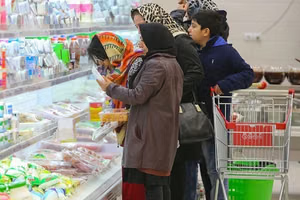
Shoppers walk through a market in Iran, where rising living costs and shrinking purchasing power reflect the economic toll of 47 years of Islamic Republic rule.
Nearly 47 years after Iran's 1979 revolution, a former football chief has asked what Iranians got for its promises, pointing to officials’ children living abroad, oil wealth that never reached wages and a state that answered protests with bullets.
“You haven’t done anything for 47 years. All you talk about is dignity, dignity, dignity. What dignity?” Mohammad Dadkan, former president of Iran’s Football Federation, said in an interview on the Persian-language podcast Tak be Tak.
The cost of confronting US
"What would we have to talk about if it weren't for 'Death to America'? What would we use to keep people occupied?" Dadkan asked.
The slogan has been at the heart of the Islamic Republic’s identity since 1979, when students loyal to Ayatollah Khomeini seized the US embassy and held its diplomats hostage.
Decades of confrontation, and the dispute over the nuclear program, brought broad US sanctions on oil, banking and trade.
They have deterred investment and raised the cost of imports, and the state’s own mismanagement has done the rest. Iranian households live with high inflation, falling purchasing power and few jobs.
Officials call resistance to Washington the measure of national independence. Iranians have paid for it in prices.
Shoppers crowd a bazaar in Iran, where decades of economic hardship, rising prices and declining purchasing power have taken a toll on everyday life.
Privilege at home, children abroad
"What have you done other than fill your own pockets, send your children abroad and take all the privileges for yourselves?" Dadkan said.
The children of senior officials living in the countries their parents denounce have long drawn anger.
Fatemeh Ardeshir Larijani, daughter of Ali Larijani, the former secretary of the Supreme National Security Council killed in an Israeli strike in March, worked as a cancer specialist at Emory University in the United States until January, when Emory said her employment had ended after protests by Iranian Americans. A government spokesman said she had already returned to Iran.
Issa Hashemi is the son of Masoumeh Ebtekar, a former vice president who was spokeswoman for the students who seized the US embassy in 1979.
He lived in Los Angeles with his wife and son until April, when US immigration authorities detained the family and Secretary of State Marco Rubio revoked their permanent residency over their connection to Ebtekar.
For most Iranians, a falling currency and closing visa doors have made studying or settling abroad ever harder.
Oil wealth and shrinking wages
"We have stone, gold, oil, the best resources and an excellent geographical position for attracting tourists. We haven't done anything," Dadkan said.
Iran has some of the world’s largest oil and gas reserves. Its people have not seen the benefit.
Annual inflation reached 76.8 percent in October, according to the Statistical Center of Iran, and prices were 88.7 percent higher than a year earlier.
The dollar traded at about 2.63 million rials in November, against about 1.6 million in early April: the rial lost nearly 40 percent of its value in seven months.
The base minimum wage for the Iranian year that began in March was set at about 166 million rials a month. At today’s rate that is about $63.
'National dignity’
Dadkan also turned the officials’ favorite word back on them, pointing to Iranian women driven into prostitution in neighboring countries.
The US State Department’s 2019 Trafficking in Persons Report cited growing numbers of young Iranian women in prostitution in Dubai, some controlled by networks that took their passports and threatened violence, and possible links between traffickers and members of the police, the Revolutionary Guards and the Basij militia.
Its 2022 report identified Iranian women as vulnerable to sex trafficking in Turkey, especially near the border.
Resilience, salaries and missiles
"They've come up with something new, and apparently they all say the same thing," Dadkan said, criticizing officials' repeated use of the term resilience.
The Persian term tabavari, meaning resilience or the ability to withstand hardship, has increasingly featured in speeches by Iranian officials urging the public to cope with economic and social pressures.
Shoppers browse fresh produce at a market in Iran.
The appeals have come as households struggle with persistent inflation, declining purchasing power, electricity outages and water shortages. Power cuts have disrupted businesses and industrial production, while water shortages have affected daily life in several provinces.
Dadkan's criticism focused on the expectation that citizens should repeatedly adjust to worsening conditions, with officials emphasizing their capacity to endure hardship rather than explaining how the underlying problems would be addressed.
Dadkan also challenged demands for higher parliamentary salaries.
"Why should your salary get increased? What have you done?" he asked.
He contrasted lawmakers' benefits with the struggles of retirees who have repeatedly demonstrated for pensions that keep pace with inflation.
Military priorities drew similar criticism.
"You come on television in the morning and say the missiles' range should be increased. Why is that your concern? Go take care of people's lives, their welfare and their security," Dadkan said.
Iranian officials have made expanding the country's missile capabilities a priority, even as power cuts disrupt homes and factories, water shortages worsen and basic infrastructure falls into disrepair.
The right to protest
"Now tell those who don't agree with your policies to come out. See if you can contain the crowds. Then you'll find out whether people want you," Dadkan said.
His challenge followed years of anti-government demonstrations, including protests in 2017–18 and 2019, the Woman, Life, Freedom uprising of 2022 and the nationwide protests of January 2026.
The January crackdown, particularly the killings on January 8 and 9, became central to questions about the system's treatment of dissent.
On January 25, Iran International's editorial board announced that more than 36,500 people had been killed during those two days, citing confidential security documents, field reports and testimony from medical workers, witnesses and victims' families.
One generation lived through revolution, war and one economic crisis after another. The next grew up with falling incomes and few prospects, and many left. Others buried relatives killed in the streets.
Forty-seven years is a chapter in a state’s history. For Iranians it is a lifetime of youth spent getting by, futures abandoned and families split by emigration or death. None of it can be given back.
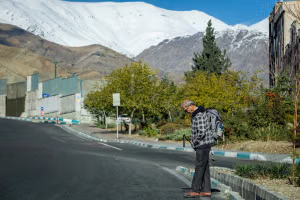
A man stands along a street in Tehran after rainfall, with clear skies and snow-covered mountains in the background, November 9, 2026
More than 70% of respondents to an Iran International survey on household finances said they had either reduced food purchases or postponed medical treatment to cope with rising prices, illustrating the difficult choices facing families struggling with Iran's economic crisis.
The survey, conducted between October 30 and November 3, 2026, collected responses from 404 people, alongside personal accounts of mounting debt, unpaid wages, depleted savings and the psychological toll of financial hardship.
Of the 374 respondents who answered a question about coping with rising prices, 230, or 61%, said they had reduced food purchases, particularly meat and dairy products. Another 177, or 47%, reported postponing medical treatment or medication.
A total of 142 respondents had done both, while 265, or 71%, had taken at least one of these measures over the previous year. Cutting spending on recreation, clothing and education was even more common.
The survey was voluntary and conducted among Iran International's audience, rather than a randomly selected sample of the population. Its findings therefore cannot be considered representative of Iranians as a whole.
‘Can’t afford potatoes’
One participant, who identified themselves as a Social Security pensioner, described receiving 32 million tomans a month, of which 25 million went on rent, five million on loan repayments, 1.2 million on building charges and 200,000 on electricity.
That left just 600,000 tomans for other monthly expenses.
“I don't have money for potatoes and onions,” the pensioner wrote.
The respondent also described having diabetes but being unable to afford medical appointments or medication.
Another participant described the cost of sending three children to school.
“My first-grader went to school with a schoolbag his brother used several years ago and the shoes he wore for Nowruz,” the parent wrote.
“I sewed his coat and trousers myself to save a little money so I could buy them school supplies … Thank God I have children who are content with little. They understand.”
In another message, a respondent described buying barbari bread for 25,000 tomans one day and 40,000 the next. The participant said a local baker had warned that flour was running out and production might stop if more supplies did not arrive.
Food prices have risen particularly sharply as the rial's collapse drives up costs across the economy.
Official figures showed food and beverage prices in September were more than 120% higher than a year earlier, compounding the impact of years of inflation, US sanctions and economic mismanagement.
‘Living in name only’
The survey also examined employment and the number of income earners in each household.
Of the 387 participants who reported their number of jobs, 177, or 46%, said they held one job. Another 95, or 25%, reported two jobs, while 23, or 6%, held three or more.
In total, 118 respondents, or 30.5%, held at least two jobs. Another 92, or 24%, said they had no income-generating employment.
A separate question found that 47% of respondents lived in households with only one income earner, while 6% said nobody in their household earned an income.
For some, even holding multiple jobs was not enough to cover basic expenses.
One participant, the sole income earner in their household, said they worked two jobs but had fallen behind on rent and three loan installments, had unpaid electricity and gas bills, and had not received their wages for a month.
“I borrowed about 60 million tomans from people, and I haven't been able to pay back even one million,” the respondent wrote. “Our life is only a life in name.”
Another participant, who reported holding three or more jobs, said their motorcycle had been taken and they could not afford to retrieve it. The respondent had also reduced food purchases and postponed medical treatment or medication.
A worker living with a spouse and three children described similar pressures despite holding two jobs.
“I can't manage even the simplest things,” the worker wrote, adding that low wages and unemployment had made “anger and arguments an inseparable part of life.”
The war has added to an already weak labour market, damaging factories and infrastructure, disrupting trade and forcing businesses to scale back or close.
US sanctions and restrictions on banking and imports have further constrained businesses, while years of underinvestment and mismanagement have left the economy poorly equipped to absorb the shocks.
‘Getting poorer before my eyes’
As rising prices eroded purchasing power, many respondents reported relying on resources accumulated in better times or taking on new financial obligations.
Of the 374 people who answered the question about coping with inflation, 171 reported spending savings and 86 said they had sold possessions.
After accounting for overlap between the two groups, 200 respondents, or 53.5%, had used at least one of these measures. Another 128 had borrowed money, while 97 had postponed rent or bill payments.
Nearly two-thirds of respondents to the question reported taking at least three different measures to cope with rising prices over the previous year. Almost 30% had taken five or more.
The questionnaire did not measure how much money respondents had borrowed, the value of possessions sold or the amount of savings spent. But drawing on savings and selling assets can provide only temporary relief, leaving households with fewer resources to withstand future financial shocks.
The rial has lost more than half its value against the dollar over the past year. The war and US blockade of Iranian ports have sharply curtailed oil exports and government revenues, intensifying pressures on an economy already weakened by sanctions and systemic corruption.
One respondent began a message with a direct appeal: “If you can, please help me a little.”
The participant said their workshop had closed, leaving them without income for six months. They had three children and reported that nobody in the household earned an income, describing the circumstances as “the hardest moments of my life.”
Another participant, who was employed and lived in a household with two income earners, said: “I can see myself getting poorer before my eyes.”
The psychological toll
The financial pressures described by participants were accompanied by widespread anxiety and pessimism about the future.
Of 398 people who answered a question about their household finances over the previous year, 375, or 94%, said their situation had worsened. Three-quarters described the deterioration as severe.
Expectations for the coming year were similarly bleak, with 91% anticipating further financial deterioration. Separately, 90% said inflation and economic uncertainty had significantly affected their psychological well-being, including their sleep and peace of mind.
The prolonged conflict with the United States and Israel has deepened uncertainty over jobs, prices and access to essential goods, while repeated disruptions to everyday life have compounded the strain of years of economic instability.
One participant described being unable to afford dental treatment despite holding two jobs and living in a household with two income earners.
Another message described medical treatment that had been interrupted for three years. The respondent said they suffered from depression, had been dismissed from a government job because of illness-related absences and were living with an ailing mother in a household without an income.
“I'm exhausted right now, and I'm writing this while crying,” the message said.
Another participant, the sole income earner in a household with a disabled daughter, said they worked two jobs but had still postponed medical treatment or medication and sold possessions.
Among the 142 respondents who had both reduced food purchases and postponed treatment or medication, 135 reported a significant or very significant psychological impact.
Three participants expressed thoughts of suicide or a wish to die in their written messages. The questionnaire was not designed to clinically assess depression or suicide risk, and the prevalence of such conditions cannot be determined from these accounts.
Little hope of improvement
The survey also examined the relationship between respondents' experiences over the previous year and their expectations for the future.
Of those who described the previous year as having been much worse, nearly 85% expected similarly severe deterioration in the coming year.
Respondents reporting greater financial hardship also tended to describe more severe psychological distress and to have adopted more measures to cope with rising prices.
These findings show an association between financial hardship, psychological pressure and pessimism about the future among respondents, but do not establish cause and effect.
Prospects for recovery remain clouded by the unresolved confrontation with Washington, continuing sanctions and the damage inflicted on Iran's productive capacity.
Even an end to the fighting would leave the country confronting longstanding structural problems, including corruption, weak investment and economic mismanagement.
One participant wrote: “I wish tomorrow wouldn't come,” explaining that they expected each new day to bring greater hardship.
The survey was conducted among Iran International's audience from October 30 to November 3, 2026, and received 404 voluntary responses. Not all participants answered every question, and percentages were calculated from valid responses. Personal accounts were drawn from written messages submitted by respondents and reviewed without identifying information.
The facade of a residential building in the Ekbatan complex in western Tehran, November 6, 2026
I was at a gathering of about a dozen friends in Tehran on Thursday night. It was hilariously tragic to watch a bunch of slightly tipsy people at each other's throats over an election in which none of us had a vote but whose outcome could profoundly affect our lives.
We spent much of the evening arguing about Democrats and Republicans, Donald Trump and Benjamin Netanyahu, and whether the election of Muslim politicians in America was something to celebrate or fear.
“Imagine being told ten years ago that a man with a name like Abdul El-Sayed would become a United States senator,” one friend said. “You’d ask them what drug they were on.”
“Oh, come on,” another protested. “You think America is turning into another Iran because they've elected a progressive senator or mayor who happens to be a Muslim?”
The greatest strength of American democracy, he argued, was that voters could throw out leaders who made a mess of things, or at least take away some of their power.
Quite a few shook their heads. “The trouble is,” one said, “once political Islam gets into power, you can't necessarily get rid of it with another election.”
It was an argument familiar to anyone who has spent time around politically engaged Iranians, but there was something almost comical about hearing it unfold in a Tehran living room.
We were worrying about whether American democracy could survive the election of a Muslim politician while living in a country where our own ability to choose those who govern us has been contested for decades.
The conversation grew louder when someone admitted she was disappointed by the Democratic gains. She had been hoping that Trump and Netanyahu might finally bring about the end of the Islamic Republic.
“The Democrats will make a deal with the mullahs, and we'll be stuck with this lot for another 50 years,” she said.
Her brother was having none of it: “You seriously think Trump and Netanyahu went to war because they care about you and me? All they ever wanted was to force the regime to give them what they came for. Then they’ll walk away. And it’ll be us and the mullahs all over again.”
I have heard versions of this disagreement many times. Some people still hope that outside pressure might accomplish what years of protest have failed to achieve. Others find that hope almost unbearable, particularly after seeing what war has done to the country and how little it has changed the lives of those who survived it.
What struck me, though, was how easily everyone moved between these positions, sometimes contradicting themselves, sometimes laughing at arguments they had made quite seriously only minutes earlier. Nobody seemed especially interested in convincing anyone else.
“I don't even know why you're burning calories over this,” said one of the two friends who had barely spoken until then. “We don't even know if we'll have enough money to pay next month's rent. To hell with the American elections.”
That took some of the energy out of the argument. We could disagree all night about American politics, but there was rather less to disagree about when it came to paying the rent.
And what was the point of discussing that anyway, one friend said bitterly, as though talking about our problems might somehow make them go away.
Perhaps that is what a year of protests, crackdowns, war and unrelenting financial anxiety have done to us. We do talk about politics all the time. But most of us have stopped expecting much from it.
There was a time when conversations like this came with confident predictions. The regime would fall, a deal would be reached, sanctions would be lifted, or another protest would finally change everything. But we’ve stopped making promises about the future, even to ourselves.
None of us in that room had an answer to the question of how we would afford another month, let alone what the American elections might mean for us. But at least we could argue about the latter without having to check our bank balances.
“Avoid the pain if you can” seems to be how we hang on these days. “Take it one breath at a time.”
Iran signaled a willingness to negotiate an end to its confrontation with the United States on Monday, but insisted Washington must first lift measures imposed since the Islamabad understanding, as disputes over nuclear activities and control of the Strait of Hormuz continued.
President Masoud Pezeshkian said former Supreme Leader Ali Khamenei had instructed officials to end the country's prolonged state of uncertainty between war and peace, opening the door to negotiations.
"The supreme leader ordered us to end the no-war, no-peace situation," Pezeshkian said. "We can hold talks with dignity and bring the matter to an end with dignity."
The president also called for changes in how Iran is governed, saying the country's resources should not leave its people struggling to meet basic needs.
"I cannot accept that anyone in the country goes to bed hungry," Pezeshkian said.
Iran sets conditions for two-day proposal
The president's remarks came as the foreign ministry outlined conditions for a proposed diplomatic arrangement that it said could restore regional security within two days.
Iran would fulfill its commitments under the proposal if Washington lifted sanctions, the naval blockade and other measures imposed since the Islamabad understanding, Foreign Ministry spokesperson Esmaeil Baghaei said.
The proposal was a shortened version of an earlier seven-day plan, Baghaei said, adding that Qatar and Pakistan remained in regular contact with both sides.
The demands drew a sharp contrast with Washington's position after US Secretary of State Marco Rubio described Iran's terms as unacceptable.
Baghaei rejected the criticism and accused Washington of imposing unreasonable conditions on negotiations.
"We have made it very clear that if the United States meets the Islamic Republic's demands, security will return to the region within two days," Baghaei said.
Nuclear disputes remain unresolved
Iran will not transfer its enriched uranium abroad, and inspections of nuclear facilities damaged by US attacks cannot proceed under existing conditions, Baghaei said separately in an interview with Lebanon's Al Mayadeen television.
The spokesman said International Atomic Energy Agency inspectors had visited the Bushehr nuclear power plant several days earlier and that Iran remained in contact with the UN nuclear watchdog.
However, he argued that the attacks had complicated Iran's ability to fulfill its safeguards obligations.
The remarks coincided with comments from Iranian lawmakers about the country's nuclear capabilities and future policy.
Esmail Kowsari said US strikes during the 12-day war had destroyed aboveground buildings near nuclear facilities at Fordow, Natanz and Isfahan but had not damaged centrifuges or uranium enriched to 60%.
Another lawmaker, Hamidreza Gudarzi, argued that Iran should acquire nuclear weapons to deter future threats, while acknowledging that decisions on changes to the country's nuclear doctrine rested with senior authorities.
Hormuz dispute and regional diplomacy
Beyond the nuclear issue, Iran and the United States continued to dispute the security situation in the Strait of Hormuz.
The Revolutionary Guards denied that US forces had cleared any naval mines from the strategic waterway.
"No war mines have been cleared from the Strait of Hormuz, and this claim is an outright lie," Revolutionary Guards spokesperson Hossein Mohebi said.
The disagreement came as regional governments sought to prevent further military escalation.
Turkish President Recep Tayyip Erdogan said he had told US President Donald Trump during a recent telephone conversation that Ankara opposed another round of attacks on Iran and favored a diplomatic solution.
The United Arab Emirates also warned that a comprehensive settlement between Washington and Tehran remained difficult.
The consequences of the war could persist for years, requiring stronger defense capabilities and sustained diplomatic engagement, UAE presidential adviser Anwar Gargash said.
China pursued its own diplomatic contacts, with special envoy Zhai Jun meeting Iranian security official Ali Bagheri Kani during a regional tour that also includes Oman and Saudi Arabia.
Beijing emphasized that the widening Middle East conflict could not be resolved through military force.
Monday's developments left Iran and the United States expressing sharply different conditions for ending their confrontation, with nuclear disputes, sanctions and maritime security remaining central obstacles to a negotiated settlement.
Iran is using oil terminals and storage facilities in China to keep sanctioned tankers operating despite US restrictions, according to a confidential document obtained by Iran International and information from Oil Ministry sources.
The document is a confidential letter from Hamid Bovard, the former head of the National Iranian Oil Company and current acting oil minister, responding to a highly confidential letter Ali Shamkhani, a former secretary of the Supreme National Security Council, sent to then-supreme leader Ali Khamenei.
Shamkhani, who served as Khamenei's political adviser, had described oil sales under President Masoud Pezeshkian as disastrous. Both Shamkhani and Khamenei were killed in US-Israeli strikes on February 28, 2026.
In his letter, Bovard criticized the administration of former President Ebrahim Raisi for its policy of using newer vessels and described an arrangement developed under Pezeshkian with what he characterized as covert cooperation from China.
According to Bovard, Iranian authorities instructed trusted oil intermediaries to continue using sanctioned vessels capable of docking at designated ports.
Bovard said Iran's Foreign Ministry negotiated with China to acquire port facilities and oil terminals, establishing a hub for sanctioned Iranian crude.
Tehran also secured long-term leases on large oil storage facilities in several Chinese locations, allowing it to sell Iranian crude directly in the Chinese market.
Under the arrangement, vessels belonging to Hossein Shamkhani, Ali Shamkhani's son and the owner of a fleet of tankers commonly described as a shadow fleet, transport Iranian oil to docks in China controlled by Tehran. The facilities allow the vessels to continue delivering oil despite US sanctions.
The arrangement is designed to reduce the impact of US sanctions on Hossein Shamkhani's shipping operations. The US Treasury has sanctioned 51 vessels linked to him.
For years, Iran has worked with China to sell oil through trusted intermediaries to small independent Chinese refineries, known as "teapot" refineries. The United States has repeatedly sanctioned companies involved in these transactions, but the use of intermediaries helps shield China's major banks and three largest oil companies from US sanctions.
Iran's oil terminals and storage facilities in China
Two sources in Iran's Oil Ministry told Iran International that Tehran has acquired control of port facilities at three locations in China. One is in the Ningbo-Zhoushan free trade zone, where Iran gained control of a terminal by helping build several smaller transit facilities.
Tehran also secretly acquired stakes in smaller docks at the ports of Qingdao and Pant in China's Shandong province, according to the sources.
The docks are located near pipelines, allowing Iranian crude to reach Chinese refineries quickly without being transferred to other vessels.
Iran has also purchased seven oil storage tanks in China, allowing it to ship crude to the country before securing buyers.
Four large Iranian-owned oil storage tanks are located at the ports of Dalian and Huizhou and in the coastal cities of Dongying and Weifang.
The Oil Ministry controls three other large storage tanks in the Zhoushan area of the Ningbo-Zhoushan archipelago, according to Iran International's sources. They are the Kamergi tank on Aoshan Island, a tank at the Shulanghu Island terminals and another in the Zengyamuo oil zone.
Two months ago, Iran International published a document showing that Mohammad Javad Bavand, a special assistant to the oil minister, instructed oil intermediary Mohammad Hadi Momenin, who owed $2 billion, to use a vessel belonging to Hossein Shamkhani to deliver oil for storage at one of the Chinese ports.
China also earns revenue from storing Iranian oil. Nearly two years ago, Reuters reported that 25 million barrels of Iranian crude were stranded in storage facilities in China and that Tehran had paid $450 million in storage fees.
China distances itself from Iranian oil
Despite these arrangements, the confidential correspondence suggests that Tehran was facing growing pressure from its main oil buyer.
Bovard's confidential letter to Khamenei's office indicates that China had begun distancing itself from Iranian oil even before the 40-day war. According to the letter, Beijing rejected Tehran's request to increase crude oil import quotas for Chinese refineries, increased imports from Venezuela and demanded deeper discounts on Iranian oil.
Two months ago, US Treasury Secretary Scott Bessent said at the launch of an initiative to economically isolate Iran that China and the United States had more in common than differences. He said China obtained 50 percent of its energy needs from the Persian Gulf and supported the free flow of maritime trade through the Strait of Hormuz.
Hossein Shamkhani's grip on Iranian oil trading in Dubai
Throughout the confidential letter, Bovard criticizes Ali Shamkhani, suggesting that his primary concern was protecting his son's interests in the oil trade rather than Iran's oil sales.
Bovard alleged that Hossein Shamkhani used Iranian government loans to purchase vessels but deployed them to transport Russian oil rather than Iranian crude.
According to Bovard, Hossein Shamkhani received Iranian oil on consignment without providing collateral and sold it on the market. Bovard portrayed the United Arab Emirates as Shamkhani's exclusive trading domain, saying the Oil Ministry had effectively become his agent rather than the other way around.
Former lawmaker Ahmad Amirabadi Farahani recently said the then-head of NICO, the National Iranian Oil Company's international trading arm, had barred Hossein Shamkhani and three other oil intermediaries from selling Iranian crude because they owed several billion dollars.
According to Bovard's confidential letter, Ali Shamkhani told Khamenei that Iranian oil had been sold at a discount of 50 cents per barrel under former President Ebrahim Raisi, compared with $9 per barrel under Pezeshkian. The Oil Ministry disputed Shamkhani's figures.
In September, Iran International reported that Mohammad Javad Bavand, a special assistant to the oil minister, had assigned four oil intermediaries, including Hossein Shamkhani, to sell 86 million barrels of Iranian crude at an 8.5 percent discount. The arrangement followed the transfer of oil sales from a network linked to the Intelligence Ministry to one linked to the intelligence arm of the Islamic Revolutionary Guard Corps.
Oil intermediaries discussed possible collapse of Islamic Republic
Former lawmaker Ahmad Amirabadi Farahani said during a debate that four oil intermediaries met at Charlie restaurant in Dubai hours after Ali Khamenei was killed in US-Israeli strikes. He said they declared that the Islamic Republic was collapsing and that they no longer needed to return proceeds from Iranian oil sales.
The Islamic Republic remained in power, but Oil Minister Mohsen Paknejad was later dismissed following Shamkhani's letter to Khamenei.
Two weeks ago, Hossein Ghorbanzadeh, a board member of Persian Gulf Petrochemical Company and an associate of parliament speaker Mohammad Bagher Ghalibaf, told the Fars news agency that Paknejad's dismissal, carried out three weeks earlier, had originally been planned for Esfand, the Iranian calendar month spanning February and March.
Ghorbanzadeh said President Masoud Pezeshkian had told a cabinet meeting that Khamenei asked him to dismiss Paknejad over his handling of the crisis involving oil intermediaries. Khamenei's death and the outbreak of the 40-day war delayed the dismissal, he said.