Iran's Revolutionary Guards unveil new underground missile site

Iran's Revolutionary Guards unveiled what they described as a new underground missile facility on Tuesday, releasing footage of senior military commanders touring the complex.
Iran's Revolutionary Guards unveiled what they described as a new underground missile facility on Tuesday, releasing footage of senior military commanders touring the complex.
Iranian state media showed Ali Abdollahi, chief of staff of Iran's armed forces, and Majid Mousavi, commander of the Revolutionary Guards Aerospace Force, touring sections of the underground complex.
Authorities did not disclose the facility's location or specify when the visit took place.
During the visit, Abdollahi warned that Iran could expand its retaliation beyond the Middle East if it came under renewed attack.
"If the enemy makes another move against us, our response will extend beyond the region," he said.
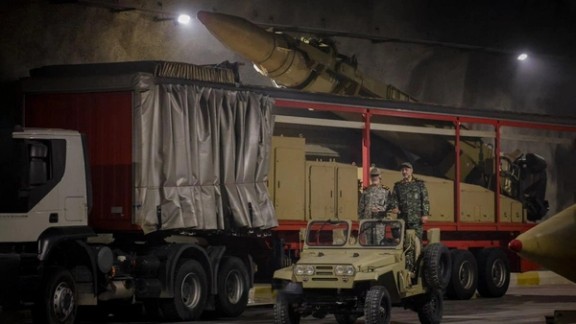
IRGC spokesperson Hossein Mohebbi had announced on Saturday that the Guards would unveil a new underground missile facility.
Mohebbi said the Guards had moved some missile production underground to protect it from airstrikes and maintain operations during wartime. He also warned that Iran could deploy previously undisclosed weapons if fighting with the United States and Israel intensified.
The announcement comes as Washington weighs further military action against Iran following US strikes on Qeshm Island earlier this month.
Iran's underground missile network
Iran has spent years developing underground missile storage and launch facilities, which it calls "missile cities," as part of efforts to protect its weapons from airstrikes.
The facilities have been targets of Israeli military operations. During last year’s war, Israel struck Iranian missile launchers, storage sites and associated infrastructure in an effort to weaken Tehran's ability to launch retaliatory attacks.
Satellite imagery reviewed by Reuters in February showed Iran repairing missile bases damaged during that conflict, alongside work to reinforce or conceal sensitive military and nuclear facilities.











The US military moved tankers and tiltrotor aircraft out of RAF Mildenhall in eastern England on Monday over a threat from Iran, the Wall Street Journal reported, the second British base it has thinned out since a suspected Iran-linked plot at RAF Fairford in September.
Flight-tracking data showed nine KC-135 refueling tankers and three V-22 Ospreys leaving Mildenhall in Suffolk on Monday afternoon and evening, Sky News reported. Most of the tankers went to bases in Germany and Spain and one to Prestwick in Scotland. The Ospreys moved to nearby RAF Lakenheath.
The exact nature of the threat was still under discussion among US officials, the Journal said. Washington raised the security level at Mildenhall and Lakenheath to FPCON Charlie, the second-highest on the Pentagon’s scale, which applies when intelligence indicates that some form of terrorist action is likely.
US European Command said aircraft move between locations “for a variety of reasons” and that it could not discuss force protection measures.
Britain’s Ministry of Defense said it did not comment on other nations’ activity. “We’re constantly keeping the security of our bases under review,” cabinet minister Lucy Powell told Sky News, “and as we’ve seen with other cases recently, we take firm and quick action where we need to.”
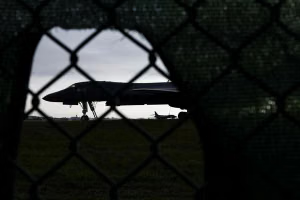
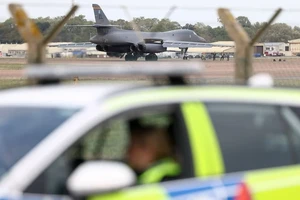
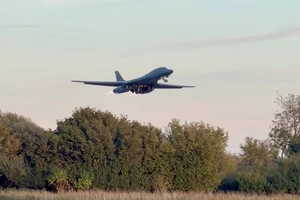
The move comes six weeks after police arrested five men in the early hours of September 27 near RAF Fairford in Gloucestershire, which US bombers used to strike Iran during the war, after a local farmer reported three white vans and a group of men, some with their faces covered. The United States pulled all 12 of its B-1B bombers from Fairford on October 4.
Two men were charged last month under the National Security Act. Prosecutors said one, a British-Iranian dual national, had arranged for the men to drive to the base on the instructions of a man known only as “Ali,” and accused him of assisting a foreign intelligence service; police said they believed that country to be Iran. Six others remain on bail. Prime Minister Andy Burnham said the plot was “almost certainly” directed by the Revolutionary Guards.
Iran’s ambassador in London has denied any involvement. The Revolutionary Guards warned Britain in July that Fairford and any other base used to attack Iran would be a legitimate target.
Iran has selected Abdolreza Masgarian, another IRGC Quds Force commander, as its next ambassador to Iraq, according to Iraqi and Iranian reporting, extending a pattern of military figures holding a diplomatic post central to Tehran’s regional influence.
The brigadier general’s reported appointment comes weeks after former foreign minister Mohammad Javad Zarif’s criticism of that approach resurfaced, questioning why Iran sends representatives of the Guards’ overseas operations arm to neighboring countries rather than diplomats and businesspeople.
US government-funded broadcaster Al-Hurra first reported the nomination on Monday, citing an Iraqi Foreign Ministry source who said Baghdad had received Masgarian’s name as the proposed replacement for Mohammad Kazem Al-e Sadegh.
Akram Ehghaghi, chief foreign policy correspondent for Iran’s semi-official ISNA news agency, subsequently described Masgarian as the newly selected ambassador in a profile posted on X, saying he would succeed Al-e Sadegh after his four-year tenure.
Iraqi outlet Shafaq News separately cited an informed source as saying Masgarian would take up the post at the beginning of 2027 under his full name, Abdolreza Nobakht.
Iran has not yet officially confirmed the appointment. Al-Hurra said neither country’s foreign ministry had announced the nomination.
Masgarian’s reported responsibilities already place him at the intersection of Iran’s military, political and diplomatic dealings with Iraq.
According to Al-Hurra, he oversees joint security coordination between Tehran, Baghdad and Erbil, having previously handled security coordination between Iran and Iraq’s Kurdistan Region.
The US advocacy group United Against Nuclear Iran has identified him as commander of the IRGC’s Ramadan Headquarters, with responsibilities that include coordinating with Iraqi Shiite armed factions.
Ehghaghi’s account emphasized his longstanding involvement in Iraqi affairs and his relationships across the country’s political spectrum.
She described him as a Kurd from the western Iranian city of Kermanshah with close ties to Kurdish officials, saying his detailed knowledge of Iraq was among the reasons for his selection.
Diplomatic outreach already underway
Those contacts were on display on Sunday, when, according to Ehghaghi, Masgarian visited Erbil and met Kurdistan Region President Nechirvan Barzani.
Barzani’s office confirmed a meeting with an Iranian delegation on November 8, although its published readout did not name Masgarian. It said discussions covered relations with Iran, security cooperation and security agreements involving Baghdad and the Kurdistan Region. Both sides emphasized diplomacy and peaceful approaches to resolving disputes.
The reported selection would continue Tehran’s practice of assigning commanders with experience in Iraq to its embassy in Baghdad, where relations with the central government overlap with ties to Kurdish leaders and Iran-backed armed groups.
One prominent predecessor, Iraj Masjedi, was a senior Quds Force officer and close adviser to its former commander, Qassem Soleimani.
The US Treasury sanctioned Masjedi while he was ambassador in October 2020, accusing him of overseeing support for Iraqi militias and using his diplomatic position to facilitate financial transfers for the Quds Force. Those allegations illustrated Washington’s concern that the embassy served military networks alongside its diplomatic functions.
Zarif’s criticism addressed the thinking behind such appointments.
In footage from a 2025 speech that circulated again last month, he argued that treating neighboring countries primarily as security threats shaped both Iran’s choice of ambassadors and the relationships it pursued.
“Why are our ambassadors in Afghanistan, Syria and Iraq representatives of the Quds Force?” he asked. “Because we see them as threats.”
He argued that an approach centered on opportunities would instead favor businesspeople and diplomats, allowing economic cooperation to play a larger role in Iran’s regional policy.
The remarks drew an angry response from the hardline Kayhan newspaper, which accused him of undermining Iran’s security institutions and helping Washington. Zarif, who served as foreign minister from 2013 to 2021, has defended Iran’s regional military capabilities while advocating greater reliance on diplomacy and economic ties.
The reported change in Baghdad also comes amid friction over US efforts to restrict Iran’s access to trade routes through Iraq.
Al-Hurra linked the nomination to tensions following Iraq’s October 21 closure of the al-Sheeb border crossing in Maysan province. It previously cited Iraqi government sources alleging that Al-e Sadegh was encouraging tribal leaders to pressure Baghdad to reopen it.
Ehghaghi, however, presented the succession as the end of the incumbent’s term. Neither account establishes that the border dispute prompted his replacement.
Iran signaled a willingness to negotiate an end to its confrontation with the United States on Monday, but insisted Washington must first lift measures imposed since the Islamabad understanding, as disputes over nuclear activities and control of the Strait of Hormuz continued.
President Masoud Pezeshkian said former Supreme Leader Ali Khamenei had instructed officials to end the country's prolonged state of uncertainty between war and peace, opening the door to negotiations.
"The supreme leader ordered us to end the no-war, no-peace situation," Pezeshkian said. "We can hold talks with dignity and bring the matter to an end with dignity."
The president also called for changes in how Iran is governed, saying the country's resources should not leave its people struggling to meet basic needs.
"I cannot accept that anyone in the country goes to bed hungry," Pezeshkian said.
Iran sets conditions for two-day proposal
The president's remarks came as the foreign ministry outlined conditions for a proposed diplomatic arrangement that it said could restore regional security within two days.
Iran would fulfill its commitments under the proposal if Washington lifted sanctions, the naval blockade and other measures imposed since the Islamabad understanding, Foreign Ministry spokesperson Esmaeil Baghaei said.
The proposal was a shortened version of an earlier seven-day plan, Baghaei said, adding that Qatar and Pakistan remained in regular contact with both sides.
The demands drew a sharp contrast with Washington's position after US Secretary of State Marco Rubio described Iran's terms as unacceptable.
Baghaei rejected the criticism and accused Washington of imposing unreasonable conditions on negotiations.
"We have made it very clear that if the United States meets the Islamic Republic's demands, security will return to the region within two days," Baghaei said.
Nuclear disputes remain unresolved
Iran will not transfer its enriched uranium abroad, and inspections of nuclear facilities damaged by US attacks cannot proceed under existing conditions, Baghaei said separately in an interview with Lebanon's Al Mayadeen television.
The spokesman said International Atomic Energy Agency inspectors had visited the Bushehr nuclear power plant several days earlier and that Iran remained in contact with the UN nuclear watchdog.
However, he argued that the attacks had complicated Iran's ability to fulfill its safeguards obligations.
The remarks coincided with comments from Iranian lawmakers about the country's nuclear capabilities and future policy.
Esmail Kowsari said US strikes during the 12-day war had destroyed aboveground buildings near nuclear facilities at Fordow, Natanz and Isfahan but had not damaged centrifuges or uranium enriched to 60%.
Another lawmaker, Hamidreza Gudarzi, argued that Iran should acquire nuclear weapons to deter future threats, while acknowledging that decisions on changes to the country's nuclear doctrine rested with senior authorities.
Hormuz dispute and regional diplomacy
Beyond the nuclear issue, Iran and the United States continued to dispute the security situation in the Strait of Hormuz.
The Revolutionary Guards denied that US forces had cleared any naval mines from the strategic waterway.
"No war mines have been cleared from the Strait of Hormuz, and this claim is an outright lie," Revolutionary Guards spokesperson Hossein Mohebi said.
The disagreement came as regional governments sought to prevent further military escalation.
Turkish President Recep Tayyip Erdogan said he had told US President Donald Trump during a recent telephone conversation that Ankara opposed another round of attacks on Iran and favored a diplomatic solution.
The United Arab Emirates also warned that a comprehensive settlement between Washington and Tehran remained difficult.
The consequences of the war could persist for years, requiring stronger defense capabilities and sustained diplomatic engagement, UAE presidential adviser Anwar Gargash said.
China pursued its own diplomatic contacts, with special envoy Zhai Jun meeting Iranian security official Ali Bagheri Kani during a regional tour that also includes Oman and Saudi Arabia.
Beijing emphasized that the widening Middle East conflict could not be resolved through military force.
Monday's developments left Iran and the United States expressing sharply different conditions for ending their confrontation, with nuclear disputes, sanctions and maritime security remaining central obstacles to a negotiated settlement.
Task Force Iron Gate, a new US team targeting weapons shipments and other illicit flows across Iran’s land borders and the Caspian Sea, may not fully close Iran’s northern supply routes but could make the arms and equipment Tehran needs harder to obtain.
Success will depend less on Washington’s ability to track shipments than on persuading governments, banks and suppliers to stop them.
According to CENTCOM’s November 7 announcement, Iron Gate consists of roughly 20 civilian and military personnel based in Tampa, coordinating with other US agencies.
It follows a naval blockade that CENTCOM estimates has prevented more than $25 billion in crude exports, giving Tehran greater incentive to develop alternative supply routes.
The task force adds coordination capacity, but its announcement offers no indication of new authority to board vessels in the Caspian or access neighboring countries’ ports.
Washington’s leverage lies upstream
A June CSIS assessment argues that Iran needs imported machine tools, electronics and engines to rebuild its military industries. It identifies the Caspian and Pakistan as possible alternatives to disrupted procurement through the United Arab Emirates.
Washington’s strongest leverage may lie with suppliers before those goods reach the region. A distributor with customers in Europe or access to American finance has more to lose than an Iranian shipping company already under sanctions.
Finding that distributor and giving its government evidence of a prohibited sale may achieve more than tracking the vessel carrying the goods.
In September 2024, the State Department designated Russian shipping companies and identified vessels it said transported Iranian military equipment across the Caspian to Russia.
Those measures targeted supplies leaving Iran rather than entering it, but provide an enforcement precedent. They can expose suppliers and discourage businesses from handling their cargo, while offering less leverage over operators whose owners and host governments accept the consequences.
Iron Gate’s better opportunity lies in equipment Iran struggles to replace. A factory awaiting an essential component may remain idle even while food imports grow.
The distinction matters: restricting military procurement does not require closing ordinary commerce, and rising trade volumes would not necessarily mean the task force had failed.
Russia’s role limits US options
Russia poses the hardest problem. Its military relationship with Iran gives Moscow reasons to keep transport connections open, limiting Washington’s prospects of securing cooperation along a major northern route.
In an October analysis for the Yorktown Institute, Nikita Smagin describes expanding Caspian commerce alongside shipping shortages, port limitations and rising freight costs.
The corridor offers Tehran relief but lacks the capacity to replace its southern gateways. That does not mean it cannot carry smaller volumes of militarily important equipment and components.
These constraints could make individual shipments more vulnerable to disruption. They also complicate any assessment of enforcement: congestion, shallow water and seasonal conditions can slow deliveries without American intervention.
Pressure could leave Tehran more reliant on Moscow if other suppliers withdraw while Russian routes stay open.
Iran would then have less room to bargain, while the military partnership Washington hopes to weaken could survive. Economic dependence and military supply would not necessarily move in the direction Washington intends.
Neighbors need different bargains
Kazakhstan illustrates the tension between financial pressure and regional transport ambitions. In May, Deputy Prime Minister Serik Jumangarin said payment risks had stalled contracts with Iran.
A month later, Kazakhstan signed an agreement for a logistics terminal at Iran’s Shahid Rajaee port.
Although the port is on Iran’s southern coast, the project demonstrates Astana’s wider interest in maintaining transport links through Iran. Financial pressure can discourage traders even while their government pursues closer connections.
Washington may therefore have more influence over specific prohibited transactions than over Kazakhstan’s broader commitment to those links.
Azerbaijan suspended cargo crossings on March 5, 2026, after accusing Iran of a drone attack on its territory, then reopened them on March 9.
That episode was a security dispute rather than a sanctions-enforcement test, so it does not establish how Baku would respond to US requests.
The brief closure nevertheless cautions against assuming Azerbaijan would sustain a broad interruption of trade. Requests to inspect specific suspect shipments may have better prospects than demands to shut a major route indefinitely.
Turkmenistan also sees value in keeping Iranian routes open. Its foreign ministry reported talks in September 2025 on increasing transit cargo and developing the China–Kazakhstan–Turkmenistan–Iran railway.
These projects are not evidence of wrongdoing, but they help explain why Ashgabat might resist sweeping restrictions.
Requests to stop weapons shipments backed by clear evidence may find a more receptive audience, although the task force announcement offers no indication that Turkmenistan has agreed to cooperate.
The test is military production
Iranian buyers can change intermediaries more easily than they can replace scarce equipment or technical expertise. Enforcement needs to follow those dependencies rather than simply add names to sanctions lists.
Useful measures of success would include documented procurement failures, interrupted payments, longer waits for critical components and confirmed interceptions of prohibited shipments.
The ultimate test is whether those obstacles constrain the restoration of Iranian military production.
Iron Gate’s best chance lies in restricting difficult-to-replace military inputs while securing cooperation neighboring governments can sustain.
Otherwise, Washington risks making trade more cumbersome—and Iran more dependent on Russia—while leaving its essential military supply relationships intact.
Iran's Revolutionary Guards warned ships against cooperating with US forces after reporting three tankers on fire in the Strait of Hormuz, while Houthis targeted Saudi Arabia and Israel warned of unfinished operations against Iran on Sunday.
The Revolutionary Guards said three oil tankers caught fire after taking what they described as an unauthorized route through the Strait of Hormuz.
The Guards linked the fires to vessels disabling their navigation and identification systems and cooperating with US forces, warning that ships defying transit rules and accompanying the US military would face similar consequences.
The UK Maritime Trade Operations center separately reported that a tanker was struck by an unknown projectile while sailing outbound through the strait on Saturday. All crew members were safe, and no environmental damage was reported.
UKMTO also received a report of another tanker catching fire near Oman's Musandam Peninsula, prompting the evacuation of its crew. Authorities were investigating both reports.
Houthi attacks on Saudi Arabia
Saudi-led coalition forces intercepted two ballistic missiles launched toward Riyadh by Yemen's Houthis, followed by two cruise missiles targeting Riyadh and southern Saudi Arabia, according to coalition statements.
The coalition also reported intercepting a Houthi drone aimed at the kingdom's southern region.
Saudi Arabia's Energy Ministry said falling debris damaged an Aramco administrative building in Riyadh without causing casualties. Reuters reported that windows were blown out across several floors of the building.
A separate tower in Riyadh's King Abdullah Financial District was also damaged by a projectile, Reuters reported, citing witnesses and people briefed on the matter.
The Houthis later announced that they had targeted King Khalid International Airport, Saudi Aramco oil storage tanks and a financial center in the Saudi capital.
Israel warns Iran over nuclear activities
Israel's Defense Minister Israel Katz said the country's mission against Iran's nuclear threat was not yet complete, maintaining that Tehran was renewing efforts to acquire nuclear weapons.
"Regarding Iran, the mission is not yet complete," Katz said at a memorial ceremony for soldiers killed in Operation Kadesh.
Katz also warned Hezbollah against joining a possible Iranian attack on Israel, saying the group would face a severe military response and lose additional territory.
Iranian military officials issued warnings of their own.
An adviser to the Revolutionary Guards' aerospace force said Iran had sufficient weapons reserves to defend itself for years and was continuing to reverse-engineer foreign military equipment.
Ali Balali warned that any move by Iran's adversaries would trigger a "devastating response," adding that the country's armed forces had "their fingers on the trigger."
Separately, Revolutionary Guards spokesman Hossein Mohebi dismissed a new US initiative to restrict overland routes used to transfer weapons and sanctioned goods.
Mohebi said Task Force Iron Gate, established by US Central Command, would fail to isolate Iran from its neighbors.