Argentina designates Iran’s Revolutionary Guards as a terrorist organization
Argentina has designated Iran’s Islamic Revolutionary Guard Corps a terrorist organization, broadening a years-long effort by Buenos Aires to hold Tehran and its proxies responsible for the deadliest attacks in the country’s history.
In a statement issued on Tuesday, President Javier Milei’s office said Argentina had added the IRGC to its public registry of individuals and entities linked to terrorism and its financing, a move that allows financial sanctions and operational restrictions.
“The National Government has declared the Islamic Revolutionary Guard Corps (IRGC) a terrorist organization,” the statement said.
Argentina tied the decision directly to the 1992 bombing of the Israeli Embassy in Buenos Aires, which killed 29 people and wounded more than 200, and the 1994 bombing of the AMIA Jewish community center, which killed 85 people and wounded more than 300.
“The Republic of Argentina was the victim of two of the most serious terrorist attacks in history, perpetrated in the 1990s by the operational arm of the IRGC in the region, the Hezbollah organization,” the statement said.
It added that judicial investigations and intelligence work had found that both attacks were “planned, financed and executed with the direct participation of senior officials of the Iranian regime and operatives of the Revolutionary Guard.”
The announcement also renewed attention on Ahmad Vahidi, the IRGC chief commander and former Iranian defense minister, who has long been sought by Argentine authorities over the AMIA case.
Argentina said Interpol red notices had been issued for several Iranian citizens, “among them former Defense Minister Ahmad Vahidi, who was recently appointed to lead the IRGC.”
The move goes beyond Argentina’s earlier designation of the Quds Force, the IRGC’s extraterritorial arm responsible for operations abroad.
A State Department cable earlier this month showed Secretary of State Marco Rubio had instructed US diplomats to press foreign governments to designate both groups as terrorist organizations.
Milei’s office cast the decision not only as a security measure, but as a moral and political one.
“The President Javier Milei hopes that this decision will settle a historic debt of more than 30 years with the families of the victims,” the statement said.
It added that his government remained committed to “recognizing terrorists for what they are.”
Milei’s statement ended in broader ideological terms, saying the government was determined to align Argentina with “Western civilization” while confronting those “who want to destroy it.”
The death of 11-year-old Alireza Jafari, the first known child recruit killed during the Iran war, underscores what rights advocates describe as a governing doctrine that places regime survival above civilian protection amid mounting wartime pressure.
Jafari, a fifth-grade student, was killed at a military checkpoint in Tehran during US and Israeli airstrikes targeting military sites, according to Hengaw, a Norway-based Kurdish human rights organization that monitors abuses in Iran.
In an interview with the state-affiliated Hamshahri newspaper, the boy’s mother said that because of a “shortage of personnel,” his father had taken him to the checkpoint. He was later killed in a drone strike while stationed there.
The Basij Organization confirmed that the 11-year-old died “while on duty” at a checkpoint on Artesh Highway as a result of the strike.
Why he was sent remains difficult to verify. In Iran’s tightly controlled information environment, families often speak under pressure, with state scrutiny and the threat of reprisals limiting candor.
The case comes as officials with the Islamic Revolutionary Guard Corps have openly acknowledged lowering the minimum age for war-related support roles to 12.
Rahim Nadali, a cultural official with the Guards in Tehran, said in remarks aired on state media that an initiative called For Iran was recruiting participants for patrols, checkpoints and logistics.
“Given that the age of those coming forward has dropped and they are asking to take part, we lowered the minimum age to 12,” he said, adding that 12- and 13-year-olds could now take part if they wished.
The state-backed recruitment drive makes Jafari’s death more than an isolated case. Together with precedent from the Iran-Iraq war, it suggests children even younger than the officially stated minimum may also be drawn into the war effort.
For rights advocates, the case reveals both a propaganda strategy and a manpower crisis inside a weakened state.
“They want to recruit these young people, use them as a kind of human shield. Because if they attack these kids, they start saying, ‘Oh look, they attack kids,’ and that’s what they’re doing,” said Shiva Mahbobi, a former political prisoner and London-based human rights advocate.
The child was placed at a military checkpoint even as the regime knew such sites were active targets of Israeli strikes, underscoring the degree to which minors were knowingly exposed to lethal risk.
A recruitment poster for Iran's Basij militia. It says people should inquire at their local mosque for further details.
Analysts say the reliance on minors also points to deeper strain within the regime’s security structure. After months of domestic unrest, wartime losses and reported cracks within some IRGC ranks, including defections, the state appears increasingly short on trusted personnel for checkpoint and support roles.
“They have actually called upon younger people to come and tried to recruit them. It shows they are preparing for a battle where they know they will need many more forces,” Mahmood Amiry-Moghaddam of the Norway-based Iran Human Rights organization told Iran International.
“It also shows they are not in a good condition. They are struggling for their survival.”
“They have only one principle, which is holy to them, and that’s to preserve the establishment," he added.
Through his human rights organization, Amiry-Moghaddam has documented cases from the January crackdown in which the regime placed weapons in the hands of minors and sent them to fire on protesters, exploiting the hesitation many civilians feel when confronted by a child.
A holy pledge: preserve the regime
The use of children in conflict, rights groups say, is not new. It reflects a longer doctrine in which vulnerable lives are used to offset military weakness and preserve the state.
“The Islamic Republic used a large number of child soldiers during the war with Iraq. They also sent Afghan children to fight in Syria,” said Shahin Milani, executive director of the Iran Human Rights Documentation Center.
“Given the pressure they are under, it is not surprising that they have resorted to using minors to man checkpoints. Perhaps they want to keep their trained fighters for more critical roles. Since it came to power in 1979, the Islamic Republic has relied on sacrificing its soldiers to compensate for technological inferiority.”
That logic, rights defenders argue, crosses from military expediency into deliberate political calculation.
“The deployment of children in checkpoint and wartime support roles is not only a grave rights violation but in the case of children under 15 may meet the threshold of a war crime under international law,” said Roya Boroumand, co-founder and executive director of the Abdorrahman Boroumand Center.
The move comes despite Iran’s obligations under the Convention on the Rights of the Child, which prohibits the use of children in military activities. Iran signed the treaty on September 5, 1991 and ratified it on July 13, 1994.
For Boroumand, the use of minors reflects a governing doctrine in which human life is subordinated to state survival.
“They are disposable and instruments for a higher purpose. In this case, the loss of children’s lives increases the political cost of war for their enemies. So rather than protecting and evacuating them to safe shelters, they deliberately expose them to danger,” she said.
So far, UNICEF has not publicly condemned the Islamic Republic’s stated policy of recruiting children into war-related support roles. Iran International has reached out to UNICEF’s communications team for comment.
A leaked internal directive from the IRGC’s missile command appears to show that the use of civilian locations to conceal, support and in some cases facilitate missile launch operations is not ad hoc, but structured, documented and built into operational planning.
The 33-page document shared with Iran International by the hacktivist group Edalat-e Ali (Ali’s Justice) has been marked “very confidential” and is titled Instruction for Identification, Maintenance, and Use of Positions.
The document is attributed to the Specialized Documents Center of the Intelligence and Operations Deputy of the IRGC's missile command.
A framework for missile operations
What emerges from the directive is a bureaucratic framework for missile deployment that goes well beyond hardened silos or underground “missile cities.”
The text lays out categories of launch positions, inspection procedures, coding systems, site records, chains of responsibility and rules for maintaining access to a wide network of locations that can be used before, during and after missile fire.
Its significance lies not only in the variety of launch positions it defines, but in the explicit inclusion of non-military environments in that system.
In its introduction, the document says missile positions are an inseparable part of missile warfare tactics and argues that the enemy’s growing ability to detect, track and destroy missile systems requires special rules for identifying, selecting, using and maintaining such positions.
It adds that the use of “deception,” “cover” and “normalization” alongside other methods would make the force more successful in using those positions.
That language is important. It suggests the document is not merely about protecting fixed military assets. It is about making missile units harder to distinguish from their surroundings and harder to detect in the first place.
The implication of the directive is that it describes a system for embedding missile activity within ordinary civilian geography.
Rather than relying only on conventional military facilities, the document sets out a model in which missile units can move across a wider landscape of pre-identified sites selected for concealment, access and operational utility.
The result is a structure that appears designed to preserve launch capability while reducing visibility and complicating detection.
The clearest indication comes in the section on what the document describes as artificial dispersion or cover positions. These include service, industrial and sports centers, as well as sheds and warehouses – places that are civilian in function or appearance, but can be repurposed to hide missile units.
The conditions listed for such sites include being enclosed, not overlooked by surrounding buildings, and either lacking CCTV cameras or allowing them to be switched off.
Taken together, those requirements point to a deliberate screening process for civilian sites that can be used as missile cover. The concern is not only protection from attack, but invisibility within the civilian landscape.
The broader structure of the document reinforces that conclusion. It contains sections on site identities, naming and coding, inspections of routes and positions, record maintenance and responsibilities across intelligence, operations, engineering, communications, safety, health and counterintelligence.
This is the language of a standing system, not an improvised wartime workaround.
An Iranian couple walks near Iranian missiles in a park in Tehran, March 26, 2026.
A system for concealment
Farzin Nadimi, a senior defense and security analyst at the Washington Institute who reviewed the document for Iran International’s The Lead with Niusha Saremi, said the text points to a database-driven effort to identify areas around missile bases that can be used for different kinds of positions.
He said the IRGC missile force appears to have mapped not only launch positions, but also dispersal, deception and technical positions – the latter being places suitable for storing launchers and support vehicles and, when needed, preparing missiles for firing.
“These technical positions,” Nadimi said, “can include large, covered spaces such as industrial sheds or sports halls, where missile launchers and support vehicles can be brought inside, and where missiles can be mounted onto launchers, warheads attached and, in the case of liquid-fueled systems, fueling operations carried out.”
That point is critical. If civilian-looking or civilian-owned structures are being used not only to shelter launchers, but also to prepare them for launch, then the document describes more than concealment. It describes the embedding of missile operations inside civilian infrastructure.
A network built for dispersal
Nadimi also said the directive places repeated emphasis on speed – getting launch vehicles into these buildings quickly before launch and returning them to cover quickly afterward.
In his reading, the database tied to these positions includes technical features of each site, access routes and nearby facilities, including the nearest medical center, police station and military post.
It also, he added, records whether use of the property can be coordinated in advance with the owner, including contact details, or whether occupation could occur without prior coordination in urgent cases.
If so, that would suggest the system extends down to the level of property access and local civilian surroundings, turning seemingly ordinary sites into preplanned nodes in a missile network.
The document’s own emphasis on route inspection, site profiles, records and coded classification supports the picture of a missile force operating through a dispersed support architecture rather than through fixed bases alone.
Iranian missiles displayed in a park (March 26, 2026)
Why this puts civilians at risk
Nadimi warned that the use of civilian environments is especially troubling because many IRGC launchers are themselves designed to blend into civilian traffic.
“Many of these launchers essentially resemble civilian vehicles or trailers,” he said.
He added that larger launchers for Khorramshahr missiles can be covered with a white casing that makes them look like an ordinary white civilian trailer, while the towing vehicle is also typically white.
Smaller launchers, he said, are often painted not in conventional camouflage but in ways that make them less conspicuous in civilian surroundings.
That observation fits closely with the document’s emphasis on cover, concealment and post-launch disappearance. The combination of disguised launch vehicles and preidentified civilian sites suggests an operational doctrine built around blending missile units into non-military space.
According to Nadimi, this has direct consequences under the laws of war.
“The use of civilian environments, structures and buildings for this purpose is unlawful under the laws of war,” he said. “It removes the protection those buildings would otherwise have and turns them into legitimate military targets.”
The danger, he added, is that civilians living or working in such places may have no idea a missile launcher is being hidden in their vicinity until they themselves are exposed to attack.
An organized doctrine, not an exception
The leaked directive therefore appears to document something broader than the existence of underground missile facilities or dispersed launch sites.
It points to an organized method for extending missile operations into the civilian sphere – using industrial buildings, service facilities, sports complexes, warehouses and other non-military spaces as part of a launch architecture designed to survive surveillance, evade detection and preserve firing capability under wartime pressure.
In that sense, the document is not just about positions where missiles are launched from. It is about how a military force can fold launch operations into everyday civilian geography – and in doing so, transfer the risks of missile warfare onto places and people that outwardly have nothing to do with it.
Iran’s security and military forces moved personnel, weapons and equipment into at least 70 civilian sites during the US-Israeli airstrikes, an Iran International investigation found, exposing what appears to be a nationwide pattern of using public spaces for military purposes.
The sites span 17 provinces, 28 cities and two villages. Nearly half of them – 34 in total – were primary or secondary schools. Other locations identified in eyewitness accounts and documents reviewed by Iran International included hospitals, stadiums, universities, mosques, parks and government offices.
The accounts were gathered over a 10-day period from March 2 to March 14, 2026, during a near-total internet shutdown that sharply restricted the flow of messages, photos and video from inside Iran.
While Iran International could not independently verify every account, it geolocated visual evidence from seven reported sites, all of them schools.
Civilian sites and battlefield risk
The deployment of military forces at civilian sites “shifts battlefield risks onto civilians,” a regional security source who requested anonymity said, adding that using such locations for military purposes is prohibited under international law.
“When security or paramilitary forces move into schools, hospitals or mosques, they endanger civilians physically, degrade protected civilian services and may turn those sites into military objectives,” the source said.
Under international humanitarian law, civilian sites can lose protected status if used for military purposes, though attacking forces must still comply with rules on distinction, proportionality and precaution.
The source said the legal implications vary depending on the type of site but warned that such practices can strip civilian locations of their protected status.
“Schools are civilian objects; using them as barracks, firing positions, detention sites, or weapons depots can make them lawful military targets, while still leaving the attacker bound by distinction, proportionality, and feasible precautions,” the source said, adding that this “amounts to human shielding.”
At least four hospitals were identified in eyewitness accounts as having nearby or associated military deployments, including Golestan Hospital in Ahvaz and medical sites in Kermanshah and other western regions.
“Hospitals get even stronger protection than schools. Under International Humanitarian Law, they must be respected and protected, but if they are used outside their humanitarian role, such as for a base, observation post, military center, shelter for military-security personnel, or weapons depot, they lose that special protection, although a clear warning is required before any attack,” the source said.
At least three mosques were identified in eyewitness accounts as having been used for military deployments. In the capital, Tehran, this included Rezvan Mosque on March 8 and Chahardeh Masoum Mosque in University Town on March 7, where special police units were stationed.
Malek Ashtar Mosque in Khosrowshah in East Azarbaijan province was also used on March 9, where IRGC forces were relocated.
To zoom in on the map, visit https://app.everviz.com/share/tryunIV0o
Mosques are protected as civilian objects and may also qualify as cultural property under the 1954 Hague Convention for the Protection of Cultural Property, the source said.
“Using mosques for military purposes is prohibited, but if turned into a military objective, they lose protection, while attacking forces must still take precautions and avoid indiscriminate or disproportionate action,” the source added.
How the reporting was assembled
As authorities imposed a near-total internet shutdown across the country after the outbreak of the war, only a limited number of messages were able to get through filtering systems, while photo and video footage remained scarce.
Iran International collected eyewitness accounts from March 2 to March 14 but could not independently verify every claim.
It was nevertheless able to geolocate visual evidence accompanying some of the reports, identifying seven locations, all of them schools.
A pattern across multiple provinces
The accounts reviewed by Iran International illustrate the breadth of the reported deployments across multiple provinces.
In the northeastern Iranian city of Mashhad, footage sent to Iran International on March 10 from Fakouri Boulevard showed vehicles belonging to security forces present in the courtyard of Ali Shahrestani primary school.In Tehran, eyewitness reports and images sent to Iran International on March 6, from the city’s Tehranpars neighborhood showed special police unit vehicles deployed inside the courtyard of Hashemi Nejad boys’ primary school on Parvin Boulevard, next to Bent ul-Hoda girls’ school.Footage and eyewitness reports from March 3, in Tehran’s Pirouzi neighborhood showed military forces deployed in the courtyard of Fatemeh Talimi girls’ high school, with buses stationed nearby and an individual carrying a weapon visible in the images.In Qazvin in northwestern Iran, footage sent to Iran International on March 2 showed military forces and motorcycles deployed at Sedigheh Kobra Girls’ School on Shahid Sales Street in the Sartak neighborhood. In Shahriar, west of Tehran, footage sent to Iran International on March 13 showed a Toyota pickup truck arriving at Al-Zahra High School carrying what appeared to be a machine gun concealed under a tarp.White Toyota pickup trucks fitted with machine guns or used to transport security forces were also reported during the crackdown on January’s nationwide protests in Tonekabon in Mazandaran province in northern Iran on January 11, 2026.Photo caption: In the northern Iranian city of Tonekabon, footage sent to Iran International on March 10 showed a police car inside Chamran Primary School on Sheikh Fazlollah Nouri Street in a busy central area, with witnesses saying forces had moved from a nearby police station into schools.
In Tehran and surrounding areas in north-central Iran, eyewitness reports said police, intelligence and administrative offices in Malard were relocated on March 8 to Fatemiyeh Girls’ High School, which is located alongside two other schools near a gas station.
One of the main hubs for Iran’s plainclothes security forces in Tehran is the Basij’s Meghdad Resistance District, known as the “Meghdad base.” It is located on Azadi Street, next to Sharif University of Technology.
During the June 15, 2009 protests – part of the mass demonstrations that followed Iran’s disputed presidential election and became known as the Green Movement – gunfire using live ammunition was directed at demonstrators from the base’s rooftop.
The Meghdad base sits next to the central headquarters of the West Tehran Combatants Council, a complex with significant influence across paramilitary and security structures. The surrounding area was targeted in strikes on March 6.
After the strikes, eyewitness accounts on March 8 said remaining personnel and equipment had been moved to a fire department building directly opposite the former Meghdad base.
Another eyewitness account on March 9 said forces and equipment were relocated again, this time to a Bank Mellat complex on Azadi Street near the start of Jeyhoon Street. The site is one of the bank’s key national facilities and houses its data center.
Beyond the capital, similar deployments were reported across multiple regions of the country.
In Khuzestan province in southwestern Iran, eyewitness accounts said military forces were stationed at Takhti stadiums in Izeh and Ahvaz, as well as at Chamran University and near Golestan Hospital in Ahvaz, and at a girls’ primary school in Dezful.
In Fars province in southern Iran, military forces were reported at Sardaran Stadium and near the Negin commercial complex in Shiraz, as well as at schools in rural areas.
In Kermanshah in western Iran, missile launchers and military forces were deployed near major hospitals and at an industrial factory. In East Azarbaijan in northwestern Iran, forces were reported at multiple schools in Tabriz and in Hadishahr.
In Isfahan province in central Iran, forces were stationed at women’s parks, sports facilities and schools in several cities, including Isfahan, Dastgerd and Naein. In Alborz province west of Tehran, deployments were reported across Karaj, Hashtgerd and Mehrshahr.
In Razavi Khorasan in northeastern Iran, forces were reported to have used schools in Mashhad as bases, while in Bushehr in southern Iran they were stationed at universities.
In West Azarbaijan in northwestern Iran, forces were reported at a school in Khoy, while 22 Bahman Stadium in Qazvin in north-central Iran served as a main base.
In Kohgiluyeh and Boyer-Ahmad province in southwestern Iran, military forces used Naft Stadium in Gachsaran. In Markazi province in central Iran, deployments were reported at a school and a government office in Arak. In Mazandaran in northern Iran, schools in Tonekabon were used as bases.
In Golestan in northern Iran, military forces were reported at a school and a government building in Gorgan, while in Lorestan in western Iran, deployments were reported at several high schools in Borujerd.
US warning and Israeli response
Iranian officials have repeatedly denied accusations that the country uses civilians as shields and have accused Israel of targeting civilian infrastructure during the conflict.
The Israeli military, when contacted for comment, confirmed that Iranian forces were deploying personnel and weapons at civilian sites such as schools, mosques and stadiums.
“Iran’s regime, like all of its proxy and terrorist groups across the Middle East that are activated and employed by this regime, has effectively turned defenseless people into its human shields and hides behind these innocent, unfortunate civilian populations,” Israel Defense Forces Persian-speaking spokesman Kamal Penhasi told Iran International.
“It tries to conceal its military assets and weapons behind people and among the population, including in hospitals, schools, and mosques,” he added.
Asked how civilian harm is minimized in populated areas, Penhasi said evacuation warnings are issued ahead of operations and precision-guided weapons are used to limit collateral damage.
“We do everything within our power to the extent possible to prevent harm to civilians and the citizens of the dear Iranian nation.”
Penhasi urged people to distance themselves from such locations and follow evacuation warnings.
“I ask the people of Iran to pay attention to our messages to protect their lives and safety. As soon as they receive a warning message, they should move away and also pass it on to their neighbors, friends, and relatives,” he said.
Iran International also reached out to the US Central Command, the White House and the Pentagon for comment, but they did not immediately respond to requests for comment.
US Central Command on March 8 issued a safety warning to civilians in Iran, saying civilian locations used for military purposes could become legitimate military targets under international law.
“The Iranian regime is using heavily populated civilian areas to conduct military operations, including launching one-way attack drones and ballistic missiles,” CENTCOM said in a statement.
“This dangerous decision risks the lives of all civilians in Iran since locations used for military purposes lose protected status and could become legitimate military targets under international law,” the statement added.
Serious disagreements have emerged between Iran’s President Masoud Pezeshkian and IRGC chief-commander Ahmad Vahidi over how to manage the war and its damaging impact on people’s livelihoods and the economy, sources with knowledge of the matter told Iran International.
Pezeshkian has criticized the approach of the Islamic Revolutionary Guard Corps regarding escalating tensions and continuing attacks on neighboring countries, warning about the economic consequences of the situation, according to the sources who spoke on condition of anonymity.
He has stressed that without a ceasefire, Iran’s economy could face total collapse within three weeks to one month, the sources said.
On March 7, Pezeshkian in a video message apologized for what he called “fire at will” attacks by the country’s armed forces on neighboring countries and instructed them to stop such attacks.
However, the attacks continued shortly after the release of his message.
Call for restoration of executive power
Informed sources told Iran International that Pezeshkian has called for executive and managerial powers to be returned to the administration, a demand that has been firmly rejected by Vahidi.
In response to the criticism, the IRGC commander blamed the current situation on the government’s failure to implement structural reforms before the conflict began, the sources said.
In recent days, Israeli media have also reported signs of divisions within Iran’s ruling system. The Times of Israel, citing a senior Israeli official, wrote: “There are signs of cracks in the Iranian regime. We are now creating conditions for its overthrow, but ultimately everything depends on the Iranian people.”
The Israeli outlet Ynet also reported similar internal divisions earlier this month.
Economic impacts
As the war enters its fifth week, its economic effects are increasingly visible. Reports from major cities indicate that many ATMs are out of cash, not functioning, or physically inaccessible, while online banking services for several major banks, including Bank Melli, are periodically disrupted.
Government employees have told Iran International that salaries and benefits for large segments of workers have not been paid regularly over the past three months.
In February, before the outbreak of the ongoing war, average inflation for basic necessities reached triple digits, estimated between 105% and 115%.
Washington’s sanctions waiver, introduced during the Iran war to ease oil supply pressure, is channeling discounted crude away from China and toward India, strengthening energy ties with New Delhi.
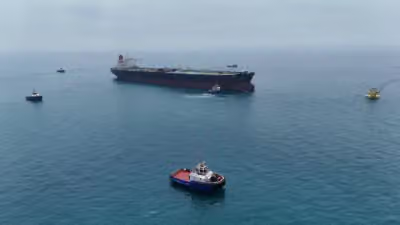
In response to Operation Epic Fury, Tehran turned to asymmetric leverage, relying on its capacity to disrupt shipping through the Strait of Hormuz and drive up global oil prices.
Anticipating market volatility, the US Treasury issued a targeted sanctions waiver designed to stabilize oil markets while preserving financial pressure on Tehran.
Yet as the waiver framework evolved from an India-specific mechanism into a more generalized policy, it continued in practice to serve Indian refiners, redirecting sanctioned crude away from China and toward India.
The Russian test case
On March 5, Treasury issued a waiver allowing Indian refiners — IOC, BPCL, HPCL, and Reliance Industries — to purchase already-produced Russian crude cargoes that were on the water.
When Treasury expanded the waiver on March 12–13, Indian refiners remained the only significant buyers of the authorized Russian barrels. The expansion continued to apply only to cargoes already on the water, did not restore formal banking channels, and did not lift underlying sanctions.
Miad Maleki, a former US Treasury official, described General License U as authorizing “the commodity transaction; it says nothing about payment.” The license permits the sale of oil but does not restore banking access or create a formal payment channel. That distinction allowed trade in physical barrels while preserving financial pressure.
The March 20 application of the same waiver model to roughly 170 million barrels of Iranian crude floating offshore replicated the policy — and once again, India remained the only swing buyer.
Reliance Industries, the largest Indian public company, purchased 5 million barrels of Iranian crude at a $7 premium to Brent. The same Indian refiners, IOC, BPCL, and HPCL, reportedly plan to resume purchases.
Homayoun Falakshahi, head of crude oil analysis at Kpler, said Iranian crude often remains unsold until reaching Asian discharge zones such as Singapore or Malaysia. Because many cargoes were already produced but waiting for buyers, releasing them under the waiver had immediate supply effects. He added: “Now that India has entered as a competitor, the price in China will most likely increase.”
In effect, India’s participation disrupted China’s near-monopsony over sanctioned Iranian crude — reshaping pricing leverage without formally lifting sanctions.
Before 2019, Indian refiners imported roughly 450,000 barrels per day of Iranian crude under contracts with National Iranian Oil Company. They retain the technical configuration and commercial familiarity to scale quickly within short waiver windows. That institutional memory gives Washington a ready-made alternative buyer base whenever it chooses to recalibrate supply pressure.
India’s strategic ascent
India’s admission into the Pax Silica, formalized on February 20, placed it within the US-led supply-chain initiative focused on reducing dependence on China in semiconductor and AI production. As Under Secretary Jacob Helberg said: "Pax Silica is really not about China, it is about America. We want to secure our supply chains. We view India as a partner to help de-risk and diversify those supply chains."
Prime Minister Narendra Modi visited Israel on February 25–26, where the two countries elevated ties to a “special strategic partnership.” Two days later, Operation Epic Fury began.
The new world order
Early in President Trump’s second term, Washington sought to reshape the global order. India was expected to become a counterweight to China, and Iran was given a chance for realignment. Neither objective materialized at the outset. India’s role remained limited, negotiations with Iran collapsed, and a 12-day war followed. Trade and tariff disputes further complicated the restructuring effort.
Washington’s tactical support of India’s energy role may carry implications beyond temporary oil supply management. Pax Silica realigns industrial supply chains; the waiver framework redirects sanctioned energy flows. Together, they position India within the technological and commodity axes of great-power competition.
This suggests a second, more structured attempt to reshape the global order. With India onboard, the decisive variable becomes whether Operation Epic Fury generates sufficient leverage to push Iran away from its long-standing partnerships with Beijing and Moscow. A realignment toward Washington could be the tipping point in the consolidation of this new order.