• العربية
  • فارسی
BrandBrand
  • Iran Insight
  • Politics
  • Economy
  • Analysis
  • Special Report
  • Opinion
  • Podcast
  • Live TV
  • Iran Insight
  • Politics
  • Economy
  • Analysis
  • Special Report
  • Opinion
  • Podcast
  • Live TV
  • Theme
  • Language
    • العربية
    • فارسی
  • Iran Insight
  • Politics
  • Economy
  • Analysis
  • Special Report
  • Opinion
  • Podcast
  • Live TV
All rights reserved for Volant Media UK Limited
volant media logo
INSIGHT

Iran in Israeli election: Netanyahu all-in on regime change, rivals want more

Oct 20, 2026, 22:52 GMT+1

Israeli Prime Minister Benjamin Netanyahu is making regime change in Iran an explicit goal ahead of Israel’s election, while political rivals advocate tough measures against Tehran and criticize his failure to eliminate the Iranian threat.

The debate puts competing promises of security before voters whom analysts describe as exhausted by years of conflict, raising questions about what would constitute victory and how far Israel would go to achieve it.

“We must complete the elimination of the Iranian regime — that is the primary objective,” Netanyahu said Tuesday at Tel Hai University in Kiryat Shmona, near the Lebanese border.

Continue reading

Most Viewed

US and Israel threaten renewed Iran strikes, Tehran warns of response
1

US and Israel threaten renewed Iran strikes, Tehran warns of response

2

Iran threatens stronger response to new US attack as Lavrov visits Tehran

3

Russia vows continued Iran ties as Trump welcomes limits on support

4
VOICES FROM IRAN

Iranians report mass security warnings over social media activity

5
ANALYSIS

Iran deal remains elusive amid risk of renewed strikes

Spotlight

  • Iran in Israeli election: Netanyahu all-in on regime change, rivals want more
    INSIGHT

    Iran in Israeli election: Netanyahu all-in on regime change, rivals want more

  • Saudi Arabia should join US-led push for change in Iran, analyst says
    ONE-ON-ONE

    Saudi Arabia should join US-led push for change in Iran, analyst says

  • Ex-president's remarks expose divide over costs of Iran’s Palestine policy

    Ex-president's remarks expose divide over costs of Iran’s Palestine policy

  • Teenager killed by gunshot to eye after arrest in Iran, source says

    Teenager killed by gunshot to eye after arrest in Iran, source says

  • Soaring medical costs and staff shortages strain Iran’s hospitals
    VOICES FROM IRAN

    Soaring medical costs and staff shortages strain Iran’s hospitals

  • Architect of Guards' missiles becomes Iran's defense minister

    Architect of Guards' missiles becomes Iran's defense minister

Banner
Banner
Banner
Banner
Banner
•
•
•

More Stories

Iran in Israeli election: Netanyahu all-in on regime change, rivals want more

Oct 20, 2026, 22:24 GMT+1
•
Negar Mojtahedi
100%
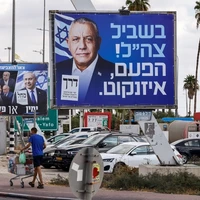
تابلوهای تبلیغاتی بنیامین نتانیاهو، نخست‌وزیر اسرائیل از حزب لیکود (چپ)، و گادی آیزنکوت، رئیس پیشین ستاد ارتش اسرائیل و رهبر حزب یاشار (راست)، در ورودی شهر کریات ملاخی اسرائیل، ۲۰ اکتبر ۲۰۲۶. روی تابلو تبلیغاتی نتانیاهو نوشته شده است: «راست یا فلسطین». روی تابلو تبلیغاتی آیزنکوت نیز نوشته شده است: «برای ارتش اسرائیل! این بار، آیزنکوت».

Israeli Prime Minister Benjamin Netanyahu is making regime change in Iran an explicit goal ahead of Israel’s election, while political rivals advocate tough measures against Tehran and criticize his failure to eliminate the Iranian threat.

The debate puts competing promises of security before voters whom analysts describe as exhausted by years of conflict, raising questions about what would constitute victory and how far Israel would go to achieve it.

“We must complete the elimination of the Iranian regime — that is the primary objective,” Netanyahu said Tuesday at Tel Hai University in Kiryat Shmona, near the Lebanese border.

Netanyahu has long welcomed the prospect of the Islamic Republic’s collapse. Now, with Israelis voting on October 27, he is placing the removal of Iran’s leadership at the forefront of his message.

Netanyahu argued that weakening Iran militarily would not guarantee Israel’s security. As long as the Islamic Republic remains in power, he said, it will attempt to rebuild its nuclear capabilities and regional network.

“Finishing the job means bringing down the terrorist regime in Iran,” Netanyahu said, describing Tehran as the head of a “poisonous octopus” whose removal, he argued, would also bring down Hezbollah in Lebanon.

The declaration followed discussions with US President Donald Trump and an unannounced visit by US Defense Secretary Pete Hegseth. Washington, however, has not publicly committed to regime change, emphasizing instead the prevention of a nuclear-armed Iran.

Why emphasize regime change now?

Netanyahu’s declaration comes as he seeks another term following three years of war and repeated military confrontations with Iran and its regional allies.

Itai Reuveni, director of communications and outreach at NGO Monitor, said the prime minister was articulating what many Israelis had already understood to be the broader ambition behind military operations against Tehran.

“I think he just summarized all the things that everyone meant,” Reuveni told Iran International.

Making regime change the declared objective raises questions about whether weakening Iran’s military and nuclear capabilities would be sufficient for Netanyahu to claim victory.

Yaakov Katz, former editor-in-chief of The Jerusalem Post and author of four books on Israel’s military, said repeated strikes alone cannot permanently eliminate the Iranian threat.

“You can bomb them, you can destroy facilities, you can set back nuclear programs, but they will rebuild,” Katz told Iran International.

Netanyahu is presenting regime change as the route to lasting Israeli security, a message delivered in Kiryat Shmona, a historically Likud-supporting community repeatedly targeted by Hezbollah.

Vivian Bercovici, Canada’s former ambassador to Israel and founder and editor-in-chief of State of Tel Aviv, said the location allowed Netanyahu to appeal directly to voters who have experienced the consequences of Iran’s regional influence.

But she questioned whether the declaration would persuade Israelis beyond his existing supporters.

“I really think that people have tuned him out,” she said.

A shared concern, a public tired of war

Those interviewed described opposition to the Islamic Republic as extending across much of Israel’s political spectrum, while drawing a distinction between agreement on the threat and enthusiasm for another military confrontation.

“It’s the one issue on which there’s no daylight in Israel,” Bercovici said.

Yet she described a public exhausted by years of fighting.

“I don’t think that Israel has any appetite for war,” she said. “We’ve had way too much war in the last three years.”

Reuveni described a similar tension. Many Israelis believe Iran’s immediate military threat has diminished following Israeli and American strikes, he said, complicating the case for further military action.

“People are tired from the war,” he said.

Katz said the election ultimately comes down to which leader Israelis trust to protect them, rather than any single declaration about Iran.

“What is important is the belief in which leader do Israelis think can keep them safe,” he said.

Does Netanyahu’s declaration set him apart?

Netanyahu’s explicit objective does not necessarily distinguish him from his political rivals, several of whom have advocated aggressive measures against Tehran and criticized his failure to eliminate the Iranian threat.

Former prime ministers Naftali Bennett and Yair Lapid are contesting the election together under the joint list Together (Beyachad).

Lapid has advocated striking Iran’s energy infrastructure, including Kharg Island, while Bennett has long promoted confronting Tehran directly rather than focusing on its regional proxies.

Gadi Eisenkot, the former military chief who leads the centrist Yashar party, has questioned whether regime change is achievable through military action, emphasizing the permanent dismantling of Iran’s nuclear capabilities.

Avigdor Lieberman, leader of Yisrael Beiteinu, has also advocated overthrowing the Islamic Republic and criticized previous Israeli efforts as insufficient.

Eric Mandel, founder and director of the Middle East Political and Information Network, said the broad agreement on Iran means a change of government in Israel would not necessarily produce a fundamental shift in policy.

“I think most Israelis know that it doesn’t matter who’s going to get elected, they’re going to have the same policy in Iran,” Mandel told Iran International.

But agreement on the threat is different from agreement on how to eliminate it.

Mandel said achieving regime change would require American involvement, underscoring the gap between Netanyahu’s declared ambition and Washington’s publicly stated objectives.

“Israel is a regional power, America is a superpower,” he said. “Israel could be very helpful, but Israel can’t do it on its own.”

Nowhere else to go? The puzzle behind Iran’s stock rally

Oct 14, 2026, 07:05 GMT+1
•
Behrouz Turani
100%
File photo: A man speaks on his phone beneath a market board at the Tehran Stock Exchange.

Iran’s stock market is raising eyebrows with a sustained rally even as the country’s economy struggles with dwindling foreign-currency inflows, energy shortages and uncertainty over the war.

The divergence is particularly striking after the International Monetary Fund on Tuesday forecast Iran's economy would contract 7.6% in 2026, far more sharply than the 0.3% decline expected across the Middle East and Central Asia.

Against that backdrop, the strength of Tehran's stock market raises a question: are investors betting that the worst is approaching an end, or simply running out of places to protect their money?

Recent analyses in Iranian media offer competing explanations, ranging from expectations of an Iran-US agreement to the immediate pressures of dwindling foreign currency and energy shortages.

Dollars in short supply

Iran's oil exports have effectively stopped under the US blockade, while non-oil exports including steel and petrochemicals have also fallen. Delays in repatriating export earnings have further restricted the supply of hard currency.

Fararu identifies dwindling foreign-exchange inflows, energy shortages and uncertainty as the three principal pressures on the economy. Khabar Online puts the currency shortage at the center of its analysis, pointing to a 35,000-toman rise in the free-market dollar over the past month.

The widening gap between official and market exchange rates has added to volatility, while businesses dependent on imported machinery and raw materials face higher costs and tighter access to foreign currency.

Energy shortages are compounding those problems. Years of underinvestment have left Iran struggling to meet domestic demand, while wartime damage to infrastructure has added pressure on production.

Hovering over both is uncertainty about what comes next. The economic consequences of renewed fighting would differ dramatically from those of a negotiated settlement, making long-term investment all but impossible and pushing businesses and households toward assets that can preserve value.

Why are stocks rising?

That makes the performance of Tehran's stock market more striking.

Rouydad24 interprets its wartime strength as a sign that investors increasingly expect an Iran-US agreement. On that reading, equities are looking beyond present economic conditions toward possible de-escalation, sanctions relief and improved access to international markets.

But there is another explanation that requires no assumption that investors know where negotiations are heading: they may simply have nowhere better to go.

With the rial losing value, foreign currency increasingly scarce, property relatively illiquid and bank deposits losing purchasing power to inflation, domestic equities can become attractive even when confidence in the underlying economy is weak.

A rising stock market, in other words, may say less about optimism over Iran's economic prospects than about the scarcity of alternatives for preserving wealth.

That would also help reconcile what otherwise appear to be conflicting signals. The currency market reflects immediate scarcity and fear of further deterioration, while stocks may reflect either hopes for political relief or an effort to escape the declining value of cash.

Different markets, different futures

The IMF's latest forecast represents another substantial downgrade from the 5.4% contraction it expected as recently as July. Iranian government data has meanwhile shown GDP contracting 10% year-on-year in the spring, with the downturn extending beyond the oil sector.

For businesses and investors, much now depends on which of two very different futures emerges: renewed conflict and prolonged restrictions on oil exports, or de-escalation that begins restoring access to foreign currency and international trade.

Iran's markets may therefore be pricing different risks rather than delivering contradictory verdicts. The currency market reflects a shortage that already exists. The stock market may be looking toward political relief or reflecting the capital having nowhere else to go.

Tehran seizes on Rubio’s Xerxes remarks to champion a past it once disparaged

Oct 12, 2026, 14:08 GMT+1
100%
US Secretary of State Marco Rubio speaks at the Pnyx hill, where ancient Athenians held democratic assemblies, with the ancient Parthenon temple atop the Acropolis in the background, in Athens, Greece October 7, 2026.

Marco Rubio’s invocation of ancient Persia in a speech championing Western power has given Tehran an opportunity to present itself as a defender of Iranian identity, even as critics recall the Islamic Republic’s own record of disparaging pride in the country’s pre-Islamic rulers.

The US secretary of state’s October 7 address in Athens drew on Xerxes’ invasion of Greece in 480 BC to celebrate Western resilience, before contrasting Western traditions of sacrifice with what he called the Iranian leadership’s “cult of death.”

The remarks drew objections even from critics of the Islamic Republic, who argued that opposition to clerical rule does not diminish Iranians’ attachment to their ancient history.

Iranian officials seized on that sensitivity to cast themselves as defenders of the country’s ancient heritage. Parliament speaker Mohammad Bagher Ghalibaf accused Iran’s adversaries of seeking to erase ancient civilizations and warned Washington that it would meet the fate of Persia’s defeated enemies.

“Those who chase Alexander’s legacy will share Valerian’s fate: you will kneel,” he wrote on X on Friday, referring to the Roman emperor captured by the Sasanian king Shapur I.

The history Khamenei dismissed

That embrace of ancient Persian power contrasts with slain Supreme Leader Ali Khamenei’s criticism of the very campaign Rubio recounted.

Addressing army commanders in April 2012, Khamenei cited Xerxes’ invasion of Greece as an example of military force serving rulers’ political ambitions rather than national interests. He described an army returning defeated, its ships wrecked, and associated the campaign with Iran’s historical taghut, a religious term used to condemn illegitimate or ungodly rule.

“These were not for national interests,” he said.

In 2018, Khamenei dismissed pride in the rule of the ancient Kayanian and Achaemenid dynasties as illusory, arguing that national esteem should rest on tangible achievements in contemporary society.

Those remarks complicate the authorities’ present effort to speak for Iranians offended by Rubio’s account. One Persian-language X user mocked government supporters’ sudden concern for Xerxes, contrasting it with their past ridicule of ancient Persian figures and people visiting historical sites.

The struggle over these symbols predates the current war. During Nowruz in March 2025, crowds gathered at Persepolis and the tombs of Hafez and Ferdowsi while authorities promoted religious mourning coinciding with the holiday.

After the June 2025 war with Israel and the United States, patriotic music entered the leadership’s own ceremonies: Khamenei asked eulogist Mahmoud Karimi to perform “Ey Iran Iran” at a July mourning gathering, a separate song from the better-known anthem.

Later, media reports documented a statue of the mythical archer Arash in Tehran, banners likening Iranian missiles to his legendary arrows, and a billboard depicting Benjamin Netanyahu kneeling before an ancient Persian emperor.

By November 2025, authorities had also unveiled a statue depicting Valerian’s submission to Shapur I. Such imagery associated the state’s confrontation with foreign powers with a national history reaching far beyond the Islamic Republic.

A propaganda opening

Speaking at the Pnyx with the Acropolis behind him, Rubio recounted the Persian destruction of Athens’ sanctuaries and the city’s subsequent rebuilding. He also praised the Spartans’ last stand at Thermopylae, presenting ancient Greek traditions as foundations of Western courage, ambition and duty.

His explicit attack on contemporary Iran targeted its rulers, whom he called “radical mullahs.” But placing that criticism within a speech celebrating resistance to Persian armies prompted objections to the implied continuity between ancient conflict and today’s war.

Historian Touraj Daryaee told the Tehran Times that treating the ancient wars as a confrontation between East and West misrepresented a conflict between an empire and Greek city-states. He also challenged the use of that history to frame the present conflict.

Questions about Rubio’s historical framing also came from admirers of the speech. Writing in the Spectator, Alexander Munguía praised its defense of the West but argued that its celebration of relentless ambition better resembled Alcibiades, who championed Athens’ disastrous expedition to Sicily, than Pericles, whose wartime strategy emphasized restraint.

US-based Iranian journalist and analyst Omid Memarian warned on X that Rubio “may have just handed Tehran one of the biggest propaganda gifts of this war.”

“It just reframes this war as a civilizational clash. And that plays directly into Tehran’s hands,” he wrote, arguing that the rhetoric helped authorities portray Washington as an enemy of Iran itself rather than its government.

The State Department did not immediately respond to Iran International’s request for comment on the criticism and whether Rubio intended to draw a parallel between ancient Persia and today’s Iranian government.

A distinction between Iran and its rulers

Iranian political analyst Nejat Bahrami disputed the interpretation of Rubio’s speech as an attack on Iranian civilization.

“Rubio’s speech was part of a broader theme that he, the current Trump administration and right-wing political figures in Europe have pursued in recent years: that the West must return to its roots, resist the erosion of Western civilization and preserve Western values,” he told Iran International.

“Contrary to the fuss made by the Islamic Republic, Rubio did not attack Iranian civilization in the speech. He referred to a historical event: the Persian attack on Athens and the destruction that followed, before describing how the Greeks returned and rebuilt. His point was that the West today should similarly follow their example of determination and resilience.”

Rubio had previously drawn an explicit distinction between Iranians and their rulers. At his January 2025 Senate confirmation hearing, he praised Iran’s ancient civilization and culture and Iranians’ pride in their Persian heritage, saying he knew of no country with a greater divide between its people and those governing them.

US pressure threatens Iran’s political survival but may not bring concessions

Oct 11, 2026, 11:09 GMT+1
100%
Panelists discuss the impact of US sanctions and the naval blockade on Iran's economy, financial networks and political leadership during an Iran International Insight discussion hosted by Fardad Farahzad in Washington, DC.

The US blockade and tighter sanctions enforcement are cutting into Iran’s oil income and targeting financial networks that sustain the Islamic Republic, but may still fall short of forcing Tehran into concessions, experts said at an Iran International town hall in Washington.

The discussion, hosted by Fardad Farahzad, brought together Kerri Bitsoff, a former senior official at the US Treasury Department’s Office of Foreign Assets Control (OFAC); Patrick Clawson, the Morningstar senior fellow at the Washington Institute; and Mohammad Machine-Chian, a senior economist and analyst at Iran International.

“The thing about sanctions, if they’re on the books but not enforced, they only hurt the people,” Bitsoff said, arguing that the current US campaign differed from previous rounds by focusing more heavily on enforcement and the financial intermediaries sustaining Iran’s economy.

Blockade bites

Iran faces declining oil revenues alongside damage to its energy infrastructure following the war, raising the prospect of severe economic difficulties during the coming winter, Clawson said.

  • Satellite images show Iran’s key ports falling quiet under US blockade

    Satellite images show Iran’s key ports falling quiet under US blockade

President Masoud Pezeshkian had acknowledged that Iran could not export oil during the initial blockade, according to Clawson, who said the country subsequently sought alternative routes for limited shipments.

Iran had also relied on oil previously stored aboard vessels and in China, but those reserves were approaching exhaustion, he said.

Damage to natural gas infrastructure could compound the difficulties, potentially forcing greater reliance on mazut, a heavily polluting fuel used for electricity generation.

100%
Patrick Clawson, a senior fellow at the Washington Institute, discusses the impact of US sanctions and the naval blockade on Iran's economy during Iran International's Insight panel in Washington, DC.

Iran depends on natural gas for approximately 69 percent of its energy requirements, making disruptions particularly consequential for households and industry, Clawson said.

Machine-Chian estimated that between $21 and $23 billion in export proceeds had not returned to Iran and that the blockade could cost the country another $35 billion in oil revenue.

Hitting financial networks sustaining Iran's leadership

The current campaign differs from previous sanctions because Washington is concentrating on enforcement and the intermediaries sustaining Iran's economy rather than simply announcing additional restrictions, Bitsoff said.

  • US sanctions Turkish bank as Iran financial crackdown widens

    US sanctions Turkish bank as Iran financial crackdown widens

She pointed to restrictions imposed by the United Arab Emirates, measures against Iranian airlines and Turkish action against banks connected to Iranian transactions.

Such measures could influence officials and business figures whose continued support for the Islamic Republic depends on financial privileges and access to international markets.

100%
Kerri Bitsoff, a former senior US Treasury official and sanctions expert, discusses the impact of US economic pressure on Iran during Iran International Insight panel.

Earlier sanctions had often pushed legitimate commerce underground while allowing networks connected to the Revolutionary Guards to profit, Bitsoff said.

Machine-Chian described the emergence of wealthy intermediaries, sometimes called sanctions merchants, who benefited from moving Iranian oil and money through opaque arrangements.

Those networks subsequently became obstacles to negotiations and economic normalization because their commercial interests depended on maintaining the existing system, he said.

Machine-Chian distinguished between sanctions that impose prolonged hardship without producing results and measures designed to achieve specific objectives within a foreseeable period.

The loss of the UAE, Machine-Chian added, as a major commercial and financial intermediary has further complicated Iran's position.

Dubai previously provided an important channel for Iranian transactions, but restrictions have forced businesses to seek alternatives through Turkey, Pakistan and Afghanistan, Machine-Chian said.

  • Iranian banks remain open in UAE as US campaign squeezes Dubai trade - FT

    Iranian banks remain open in UAE as US campaign squeezes Dubai trade - FT

Those routes, he said, have limited capacity and cannot quickly replace the financial infrastructure previously available through the Emirates.

China and regional allies face financial constraints

China remains Iran's principal oil customer, but its commercial relationship offers fewer advantages to the Islamic Republic than commonly assumed, Bitsoff said.

Independent Chinese refineries purchase Iranian crude at substantial discounts, while payments in yuan often remain in China and are largely available for purchasing Chinese goods.

  • China shifts to Iraqi oil: is Iran using old workaround to beat US blockade?

    China shifts to Iraqi oil: is Iran using old workaround to beat US blockade?

Major Chinese banks generally avoid Iranian transactions, leaving smaller intermediaries to facilitate much of the remaining trade, she said.

The blockade also allows Washington to restrict Iranian oil exports without directly confronting major Chinese financial institutions, Clawson said.

Targeting those institutions could provoke Chinese retaliation affecting broader US economic interests.

The financial pressure is also affecting Iran's regional allies.

  • Iran's reported $200 million Hezbollah aid angers cash-strapped citizens

    Iran's reported $200 million Hezbollah aid angers cash-strapped citizens

Hezbollah has struggled to maintain basic financial obligations and social support programs since the blockade began, Bitsoff said.

Machine-Chian argued that Iran's relationships with allied armed groups had become increasingly transactional, making continued financial assistance essential to sustaining their loyalty.

Political survival and prospects for negotiations

Despite the mounting pressure, the panelists differed over whether the Islamic Republic would ultimately accept Washington's demands.

Economic hardship alone was unlikely to persuade Iran's leadership to abandon its objectives, Bitsoff said.

Instead sustained pressure could influence members of the security apparatus whose loyalty depends on salaries, privileges and expectations of continued stability.

Clawson considered negotiated concessions possible, pointing to previous occasions when Iran reversed positions it had presented as nonnegotiable.

He suggested Iran could accept a three-year suspension of uranium enrichment, particularly because its facilities had been damaged and were not operational.

Machine-Chian was more skeptical, arguing that abandoning regional ambitions and nuclear objectives would challenge central elements of the Islamic Republic's political identity.

100%
Audience members attend an Iran International Insight panel discussion in Washington, DC.

The blockade's sustainability also remains a concern because maintaining naval operations places substantial demands on American ships, crews and maintenance resources, Bitsoff said, although she expected the operation to continue.

The discussion highlighted a central uncertainty: whether sustained economic pressure will produce concessions, weaken the leadership's support structures or prolong Iran's economic difficulties without fundamentally changing its political direction.

War puts Iran’s nuclear ambiguity under scrutiny

Oct 10, 2026, 19:54 GMT+1
•
Behrouz Turani
100%
A portrait of slain Supreme Leader Ali Khamenei beside his tomb in Mashhad, Iran.

A revisionist argument is emerging in Tehran over Iran’s nuclear strategy: that its longstanding policy of nuclear ambiguity failed its most important test when it did not deter the United States and Israel from attacking, and should now be reconsidered.

Nezamoddin Mousavi, a former conservative lawmaker with longstanding ties to the Islamic Revolutionary Guard Corps (IRGC), gave unusually explicit expression to that argument this week, declaring that “nuclear ambiguity did not prevent war” and raising the prospect of revisiting Iran’s nuclear doctrine and even its membership in the Nuclear Non-Proliferation Treaty (NPT).

Mousavi, who helped found IRGC-linked media outlets, made the remarks in an interview with Ensaf News, a website close to President Massoud Pezeshkian.

Senior Iranian officials have previously hinted that Tehran could change its nuclear doctrine if sufficiently threatened. But such warnings have generally been directed outward, rather than framed as criticism of an established policy favored by slain Supreme Leader Ali Khamenei.

Mousavi, however, is effectively arguing that a policy intended to preserve strategic uncertainty while stopping short of weaponization failed to provide the deterrence its architects expected.

That diagnosis feeds into a wider debate over what lesson Iran should draw from the war: whether the failure was one of deterrence, requiring greater military leverage, or of escalation management, requiring a different approach to diplomacy.

Iran has long cited Khamenei’s fatwa prohibiting the possession and use of nuclear weapons when confronted with accusations that it might seek a bomb.

Critics, however, have questioned how absolute that prohibition would prove in an existential crisis, especially since Khamenei’s predecessor and founder of the Islamic Republic, Ruhollah Khomeini, held that preserving the state was paramount, taking precedence even over religious obligations.

Against that backdrop, Mousavi said Tehran should reassess its international commitments, the value of NPT membership and its broader deterrence strategy following attacks on Iran’s nuclear facilities.

He stopped short of explicitly advocating the acquisition of nuclear weapons.

His reasoning amounts to three premises and a conclusion: Iran refrained from building a nuclear weapon; ambiguity was supposed to contribute to deterrence; yet Iran was attacked and senior leaders and military commanders were killed. The assumptions underlying Iran’s deterrence strategy, he argues, must therefore be reconsidered.

Beyond Khamenei

Mousavi also ventured into another sensitive subject: whether Khamenei’s death would fundamentally alter Iran’s strategic direction.

He argued that he would not expect dramatic change. Foreign and security policy, he said, is not simply the product of one individual but of institutional thinking and long-term calculations developed over decades.

It reflects a distinctly conservative view of regime continuity: leaders matter, but institutions matter more. Major strategic directions, in this reading, are unlikely to change abruptly regardless of who occupies the highest office.

That also gives the nuclear debate greater significance. If Iran’s strategic direction is fundamentally institutional rather than dependent on one leader, the lessons the establishment draws from the war could outlast the present leadership.

Deterrence or de-escalation?

Not everyone in Tehran is drawing the same lesson.

An article published Wednesday in Etemad newspaper highlighted a competing strand of Iranian political thinking. Where Mousavi sees a failure of deterrence, more moderate voices see a failure to manage escalation.

The hardline argument holds that the United States and Israel seek to weaken Iran regardless of its diplomatic behavior and that negotiations cannot guarantee security while military pressure continues.

The more moderate argument sees the conflict as the product of a broader strategic environment shaped by political, regional, military and economic pressures. For this camp, the lesson is not necessarily that Iran needs greater deterrence, but that it needs more effective crisis management.

The emerging argument in Tehran, then, appears to be shifting from how this war ends to what lesson should be drawn from it: whether greater military and potentially nuclear deterrence offers the best protection against another conflict, or whether security ultimately depends on preventing the next escalation before it begins.