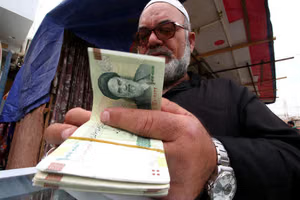
The Treasury Department’s Financial Crimes Enforcement Network (FinCEN) on Thursday issued an alert asking financial institutions to report potential Iranian government abuse of religious charity networks, including the diversion of khums, a religious levy paid by Shiite Muslims.
Treasury said organizations collecting such payments may act on behalf of prominent Iranian ayatollahs with ties to the government and may use informal financial channels, including hawala networks and cash couriers, to transfer money to Iran or Iran-linked actors.
“Under President Trump’s leadership, Treasury will not allow the Iranian regime to continue its long history of abusing religious institutions to line the pockets of its elites and fund terrorism,” Treasury Secretary Scott Bessent said.
FinCEN identified several red flags, including charities soliciting donations without apparent charitable activity; organizations receiving large donations from unknown sources over a short period before transferring significant sums to other nonprofits; attempts to evade reporting or recordkeeping requirements; and recipients with no clear business relationship to a charity withdrawing its transfers in cash or sending them onward.
The alert also says no single indicator establishes illicit or suspicious activity.
The alert does not identify specific religious centers in the United States or Europe as participants in the conduct described. But US and European authorities have previously investigated organizations with alleged institutional or financial links to the Islamic Republic.
These cases involved different allegations and legal proceedings and should not be treated as equivalent evidence of diverted religious donations.
Khums case in the United States
A US criminal case cited in the alert involved khums payments collected for transfer to Iran without the required US Treasury licenses.
In 2024, Muzzamil Zaidi and Asim Mujtaba Naqvi pleaded guilty to conspiring to violate US sanctions by collecting tens of thousands of dollars for transfer to Iran, including funds collected in the name of then-Supreme Leader Ali Khamenei.
According to the Justice Department, Zaidi received permission in 2018 to collect khums on behalf of several clerics. Zaidi and Naqvi subsequently collected religious payments as well as donations purportedly intended to help victims of the war in Yemen.
Prosecutors said the men arranged for money to reach Iran and Khamenei’s office by using friends, relatives and other associates to carry cash out of the United States. In one instance, 25 travelers on a religious pilgrimage to Iraq carried dollars that were subsequently taken to Iran. The amounts were structured below $10,000 to avoid scrutiny, according to court documents.
FinCEN cited the Zaidi and Naqvi prosecution in Thursday’s alert as an example of illicit transfers involving khums payments.
Alavi Foundation’s long-running US case
The broader question of Tehran-linked financial activity in the United States has also surfaced in the long-running litigation surrounding the Alavi Foundation and the 650 Fifth Avenue office tower in Manhattan.
US prosecutors alleged in the case that entities associated with the property concealed an ownership interest held by Iran’s state-owned Bank Melli. The litigation ultimately ended in a global settlement that the Justice Department announced in March 2026 would provide approximately $318 million to victims of Iran-sponsored terrorism.
Alavi admitted no liability or wrongdoing under the settlement and rejected allegations that it had operated as an agency or instrumentality of the Iranian government. The foundation said all claims against it and its properties were dismissed with prejudice and that it transferred its assets, including its interest in 650 Fifth Avenue, to a newly created, IRS-approved public charity and would cease operations once its affairs were wound down.
Scrutiny in Britain
Britain’s Charity Commission has separately taken regulatory action involving the Islamic Centre of England, a Shiite religious institution in north London.
The Charity Commission opened a statutory inquiry in 2022 over what it described as serious governance concerns. The inquiry followed an official warning related to two events at the center in 2020 that eulogized Qassem Soleimani, the former commander of the IRGC’s Quds Force who was under UK sanctions.
The regulator later appointed an interim manager after finding failures by trustees to comply with their legal duties and protect the charity’s assets.
In May 2025, the Charity Commission said it had found misconduct and/or mismanagement during its ongoing inquiry and ordered governance reforms. During the inquiry, a requirement in the center’s governing document for one trustee to serve as the official UK religious representative of Iran’s supreme leader was removed, and the occupant left the role. The regulator said the change addressed concerns about conflicts of interest and an apparent lack of independence.
The trustees disputed some of the regulator’s findings. The Commission also discharged the interim manager after she implemented specified improvements, leaving further reforms to the trustees.
The Commission said at the time that its statutory inquiry remained ongoing.
Germany shut down Khamenei-linked center
Germany banned the Islamic Centre Hamburg, or IZH, and its affiliated organizations in July 2024, saying the organization pursued Islamist extremist goals.
Germany’s Interior Ministry said IZH acted as a direct representative of Iran’s Supreme Leader and sought to bring about an Islamic revolution in Germany. Authorities searched 53 premises in eight German states, and four Shiite mosques were closed as a result of the ban. then-Interior Minister Nancy Faeser said the measure did not apply to the peaceful practice of Shiite Islam.
German authorities subsequently ordered IZH head Mohammad Hadi Mofatteh to leave the country. Hamburg’s domestic intelligence agency identified him as the official deputy of Iran’s Supreme Leader Ali Khamenei in Germany.
Iran protested the German action and summoned Berlin’s ambassador in Tehran.
A focus on financial pathways
Thursday’s US alert does not allege that all Shiite charities or religious centers are conduits for Tehran. FinCEN explicitly said legitimate charities should have access to financial services and instructed banks to use a risk-based approach rather than treating the sector as inherently suspicious.
Instead, the alert focuses on how religious donations can potentially intersect with sanctions evasion and informal financial networks.
The US khums prosecution documented religious payments collected in the United States and cash carried toward Iran for receipt by the Office of Iran’s Supreme Leader. The cases in Britain and Germany are distinct: British regulators raised governance and independence concerns involving a center whose governing document had required a trustee to serve as the supreme leader’s official UK religious representative, while German authorities said IZH acted as the supreme leader’s direct representative.
FinCEN’s new alert asks financial institutions to look for indicators of potential Iranian government abuse of religious charities, including patterns that could indicate funds are being transferred to Iran or Iran-linked actors through informal financial channels.