Presidential candidate Alireza Zakani attends a rally in Tehran on June 26, 2024.
Tehran’s hardline mayor Alireza Zakani has drawn accusations of using municipal resources to prepare for another presidential bid after announcing a freeze on basic food prices and payments to new parents.
The initiatives have won praise from conservative figures and media outlets, while raising questions about their financing, council oversight and the mayor’s priorities during wartime.
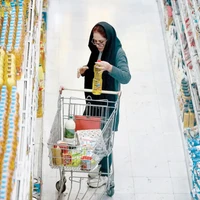
Under Zakani’s “Zero Inflation” plan, launched in late September, prices of 12 basic goods—including meat, rice, cooking oil, pulses and sugar—are to remain fixed for six months at municipal fruit and vegetable markets, Shahrvand supermarkets and the municipality’s online store, Shahrzad.
The scheme comes amid annual food inflation of nearly 130 percent.
Zakani said on television that the goods would be sold at cost, without profit, and that prices for a second six-month period would be announced after the first ended.
He portrayed the initiative as a response to what he called a US economic war against Iranians’ livelihoods. Financing would come from municipal funds, bank facilities and a Central Bank mechanism for settling foreign currency obligations, he said.
The mayor has also announced monthly municipal payments of 35 million to 40 million rials to families who have a child this year. Both initiatives have been widely advertised on billboards across Tehran.
Funding under scrutiny
Nasser Amani, a member of Tehran’s city council, said no formal bill had been submitted to the council and no specific budget approved for the price-freeze scheme.
Abdollah Ramezanzadeh, a spokesman for former reformist President Mohammad Khatami’s government, questioned where the money would come from and why the national government was not adopting the scheme if it made economic sense.
Moderate conservative commentator Mohammad Mohajeri called the plan “empty and nonsensical,” warning on X that it would lead to a “historic disaster.” He urged Tehran’s prosecutor to intervene to prevent what he predicted would become corruption.
Critics have also questioned the fairness of limiting the initiative to Tehran while residents elsewhere face rising prices.
Zakani’s supporters argue that municipal intervention could help poorer households.
Conservative politician Abdolreza Davari wrote on X that lower-income groups would be the main beneficiaries, while the losers would be the “oligarchic network dominating the basic goods market” and Zakani’s political rivals.
Hardline newspapers Kayhan and Javan, the latter affiliated with the Revolutionary Guards, have defended the initiative as an effort to improve livelihoods.
Javan accused critics of viewing every action by the mayor “through a political lens” and urged them to assess the plan’s economic and operational merits rather than speculate about future elections.
A platform for the presidency?
Zakani, a former lawmaker who has served as mayor since 2021, has sought the presidency four times since 2013. The Guardian Council barred his first two attempts. He was approved to run in 2021 and 2024 but withdrew before voting in both contests to support other conservative candidates.
Mehdi Aghrarian, another city council member, told the news website Khabar Online that he had challenged Zakani over his priorities.
“I told him that abandoning the municipality midway through your term, putting the plane on autopilot and heading off to pursue elections was not the right approach,” Aghrarian said.
He described Zakani’s activities as “performative governance” and offered this advice to the next council: “Please choose a mayor who does not want to become president.”
Khabar Online questioned whether Zakani was following the path of Mahmoud Ahmadinejad, who used the Tehran mayoralty as a springboard to the presidency. Reformist politician Ali Soufi drew the same comparison.
Zakani has faced controversy over other municipal initiatives, including the deployment of hijab enforcers and the establishment of so-called “repentance rooms” in metro stations.
After last year’s 12-day war, he made metro and bus rapid transit services free, continuing the policy despite opposition from the city council.
Praise at night-time rallies
A recently circulated video of Zakani attending a night-time pro-establishment gathering has added to speculation about his ambitions. In the footage, a young cleric urges the crowd to chant: “Zakani, hero! Thank you, thank you!”
The news website Rouydad24 questioned who was paying to promote Zakani at the rallies, which it described as increasingly factional.
Participants have chanted against figures including President Masoud Pezeshkian, parliament speaker Mohammad-Bagher Ghalibaf and Foreign Minister Abbas Araghchi, as well as former presidents and other prominent politicians, the website reported.
Zakani, by contrast, has received an unusually warm reception, it said.
Abbas Akhoundi (left) and Mohammad Khatami (center) in front of a cake at Khatami’s birthday celebration at the National Library of Iran in October 2026.
An armed man was arrested over an alleged plot to assassinate a former Iranian minister after a gathering attended by Mohammad Khatami, the former president associated with efforts to reform the Islamic Republic from within, Iran’s Reform Front said.
The event held at the National Library complex in Tehran marked Khatami’s birthday and brought together figures advocating changes to Iran’s domestic and foreign policies.
The suspect allegedly warned that others would pursue the attack on former roads minister Abbas Akhoundi and named additional assassination targets, raising concerns about threats to other political figures.
The reformist coalition said on its Telegram channel that the man confronted Akhoundi’s driver as the former minister was leaving the seminar organized by Khatami’s Baran Foundation.
The driver managed to disarm the attacker during the confrontation, and security personnel and police intervened to arrest him, according to the account, carried by Iranian news website Entekhab.
The account did not identify the suspect or the other purported targets.
On Thursday, the IRGC-affiliated Fars news agency, citing an unnamed security source, reported that the incident occurred several days earlier and remained under investigation.
The source said inquiries with legal authorities had so far found no indications that it was terrorist or organized in nature, and investigators were examining the possibility of a personal motive.
The source also accused foreign and opposition media of "exploiting the incident to deepen political divisions and portray Iran as internally insecure."
Akhoundi challenges official narratives
Akhoundi’s speech, titled “Global transitions, value chains and the architecture of Iran’s development,” challenged official portrayals of American decline and argued for an approach to security rooted in economic development and international engagement.
“Although America’s hegemonic power is diminishing, what is promoted in official media as ‘decline’ is not accurate,” he said. “We are facing the systematic containment of American power by emerging powers, not its destruction.”
He questioned whether Iran should use its position along global trade routes to generate prosperity or seek control over them, arguing that major economies, including China and India, would not tolerate prolonged insecurity along those routes.
Abbas Akhoundi addresses the seminar held at the National Library of Iran in October 2026.
Akhoundi also called for a shift from “threat-based survival” to “development-oriented prosperity.”
“Yes, we have survived, but in poverty,” he said.
Akhoundi questioned the strategy of securing Iran through involvement beyond its borders, including in Yemen and Lebanon. He called for a regional security model centered on cooperation and economic prosperity, arguing that the ambition to dominate the region had become an obstacle to understanding Iran’s place in the world.
His argument included support for increased defense spending, alongside stronger political, social and economic foundations for security.
Khatami questions intervention on Palestinians’ behalf
Khatami, speaking at the same event, condemned Israel’s establishment through what he described as occupation and force, while arguing that decisions about the Palestinians’ future belonged to Palestinians themselves.
“Occupation does not confer legitimacy,” Khatami said. “That is a matter for the Palestinian people themselves.”
He distinguished moral support for people seeking freedom from intervening and confronting a powerful adversary on their behalf.
“For me to leave here, go there, put myself in the place of those people and confront a powerful force on their behalf, only for them to end up suffering greatly and choosing a different path — that is something I cannot accept,” he said.
The Reform Front’s account did not establish any connection between the speeches and the suspect’s alleged intentions.
A Social Security hospital in Tehran has locked its main building and moved treatment into a cramped clinic in its courtyard, a member of the insurer’s healthcare oversight committee said, two months after officials listed it among the capital’s unsafe hospitals.
The main building of Shariat Razavi Hospital, run by the Social Security Organization, the state insurer that covers most of Iran’s workers and retirees, is deteriorating behind locked doors with its costly equipment still inside, Hossein Nategh told the labor-affiliated news agency ILNA on Thursday.
The move has turned a fully equipped hospital into what he called an outpatient clinic with the bare minimum of space, cutting the number of patients it can admit and the specialist care it can offer.
“The clinic set up in the yard has neither enough space for patients’ comfort nor the capacity to provide the services expected of a hospital,” he said.
The hospital’s equipment and funds belong to the workers and insured people who pay for them, Nategh said, and patients should not be left waiting in a cramped courtyard while the main building stands unused.
“If the building has a safety problem, why isn’t it being repaired? And if there is no plan to close it, why aren’t these resources being used?” he said. “This situation amounts to squandering the healthcare assets of the working community.”
He called for the main building to be reopened with its full equipment, or for an official explanation of why it was closed and what has happened to the equipment.
Neither ILNA’s report nor any statement from the Social Security Organization has explained why the building was closed or said what will happen to its equipment.
A list of unsafe hospitals
On August 18, Ali Nasiri, head of Tehran’s crisis management organization, named Shariat Razavi among 17 unsafe hospitals in the capital that were being made safe.
Warnings about the safety of Tehran’s buildings, hospitals among them, are not new. In 2024, the head of the city’s fire department said only 52 of the capital’s 189 hospitals had safety certification and that 125 were high-risk. In late 2025, a deputy fire chief, Kamran Abdoli, said 80,000 unsafe buildings had been identified in Tehran, about 27,000 of them high-risk.
Some of the warnings have ended in deaths. In June 2024, a fire at Qaem Hospital in Rasht, in northern Iran, killed at least nine patients with officials saying afterward that the hospital had never installed a fire suppression system despite earlier warnings. In early 2024, a fire broke out at Gandhi Hospital in Tehran, which fire officials said had received five safety notices beforehand and had faulty fire alarm and suppression systems.
Around the same time, Saeed Karimi, then the health ministry’s deputy for treatment, said about 100 hospitals were operating without a license because they had not fixed problems with safety or hygiene standards or with insurance contracts, and that closing them all at once would damage health services.
A satellite image taken May 9, 2026, shows strike damage to a collection of pipes sustained in an attack on May 4, 2026. Damage to a critical oil-routing system called a matrix manifold, which was struck in March, is also visible.
Iran and its allies hit water plants, airports, refineries and a nuclear power station across the Persian Gulf with a precision that rules out the official story of falling debris, a Reuters investigation has found, showing the civilian damage was the aim, not a side effect.
Reuters counted at least 135 drone and missile strikes on at least 84 infrastructure sites in Saudi Arabia, the UAE, Iraq, Qatar, Kuwait, Oman and Bahrain since the war began on February 28. Again and again, the munitions struck the one piece of equipment a facility could least afford to lose, some of it hidden under rooftops or only a few meters across.
Iran’s parliament speaker, Mohammad-Bagher Ghalibaf, has said as much. “It’s simple: the oil and gas production chain here is sprawling, accessible, and exposed,” he wrote on X in early September.
“American oil and gas companies across these waters and facilities share that exposure.” Three days later, three pumping stations on Saudi Arabia’s East-West Pipeline were hit.
Reuters based its findings on 36 interviews, imagery and satellite data.
‘Falling debris’
In at least 34 statements, the region’s governments blamed damage on debris from successful interceptions. Fourteen experts who reviewed Reuters’ imagery, 11 from the affected industries, said that was highly improbable, citing signs of explosive detonation and the importance of what was hit.
Five of the states make it illegal to photograph or share certain images of strike damage.
‘Running out of water in days’
Kuwait, a desert country, draws 90 percent of its drinking water from desalination plants, most of them attached to coastal power stations because removing salt from seawater takes enormous amounts of heat and electricity.
Iran hit at least four of Kuwait’s eight combined power and desalination plants between March 2 and July 20, Reuters found, some more than once. In one four-day period in July, it struck what the government called “several” desalination plants, one of them at least twice.
“If you were to attack enough of their capacity, we’re talking about running out of water in days or weeks,” said Michael Christopher Low, director of the Middle East Center at the University of Utah. Donald Trump had threatened Iran’s water supply in March, Low said, but it was Iran that turned the threat into reality for its neighbors.
Kuwait’s government asked citizens to save water and electricity in “the spirit of shared responsibility.”
The strikes also hit Kuwait’s main refineries. In April it exported no crude at all, the first time since 1991, according to TankerTrackers.
A nuclear power plant
On May 17, a drone hit an electrical substation at the UAE’s Barakah nuclear plant, about 130 meters from a reactor, forcing one of its four reactors onto emergency diesel generators, according to the International Atomic Energy Agency.
“This means whoever was or is behind this knew exactly what they were doing,” IAEA chief Rafael Grossi said.
Three officials told Reuters Iran had the plant’s floor plan. The UAE said the drone came from “armed factions in Iraq.” There was no radioactive release.
A satellite image taken March 5, 2026, at the United Arab Emirates port of Fujairah after an attack on March 3, 2026, shows tanks burning.
Fujairah
The UAE’s main oil port outside the Strait of Hormuz, Fujairah was the region’s lifeline once Iran blockaded the strait. It was struck at least 19 times, and for the first three months of the war was either under attack or under repair.
The first strike, on March 3, left tanks burning that were still visible from space two days later. On March 9, a strike destroyed the first of the port’s two matrix manifolds, a junction of 62 pipelines that carries crude and refined products from the terminals to the ships. Emirati officials blamed debris.
“This is a wound to the brain and heart,” said Ramanan Krishnamoorti, a petroleum engineering professor at the University of Houston, who said it stretched credibility that debris had simply fallen onto the manifold.
Strikes on March 14, 16 and 17, beginning hours after a US attack on Iran’s Kharg Island oil terminal, damaged the second manifold, Reuters found, a hit not previously reported. Loadings fell to 440,000 barrels a day in the week of March 16, less than half the 2025 average, according to Kpler.
A satellite image taken September 11, 2025, shows the aftermath of a September 10, 2026, attack on a pumping station on Saudi Arabia's East-West Pipeline.
“We were watching it come in and watching the helicopters blast the drones out of the sky,” said a foreign businessman who watched one wave from a nearby road. “They were sending swarms of drones and one or two got through.” American-made Patriot batteries sat about 3 kilometers away.
The port recovered to a weekly record of 3.2 million barrels a day by the end of March. Iran struck again on April 6 and May 4, the second time hitting the pipes feeding the first manifold. Refined exports essentially stopped: a single ship left between May 4 and June 1, and they did not recover until September. In at least six statements, Emirati authorities blamed debris; none admitted major damage.
The UAE’s reprieve
Strikes on UAE infrastructure stopped after May 17.
In June, four sources told Reuters, the UAE agreed to unlock at least $10 billion in frozen Iranian funds, $3 billion of which was released, and two said Iran agreed in return to stop attacking. The UAE denied any agreement. A senior Iranian official confirmed the transfer but said it reflected “the correction of the UAE’s behavior.”
In September, as Iran attacked ADNOC tankers at sea, Fujairah set a monthly export record of 2.62 million barrels a day.
At Qatar’s Ras Laffan, which handles nearly a fifth of the world’s liquefied natural gas, two strikes destroyed the cold boxes that chill gas into liquid. QatarEnergy says repairs will take three to five years.
On September 10, the attack on the East-West Pipeline halted crude flowing across the desert to the Red Sea port of Yanbu, a route for up to 4 percent of global supply. Riyadh blamed Iran-backed militias in Iraq.
Iran-linked strikes have damaged five of Saudi Arabia’s nine biggest refineries and output fell from more than 10 million barrels a day to below 7 million, a loss of over $50 billion.
Airports in at least four countries, Amazon data centers and the UAE’s Al Taweelah aluminum smelter were also hit. The smelter will not return to normal before 2027.
“Every single target was civilian,” said Sultan Al Jaber, head of the Abu Dhabi National Oil Company. “They are targeting our infrastructure. But what they’re really targeting is our way of life.”
A satellite image taken July 30, 2026, shows damage to tanks at Saudi Aramco's Abqaiq oil processing facility, which was attacked on July 27, 2026.
The Houthis and the Red Sea
After the April ceasefire collapsed, Revolutionary Guards commanders flew to Yemen on July 13 with missile and drone equipment for the Houthis, according to Reuters.
From July 16 to 18, US forces hit bridges and a tunnel on the roads to Bandar Abbas, strikes Iran International mapped in its investigation of Iran’s road and rail network.
The Houthis answered by hitting Saudi Arabia, knocking the Jazan refinery’s output to zero. The group has since declared a naval embargo on Saudi Red Sea ports, hit tankers and the airport in Najran, and taken the port of Mokha. On Saturday, a strike blamed on the Houthis killed 12 people at King Khalid International Airport in Riyadh.
Saudi Arabia’s crown prince asked Trump for military help in September and was rebuffed. Riyadh had already signed a mutual defense pact in Mecca with Turkey and Pakistan in August.
In 1983, a CIA assessment warned that “even a few attacks against well-chosen targets could do considerable damage” to the region’s oil facilities. Fujairah, which began full operations the same year, has since been struck at least 19 times.
Nearly five decades after the 1979 Revolution brought an end to Iran's legal wine industry, the country retains vast vineyards and a centuries-old winemaking heritage but remains absent from a global wine export market worth $37.8 billion in 2025.
Iran has approximately 128,000 hectares of vineyards, just 31,000 fewer than Australia, whose wine exports were worth around €1.3 billion ($1.45 billion) in 2025.
The disparity reflects the disappearance of an industry from Iran's economy following the revolution, when the newly established Islamic Republic banned the production and sale of alcoholic beverages.
Grapes continue to be cultivated across Iran, including in Fars, Qazvin, Hamedan and Urmia, while Iranian raisins remain present in international markets. But an industry that could have generated exports, employment and tourism has remained absent for nearly five decades.
Freshly harvested grapes are displayed alongside traditional food preparation and drying trays in Ruyan, Semnan province, northern Iran, August 31, 2026.
Historic wines of Shiraz
The name "Shiraz" is now one of the most recognizable in the global wine industry, although the grape variety has no proven genetic connection to the grapes historically cultivated in Shiraz, southern Iran.
The shared name has long fueled a theory that the Syrah grape originated in Shiraz, Persia, before reaching France. In 1832, Scottish viticulturist James Busby brought Syrah vines from France to Australia, where the variety eventually became known as Shiraz.
Genetic research later established the grape's French origins, although the precise evolution of the Australian name remains disputed. The historical association with Persia has nevertheless endured.
Wine is deeply embedded in Persian culture and literature. Words such as mey and badeh, both meaning wine, and saqi, meaning cupbearer, established an enduring presence in Persian poetry.
Wine produced in Shiraz enjoyed commercial recognition during the Safavid period, when English and Dutch merchants transported some of it through the Persian Gulf to India and other parts of Asia, primarily for their own consumption.
In 1665, Shah Abbas II granted the French East India Company permission to produce wine in Shiraz for its employees.
The tradition continued into the Pahlavi era. Before the 1979 revolution, wine production and sales were legal in Iran, with commercial wineries operating in the country.
Freshly harvested grapes in crates at a vineyard in Ruyan, Semnan province, northern Iran, August 31, 2026.
The industry that might have been
Wine is more than the product of a vineyard. The industry extends from agriculture to factories, laboratories, glass bottle manufacturing, packaging, transportation, marketing, exports and tourism.
During the same decades that Iran's wine industry ceased operating, countries including Australia, Chile and New Zealand expanded their presence in the international market through investment in technology, education and branding.
According to the International Organisation of Vine and Wine (OIV), Australia had approximately 159,000 hectares of vineyards in 2025 and exported wine worth about €1.3 billion ($1.45 billion).
The comparison does not mean Iran and Australia have identical winemaking potential. Commercial winemaking requires suitable grape varieties, specialized equipment, established production standards and access to international export networks.
A hypothetical model based on OIV statistics and Australian industry data suggests that if 20 percent of Iran's existing vineyards were dedicated to growing grapes suitable for winemaking, annual wine production could reach approximately 125 million liters.
The estimate assumes an average harvest of seven metric tons of grapes per hectare and a conversion rate of 0.7 liters of wine per kilogram of grapes.
Under a hypothetical scenario in which Iran exported half of that production, divided equally between bottled wine at about $5 per liter and bulk wine at about $0.80, annual exports would be worth around $186 million at 2025 prices.
The figure is illustrative rather than a forecast. The calculation does not account for the cost of converting vineyards and building a wine industry, or the value of grape and raisin production displaced in the process.
Even with those limitations, it illustrates how part of Iran's existing agricultural capacity could have developed into an export-oriented industry.
Such an industry could also have generated employment across grape-growing regions, supporting agricultural workers, food-processing businesses, packaging plants, transportation companies and exporters.
A wine tourism destination?
In many parts of the world, winemaking has become an important contributor to tourism, attracting visitors and generating income beyond the vineyards themselves.
Bordeaux in France, Tuscany in Italy and Napa Valley in the United States are among the best-known examples of regions where vineyards have become tourist attractions alongside their role in wine production.
Shiraz, the capital of Fars province in southern Iran, would have had many of the ingredients for developing a comparable form of tourism, although revenues generated by established international wine regions cannot simply be applied to Iran.
The city and surrounding region already boast internationally recognized attractions, including Persepolis, the ancient ceremonial capital of the Achaemenid Empire, Pasargadae, the tombs of the Persian poets Hafez and Saadi, historic Persian gardens and distinctive local cuisine.
Vineyards, winery tours and opportunities to experience local food and wine could have complemented these attractions.
The name "Shiraz" itself could also have represented a valuable commercial advantage, although its international recognition in wine today is largely the result of Australia's successful industry.
The Gate of All Nations (also known as the Xerxes Gate) at the ancient ceremonial capital of Persepolis in Fars Province, Iran.
Combining the international familiarity of the Shiraz name with the legacies of Hafez and Saadi, Persepolis, Persian gardens and the region's long history of winemaking could have helped establish a distinctive identity for local tourism.
Other grape-growing regions of Iran such as Qazvin province and the city of Takestan, as well as Hamedan and Urmia, could have established wine-producing regions based on their climates and traditions of grape cultivation.
Iran's lost opportunity extends beyond the wine that might have been produced. It encompasses nearly five decades in which investment, jobs, exports and tourism around such an industry were unable to develop.
Perhaps a glimpse of what such an industry might have become can be found in one of the most celebrated verses of Hafez, the 14th-century Persian poet whose name remains inseparable from Shiraz:
Come, let us scatter flowers and pour wine into the cup.
Let us break through the roof of heaven and devise a new design.
A former Iranian labor minister has drawn ridicule after saying the country has no economic problems other than high prices and inflation, remarks that came as official data showed year-on-year inflation approaching 90%.
Hojjat Abdolmaleki, who served under former president Ebrahim Raisi and is an economics professor, made the remarks in a recent interview with state television that has circulated widely online over the past two days.
“In the economy, the issue is only and only high prices and inflation,” Abdolmaleki said. “Set high prices aside and you have no other economic problems… We have no problems, praised be God.”
The former minister has previously made controversial remarks about the causes of inflation. In August, he claimed that rising prices were not even one percent attributable to the war and regional conditions.
Reformist and moderate newspapers, including Sazandegi, criticized the assertion as an oversimplification that ignored the economic costs and currency shocks resulting from political and military developments.
Abdolmaleki has also dismissed the economic consequences of international internet disruptions, saying nobody had lost their job because of internet shutdowns and that online sellers could move their businesses to domestic platforms.
Critics argued that changing platforms could not guarantee businesses would retain their customers, income or jobs.
Ridicule crosses political lines
Abdolmaleki's latest remarks have drawn criticism from conservatives as well as moderate and reformist voices.
The moderate conservative news website Khabar Online published the video under the headline: “Abdolmaleki’s Great Discovery About Iran’s Economy: Erase the Problem from the Equation to Solve It!”
Bamdadeno, an online media outlet active primarily on Instagram and Telegram, compared the argument to saying that “if you disregard poverty, there are no poor people; ignore unemployment, and everyone is employed.”
“The issue is not simply how bizarre a sentence is,” it added. “The issue is that decisions about employment, livelihoods and the welfare of millions of Iranians were once made on the basis of this kind of outlook and oversimplification.”
Rouhollah Jome’i, a conservative political activist, took a sarcastic swipe at Abdolmaleki, who is associated with hardline groups known as “super-revolutionaries.”
“What an interesting way of putting it! For example, if we set aside delusional super-revolutionaries, we would have no political or security problems either…” he wrote on X.
Journalist Mohammad Parsi applied the same logic to other problems facing Iranians.
“Yes, if there is no internet, there is no problem with filtering; if we do not get sick, there is no problem with medicine; and if we do not drive cars, there is no problem with petrol,” he wrote.
“This satire becomes bitter when we remember that this man was once a minister in this country and made decisions on our behalf!”
One Instagram user applied the same logic to several other problems: “Yes! The problem with drought is only a lack of water! The problem with power cuts is a lack of electricity! The problem with cars is a shortage of parts and funding! Otherwise, we have no problems!”
Another user questioned whether the country could hope for improvement with people like Abdolmaleki in positions of influence over major decisions.
Inflation approaches 90%
The remarks come as official figures indicate that inflationary pressures in Iran remain severe.
According to the latest figures from the Statistical Centre of Iran, year-on-year inflation rose by 0.8 percentage points last month to 89.8%. Annual inflation increased from 69.9% in August to 73.6% in September.
Inflation in food and beverages was considerably higher than the overall rate, with prices of some food items, including cooking oil, rising by more than 250% compared with a year earlier.
Even housing rents, which recorded the lowest rate of increase among the 12 main categories of goods and services in the household consumption basket, rose by more than 30% year on year.
The figures point to mounting pressure on Iranian households and declining purchasing power, providing a stark backdrop to Abdolmaleki's assertion that, high prices aside, the economy has no other problems.