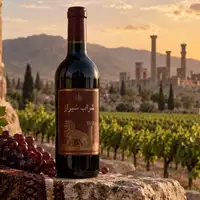
Nearly five decades after the 1979 Revolution brought an end to Iran's legal wine industry, the country retains vast vineyards and a centuries-old winemaking heritage but remains absent from a global wine export market worth $37.8 billion in 2025.
Iran has approximately 128,000 hectares of vineyards, just 31,000 fewer than Australia, whose wine exports were worth around €1.3 billion ($1.45 billion) in 2025.
The disparity reflects the disappearance of an industry from Iran's economy following the revolution, when the newly established Islamic Republic banned the production and sale of alcoholic beverages.
Grapes continue to be cultivated across Iran, including in Fars, Qazvin, Hamedan and Urmia, while Iranian raisins remain present in international markets. But an industry that could have generated exports, employment and tourism has remained absent for nearly five decades.
Freshly harvested grapes are displayed alongside traditional food preparation and drying trays in Ruyan, Semnan province, northern Iran, August 31, 2026.
Historic wines of Shiraz
The name "Shiraz" is now one of the most recognizable in the global wine industry, although the grape variety has no proven genetic connection to the grapes historically cultivated in Shiraz, southern Iran.
The shared name has long fueled a theory that the Syrah grape originated in Shiraz, Persia, before reaching France. In 1832, Scottish viticulturist James Busby brought Syrah vines from France to Australia, where the variety eventually became known as Shiraz.
Genetic research later established the grape's French origins, although the precise evolution of the Australian name remains disputed. The historical association with Persia has nevertheless endured.
Wine is deeply embedded in Persian culture and literature. Words such as mey and badeh, both meaning wine, and saqi, meaning cupbearer, established an enduring presence in Persian poetry.
Wine produced in Shiraz enjoyed commercial recognition during the Safavid period, when English and Dutch merchants transported some of it through the Persian Gulf to India and other parts of Asia, primarily for their own consumption.
In 1665, Shah Abbas II granted the French East India Company permission to produce wine in Shiraz for its employees.
The tradition continued into the Pahlavi era. Before the 1979 revolution, wine production and sales were legal in Iran, with commercial wineries operating in the country.
Freshly harvested grapes in crates at a vineyard in Ruyan, Semnan province, northern Iran, August 31, 2026.
The industry that might have been
Wine is more than the product of a vineyard. The industry extends from agriculture to factories, laboratories, glass bottle manufacturing, packaging, transportation, marketing, exports and tourism.
During the same decades that Iran's wine industry ceased operating, countries including Australia, Chile and New Zealand expanded their presence in the international market through investment in technology, education and branding.
According to the International Organisation of Vine and Wine (OIV), Australia had approximately 159,000 hectares of vineyards in 2025 and exported wine worth about €1.3 billion ($1.45 billion).
The comparison does not mean Iran and Australia have identical winemaking potential. Commercial winemaking requires suitable grape varieties, specialized equipment, established production standards and access to international export networks.
A hypothetical model based on OIV statistics and Australian industry data suggests that if 20 percent of Iran's existing vineyards were dedicated to growing grapes suitable for winemaking, annual wine production could reach approximately 125 million liters.
The estimate assumes an average harvest of seven metric tons of grapes per hectare and a conversion rate of 0.7 liters of wine per kilogram of grapes.
Under a hypothetical scenario in which Iran exported half of that production, divided equally between bottled wine at about $5 per liter and bulk wine at about $0.80, annual exports would be worth around $186 million at 2025 prices.
The figure is illustrative rather than a forecast. The calculation does not account for the cost of converting vineyards and building a wine industry, or the value of grape and raisin production displaced in the process.
Even with those limitations, it illustrates how part of Iran's existing agricultural capacity could have developed into an export-oriented industry.
Such an industry could also have generated employment across grape-growing regions, supporting agricultural workers, food-processing businesses, packaging plants, transportation companies and exporters.
A wine tourism destination?
In many parts of the world, winemaking has become an important contributor to tourism, attracting visitors and generating income beyond the vineyards themselves.
Bordeaux in France, Tuscany in Italy and Napa Valley in the United States are among the best-known examples of regions where vineyards have become tourist attractions alongside their role in wine production.
Shiraz, the capital of Fars province in southern Iran, would have had many of the ingredients for developing a comparable form of tourism, although revenues generated by established international wine regions cannot simply be applied to Iran.
The city and surrounding region already boast internationally recognized attractions, including Persepolis, the ancient ceremonial capital of the Achaemenid Empire, Pasargadae, the tombs of the Persian poets Hafez and Saadi, historic Persian gardens and distinctive local cuisine.
Vineyards, winery tours and opportunities to experience local food and wine could have complemented these attractions.
The name "Shiraz" itself could also have represented a valuable commercial advantage, although its international recognition in wine today is largely the result of Australia's successful industry.
The Gate of All Nations (also known as the Xerxes Gate) at the ancient ceremonial capital of Persepolis in Fars Province, Iran.
Combining the international familiarity of the Shiraz name with the legacies of Hafez and Saadi, Persepolis, Persian gardens and the region's long history of winemaking could have helped establish a distinctive identity for local tourism.
Other grape-growing regions of Iran such as Qazvin province and the city of Takestan, as well as Hamedan and Urmia, could have established wine-producing regions based on their climates and traditions of grape cultivation.
Iran's lost opportunity extends beyond the wine that might have been produced. It encompasses nearly five decades in which investment, jobs, exports and tourism around such an industry were unable to develop.
Perhaps a glimpse of what such an industry might have become can be found in one of the most celebrated verses of Hafez, the 14th-century Persian poet whose name remains inseparable from Shiraz:
Come, let us scatter flowers and pour wine into the cup.
Let us break through the roof of heaven and devise a new design.
A former Iranian labor minister has drawn ridicule after saying the country has no economic problems other than high prices and inflation, remarks that came as official data showed year-on-year inflation approaching 90%.
Hojjat Abdolmaleki, who served under former president Ebrahim Raisi and is an economics professor, made the remarks in a recent interview with state television that has circulated widely online over the past two days.
“In the economy, the issue is only and only high prices and inflation,” Abdolmaleki said. “Set high prices aside and you have no other economic problems… We have no problems, praised be God.”
The former minister has previously made controversial remarks about the causes of inflation. In August, he claimed that rising prices were not even one percent attributable to the war and regional conditions.
Reformist and moderate newspapers, including Sazandegi, criticized the assertion as an oversimplification that ignored the economic costs and currency shocks resulting from political and military developments.
Abdolmaleki has also dismissed the economic consequences of international internet disruptions, saying nobody had lost their job because of internet shutdowns and that online sellers could move their businesses to domestic platforms.
Critics argued that changing platforms could not guarantee businesses would retain their customers, income or jobs.
Ridicule crosses political lines
Abdolmaleki's latest remarks have drawn criticism from conservatives as well as moderate and reformist voices.
The moderate conservative news website Khabar Online published the video under the headline: “Abdolmaleki’s Great Discovery About Iran’s Economy: Erase the Problem from the Equation to Solve It!”
Bamdadeno, an online media outlet active primarily on Instagram and Telegram, compared the argument to saying that “if you disregard poverty, there are no poor people; ignore unemployment, and everyone is employed.”
“The issue is not simply how bizarre a sentence is,” it added. “The issue is that decisions about employment, livelihoods and the welfare of millions of Iranians were once made on the basis of this kind of outlook and oversimplification.”
Rouhollah Jome’i, a conservative political activist, took a sarcastic swipe at Abdolmaleki, who is associated with hardline groups known as “super-revolutionaries.”
“What an interesting way of putting it! For example, if we set aside delusional super-revolutionaries, we would have no political or security problems either…” he wrote on X.
Journalist Mohammad Parsi applied the same logic to other problems facing Iranians.
“Yes, if there is no internet, there is no problem with filtering; if we do not get sick, there is no problem with medicine; and if we do not drive cars, there is no problem with petrol,” he wrote.
“This satire becomes bitter when we remember that this man was once a minister in this country and made decisions on our behalf!”
One Instagram user applied the same logic to several other problems: “Yes! The problem with drought is only a lack of water! The problem with power cuts is a lack of electricity! The problem with cars is a shortage of parts and funding! Otherwise, we have no problems!”
Another user questioned whether the country could hope for improvement with people like Abdolmaleki in positions of influence over major decisions.
Inflation approaches 90%
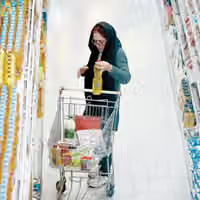
The remarks come as official figures indicate that inflationary pressures in Iran remain severe.
According to the latest figures from the Statistical Centre of Iran, year-on-year inflation rose by 0.8 percentage points last month to 89.8%. Annual inflation increased from 69.9% in August to 73.6% in September.
Inflation in food and beverages was considerably higher than the overall rate, with prices of some food items, including cooking oil, rising by more than 250% compared with a year earlier.
Even housing rents, which recorded the lowest rate of increase among the 12 main categories of goods and services in the household consumption basket, rose by more than 30% year on year.
The figures point to mounting pressure on Iranian households and declining purchasing power, providing a stark backdrop to Abdolmaleki's assertion that, high prices aside, the economy has no other problems.
People wait for service at a post office in Iran, October 8, 2026
Iranians receiving unemployment benefits say payments have been delayed by up to two months, leaving some struggling to pay for food and service debts, according to messages sent to Iran International.
Recipients described repeated delays of several weeks and said banks and Social Security offices had provided little clarity over when the money would arrive, as inflation above 70% and the rial’s steep decline further squeeze household finances.
“Unemployment benefits are our only lifeline. I’m struggling to cover expenses for myself, my spouse and children,” one recipient said. “Every day the money doesn’t arrive, we’re left with an empty table and a sense of shame.”
Payments ‘weeks late’
Several recipients reported recurring delays of 20 to 25 days, while others said they had gone without benefits for as long as two months.
One person whose payment was more than a month overdue said people depended on the modest allowances to put food on the table and service debts.
The person said Bank Melli and Refah Bank had refused to accept responsibility for the delay, while the Social Security Organization said it had issued the payment check and the matter was now in the banks’ hands.
Another recipient reported a 25-day delay in receiving a monthly allowance of 160 million rials, saying Branch 15 of the Social Security Organization routinely made late payments.
A person with 22 years of employment history who had been unemployed for six months said the organization’s Shemiran branch in northern Tehran had failed to pay their benefits.
Others described receiving vague promises from local offices.
“The payment was supposed to arrive by the 15th of the month, but there’s been nothing. Some branches told us to wait until the 30th because it might be paid then,” one person said.
Under Iranian law, workers who involuntarily lose their jobs may qualify for unemployment benefits if they meet employment and insurance requirements.
For many recipients, the payments are their primary source of income while looking for work.
Social Security under strain
The delays come amid wider concerns about the finances of the Social Security Organization (SSO), Iran’s main social insurance institution responsible for unemployment benefits and pensions.
SSO chief Mostafa Salari said on July 27 that the organization faced a monthly pension shortfall of at least 170 trillion rials even if it collected all current insurance contributions. He put its debt to the central bank at 750 trillion rials.
Pensioners have also protested over delayed payments in recent months. On Sept. 20, retirees gathered in Tehran, Ahvaz, Rasht, Shush and Kermanshah to demand outstanding payments, including delayed pension adjustments.
The complaints come alongside broader reports of unpaid wages and insurance contributions across Iran.
Iran International reported last month that workers in several sectors, including factories and healthcare facilities, were facing delayed salaries and insurance contributions.
Workers laid off from Rajaee Port in Bandar Abbas have also reported unpaid wages and difficulties accessing unemployment benefits.
For those waiting for payments, however, the immediate problem is making ends meet.
“They haven’t deposited my unemployment benefits. I have countless loan repayments and debts, and I’m desperate,” one recipient said. “Social Security treats us so badly, as though we’re the ones who owe them money.”
Farmers harvesting wheat in the Deylaman region of Siahkal County, Gilan Province, Iran.
Iranian wheat farmers told Iran International that delayed government payments for their previous harvest are leaving them short of cash for autumn planting, while inflation and the falling rial erode the value of money they are still owed.
Farmers described having to pay cash for seeds, fertilizer, pesticides, labor, irrigation and other costs while waiting for the government to settle payments for wheat already delivered.
A farmer in the Sanjabi area of the western province of Kermanshah told Iran International that the delays were making it increasingly difficult to cover essential expenses.
"Most of my farming expenses have to be paid in cash, while the government pays us our own money in installments," the farmer said.
Another farmer in western Iran said inflation and the rial's depreciation meant that delayed payments were worth considerably less by the time they arrived.
"By the time they pay us everything they owe for our wheat, gold and dollar prices and inflation will have multiplied, and the value of our money will have fallen sharply. Which official cares about the difference?" the farmer told Iran International.
Even when farmers eventually receive the full amount originally agreed, the money may buy considerably less than it would have when they delivered their crop.
Between 10% and 30% of payments owed to wheat farmers remain outstanding in different provinces, according to Ghadam Borbor, deputy head of Iran's National Wheat Foundation.
Rial depreciation cuts dollar value of wheat payments by 36%
Earlier this year, the government set its guaranteed wheat purchase price for the previous agricultural year at between 475 million and 495 million rials per metric ton, depending on the type and quality of the crop.
At the time, the dollar traded at 1,663,700 rials on the open market, making the highest guaranteed price equivalent to approximately $298 per ton.
At the current open-market rate of about 2.615 million rials to the dollar, that same 495 million-rial payment is worth about $189, a decline of roughly 36%.
The figures illustrate how the depreciation of the rial has reduced the dollar value of farmers' earnings while the government's nominal debt has remained unchanged.
The actual loss of purchasing power depends on changes in domestic prices and agricultural production costs, but farmers say they are increasingly unable to afford supplies needed for the next harvest.
Billions owed as government cites administrative delays
Borbor said the new 1405–1406 agricultural year (2026–2027) had begun without a guaranteed wheat purchase price and with preparations for autumn planting still incomplete.
Iran's government says it has settled most of its debts to wheat farmers but has not announced a deadline for paying the remainder.
According to figures released by the Targeted Subsidies Organization, the government body responsible for administering subsidy payments, on October 9, approximately 3,920 trillion rials ($1.50 billion at the current open-market rate) of the 4,100 trillion rials ($1.57 billion) owed to wheat farmers had been paid.
That left about 180 trillion rials ($69 million) outstanding.
Hassan Norouzi, head of the organization, said some payments were being held up by discrepancies between its records and those of the Ministry of Agriculture.
He said the remaining payments depended on correcting information in the government's administrative system.
For farmers who need the money for autumn planting, that means continuing to cover new production costs while government agencies resolve the discrepancies.
The Ministry of Agriculture has set wheat seed prices at between 720,000 and 756,000 rials ($0.28–$0.29) per kilogram, at least 45% above the highest guaranteed government purchase price of 495,000 rials ($0.19) per kilogram for harvested wheat.
Although seeds prepared for planting differ from ordinary harvested wheat, the price difference illustrates the financial burden facing farmers as they prepare for the new season.
A farmer in Nourabad told Iran International that the situation was becoming increasingly difficult.
"We have to buy seeds with cash, even though the government owes us money. Under these circumstances, what motivation is left to continue?" the farmer said.
Farmers turn to middlemen for immediate payment
The payment delays have prompted some farmers to sell their wheat to middlemen at prices below the government's guaranteed purchase rate.
Peyman Alemi, head of Iran's Chamber of Agricultural Guilds, said farmers urgently needing cash were selling wheat to intermediaries for between 380,000 and 440,000 rials ($0.15–$0.17) per kilogram.
That compares with the government's highest guaranteed purchase price of 495,000 rials ($0.19) per kilogram.
The difference means farmers accepting lower prices for immediate payment are sacrificing part of their potential income to cover mounting expenses.
Alemi warned that continued delays could discourage farmers from selling wheat to the government and potentially reduce domestic production in the next agricultural year.
Lower government purchases or falling domestic wheat output could complicate efforts to maintain strategic wheat reserves and increase reliance on imports, particularly as the rial's depreciation raises the cost of purchasing grain from abroad.
Bread prices climb despite unpaid farmers
The payment delays also come as bread prices rise across Iran, adding to the financial pressure on households.
Under the latest officially approved prices in Tehran, a loaf of sangak, a traditional Iranian flatbread, costs 155,000 rials (about $0.06), while barbari bread costs 100,000 rials (about $0.04).
Prices are considerably higher at bakeries operating outside the subsidized pricing system.
A review of prices recorded in October showed some varieties of sangak selling for as much as 500,000 rials ($0.19) in Tehran and 400,000 rials ($0.15) in the northeastern city of Mashhad.
The increases mean consumers are paying more for bread while some farmers who produced the wheat are still waiting for their earnings.
However, the current rise in bread prices cannot be directly attributed to delayed government payments, and the potential effects on future wheat production and imports have yet to materialize.
New planting season begins without guaranteed prices
Farmers face further uncertainty because the government has yet to announce the guaranteed purchase price for wheat from the current agricultural year.
The lack of a confirmed price makes it harder for farmers to calculate expected income and decide how much they can afford to spend on the new crop.
Many are therefore beginning the new planting season with part of the money for their previous harvest still unpaid, production costs that must largely be met in cash and no certainty over what the government will pay for their next crop.
Even if the government settles all outstanding payments, farmers may not recover the purchasing power lost during months of delays or the opportunities missed to buy agricultural supplies earlier.
Their previous wheat harvest has already been delivered to government storage facilities, but some producers are still waiting to be paid.
Agricultural officials warn that continued delays could undermine farmers' willingness to plant wheat or sell it to the government, potentially creating further challenges for Iran's domestic wheat supply.
File photo: A man speaks on his phone beneath a market board at the Tehran Stock Exchange.
Iran’s stock market is raising eyebrows with a sustained rally even as the country’s economy struggles with dwindling foreign-currency inflows, energy shortages and uncertainty over the war.
The divergence is particularly striking after the International Monetary Fund on Tuesday forecast Iran's economy would contract 7.6% in 2026, far more sharply than the 0.3% decline expected across the Middle East and Central Asia.
Against that backdrop, the strength of Tehran's stock market raises a question: are investors betting that the worst is approaching an end, or simply running out of places to protect their money?
Recent analyses in Iranian media offer competing explanations, ranging from expectations of an Iran-US agreement to the immediate pressures of dwindling foreign currency and energy shortages.
Dollars in short supply
Iran's oil exports have effectively stopped under the US blockade, while non-oil exports including steel and petrochemicals have also fallen. Delays in repatriating export earnings have further restricted the supply of hard currency.
Fararu identifies dwindling foreign-exchange inflows, energy shortages and uncertainty as the three principal pressures on the economy. Khabar Online puts the currency shortage at the center of its analysis, pointing to a 35,000-toman rise in the free-market dollar over the past month.
The widening gap between official and market exchange rates has added to volatility, while businesses dependent on imported machinery and raw materials face higher costs and tighter access to foreign currency.
Energy shortages are compounding those problems. Years of underinvestment have left Iran struggling to meet domestic demand, while wartime damage to infrastructure has added pressure on production.
Hovering over both is uncertainty about what comes next. The economic consequences of renewed fighting would differ dramatically from those of a negotiated settlement, making long-term investment all but impossible and pushing businesses and households toward assets that can preserve value.
Why are stocks rising?
That makes the performance of Tehran's stock market more striking.
Rouydad24 interprets its wartime strength as a sign that investors increasingly expect an Iran-US agreement. On that reading, equities are looking beyond present economic conditions toward possible de-escalation, sanctions relief and improved access to international markets.
But there is another explanation that requires no assumption that investors know where negotiations are heading: they may simply have nowhere better to go.
With the rial losing value, foreign currency increasingly scarce, property relatively illiquid and bank deposits losing purchasing power to inflation, domestic equities can become attractive even when confidence in the underlying economy is weak.
A rising stock market, in other words, may say less about optimism over Iran's economic prospects than about the scarcity of alternatives for preserving wealth.
That would also help reconcile what otherwise appear to be conflicting signals. The currency market reflects immediate scarcity and fear of further deterioration, while stocks may reflect either hopes for political relief or an effort to escape the declining value of cash.
Different markets, different futures
The IMF's latest forecast represents another substantial downgrade from the 5.4% contraction it expected as recently as July. Iranian government data has meanwhile shown GDP contracting 10% year-on-year in the spring, with the downturn extending beyond the oil sector.
For businesses and investors, much now depends on which of two very different futures emerges: renewed conflict and prolonged restrictions on oil exports, or de-escalation that begins restoring access to foreign currency and international trade.
Iran's markets may therefore be pricing different risks rather than delivering contradictory verdicts. The currency market reflects a shortage that already exists. The stock market may be looking toward political relief or reflecting the capital having nowhere else to go.
Director Asghar Farhadi poses during a photocall for the film "Histoires paralleles" (Parallel Tales) in competition at the 79th Cannes Film Festival in Cannes, France, May 15, 2026.
Oscar-winning Iranian filmmaker Asghar Farhadi says his next film will be in Persian and set in Tehran but shot abroad to avoid Iran's mandatory hijab rules and government permit requirements.
In a caption accompanying Instagram video excerpts from a cinema masterclass in Brazil, Farhadi said the screenplay for his next film, a social drama, was nearing completion and filming was planned for 2027.
"My next film, whose screenplay is nearing completion, is a social drama in Persian and has nothing to do with Palestine," he wrote, apparently responding to social media rumors.
"Although the story is set in Tehran, as I have previously stated, I am not willing to make a film under an official permit and with mandatory hijab requirements. For this reason, the film is scheduled to be shot outside Iran next year."
Under Iran's film regulations, filmmakers must obtain production permits from the Ministry of Culture and Islamic Guidance, which oversees the film industry and enforces government censorship requirements.
Directors must submit scripts for approval before filming, while completed productions undergo a separate review before they can be screened publicly. Female performers are also required to wear the hijab on screen, including in scenes depicting private settings.
Farhadi, who won Academy Awards for A Separation and The Salesman, had already announced plans to return to Persian-language filmmaking.
In an August 18 interview with film industry publication Screen Daily, he said his next project would be shot outside Iran and France, citing political and social restrictions as his reason for not filming in his home country.
His latest comments explicitly reaffirmed his refusal to work under Iran's official permit system and mandatory hijab requirements.
Farhadi rejects Tehran’s interpretation of his Hollywood remarks
The filmmaker also addressed controversy surrounding remarks he made about Hollywood cinema and American democracy during a masterclass in Brazil.
Farhadi said some media outlets had incorrectly described his comments as an interview with entertainment publication Variety, when they were made in response to a moderator's question about the Hollywood film Argo during a session attended by students and cinema enthusiasts.
The 2012 film, directed by Ben Affleck, depicts a CIA operation to rescue six Americans from Iran during the 1979 hostage crisis.
"Criticizing parts of Hollywood cinema, the condescending perspective in some films, and discussing American democracy in no way means endorsing the existence of democracy or the way Iran is governed," Farhadi wrote.
He accused media outlets close to Iran's government of exploiting his remarks for political purposes, saying the same outlets had spent years insulting and attacking him.
"The appropriation of my remarks by certain media outlets close to the government is a blatant misuse for their political objectives, which I have never believed in," he wrote.
"Iran, my homeland, has been my red line throughout all these years," Farhadi added. "Everything I have said, and everything I will say from now on, has always been based on this conviction."