Most Viewed
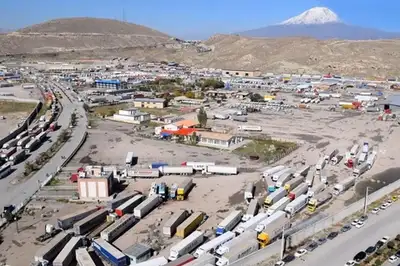


Reports that the Islamic Republic sent $200 million to Lebanon's Hezbollah have drawn anger from Iranians struggling with rising living costs, low wages and medicine shortages, according to messages sent to Iran International.
Citizens accused the authorities of prioritizing financial support for regional allies over the needs of Iranians, contrasting the reported payment with their own incomes, government subsidies and mounting household expenses.
In messages, several people described struggling to afford basic necessities, while others questioned why the Islamic Republic was directing resources abroad during Iran's economic crisis.
"You give each Hezbollah family 8 billion rials, but deposit a 5000,000-rial food allowance for each Iranian and then take even that back a few hours later. This country's money belongs to its people, not Hezbollah," one citizen said.
Another compared the payments with compensation given to Iranian soldiers.
"A soldier who spent eight months under missile fire with no way to escape received seventy million rials in combat pay. Then you gave Hezbollah 8 billion rials from our money," the citizen said.
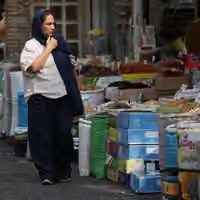


Citizens accused the authorities of prioritizing financial support for regional allies over the needs of Iranians, contrasting the reported payment with their own incomes, government subsidies and mounting household expenses.
In messages, several people described struggling to afford basic necessities, while others questioned why the Islamic Republic was directing resources abroad during Iran's economic crisis.
Hezbollah payments dwarf Iranian wages
"You give each Hezbollah family 8 billion rials, but deposit a 5000,000-rial food allowance for each Iranian and then take even that back a few hours later. This country's money belongs to its people, not Hezbollah," one citizen said.
Another compared the payments with compensation given to Iranian soldiers.
"A soldier who spent eight months under missile fire with no way to escape received seventy million rials in combat pay. Then you gave Hezbollah 8 billion rials from our money," the citizen said.
Reuters reported on October 7, citing two people with direct knowledge, that Hezbollah received $200 million from Iran in September and planned initial payments of $3,000 per family, prioritizing approximately 50,000 families displaced by the war.
The reported transfer has been disputed by Washington. The US State Department disputed the reported transfer. Spokesperson Tommy Pigott accused Hezbollah of trying to “save face with fake stories about cash influxes from Iran”, saying the group “can claim whatever it wants, but the money is not there”.
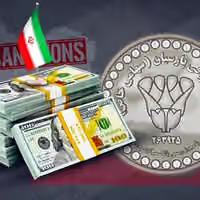
Pigott said Tehran was suffering under a US blockade of its oil exports and that Washington would continue targeting Hezbollah's finances through sanctions while supporting the Lebanese government's efforts to rebuild the country's south.
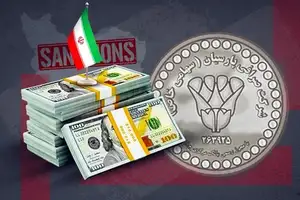
At an exchange rate of approximately 2.67 million rials per dollar on Iran's open market, $3,000 amounts to roughly 8 billion rials.
A teacher in Tehran with 18 years of experience compared the payments with his annual salary.
"My salary for an entire year is about 3 billion rials, yet you gave 8 billion rials of our money to the Lebanese," the teacher said.
A local government employee with 29 years of service and a master's degree said his total monthly income was 350 million rials.
Citizens in Neyshabur and Malard also criticized the reported payments, saying the Islamic Republic was directing national resources toward allied groups abroad while Iranians faced poverty and declining purchasing power.
Islamic Republic officials have not formally confirmed the reported $200 million transfer, and the US government has rejected the account.
"Hezbollah has been decimated and caused misery for hundreds of thousands of innocent Lebanese. It is now trying to save face with fake stories about cash influxes from Iran," US State Department spokesperson Tommy Pigott said in a statement. "It can claim whatever it wants, but the money is not there."
Families sell belongings to afford basic necessities
Several citizens described the financial pressures facing their families, including difficulties paying for medicine, food and other essentials.
One person said her husband and son had been forced to sell their mobile phones to cover household expenses, contrasting the family's financial difficulties with the reported funding for Hezbollah.
Another described the rising cost of medication for her father.
"I bought just three blood pressure and heart medications for my father, and they cost 85 million rials. I didn't have enough money to buy the rest of his medicines. Insulin is also unavailable. Previously, these medicines did not even cost 5 million rials," the citizen said.
Other citizens described struggling to afford food and household expenses despite receiving government subsidies and food vouchers.
One person said the authorities treated modest increases in food assistance as a financial burden while continuing to spend substantial sums supporting allied groups in Lebanon.
Anger over Islamic Republic's spending priorities
Some calculated how many Iranian households could benefit from the reported $200 million payment, arguing that the money could help tens of thousands of families struggling with living expenses.
One person directed criticism at Supreme Leader Mojtaba Khamenei over the allocation of national resources.
"You have abandoned your own nation and are giving the Iranian people's money to the Lebanese. It is not your father's inheritance. Charity begins at home," the citizen said.
Another questioned the priorities of President Masoud Pezeshkian and his deputy, saying their public emphasis on serving Iranians conflicted with the financial support directed toward Hezbollah.
The citizen also expressed concern that such funding could contribute to continued armed conflict and civilian deaths.
Several others described the reported payment as part of the Islamic Republic's longstanding policy of financing allied armed groups across the Middle East.
Reuters reported in June that Hezbollah was awaiting additional financial support from Iran after suffering heavy losses in its war with Israel.
The US Treasury Department previously said Iran had transferred over $1 billion to Hezbollah during the first 10 months of 2025.
Messages sent to Iran International by employees at companies spanning the automotive, energy, pharmaceutical and aviation industries describe wages arriving weeks or months late, with some workers saying they have taken second jobs to cover everyday expenses.
Several employees said their salaries were being paid in installments rather than on schedule. Others described losing workplace benefits or being told to resign if they objected to payment delays.
Delayed wages and disappearing benefits
Two workers at Megamotor, a subsidiary of automaker Saipa, criticized the company's wage and benefit payments in messages to Iran International.
Salary payments became irregular after the 40-day war, one worker said.
“We are suffering greatly and do not know how we can provide for our families.”
Another Megamotor employee said some wages and benefits, including overtime and meal allowances, were no longer being paid to workers, while managers and supervisors continued to receive overtime and other benefits.
Low pay at Saipa Yadak has forced most employees to work for the Snapp ride-hailing service from the afternoon until late at night, an employee of the auto-parts company said.
Some of the company's resources are spent on government ceremonies or large payments to senior managers, the employee added.
Workers at Bahman Motor are also facing financial and psychological pressure, an employee of the automaker said.
The company has declined to make payments to employees even as it continues constructing new industrial buildings, according to the employee.
The accounts come as Iran's economic problems have deepened in recent months alongside the Islamic Republic's regional policies, tighter sanctions and a sharp decline in the value of the national currency.
Rapid inflation and declining purchasing power have increased pressure on household budgets and made basic goods harder to afford for a broad section of the population.
Iran International reported in August that workers at mines and companies had gone months without receiving wages.
Workers say complaints put jobs at risk
Employees at other companies described wages being divided into installments and said challenging the delays could put their jobs at risk.
Salaries at Imen Tak Pishro in Jajrud are paid in installments and employees who object are warned they could be dismissed, one worker told.
Another employee previously told Iran International that their employer paid three months of overdue salaries in two installments.
Mapna has not paid workers at 25 power plants for 40 days, an employee of the company said.
At pharmaceutical company Arya Tinagen, salaries remained unpaid 11 days into the month, an employee said.
“The company has cut all employee benefits, from meals to the monthly benefit card. If we complain, they tell us to resign and leave.”
Messages in recent days have also described overdue wages, unpaid insurance contributions and warnings of dismissal across a range of workplaces.
An employee at Yasuj University of Medical Sciences said at the time that staff had gone three months without salaries and were warned they could lose their jobs if they pursued their demands.
Second jobs and unemployment fears
For some workers, irregular wages and rising living costs have made additional employment a necessity. For others, the concern is whether their main job will survive at all.
An employee at Ata Airlines said inflation, the rising exchange rate and aviation sanctions had led the carrier to cut jobs.
The airline had previously borrowed billions of tomans in an effort to avoid dismissing employees, according to the worker.
Employees at Kish Air said they had been instructed not to report for work until further notice and had not received a year's worth of performance-related payments.
Concerns extend beyond individual companies.
Large numbers of factories at the Shamsabad industrial estate have shut down, one person familiar with employment conditions there told Iran International.
The person said they had filled out around 50 job applications for factories in the industrial estate without receiving an offer.
The accounts follow broader signs of concern about employment. In an Iran International survey published in August, 92% of respondents said they had witnessed unemployment among people around them.
The posts reviewed by Iran International reflect individual online reactions and are not representative of public opinion in Iran. But they show how the growing economic pressure is being interpreted by people arguing both for and against the blockade.
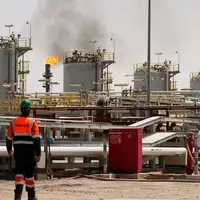
That pressure has intensified as the US naval blockade sharply curtailed Iran’s oil exports, a major source of foreign currency. Iranian crude loadings fell from about 2 million barrels per day in March to roughly 220,000-255,000 in August, according to shipping data cited by Reuters.
“Great. An air and sea blockade, then a land blockade, will lead to the government’s fall,” one Persian-language social media user wrote.
“The economic blockade is choking it,” another wrote.
Support for continued pressure has also appeared on Reddit. “I said months ago that the blockade is a good strategy,” one commenter wrote, expressing hope that US President Donald Trump would maintain it.
Another user in the discussion described maintaining the pressure as “Great for Iran.”
Taken together, the posts illustrate a view among supporters of the blockade that restricting trade and government revenue could weaken the Islamic Republic’s ability to withstand domestic pressure.
One user argued that the blockade could erode the authorities’ ability to administer and control the country by reducing oil revenue, weakening internal cohesion and increasing economic pressure.
“The blockade is not the objective, but the instrument,” he wrote, arguing that the aim was to increase pressure until the authorities struggled to maintain stability and manage the economy.
Others say ordinary Iranians will pay
Other users rejected the idea that economic isolation would bring political change and warned that the greatest burden would instead fall on the public.
“I don’t know of an example in history where sanctions and an economic blockade caused a revolution. Ordinary people just suffer,” one user wrote on X.
Another said prolonged isolation could strengthen corruption and preferential access, leaving politically connected people better placed to profit from shortages while the wider population becomes poorer.
“This situation could continue for years,” the user wrote, adding that the authorities could blame worsening economic conditions on the blockade.
For others, the consequences are already visible far beyond politics and trade.
“You can’t leave the country by air or sea. All the language exams have sanctioned us. Eighty percent of online games are restricted for Iranians. You can’t even create a Gmail account,” another person wrote on Instagram.
“It’s as though the project to erase Iranians from the face of the earth has officially begun,” the user added.
Dark humor over growing isolation
The restrictions have also prompted sarcasm directed at official assertions of resilience.
After Turkish Airlines suspended its Iran flights until at least March 2027, one commenter ironically invoked a familiar phrase in Iranian political rhetoric: “America can’t do a damn thing.”
“They just keep announcing victories one after another,” another wrote with laughing emojis.
A longer sarcastic comment mocked rhetoric about missiles, drones and military strength before concluding: “If the blockade continues, soon we’ll have to eat grass.”
Economic hardship also featured in discussions on Reddit. One commenter said half their monthly salary went on groceries and food and the other half on rent, leaving them dependent on savings. Another described paying 15 million rials for a kilogram of cold cuts and pickles.
The rial has fallen sharply during the economic squeeze, trading at more than 2.3 million to the dollar in September.
Iran’s official minimum monthly wage is about 166 million rials, worth roughly $71 at that exchange rate, meaning the purchase described by the commenter would amount to about 9% of a minimum-wage worker’s basic monthly pay.
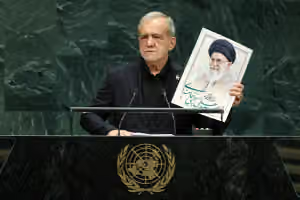
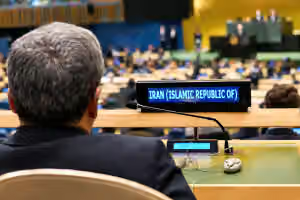
Speaking at the 81st General Assembly on Wednesday, the president said Tehran was ready for dialogue but rejected "the language of force," called Donald Trump's words a sign of "the character of a bully and the logic of force," and held up photographs of the late Ali Khamenei and of schoolchildren killed in the strike on Minab in the war's first hours.
Three things drew the messages: the gap between the president's posture abroad and the state's conduct at home; the crackdown of January that he did not name; and the way he spoke.
'Only brave in front of us'
The most frequent reaction set the president's words in New York beside the state's words in Iran.
"The Islamic Republic wants dialogue with anyone stronger than itself," one wrote, "and bullies its own defenseless people."
Another pointed to Pezeshkian's repeated use of the word force: inside Iran the state threatens America, he wrote, and in New York it asks "why are you bullying us."
The president's own language on the January protests was not far from writers' minds. In August he called the protests a "riot" and described those who reported the killings as "cowards and traitors," remarks that had drawn an earlier wave of messages. On January 11, days after the killings, he had called the protesters "terrorists" and demanded a "decisive" response from the security forces.
One writer put it in a single line: for 47 years the Islamic Republic has been busy with terror, and now Pezeshkian comes to play the victim.
Another watched the delivery rather than the text. "People like Pezeshkian only claim power and swagger in front of us," he wrote. "From the trembling voice, the stumbles and the level of stress in his speech, it was clear how brave he is in front of real superpowers."
What he left out
Pezeshkian never used the word protests. The Iranians he described in the streets these past seven months were the crowds at the state's own rallies, organized by the Revolutionary Guards and the Basij, out at night, in his telling, to defend the country against people "America and Israel had incited and put guns in the hands of."
The millions who came out against the state, and the tens of thousands killed, did not appear in the speech at all.
A writer from Qeshm, the island in the Strait of Hormuz, said the president had repeated the state's version of the protests instead of speaking about Iran's own victims, including those killed on January 8 and 9 and in earlier crackdowns.
Others treated the speech as an occasion to list what it omitted: the protests of December 2017 and January 2018, Bloody November in 2019, the Woman, Life, Freedom uprising of 2022, the January 2026 uprising, and the poisoning of girls' schools in 2022 and 2023.
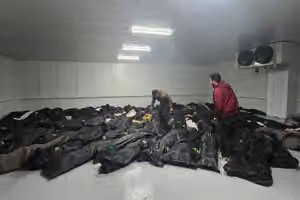
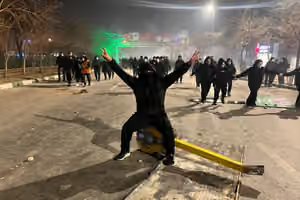

The messages came days after the UN fact-finding mission on Iran presented its latest report. Its chair, Sara Hossain, said the January crackdown had met protests with an "extremely violent" response, and that many of the violations, including killings and imprisonment, amounted to crimes against humanity.
Several writers said that Iranians themselves had been pushed to the margins of the speech. "Pezeshkian was more a defender of the Revolutionary Guards and of Palestine," one wrote, "than someone who wanted to say anything about the people of his own country."
How he said it
The third and most personal thread was the president's manner: his walk, his delivery, his command of his own text.
Many described his bearing as a street tough's swagger and compared him to Shaban Bi-Mokh, the Tehran strongman whose mobs helped bring down the government in the 1953 coup and whose nickname means "the brainless." Writers said his grip on the speech was so weak that a passerby pulled off the street and put at the UN lectern would have spoken more fluently and said more.
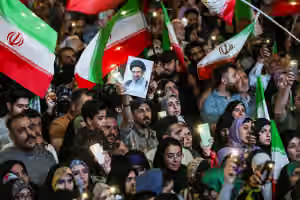
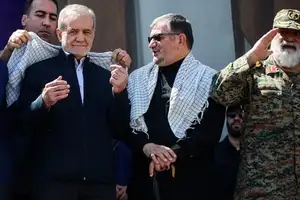
A writer from Tehran said he had been ashamed to watch Pezeshkian represent Iran, in a speech he found empty of manners, culture or "any diplomatic decorum."
"Why can't he speak properly?" another asked. "He talked as if someone had a gun to his head."
One writer compared the speech to those of Mohammad Reza Shah Pahlavi and said the level of language from the president of the Islamic Republic had left him astonished.
Several concluded that the delivery reflected the office. Pezeshkian, they wrote, has no authority of his own; he reads what is written for him and handed to him.
"That is why they made him president," one wrote. "The text they write for him usually has a fixed structure, and it is on file at the foreign ministry and the presidency."