• العربية
  • فارسی
Brand
  • Iran Insight
  • Politics
  • Economy
  • Analysis
  • Special Report
  • Opinion
  • Podcast
  • Live TV
  • Iran Insight
  • Politics
  • Economy
  • Analysis
  • Special Report
  • Opinion
  • Podcast
  • Live TV
  • Theme
  • Language
    • العربية
    • فارسی
  • Iran Insight
  • Politics
  • Economy
  • Analysis
  • Special Report
  • Opinion
  • Podcast
  • Live TV
All rights reserved for Volant Media UK Limited
volant media logo
VOICES FROM IRAN

'Killers in suits': Iranians ask New York's mayor why Pezeshkian walks free

Saba Heidarkhani
Saba Heidarkhani

Iran International

Sep 24, 2026, 09:13 GMT+1
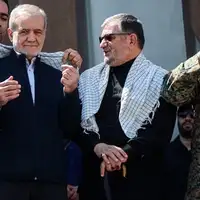
Foreign Minister Abbas Araghchi, seen from behind, listens as President Masoud Pezeshkian addresses the UN General Assembly in New York on September 23, 2026.

Iranians writing to Iran International this week did not see a diplomatic visit. They saw the men they hold responsible for January's massacre walking free in New York, and they asked the city's mayor, who once promised to arrest Netanyahu, why.

As President Masoud Pezeshkian and Foreign Minister Abbas Araghchi arrived for the UN General Assembly, the messages came in with a phrase that recurred until it became the story's own name: the "killers in suits." The demand attached to it was the same almost every time. Arrest them.

Voices from Iran draws on messages sent to Iran International by people inside the country. Names are withheld for their safety.

100%
Foreign Minister Abbas Araghchi (left) and other members of Iran's delegation in the General Assembly hall listen as President Masoud Pezeshkian speaks in New York on September 23, 2026.

The demand

A writer from Fardis, on the western edge of Karaj, pointed to the latest human rights reports and asked why officials responsible for crushing 40,000 protesters in January were not being detained in New York.

Another wrote simply that now they were there, this was a good chance to arrest Pezeshkian and Araghchi.

The UN fact-finding mission on Iran said in its new report that many of the violations committed in the crackdown on the January 2026 protests, including murder, imprisonment and severe deprivation of liberty, amounted to crimes against humanity. Its chair, Sara Hossain, said the true number of victims could be "significantly" higher than the government's own figure.

One writer suggested that while the officials were at the United Nations, footage and documents of the killings should be handed to the same body. Others addressed Donald Trump directly, asking him to act on the crackdown rather than host or negotiate with the delegation.

And several turned to Zohran Mamdani, who as a candidate for mayor of New York said he would have Benjamin Netanyahu arrested if the Israeli prime minister set foot in the city, citing the International Criminal Court warrant against him.

"The mayor of New York who wanted to arrest Netanyahu," one wrote, "does he by any chance not intend to arrest the criminals in suits who sit on the Supreme National Security Council and whose signatures are on the massacre of January 8 and 9?"

The visas

A second thread was anger at what writers called the West's double standard: condemning the repression while receiving the men accused of it.

"My question is this," one wrote. "Didn't Mr. Trump always talk about the January massacre? So why has he given visas to the ringleaders of the killers of Iran's children?"

The State Department has said that admitting the core members of the Iranian delegation was an obligation Washington carries as host of the United Nations, and that the delegation's movements were restricted. The US government also agreed to Araghchi's request for a security detail during his stay.

"Bodies attached to the United Nations say the leaders of the Islamic Republic have committed crimes against humanity," another writer addressed the president. "Why are they now freely, and even under your escort, in America and at the UN?"

Not everyone expected an arrest. One writer said it was probably beyond the West to detain the officials, and proposed instead that Iranians abroad gather outside UN headquarters.

'A puppet'

The other constant in the messages was that Pezeshkian does not decide anything, and that his presence at the UN is a performance of the system that does.

Writers called him a marionette, a wind-up doll, and the tea boy of the power mafia, and called the trip a circus staged for legitimacy.

Some pointed to how little it achieved. One wrote that for years the Islamic Republic's only gain from attending the UN had been shopping in New York, and that Trump had taken even that away.

Last September the State Department restricted the Iranian delegation's access to wholesale and luxury stores during its stay.

Beneath the mockery ran a fear. Several writers worried that a deal might be struck, and that the file on the killings would be pushed aside for it.

Banner

Most Viewed

Tehran sets out terms as US-Iran talks intensify in New York
1

Tehran sets out terms as US-Iran talks intensify in New York

2

Trump sees ‘momentum’ for Iran deal after New York meetings

3

Iranian airlines continue foreign flights after US sanctions deadline - Bloomberg

4

Iran offers to reopen Hormuz within seven days if US lifts Hormuz blockade

5
ANALYSIS

Freeway sign hack aims to frighten Iranians in Los Angeles, experts say

Banner

Spotlight

  • New US-Iran talks run into old question of who speaks for Tehran
    ANALYSIS

    New US-Iran talks run into old question of who speaks for Tehran

  • They can erase you without arresting you
    TEHRAN INSIDER

    They can erase you without arresting you

  • Freeway sign hack aims to frighten Iranians in Los Angeles, experts say
    ANALYSIS

    Freeway sign hack aims to frighten Iranians in Los Angeles, experts say

  • The price of US pressure moves up Iran’s social ladder
    VOICES FROM IRAN

    The price of US pressure moves up Iran’s social ladder

  • Pezeshkian squeezed at home over meeting Trump in New York

    Pezeshkian squeezed at home over meeting Trump in New York

  • Can Iran and US find a deal while threatening escalation?
    ANALYSIS

    Can Iran and US find a deal while threatening escalation?

Banner
Banner
  • US slaps movement curbs on Iran's UN delegation to scotch shopping trips

    US slaps movement curbs on Iran's UN delegation to scotch shopping trips

  • UN says Iran committed crimes against humanity, US committed war crimes

    UN says Iran committed crimes against humanity, US committed war crimes

  • UN says Iran crackdown amounted to crimes against humanity

    UN says Iran crackdown amounted to crimes against humanity

•
•
•

More Stories

Threats and counter-threats complicate new US-Iran diplomacy

Sep 23, 2026, 23:30 GMT+1
•
Maryam Sinaiee
100%
File photo: Crowds gather during a state-sponsored event in central Tehran, Iran

Iran warned Wednesday that any renewed US attack would draw a stronger military response, even as officials from the two countries pursued a new diplomatic opening in New York that has triggered a backlash among hardliners in Tehran.

The warnings followed President Donald Trump's threat at the United Nations to “annihilate” Iran, while Tehran has said further negotiations depend on Washington accepting seven conditions it has put forward for ending the conflict.

Mohsen Rezaei, secretary of Iran's Supreme National Security Council, sharply criticized Trump in remarks broadcast on state television, saying Iran would not return to what he described as the previous model of diplomacy.

He said the United States would first have to meet Iran's seven conditions before Tehran would agree to reopen the Strait of Hormuz and begin negotiations.

Rezaei said it had been agreed at a meeting with President Masoud Pezeshkian that Foreign Minister Abbas Araghchi would communicate the conditions to intermediaries during his visit to New York.

That account has become significant amid a growing dispute in Tehran over Araghchi's contact with US special envoy Steve Witkoff on Tuesday and whether the foreign minister had authorization to meet him directly.

US officials have described the latest contact between the two sides as face-to-face, while Iranian accounts have emphasized the role of mediators and said the purpose was to convey Tehran's conditions to Washington.

‘Childish and vile’

Iran's state broadcaster reported Tuesday evening that Araghchi had met Witkoff at the insistence of the American side and that the purpose of the meeting was to communicate Iran's conditions for reopening the Strait of Hormuz.

Foreign Ministry spokesman Esmail Baghaei said contact with the US side took place through Qatari mediators and was intended to communicate conditions including an end to the war on all fronts, a halt to US military operations, an end to the naval blockade and economic war, and the release of Iranian assets.

The contact prompted strong criticism of Araghchi from hardline and IRGC-affiliated media.

Tasnim News Agency, which is affiliated with the IRGC, described Araghchi's explanation as “childish and vile” and demanded an apology, questioning why he needed to meet Witkoff if Iran's conditions had already been communicated through intermediaries.

Ebrahim Rezaei, spokesman for parliament's National Security and Foreign Policy Committee, also questioned the meeting and asked Araghchi to explain what authorization he had received.

But parliament member Mojtaba Zarei defended Araghchi, saying his own review indicated that the foreign minister had been authorized to meet Witkoff.

“There was and is no negotiation,” Zarei wrote, saying Iran's seven conditions, including the lifting of the blockade of Yemen, had been communicated directly to Trump's representative.

Pezeshkian’s revised speech

The dispute unfolded as Pezeshkian and Trump publicly exchanged warnings while leaving open the possibility of diplomacy.

Pezeshkian said during his address to the General Assembly on Wednesday that he had changed his prepared remarks after hearing Trump's speech.

Holding up photographs of children killed in the attack on a primary school in Minab alongside an image of late Supreme Leader Ali Khamenei, Pezeshkian accused the United States and Israel of imposing the war on Iran and said the Islamic Republic had “powerfully” defended itself.

But he also said Iran remained open to negotiations in pursuit of peace and would not accept what he called “the language of coercion.”

Trump, meanwhile, issued a fresh warning against Iran while also expressing optimism that the dispute between Washington and Tehran could be resolved.

Speaking Wednesday at a meeting with Gulf Cooperation Council leaders in New York, Trump said the United States would “immediately” attack Iran if it carried out activities at the Kolang underground facilities.

Later Wednesday, after meeting British Prime Minister Andy Burnham, Trump said negotiations were continuing and that he believed the two sides would ultimately reach an agreement.

Iran's General Staff of the Armed Forces and the Khatam al-Anbiya Central Headquarters accused Trump of using the UN podium to justify military action and said Iran was prepared to deliver “stronger, crushing and unpredictable blows” in response to any renewed attack.

The simultaneous threats and diplomatic contacts have left the two sides pursuing negotiations while publicly warning that renewed military action remains possible.

Iran’s new school year begins in the shadow of protest and war

Sep 23, 2026, 20:11 GMT+1
100%
Schoolchildren walk to class on the first day of the new academic year in Savadkuh, northern Iran, Sept. 23, 2026.

Iranian children returned to classrooms Wednesday for an unusually somber start to the school year, the first since young people were killed in a government crackdown on January protests and in the war with the United States.

The normally jovial ceremonies marking the first day of the Iranian school year were shadowed by the memory of children who might otherwise have returned to class this week.

Children were among those killed by Iranian security forces during the January protests, while 120 children died when a primary school in the southern city of Minab was struck on the first day of the war on Feb. 28.

More than 16.5 million students returned to over 124,000 schools across Iran for the new academic year, according to state media. Classes had been suspended after the United States and Israel launched strikes on Iran.

A United Nations fact-finding mission said last week there were reasonable grounds to believe US forces were responsible for the Minab attack and that the strike was indiscriminate and violated international law.

The mission also found that Iranian authorities committed crimes against humanity in their crackdown on the nationwide protests, including unlawful killings, torture and arbitrary detention.

War enters the classroom

But accounts sent to Iran International from several cities suggest the war and the government's response to it were following students back into school in other ways as well.

A parent in Mazandaran province said the principal of her son's school had warned students that failing to bring an Islamic Republic flag on the first day of school could negatively affect their end-of-year grades.

In Garmdareh, west of Tehran, another person said several flag-bearing vans and a vehicle equipped with loudspeakers entered Barati school on the first day, playing religious mourning music at high volume.

Military personnel were also present in the school grounds, the person said.

‘Cultural battle’

Iran's Education Ministry announced during the summer that material related to the conflict and the country’s military and nuclear capabilities would be incorporated into educational content.

The country's Organization for Educational Research and Planning has printed and distributed 12 million copies of educational materials titled “We Defend Our Iran” for older primary and secondary school students.

Officials with the student Basij have spoken of training tens of thousands of student “commanders” under a program called Yavaran-e Velayat for what they describe as a “cultural battle.”

As children filed back into classrooms across Iran, Pezeshkian was in New York addressing the UN General Assembly, where diplomacy aimed at ending the war was also gathering pace.

He held up photographs of children killed in the Minab strike as he accused the United States and Israel of attacking Iranian civilians.

For the children returning to school at home, however, the events of the past nine months were already part of the new school year.

New US-Iran talks run into old question of who speaks for Tehran

Sep 23, 2026, 17:47 GMT+1
•
Behrouz Turani
100%
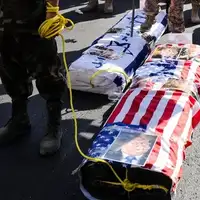
Participants stand beside mock coffins draped in US and Israeli flags during a Janfada mobilisation rally in Iran, September 18, 2026

Any effort to end the Iran war faces a fundamental obstacle even after the resumption of US-Iran diplomacy in New York: apparent divisions within Tehran over who has the authority to negotiate and how far those negotiations can go.

Iranian President Masoud Pezeshkian devoted both the opening and closing sections of his address to the United Nations General Assembly on Wednesday to rejecting President Donald Trump's accusations against Tehran.

He also made clear that while Iran welcomed negotiations, it would not yield to coercion or what he described as Trump's “bullying.”

The tension between those two messages reflects the difficult political terrain surrounding the latest diplomatic opening. Pezeshkian and Foreign Minister Abbas Araghchi have signaled a willingness to pursue talks, but criticism from hardliners has raised questions about how much room they have to negotiate.

Those divisions surfaced after Araghchi's contact with US envoy Steve Witkoff in New York on Tuesday.

The IRGC-affiliated Tasnim News Agency reported Wednesday that the contact had taken place without authorization from Iran's policymaking bodies, including the Supreme National Security Council.

Citing Mohsen Rezaei, secretary of the council, Tasnim said the approved plan had been limited to conveying Iran's seven conditions through mediators. It described Araghchi's reported interaction with Witkoff as a “major error” and called on the foreign minister to explain his actions.

The criticism points to a potentially important fault line in Tehran: not necessarily over whether diplomacy should continue, but over how direct that diplomacy is permitted to become.

Accounts of Tuesday's discussions have themselves differed. US officials have described a three-hour diplomatic exchange positively, while Iranian accounts have emphasized the role of mediators and said Tehran's conditions were conveyed to Washington.

An Iranian diplomat told Reuters before Pezeshkian's speech that discussions on ending hostilities could continue in New York and described the General Assembly as “a golden opportunity for America to return to diplomacy.”

US Secretary of State Marco Rubio said any agreement would require sustained work over time and that Trump retained military options.

Rubio also pointed to divisions within Tehran, saying potential agreements had repeatedly faltered after being referred back to the country's revolutionary establishment. He blamed the IRGC for the collapse of an earlier US-Iran understanding after it attacked ships in the Strait of Hormuz.

Hardliners test the limits

Despite Tasnim's criticism of Araghchi, some hardline messaging immediately before and during the New York talks appeared to leave room for diplomacy.

Before opposition to the talks became more vocal, even the hardline Kayhan newspaper sounded unusually supportive of Pezeshkian on Wednesday morning.

IRGC spokesman Hossein Mohebbi also delivered a dual message following reports of the talks.

“We don't reject diplomacy, but we impose our own conditions. Our defensive power will be proven in the field,” he was quoted as saying.

The formulation suggested that the IRGC was not rejecting negotiations outright, even while insisting that diplomacy take place on Tehran's terms and alongside continued military pressure.

The dispute over Araghchi's contact with Witkoff suggests the argument may therefore be less about whether Iran should negotiate than about the format, limits and authorization of those negotiations.

Pezeshkian's own language at the United Nations appeared designed to preserve that room while demonstrating that negotiations would not amount to capitulation.

Responding to Trump's rhetoric, he warned the United States, Israel and regional actors that Iran would respond forcefully to threats, while insisting that Tehran still believed in diplomacy.

Major General Ali Abdollahi, chief of staff of Iran's Armed Forces, similarly argued that “rhetoric doesn't change the power calculus” and described Trump's remarks as “a sign of desperation” on the US side.

The sequencing problem

The mediation channel has so far allowed the two sides to exchange complex proposals without requiring the politically riskier spectacle of a meeting between Trump and Pezeshkian.

But even if Tehran's internal disagreements can be contained, substantial differences remain over what each side must do first.

Washington is reportedly insisting on the clearance of maritime choke points and assurances related to Iran's nuclear program before easing its naval blockade.

Tehran, by contrast, is demanding an immediate end to US interdictions and the release of $24 billion in frozen foreign assets as conditions for further progress, according to a source close to the Iranian diplomatic team.

Iran has also linked progress in negotiations to reopening the Strait of Hormuz.

The diplomatic opening in New York therefore leaves two related questions unresolved: whether Washington and Tehran can agree on the sequence of steps needed to end the conflict, and whether Iran's diplomats have sufficient authority at home to deliver whatever they negotiate.

The reaction from the IRGC and other hardline institutions in the coming days may provide an early indication of the answer.

They can erase you without arresting you

Sep 23, 2026, 11:27 GMT+1
•
Tehran Insider
100%
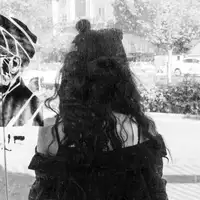
A woman with uncovered hair stands beside graffiti depicting Mojtaba Khamenei in Tehran, September 2026

One morning your phone simply stops working. There is no warning, no explanation and often no piece of paper telling you what you have done. Welcome to the Islamic Republic of Iran v.3.1.

I have been hearing versions of this story with disturbing frequency lately, from a doctor, a software engineer, an artist, a journalist and others, men and women ranging from their early twenties to their mid-forties.

Some are politically active, others barely so. What many appear to have in common is that at some point they said something online that somebody in authority did not like.

One woman in her thirties described discovering that the mobile line registered in her name had been blocked. When she tried to buy another SIM card, she learned that her national ID had also been restricted, preventing her from simply starting again with a new number.

It sounds like an inconvenience until you begin listing everything in Iran that now requires a phone number registered in your own name. Government portals routinely require text-message verification. So do university and banking services, even ride-hailing and food-delivery apps.

This is what makes the punishment so effective. The mobile phone is one of the keys to modern life here, and someone can apparently take that key away without ever coming to your door.

Life in Iran is difficult enough without inventing new ways to make it harder. People are still recovering from a brutal crackdown and war while living with the possibility of another round. Prices rise between visits to the supermarket, rent eats into salaries that were inadequate to begin with, power cuts are frequent and the internet remains unreliable.

Most people spend an extraordinary amount of mental energy simply working out how to get through another month. Now imagine trying to do all that without a functioning phone number.

A journalist in her late twenties told me she was preparing a report on SIM blocking when her own number suddenly stopped working. She knew immediately that it was not a technical glitch or an administrative accident.

"It feels as though I've ceased to exist administratively in my own country," she told me.

Others disappear even more quietly. They are not prominent activists whose names people will recognise. They are doctors, programmers, students and artists, or simply people with a few hundred followers who wrote something angry or shared something at the wrong moment.

Their phone goes dead and perhaps a handful of friends know. There is no campaign for them, and often nobody beyond their immediate circle even knows that they have been punished.

One software engineer told me that after his SIM was blocked, he began looking online for people in the same position. In about a week, he says, he came across almost 100 accounts that appeared similar to his own.

There is something particularly cruel about a punishment with no clear beginning or end. If you are charged with an offence, at least there is an accusation to confront. Here, most people are not told about the red line they crossed or how long they should suffer for it.

One person I spoke to had their SIM blocked for months after intervention by Revolutionary Guards intelligence. To have it restored, they say, they were required to delete their Twitter account and promise not to get themselves into further trouble online.

Many watching Iran from afar look at the social changes visible on Tehran's streets and conclude that the state has loosened its grip. Women now walk around without hijab in numbers that would have been difficult to imagine only a few years ago. Young men and women mix openly, and the cafés are full of people who can afford them.

None of this happened because the authorities graciously granted people more freedom of course. They fought these changes and continue to fight them, but society pushed ahead anyway and, on some fronts at least, the state appears for now to have lost.

But political dissent is a different story. There seems to be far less willingness to retreat when people challenge power itself, and the methods do not always have to be spectacular.

Repression can be something as mundane as discovering that the little device in your hand, around which so much of your life has been organised, no longer connects you to anything.

This is the latest version of the Islamic Republic: punishment hidden in plain sight, no dramatic image for the outside world to share, no prison gate for relatives to gather outside and often no official decision that can be challenged.

You can see a young woman walking down a Tehran street with her hair uncovered. What you cannot see is whether her phone still works.

Iran executed IT expert after months in isolation and forced confession

Sep 23, 2026, 10:10 GMT+1
•
Pooya Jahandar
100%
Hossein Pedaaran

Iranian authorities executed IT expert Hossein Pedaran after what sources familiar with his case described as months of solitary confinement, severe physical and psychological pressure and a forced confession.

Pedaran, born on June 26, 1985, was married and had two children, aged 15 and 11. He was arrested in July 2025 and executed on September 19 at Isfahan Central Prison, also known as Dastgerd Prison.

One informed source told Iran International that plainclothes agents raided Pedaran’s home when he was arrested and seized his personal and work belongings, along with electronic devices belonging to him and members of his family.

The source said Pedaran was then held for months in solitary confinement and in detention facilities run by security agencies, where he faced severe physical and psychological pressure.

Prolonged detention in dark conditions and deprivation of sunlight caused injuries and sores on his toes, the source said. Interrogators also pressured and threatened Pedaran and his wife to force him to make statements against himself, according to the source.

100%

Iran Human Rights previously reported that Pedaran spent four months at the Isfahan Intelligence Department’s detention center before being transferred to an intelligence detention facility in Tehran. He was returned to Isfahan a month later.

Work in information technology

Information obtained by Iran International shows that before his arrest, Pedaran worked in information technology at a company called Gostareh Tarahan Naghsh Almas.

His work included designing and setting up USSD codes and developing digital businesses.

Iran’s judiciary said after his execution that Pedaran had been sentenced to death for “espionage and intelligence cooperation in favor of Israel” and that the sentence was carried out after being upheld by the Supreme Court.

The judiciary accused him of providing Mossad with information about military and missile facilities in Isfahan province.

100%

An informed source rejected the judiciary’s account that Pedaran had access to military or missile information, telling Iran International that his professional work was commercial and focused on information technology and digital services.

Iranian authorities have executed dozens of people in recent months on charges including involvement in the January uprising and espionage.

Trial process

A source familiar with Pedaran’s case told Iran International that Judge Mohammadreza Tavakoli of the Isfahan Revolutionary Court issued the death sentence and that defense submissions filed by the family’s lawyer were not considered.

The family had appointed lawyers at different stages of the case, the source said.

According to the source, one of the lawyers told the family on the night before the execution that no notice confirming the final approval of the sentence or setting an execution date had appeared in the judiciary’s Sana electronic system.

Pedaran’s family therefore did not know when he would be executed until the sentence was carried out, the source said.

Security agencies had also pressured Pedaran’s wife from the time of his arrest not to publicize the case and had told the family that he might receive a pardon, according to the source.

100%

Body handed over after two days

The source said Pedaran’s family faced obstacles when trying to recover his body after the execution.

His body was handed over to the family late in the day after about two days of attempts to obtain it, the source said.

Pedaran was buried under security restrictions at Bagh-e Rezvan cemetery in Isfahan, and his family was not allowed to hold a public mourning ceremony, according to information obtained by Iran International.

Relatives described Pedaran as calm, disciplined, kind and hopeful about life. They said he remained hopeful until his final family visit before the execution.

Mizan, the judiciary-affiliated news agency, did not provide details about when Pedaran was arrested, his access to legal counsel or the conditions of his detention in its report on his execution.

After his death, state media also broadcast excerpts of what authorities described as Pedaran’s “confessions.”