Iran lawmakers file impeachment request against foreign minister
Some Iranian lawmakers have filed a request to impeach Foreign Minister Abbas Araghchi in parliament’s online system, but it has not yet been referred to the presiding board, lawmaker Mohammad Rashidi said on Tuesday.
Alireza Salimi, a member of parliament’s presiding board, said filing a request did not necessarily mean it would be referred to the board or placed on the agenda for a public session.
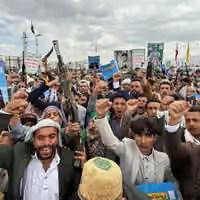
Houthi supporters rally to celebrate advances by Houthi forces along the Red Sea coastline in Sanaa, Yemen, Sept. 18, 2026. (Adel Al Khader/Reuters)
Saudi-backed Yemeni forces on Monday reversed weeks of Houthi gains around Bab al-Mandab, the strategic strait linking the Red Sea to the Gulf of Aden, exposing vulnerabilities in the Iran-backed group even as fighting elsewhere showed how far Yemen remains from a decisive shift.
As government-aligned forces advanced along Yemen’s southwestern coast, the Houthis stepped up pressure around Taiz, one of the country’s largest cities, leaving a battlefield moving in two directions at once.
The reversal came as Saudi Arabia, Turkey and Pakistan activated their Mecca Joint Defense Agreement following an emergency meeting in Riyadh, saying they would accelerate the deployment of agreed military forces and capabilities to Saudi Arabia.
Together, the developments point to a potentially consequential new phase of the Yemen war. But whether the counteroffensive can be sustained, and what any lasting reversal would mean for Iran’s position in Yemen, remains unclear.
“I think it’s too early to talk about sustainable gains against the Houthis at this point,” Thomas Juneau, a Yemen expert and non-resident fellow at the Sana’a Center for Strategic Studies, told Iran International.
“I think we need more time to see the dust settle.”
Iran watches a critical coastline
The importance Tehran attaches to Yemen’s western coast was apparent even as the latest Houthi gains were being reversed.
An IRGC-aligned Iranian newspaper led its coverage Monday with the headline “Ansarullah’s Upper Hand in Regional Equations,” arguing that Houthi positions around Bab al-Mandab translate into deterrence and regional leverage extending far beyond Yemen.
But the territory captured during the Houthis’ September advance was always going to be difficult to defend.
Juneau described southwestern Yemen as flat and exposed, with few natural defensive advantages and increasingly stretched Houthi supply lines.
“If it turns out that the losses are limited to the southwest corner of Yemen, that is not surprising in the sense that that was difficult for the Houthis to hold,” he said.
Even if pushed farther from Bab al-Mandab, the Houthis remain close enough to threaten Red Sea shipping with missiles and drones.
“So that would not be a strategic setback for them,” Juneau said.
Fatima Abo Alasrar, a Yemeni scholar, senior policy analyst and founder of Ideology Machine, said the Houthis’ September push had IRGC backing and caught Saudi-backed Yemeni forces poorly coordinated to respond.
Monday’s counteroffensive, however, demonstrated how quickly those gains could be reversed.
“The biggest takeaway is that this myth of Houthi invincibility is no longer there,” she said.
Hodeidah and Taiz complicate the picture
The more consequential test may now lie elsewhere.
The Houthis still control Hodeidah farther north on the Red Sea coast, preserving their ability to threaten maritime traffic even without holding territory immediately around Bab al-Mandab.
“Bab al-Mandab was just the icing on the cake,” Abo Alasrar said.
The possibility of attacks can itself increase shipping and insurance costs, meaning the Houthis do not need to physically control the strait to retain leverage over maritime traffic.
A loss of Hodeidah would represent a much more significant change to their strategic position. Late on Monday, the Saudi-led coalition said its naval forces struck Houthi military infrastructure in Yemen’s Hodeidah governorate, including weapons storage sites, facilities housing explosive-laden boats and stockpiles of sea mines.
At the same time, the Houthis are increasing pressure around Taiz, one of Yemen’s largest and most densely populated cities.
The geography presents a very different battlefield from the exposed southwestern coast and raises the prospect of a costly war of attrition.
“What I’m watching right now is the population centers,” Abo Alasrar said. “It’s in the cities, it’s in the population centers that the Houthis can inflict real damage.”
Iranian media has also shown growing interest in the fighting around Taiz, with Tasnim closely tracking Houthi advances there.
The simultaneous movement on the two fronts is one reason Juneau cautioned against drawing broad conclusions from the coastal counteroffensive.
“I don’t think we’re in a position to say yet that the Houthis are sustaining losses,” he said.
Two wars increasingly intertwined
The fighting is unfolding against the backdrop of the wider confrontation involving Iran, but Yemen cannot be understood solely through that lens.
“The war in Yemen is unlikely to end without a broader resolution to the war with Iran,” Mohammed al-Basha, a Yemeni-American analyst and founder of the Basha Report, told Iran International.
“But ending the confrontation in the Strait of Hormuz will not, by itself, end the war in Yemen.”
“The two conflicts are interconnected, but they are also distinct, with their own actors, grievances, battlefields, and political dynamics,” he added.
That distinction is important in assessing what the latest Houthi setbacks mean for Tehran.
Iran’s support has helped the Houthis develop into a powerful regional actor, but the group also operates within a distinctly Yemeni conflict shaped by domestic political, tribal and territorial dynamics.
A battlefield setback for the Houthis therefore does not translate automatically into an equivalent strategic loss for Iran.
Saudi Arabia signals it can absorb the risk
The activation of the Mecca Joint Defense Agreement adds another dimension to the confrontation.
Following an emergency meeting in Riyadh, Saudi Arabia, Turkey and Pakistan said they would move immediately to implement their joint-defense commitments and take measures to provide agreed military forces and capabilities and expedite their deployment in Saudi Arabia.
The three countries said the security of each member state was an integral part of their collective security and that implementing the agreement would strengthen deterrence.
“This is an important signal. It is a deterrent signal,” Abo Alasrar told Iran International following the announcement.
Saudi Arabia entered the counteroffensive knowing that supporting Yemeni government forces could expose the kingdom to retaliation from Houthi drones and ballistic missiles.
In Abo Alasrar’s assessment, the agreement signals that Riyadh is preparing to absorb that risk rather than allow the threat of retaliation to constrain the campaign.
It also sends a message about time.
The Houthis had hoped they could pressure Saudi Arabia and eventually emerge with concessions, she said. A Saudi signal that it is prepared for a prolonged confrontation potentially changes that calculation.
“This changes the rules of the game because Saudi Arabia is basically signaling that it’s going to play their game,” Abo Alasrar said. “It’s going to stay at this war as long as they want to, and that they’re ready to absorb the costs until they deal with this problem.”
Whether that deters the Houthis or leads to further escalation remains to be seen.
Limits to a broader government advance
Saudi-backed forces face another obstacle if they try to turn Monday’s counteroffensive into a broader campaign: divisions within the anti-Houthi camp.
Juneau said Iranian assistance explains only part of the Houthis’ resilience.
“Anti-Houthi forces remain fragmented and disunited,” he said.
The Houthis, by comparison, remain a considerably more coherent force, while rivalries among their opponents have repeatedly undermined efforts to establish a united front.
That is one reason Juneau remains skeptical of increasingly confident statements from Yemen’s government about eventually retaking Sana’a.
“When I hear the president of the Presidential Leadership Council, Rashad al-Alimi, talk about getting Sana’a back, as of now, I think that’s wishful thinking,” he said.
The contrast captures one of the central uncertainties surrounding the latest offensive: demonstrating that Houthi territorial gains can be reversed is one thing; translating that success into a sustained campaign against the group is another.
Tehran’s longer game
For Iran, the strategic calculation extends well beyond the movement of individual frontlines.
The Houthis have become an increasingly important part of Tehran’s regional network, particularly as other members of the so-called Axis of Resistance have come under intense pressure.
In Juneau’s formulation, small territorial losses along Yemen’s western coast are “the tree.” The durability of Houthi power is “the forest.”
“The forest, from Iran’s perspective, is the long game of seeing Houthi power in Yemen becoming institutionalized, becoming legitimated,” he said.
Juneau pointed to what appears to be an understanding under which the Houthis refrain from attacking US vessels in the Red Sea while Washington refrains from directly attacking the group.
The precise nature of any understanding remains unclear. But Washington dealing with the Houthis as an entrenched power is itself significant, he said.
“The US is making deals with the Houthis, you know, de facto a mutual non-aggression pact, which in practice legitimizes Houthi rule in large parts of Yemen, which is exactly Iran’s objective,” Juneau said.
Monday’s counteroffensive showed that recent Houthi territorial gains can be rapidly reversed. It has not yet shown that those reversals can be sustained or translated into a broader weakening of Houthi power.
Nor is the battle confined to Bab al-Mandab. The Houthis remain in control of Hodeidah, are applying pressure around Taiz and face opponents whose internal divisions have repeatedly worked to their advantage.
For Tehran, that leaves the picture similarly unsettled: one of its most important regional partners has shown itself vulnerable on the battlefield, but the foundations of the leverage Iran has built through the Houthis remain, for now, largely intact.
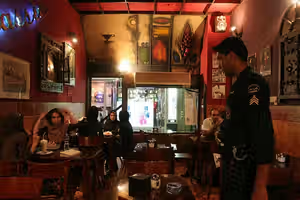
A DJ performs as people gather for drinks at a café in Iran.
Police in Tehran have warned cafes that they could face closure or lose their licenses for hosting live music, using DJs or serving hookah, extending a broader campaign of enforcement against businesses over entertainment, mandatory hijab rules and support for protests.
Ali Rafiei, head of Tehran's police department responsible for monitoring businesses and public venues, said cafes must operate strictly within the activities covered by their licenses.
“Cafes must operate only within their licensed line of business,” Rafiei said. “Serving hookah, hosting live music or DJs, and gambling-related activities are among the violations that will be dealt with.”
He said police would take action as soon as such activities were identified. Businesses could first receive warnings and be required to provide written assurances, while repeated violations could result in their licenses being revoked.
Cafes face wider scrutiny
The warning follows a series of closures targeting cafes, restaurants, shops, gyms and cultural venues across Iran in recent months.
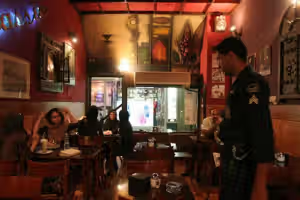
People gather at a café in Iran.
At least 42 businesses were reported sealed between late July and mid-August in different cities.
Authorities in Ardabil also announced the closure of three coffee shops and the arrest of 16 people during the same period.
Closures have not been limited to entertainment or licensing violations. Businesses have also been sealed over the enforcement of Iran's mandatory hijab rules and over support for nationwide protests.
Rafiei said police monitoring of cafes extended beyond activities inside the establishments.
He pointed to Tehran's Sanai and Iranshahr streets, saying cars cruising through the area, sidewalk setups by cafes and groups of young people gathering without what he described as a clear purpose had contributed to congestion and complaints.
Women gather at a café in Iran.
He said blocking sidewalks or public space could also lead to enforcement action. Police generally issue a warning and seek a written commitment from the operator before sealing a business, he added.
Continued violations could ultimately result in the cancellation of a business license, according to Rafiei.
The pressure on cafe operators has also extended to owners who supported the January protests.
In one case, Iran's Supreme Court in September upheld the prison sentence and confiscation of assets imposed on Sadegh Saedinia, the head of Saedinia Properties and Industries and a supporter of the protests.
Women gather at a café in Iran.
Saedinia was sentenced to 12 years, six months and one day in prison and barred from working in the cafe industry for two years after completing his sentence. All branches of his cafe business were sealed following his arrest.
The judiciary said the case involved social media posts, participation in gatherings, closing cafes and shops, and encouraging employees to take part in protests.
Young men and women gather for drinks and food at a café in Iran.
The latest police warning adds live music, DJs and hookah service to a growing list of activities that can expose cafe operators to sanctions, alongside mandatory hijab enforcement, use of public space and support for demonstrations.
The mother of Mani Safarpour, who was killed during protests in Tehran in January 2026.
Clothes, diaries, books and childhood dolls are being taken from the bedrooms of protesters killed in Iran, as security forces extend pressure on families seeking accountability into the most private spaces of their grief nearly nine months after the January 2026 killings.
“Seven plainclothes men entered our home and began searching different parts of it,” the father of a slain teenage girl told Iran International.
“They went into our daughter’s room and put some of her personal belongings, including clothes, diaries, books and even two of her dolls, into a bag and took them away.”
Security forces have raided the homes of at least five families in the past two weeks and removed belongings of their slain relatives, informed sources told Iran International. Three of those killed were under 18.
The raids, sources said, targeted families active on social media and were intended to stop them keeping the memory of their children publicly alive.
The mother of the teenage girl had previously posted videos showing objects left behind in her daughter’s room as she mourned her death.
The latest raids take the pressure on bereaved families beyond summonses, arrests and restrictions on memorials. They reach into rooms left behind by the dead and the objects through which their parents continue to remember them.
‘Nothing will remain in your child’s room’
For another family, the message was explicit.
Security forces searched their home and took a watch and clothes their child was wearing when killed, the mother told. The officers then warned the parents against publishing more photographs or videos online.
“They threatened us that if we published another photo or video on the internet, nothing would remain in our child’s room,” she said.
The officers followed that warning with another, according to the mother.
“They told us, ‘A thief might come to your home one night, and in the morning you might find an empty room.’”
For months, families seeking accountability have faced restrictions on funerals, memorial ceremonies and birthday commemorations, according to information provided to Iran International.
Gravestones have been damaged at night, mobile phone SIM cards blocked and families pressured to remove posts from Instagram.
When a doll becomes something to confiscate
Personal belongings have assumed a wider role in the families’ efforts to preserve the memory of those killed.
A bedroom can be photographed. Clothes can be shown in a video. A diary can preserve someone’s words. A childhood toy can become an intimate reminder that the person killed was a son or daughter with a life beyond the circumstances of their death.
For parents who share those objects online, private grief can become a public record.
That has made the belongings themselves part of the pressure described by the families.
Authorities have previously sought to restrict the public activities of relatives seeking accountability.
Mahmonir Molaei-Rad, the mother of Kian Pirfalak, and other families connected to those killed during the 2022 Woman, Life, Freedom protests have faced similar efforts to restrict their public activity.
But the latest accounts describe security forces crossing another boundary: moving from controlling what families publish to taking away some of the objects they publish about.
The fight over who gets remembered
The bedrooms of those killed have become more than spaces of mourning for some families.
Photographs of their possessions circulate online alongside images of graves, birthdays and family gatherings, allowing parents to preserve details of lives that might otherwise become reduced to names and death tolls.
The sources who spoke to Iran International said stopping that process was a purpose of the recent raids.
The confiscations therefore bring together two strands of pressure on families seeking accountability – attempts to restrict what they say publicly and interference with how they remember privately.
Nearly nine months after the January killings, that struggle has reached objects of little material importance but immense personal value.
For families refusing to let their children disappear from public memory, a dress, a watch, a diary or a pair of dolls can preserve a fragment of the person who once occupied an empty room, but even those fragments are now being taken away.
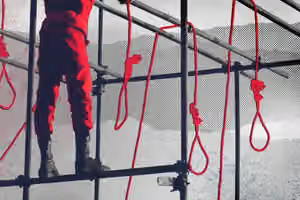
Hadi Abbasian, a 38-year-old resident of northeastern Iran, has been sentenced to death by a Revolutionary Court in Bojnurd after being arrested over his support for the nationwide protests in January, according to information obtained by Iran International.
Informed sources said Abbasian had previously posted videos on social media in support of demonstrators. The death sentence was communicated to him on Sunday at Shirvan prison.
The precise charge leading to the death sentence and the evidence presented against him have not been made public.
Arrested months after protests
Abbasian was arrested in May in Shirvan's Farhang Shahr district. During the nationwide protests earlier this year, he had published videos urging people to take part in demonstrations.
The source said Abbasian was tortured on the first day of his detention and taken to hospital after his condition deteriorated. He was later transferred to Shirvan prison.
His family has not been allowed to visit him since his arrest, the source said, adding that judicial and security authorities had prevented the family from appointing a lawyer of their choice.
Executions accelerate
The sentence comes as Iranian authorities have carried out a growing number of executions of people detained over the nationwide protests that erupted in January.
On Monday, Alireza Sepahi and Alireza Raisi were executed at Isfahan Central Prison in connection with protests in the central city, according to rights groups and Iran's judiciary.
They were among 12 defendants sentenced to death in what has become known as the Alikhani Square case. Seven people in that case have now been executed.
Sepahi married his fiancée from prison one day before his execution, according to Nobel Peace Prize laureate and lawyer Shirin Ebadi.
“Yesterday he became a groom, and today they executed him,” Ebadi wrote.
Five executions in less than a week
The two executions on Monday followed that of Siavash Jamshidi Kheirabadi, who was put to death on Saturday after being arrested during January protests in Shahrekord.
Iran's judiciary said Jamshidi had been sentenced to death for moharebeh, or “enmity against God,” over accusations that he fired at security forces. No information about his prosecution had been made public before the announcement of his execution.
Two other protesters, Ali Hemmati and Majid Nikandish, were executed on September 30 after being detained over demonstrations in Mashhad.
The judiciary accused them of involvement in the deaths of four security personnel and described them as “field operatives” in what it called an attempted coup. No court documents or independent evidence supporting those allegations were made public.
Taken together, at least five people detained in connection with the January protests have been executed since September 30.
Fair-trial concerns
Rights groups and UN experts have repeatedly raised concerns about the use of death sentences against protesters in Iran, citing reports of torture, forced confessions and denial of access to lawyers.
Mai Sato, the UN special rapporteur on human rights in Iran, raised concerns about the treatment of defendants and fair-trial standards in the Alikhani Square case, including reports that detainees and their relatives had been tortured.
A joint statement by 46 countries at the UN Human Rights Council last week also expressed concern over the execution of more than 30 protesters following the January crackdown and called on Iran to halt executions.
Iran Human Rights said in September that at least 100 people detained during the protests were at risk of execution.
Abbasian's case now adds another protester to death row, with his family still barred from visiting him and the basis for the sentence yet to be made public.
Iran’s oil minister left office as exports fell sharply and questions mounted over billions of dollars in sanctioned crude sales, bringing disputes over oil intermediaries, corporate management and political pressure into focus.
President Masoud Pezeshkian initially rejected Paknejad’s resignation, submitted some time earlier because of “personal issues,” but accepted it after the minister again pressed to step down, deputy presidential communications chief Mehdi Tabatabaei said.
Paknejad’s departure, the first by a minister from Pezeshkian’s cabinet, followed weeks of Iranian media reports linking his position to disputes over sanctioned oil sales, major energy projects and management of Persian Gulf Petrochemical Industries Company (PGPIC).
Pezeshkian appointed National Iranian Oil Company (NIOC) managing director Hamid Bovard as acting oil minister. The government has not indicated whether Bovard will remain a caretaker or be nominated for the post.
Export crisis raises questions
Several Iranian outlets had linked Paknejad’s resignation to disagreements with Pezeshkian during cabinet meetings over the oil ministry’s handling of sanctioned crude sales.
Other reported disputes concerned delays to major projects, including development of the South Pars gas field, and the network of intermediaries entrusted with selling Iranian oil and returning the proceeds while circumventing sanctions.
Paknejad left as Iran’s floating oil inventories were approaching exhaustion and questions mounted over around 80 million barrels handed to intermediaries, Rouydad24 wrote.
The website questioned whether “personal reasons” adequately explained the timing, arguing that replacing the official overseeing the sector would not resolve falling exports, foreign currency shortages, unpaid oil revenues and the opaque structure of sanctioned sales.
Eghtesad Online website similarly questioned why Pezeshkian accepted a resignation that had been pending for some time when Iranian oil exports had approached zero.
Billions at stake in trustee system
The use of trusted intermediaries to sell crude under sanctions has become a central controversy surrounding the oil ministry, with lawmakers and media raising questions over unpaid revenues and the allocation of oil.
One intermediary, Hassan Aghayari, owed several billion dollars, ILNA reported on September 13, citing a letter Bovard sent to a senior supervisory body while serving as NIOC chief.
The contract allowing Aghayari to sell oil was concluded on the minister’s order without approval from the sanctions-countering task force, Bovard wrote, according to ILNA. The oil ministry denied the report.
Around 80 million barrels were separately handed to four intermediaries following the Islamabad agreement, lawmaker Valiollah Bayati told Hamshahri newspaper. Hossein Shamkhani, son of former Supreme National Security Council secretary Ali Shamkhani, was among them, Bayati said.
More than 86 million barrels were allocated to trustees without guarantees, lawmaker Hossein Samsami said. Around 30 million barrels reached final buyers, leaving the status of more than 56 million barrels unclear, according to Samsami.
The accounts have raised questions over how intermediaries were selected, what guarantees were required and why further allocations went to people who allegedly owed money from previous oil sales.
Battle over petrochemical giant
Paknejad’s departure has also been linked to a dispute with Mohammad Shariatmadari, head of PGPIC, Iran’s largest petrochemical holding company.
The oil ministry sought to replace Shariatmadari with Hassan Abbaszadeh in July 2026. PGPIC rejected the move, saying it lacked the procedures required under stock-market regulations and board approval. Shariatmadari remained with support from the presidential office.
Paknejad was unwilling to remain as minister if Shariatmadari kept his position, Iranian media reported. Meetings ordered by Pezeshkian failed to settle the dispute, according to those reports.
Shortly before the resignation was accepted, editor of the oil-focused outlet Miz-e Naft Vahid Hajipourwrote on X that Paknejad had been given an ultimatum at a cabinet meeting over Shariatmadari’s continued tenure.
“Paknejad did not accept,” Hajipour wrote, adding that Pezeshkian consequently decided to end cooperation with the minister.
Political pressure
Political pressure offers another explanation. Parliament speaker Mohammad Bagher Ghalibaf was angered by the removal of his ally Hossein Ghorbanzadeh from PGPIC’s board and Paknejad’s refusal to reinstate him, journalist Hatef Salehi wrote on X on October 1.
Ghalibaf subsequently pressed Pezeshkian to remove Paknejad, Salehi said.
“If the oil minister is replaced in the coming days, the roots of the decision should be sought in Ghorbanzadeh’s longstanding friendship and relationship with Ghalibaf, not in the government’s strategy,” Salehi wrote.
The competing accounts leave no single explanation for Paknejad’s departure, placing it instead at the intersection of an export crisis, disputed sanctioned oil sales, a battle over one of Iran’s biggest companies and reported political pressure over control of key posts.