Iran parliament approves penalties for interviews with ‘hostile’ media
Iran’s parliament approved a bill provision that would penalize citizens for interviewing or taking part in discussions with media outlets or personalities designated as “hostile” by the Intelligence Ministry, state media reported.
Article 22 of the bill on countering foreign influence also covers media owned, managed or funded by agents linked to countries classified as level one or two.
Violations would carry one or more class-six penalties under Iran’s penal code. Government officials are exempt.
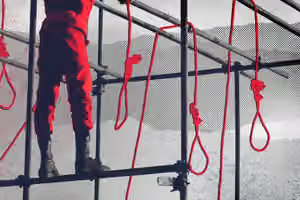
Hadi Abbasian, a 38-year-old resident of northeastern Iran, has been sentenced to death by a Revolutionary Court in Bojnurd after being arrested over his support for the nationwide protests in January, according to information obtained by Iran International.
Informed sources said Abbasian had previously posted videos on social media in support of demonstrators. The death sentence was communicated to him on Sunday at Shirvan prison.
The precise charge leading to the death sentence and the evidence presented against him have not been made public.
Arrested months after protests
Abbasian was arrested in May in Shirvan's Farhang Shahr district. During the nationwide protests earlier this year, he had published videos urging people to take part in demonstrations.
The source said Abbasian was tortured on the first day of his detention and taken to hospital after his condition deteriorated. He was later transferred to Shirvan prison.
His family has not been allowed to visit him since his arrest, the source said, adding that judicial and security authorities had prevented the family from appointing a lawyer of their choice.
Executions accelerate
The sentence comes as Iranian authorities have carried out a growing number of executions of people detained over the nationwide protests that erupted in January.
On Monday, Alireza Sepahi and Alireza Raisi were executed at Isfahan Central Prison in connection with protests in the central city, according to rights groups and Iran's judiciary.
They were among 12 defendants sentenced to death in what has become known as the Alikhani Square case. Seven people in that case have now been executed.
Sepahi married his fiancée from prison one day before his execution, according to Nobel Peace Prize laureate and lawyer Shirin Ebadi.
“Yesterday he became a groom, and today they executed him,” Ebadi wrote.
Five executions in less than a week
The two executions on Monday followed that of Siavash Jamshidi Kheirabadi, who was put to death on Saturday after being arrested during January protests in Shahrekord.
Iran's judiciary said Jamshidi had been sentenced to death for moharebeh, or “enmity against God,” over accusations that he fired at security forces. No information about his prosecution had been made public before the announcement of his execution.
Two other protesters, Ali Hemmati and Majid Nikandish, were executed on September 30 after being detained over demonstrations in Mashhad.
The judiciary accused them of involvement in the deaths of four security personnel and described them as “field operatives” in what it called an attempted coup. No court documents or independent evidence supporting those allegations were made public.
Taken together, at least five people detained in connection with the January protests have been executed since September 30.
Fair-trial concerns
Rights groups and UN experts have repeatedly raised concerns about the use of death sentences against protesters in Iran, citing reports of torture, forced confessions and denial of access to lawyers.
Mai Sato, the UN special rapporteur on human rights in Iran, raised concerns about the treatment of defendants and fair-trial standards in the Alikhani Square case, including reports that detainees and their relatives had been tortured.
A joint statement by 46 countries at the UN Human Rights Council last week also expressed concern over the execution of more than 30 protesters following the January crackdown and called on Iran to halt executions.
Iran Human Rights said in September that at least 100 people detained during the protests were at risk of execution.
Abbasian's case now adds another protester to death row, with his family still barred from visiting him and the basis for the sentence yet to be made public.
Iran’s oil minister left office as exports fell sharply and questions mounted over billions of dollars in sanctioned crude sales, bringing disputes over oil intermediaries, corporate management and political pressure into focus.
President Masoud Pezeshkian initially rejected Paknejad’s resignation, submitted some time earlier because of “personal issues,” but accepted it after the minister again pressed to step down, deputy presidential communications chief Mehdi Tabatabaei said.
Paknejad’s departure, the first by a minister from Pezeshkian’s cabinet, followed weeks of Iranian media reports linking his position to disputes over sanctioned oil sales, major energy projects and management of Persian Gulf Petrochemical Industries Company (PGPIC).
Pezeshkian appointed National Iranian Oil Company (NIOC) managing director Hamid Bovard as acting oil minister. The government has not indicated whether Bovard will remain a caretaker or be nominated for the post.
Export crisis raises questions
Several Iranian outlets had linked Paknejad’s resignation to disagreements with Pezeshkian during cabinet meetings over the oil ministry’s handling of sanctioned crude sales.
Other reported disputes concerned delays to major projects, including development of the South Pars gas field, and the network of intermediaries entrusted with selling Iranian oil and returning the proceeds while circumventing sanctions.
Paknejad left as Iran’s floating oil inventories were approaching exhaustion and questions mounted over around 80 million barrels handed to intermediaries, Rouydad24 wrote.
The website questioned whether “personal reasons” adequately explained the timing, arguing that replacing the official overseeing the sector would not resolve falling exports, foreign currency shortages, unpaid oil revenues and the opaque structure of sanctioned sales.
Eghtesad Online website similarly questioned why Pezeshkian accepted a resignation that had been pending for some time when Iranian oil exports had approached zero.
Billions at stake in trustee system
The use of trusted intermediaries to sell crude under sanctions has become a central controversy surrounding the oil ministry, with lawmakers and media raising questions over unpaid revenues and the allocation of oil.
One intermediary, Hassan Aghayari, owed several billion dollars, ILNA reported on September 13, citing a letter Bovard sent to a senior supervisory body while serving as NIOC chief.
The contract allowing Aghayari to sell oil was concluded on the minister’s order without approval from the sanctions-countering task force, Bovard wrote, according to ILNA. The oil ministry denied the report.
Around 80 million barrels were separately handed to four intermediaries following the Islamabad agreement, lawmaker Valiollah Bayati told Hamshahri newspaper. Hossein Shamkhani, son of former Supreme National Security Council secretary Ali Shamkhani, was among them, Bayati said.
More than 86 million barrels were allocated to trustees without guarantees, lawmaker Hossein Samsami said. Around 30 million barrels reached final buyers, leaving the status of more than 56 million barrels unclear, according to Samsami.
The accounts have raised questions over how intermediaries were selected, what guarantees were required and why further allocations went to people who allegedly owed money from previous oil sales.
Battle over petrochemical giant
Paknejad’s departure has also been linked to a dispute with Mohammad Shariatmadari, head of PGPIC, Iran’s largest petrochemical holding company.
The oil ministry sought to replace Shariatmadari with Hassan Abbaszadeh in July 2026. PGPIC rejected the move, saying it lacked the procedures required under stock-market regulations and board approval. Shariatmadari remained with support from the presidential office.
Paknejad was unwilling to remain as minister if Shariatmadari kept his position, Iranian media reported. Meetings ordered by Pezeshkian failed to settle the dispute, according to those reports.
Shortly before the resignation was accepted, editor of the oil-focused outlet Miz-e Naft Vahid Hajipourwrote on X that Paknejad had been given an ultimatum at a cabinet meeting over Shariatmadari’s continued tenure.
“Paknejad did not accept,” Hajipour wrote, adding that Pezeshkian consequently decided to end cooperation with the minister.
Political pressure
Political pressure offers another explanation. Parliament speaker Mohammad Bagher Ghalibaf was angered by the removal of his ally Hossein Ghorbanzadeh from PGPIC’s board and Paknejad’s refusal to reinstate him, journalist Hatef Salehi wrote on X on October 1.
Ghalibaf subsequently pressed Pezeshkian to remove Paknejad, Salehi said.
“If the oil minister is replaced in the coming days, the roots of the decision should be sought in Ghorbanzadeh’s longstanding friendship and relationship with Ghalibaf, not in the government’s strategy,” Salehi wrote.
The competing accounts leave no single explanation for Paknejad’s departure, placing it instead at the intersection of an export crisis, disputed sanctioned oil sales, a battle over one of Iran’s biggest companies and reported political pressure over control of key posts.
Senior IRGC commander Hossein-Reza Sadeghi and his son Saeed played central roles in efforts to preserve an IRGC Intelligence oil-sales network and shift its financial operations from the United Arab Emirates to Russia, an Iran International investigation found.
Two informed sources told Iran International that Sadeghi, a senior adviser to the Revolutionary Guards commander-in-chief, and his son were at the center of efforts to shift the mechanism for transferring sanctioned oil revenues from the UAE to Russia.
The sources linked the changes to the departure of Oil Minister Mohsen Paknejad.
On Sunday, the IRGC-affiliated Fars news agency reported that Iran’s Central Bank had found an alternative route to repatriate money held by oil intermediaries trusted by the Islamic Republic, known as “trustees,” and transferred $1.5 billion in Iranian oil revenues through Russia’s banking system.
Hours after the report, Paknejad resigned and President Masoud Pezeshkian accepted his resignation.
The two sources said Paknejad’s removal and the change in the money-transfer route were part of an effort to preserve the IRGC Intelligence Organization’s oil-sales corruption network.
Saeed Sadeghi’s role in Iran’s oil sector
Although Saeed Sadeghi currently holds no official Oil Ministry position, he has for years been a trusted Revolutionary Guards figure in Iran’s oil industry.
During Ebrahim Raisi’s presidency, he became chief executive of Amir Kabir Petrochemical Company. He previously served as deputy for legal affairs and contracts at the oil, gas and petrochemical holding company of the Guards’ Khatam al-Anbiya Construction Headquarters and at Shastan Investment Holding, which is affiliated with the Defense Ministry.
Two months after Pezeshkian took office, Sadeghi was appointed chief executive of Naftiran Intertrade Company (NICO). In September 2025, he was removed just one week after being appointed director of international affairs at the National Iranian Oil Company.
His removal came after it emerged that trustees had failed to return $8 billion in proceeds from oil sales to Iran.
After anti-government protests broke out in January, several establishment figures said economic pressure stemming from corruption among the trustees had caused the unrest.
Mehdi Kharatian, director of the Hayat-e Siasat think tank and an analyst close to the Islamic Republic, compared “the trustees’ failure to return the dollars” to “the pager operation in Iran” during a video podcast.
Iran International’s sources said Sadeghi traveled to Moscow at his father’s request a week before the start of the 40-day war, apparently to avoid possible judicial proceedings.
He remained in Russia until the war ended and worked on moving the financial network used to handle proceeds from sanctioned Iranian oil sales from the UAE to Russia, the sources said.
Shift from UAE to Russia
On June 6, Mohammad Javad Bavand, a former deputy head of the IRGC Intelligence Organization’s economic affairs division, was appointed the oil minister’s special assistant for sales.
Bavand had held the same position under Raisi and previously represented IRGC Intelligence on the Supreme National Security Council committee tasked with circumventing sanctions.
On June 17, Central Bank Governor Abdolnaser Hemmati visited Mir Business Bank in Moscow alongside Iran’s ambassador to Russia.
Bank Melli Iran owns all shares in the bank, which is registered in Moscow and has operated since 2002. Mir Business Bank provides correspondent accounts and services for ruble and foreign-currency transactions, connecting Iranian banks with Russia’s banking network.
The US Treasury sanctioned the bank in 2018 for providing financial services to sanctioned Iranian entities.
Iran International’s sources said proceeds from oil sold by the trustees are to be returned to Iran through Russia’s Mir financial network, which they said replaced SWIFT following US banking sanctions.
IRGC Intelligence builds new network
IRGC Brigadier General Hossein-Reza Sadeghi was tasked with completing the IRGC Intelligence Organization’s network for selling Iranian oil, according to Iran International’s sources.
Sadeghi has held senior oversight positions within the Revolutionary Guards, including heading the office responsible for special oversight of IRGC Intelligence on behalf of the Guards’ commander-in-chief. He has also served as deputy coordinator of the IRGC Intelligence Protection Organization.
The sources said the establishment of the IRGC trustee network was approved by Mehdi Sayyari, the new acting head of the IRGC Intelligence Organization.
At the same time, a separate network of oil intermediaries linked to Iran’s Intelligence Ministry, known as Shayan, came under scrutiny by the ministry’s internal security unit. Shayan, the ministry’s director-general for fuel and energy, was subsequently removed from his post.
Previous investigations traced billions in oil proceeds
One week later, Iran International identified nine trustees in the network, including children of senior security figures, among them Ali Rezaei, son of Supreme National Security Council Secretary Mohsen Rezaei.
Members of the network have collectively failed to return $11 billion in proceeds from Iranian oil sales, Iran International’s investigation found.
Two weeks later, Iran International published two confidential documents showing that Mohammad Javad Bavand, an IRGC-linked official in the Oil Ministry, had assigned the sale of 86 million barrels of Iranian oil to four trustees who already owed money from previous sales.
Iran International’s sources said that after the reports were published, IRGC commander Abdollah Zeighami, also known as Moshfegh and deputy head of the Revolutionary Guards’ media headquarters, held a confidential meeting with Bavand and Mostafa Ahadi, a former deputy for economic affairs at IRGC Intelligence who now serves as deputy head of Unit 600 of the IRGC Intelligence Organization.
The sources said the meeting focused on suppressing reporting about corruption involving IRGC-linked oil trustees.
Iran International’s sources said Sunday’s transfer of $1.5 billion in oil proceeds from Russia to Iran marked the completion of the Revolutionary Guards’ project.
Paknejad resigned hours later.
The sources said Paknejad had himself played a central role in establishing oil-sales corruption networks involving two of the Islamic Republic’s security agencies. He was removed after the new IRGC Intelligence network had been completed, while all the trustees remained free.
Parvin Momen Zahmatkesh, wife of senior Revolutionary Guards commander Ali Fadavi and founder of the Shajareh Tayyebeh school in Minab, Iran.
The school struck in February in Iran’s Minab was founded by the wife of senior IRGC commander Ali Fadavi as part of a wider educational project linked to the Guards’ navy, according to his remarks and an earlier Iranian media account.
Fadavi said Sunday that his late wife, Parvin Momen Zahmatkesh, founded around 97 Shajareh Tayyebeh schools across southern Iran, from Abadan to Chabahar. He discussed the network immediately after referring to the attack on its Minab school. An earlier account published by the pro-establishment Fash News website on June 8 explicitly connected the Minab school to Momen Zahmatkesh’s work. The account portrayed the Minab school as a partial realization of her ambition to create educational complexes, providing corroboration of its place in the network beyond Fadavi’s latest remarks.
From Rastegaran to Shajareh Tayyebeh
The schools were established inside or near IRGC Navy bases and organizational housing developments in southern Iran. Momen Zahmatkesh served as the force’s adviser on family affairs while her husband was its commander.
The Fash News account said she proposed establishing the schools and worked without a salary. It described her as a doctoral student in executive management and said the couple sold their home to help finance the project, subsequently securing support from the Education Ministry and donors.
The report tentatively dated the start of the project to 2013, in southern provinces along the Persian Gulf. The network expanded in the following years, with work continuing into 2025. Some facilities began as a single classroom or an older school or building refurbished with staff and charitable support.
The schools initially operated under the name Rastegaran between 2013 and 2015 before adopting Shajareh Tayyebeh.
The Minab attack
The Shajareh Tayyebeh primary school in Minab, in Hormozgan province, was struck on February 28, the opening day of the US-Israeli war against Iran. Local authorities subsequently put the death toll at 156, including 120 children.
Reuters reported in March that preliminary US military findings pointed to American responsibility, and the Pentagon elevated its investigation. President Donald Trump said in June that nobody had attacked the school intentionally. UN investigators said in September there were reasonable grounds to believe the US strike constituted a war crime.
A television appearance after rumors
Fadavi’s appearance on Sunday followed unverified social media rumors that he had been detained or sentenced to death for spying for Israel. Separate rumors alleged that his wife had died during interrogation.
He previously commanded the IRGC Navy and served as deputy commander of the Guards before being appointed head of the commander-in-chief’s advisory group in the Iranian month of Dey, spanning December 2025 and January 2026.
His television appearance contradicted rumors that he had been executed. Discussing his wife, he said she had “passed away” during the 12-day war in June 2025. He did not say she had been killed in an attack.
An earlier condolence message from then-IRGC commander Mohammad Pakpour, published on June 28, 2025, referred to her suffering from illness in the final years of her life. Pakpour was himself later killed during the 40-day war.
The Fash News account likewise said she had lived with diabetes for years and dated her death to Tir 1404, the Iranian month spanning late June and much of July 2025. It said she was buried in the Fatima al-Zahra section of the Imam Reza shrine in Mashhad.
Fadavi’s wording differed from the customary official description of people killed in attacks as “martyrs.” The published illness accounts provide a more specific explanation than the unsupported claims circulating online.
Momen Zahmatkesh was born in the Iranian year 1337, corresponding to 1958–59. The couple’s home was on Isar 8 alley in Tehran’s Mahallati neighborhood, where many IRGC commanders lived.
A building on the same alley was bombed during the later 40-day war. Official accounts subsequently referred to it as the site of the deaths of the “Mahallati martyrs.” That later attack was separate from the period in which her death had already been publicly announced.
Educational and business interests
The couple’s involvement in education predated the southern school network. According to Iran International’s Persian reporting, they established the Naqsh-e Kowsar Cultural and Educational Complex in April–May 1997, when Fadavi was deputy commander of the IRGC Navy. Its stated activities included establishing technical and vocational schools for girls.
Momen Zahmatkesh also chaired the board of Shajareh Touba Ferdows, an institution established in 2017.
Private schooling has been an area of activity for other families of senior Iranian officials, including the wife of former parliament speaker Gholamali Haddad-Adel and relatives of current Speaker Mohammad Bagher Ghalibaf.
Her business interests extended beyond education. In October–November 1993, she established the Alaleh Shalamcheh Agriculture and Livestock Company. Fadavi’s father, Mohammadali, joined the company in September–October 1996; both had left its board by 1999.
The enterprise now operates in Kordan, west of Tehran, as the Alaleh horse-breeding complex and riding club, according to the same report.
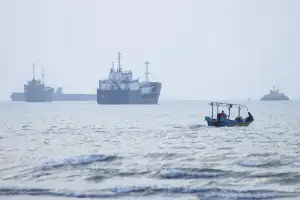
Vessels are seen off Sورو Beach in Bandar Abbas, near the Strait of Hormuz, at sunrise on Monday, Sept. 28, 2026. ISNA
Iranian President Masoud Pezeshkian said Monday that talks with the United States were meaningless, even as President Donald Trump remained open to direct negotiations, while a third tanker in two days was struck near the Strait of Hormuz.
The contrasting messages came as months of intermittent diplomacy remained stalled and tensions intensified around the strategic waterway, where Iran and the United States have imposed competing restrictions on shipping. Tehran has tied progress to conditions surrounding Hormuz, while Washington has pressed for broader concessions, including on Iran’s nuclear program.
“Our problem with the United States is that every time we come to the negotiating table, war is immediately imposed on us,” Pezeshkian told Armenian Foreign Minister Ararat Mirzoyan during a meeting in Tehran.
Pezeshkian said negotiations made no sense with an adversary that “every day engages in assassination, sanctions, pressure and threats” and breaks its commitments.
“We have been attacked three times so far following talks, and this shows that they are not seeking dialogue; rather, their goal is to overthrow the Islamic Republic,” he said.
Trump, however, said Monday that he remained open to direct talks with Tehran, keeping a diplomatic path available after saying over the weekend that Iran could resolve the confrontation “the easy way or the hard way.”
The two sides have continued exchanging messages indirectly despite the impasse. Tehran presented Washington through intermediaries with a seven-day proposal aimed at restoring security in the Strait of Hormuz, and Iranian officials said Sunday they were reviewing the US response. Foreign Minister Abbas Araghchi said Tehran remained serious about diplomacy but was also prepared to defend itself.
The diplomatic standoff coincided with another escalation at sea Monday, when a tanker was struck by an unidentified projectile in the Strait of Hormuz, sparking a fire in its engine room. UK Maritime Trade Operations said the crew was battling the blaze and no casualties or environmental impact had been reported.
The strike marked the third tanker hit in two days. UKMTO said Monday it had received delayed reports that two tankers — one carrying liquefied petroleum gas and another crude oil — were struck by unidentified projectiles Sunday.
UKMTO did not attribute those attacks to Iran. But in a separate incident Monday, it said an inbound tanker 11 nautical miles north of Khasab, Oman, turned back after Iran’s Islamic Revolutionary Guard Corps hailed the vessel and threatened to target it if it continued.
The IRGC-affiliated Fars news agency separately reported Monday that Iran had targeted 13 tankers it described as “violators” in the Strait of Hormuz over the previous seven days.
The incidents came as the United States intensified enforcement of its naval blockade against Iran. US Central Command said Monday its forces had redirected 130 commercial vessels since resuming the blockade on July 14, disabled three ships that refused to comply and destroyed 13 commercial vessels it said were violating the blockade or were part of the IRGC’s multibillion-dollar shadow network. Pasted markdown
“The US military remains intensely focused on this mission,” CENTCOM commander Adm. Brad Cooper said. “We will swiftly act against any vessels trying to run the blockade.”
Washington has also stepped up economic pressure. Treasury Secretary Scott Bessent said Monday that the rial had fallen to record lows and Iran loaded no crude onto tankers last month, citing the figures as evidence that the US pressure campaign was working.
The military pressure has also continued alongside the diplomatic impasse. Senior members of Trump’s national security team met at Camp David on Friday to discuss the Iran war, with Trump considering renewed major combat operations as negotiations remain stalled, Axios reported.
Iranian officials warned Monday that renewed military action could widen the conflict. Mohsen Rezaei, secretary of Iran’s Supreme National Security Council, said another attack or “miscalculation” against Iran could open additional fronts.
“Every miscalculation by the enemy against Iran has brought it a heavy defeat,” Rezaei said. “The next mistake will bring new fronts and bigger surprises.”