Ghalibaf says US damaged its credibility by reneging on Islamabad agreement

Iran’s parliament speaker Mohammad Bagher Ghalibaf accused the United States of failing to honor an agreement with Tehran, saying Washington had dealt another blow to its credibility after failing to achieve its military objectives against Iran.
Speaking during a meeting with Armenia’s foreign minister, Ghalibaf said the Americans “failed to achieve any of their objectives” militarily and accused them of acting in bad faith in implementing the Islamabad memorandum of understanding.












The warnings came during a day that also saw Iran execute two protesters detained during the January uprising, the Revolutionary Guards threaten a tanker in the Strait of Hormuz, and Yemeni government forces launch a major offensive against the Iran-backed Houthis.
Netanyahu says Iran is fighting for survival
Iran’s leadership is weaker than at any point since its establishment and is fighting for survival, Netanyahu said at a ceremony marking the third anniversary of the October 7 attack.
“The tyranny is weaker than it has ever been since its establishment. It is fighting for its life, and its end is to disappear — or rather, to pass from the world,” Netanyahu said.
Netanyahu portrayed the October 7 attack as the opening stage of an Iranian-led effort to destroy Israel. He described what he called a three-pronged Iranian strategy involving armed groups surrounding Israel, thousands of missiles aimed at the country and nuclear weapons intended to destroy it.
“That was Iran’s three-pronged plan. But through our combined efforts, we crushed it, stage by stage,” Netanyahu said.
Israel struck Iran’s ballistic missile stockpiles and severely damaged its nuclear program, including scientists, facilities and infrastructure, Netanyahu added.
Iran’s Armed Forces General Staff chief Ali Abdollahi issued his own warning later Monday, saying any renewed conflict would spread beyond Iran and Israel.
“If a new war begins, its fire will engulf everyone,” Abdollahi said.
Iran would respond immediately and without limits if the United States launched another strike, regardless of whether Washington acted before or after congressional elections or at Israel’s urging, Abdollahi added.
IRGC threatens tanker in Strait of Hormuz
The military warnings coincided with a confrontation in the Strait of Hormuz, where a tanker turned back after the Revolutionary Guards hailed the vessel and threatened to target it if it continued its inbound transit, the United Kingdom Maritime Trade Operations said.
The encounter took place 11 nautical miles north of Khasab, Oman. The tanker’s master complied with the instruction and reversed course, UKMTO said.
The episode came as energy shipments through Hormuz showed signs of recovery. At least three liquefied natural gas shipments had exited the strait since late last week, extending a rebound in traffic, Bloomberg reported, citing ship-tracking data. Outbound LNG flows nevertheless remained more than 75% below prewar levels.
Iranian lawmaker Hassan Ghashghavi separately warned neighboring countries that their infrastructure could be targeted if Iranian infrastructure came under attack.
“We have told our neighbors that our security is your security, and our insecurity is your insecurity,” Ghashghavi, spokesman for parliament’s national security and foreign policy committee, said.
Yemen offensive puts Houthis under pressure
Yemen’s government forces opened another regional front on Monday, launching an operation against the Iran-backed Houthis and announcing advances around the Bab el-Mandeb Strait.
Government forces took control of the strait and Dhubab airport and cut the road between Dhubab and Mokha, military spokesperson Colonel Majed al-Nuzaili said. Hundreds of Houthi fighters were surrounded in Dhubab, he added.
The Saudi-led coalition said it struck 324 targets during the operation and provided air protection over Bab el-Mandeb and air cover for Yemeni government forces.
Yemen’s presidential council earlier announced the launch of “Operation Dawn of Yemen,” which it said was intended to retake Sanaa and restore state institutions.
The developments placed the Strait of Hormuz and Bab el-Mandeb, two strategic waterways at opposite ends of the Arabian Peninsula, at the center of Monday’s regional developments.
Executions and economic strain at home
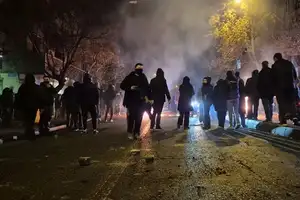
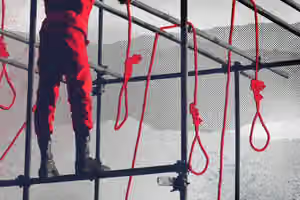
Inside Iran, the judiciary confirmed the executions of Alireza Sepahi and Alireza Raisi, two protesters detained during the January 2026 protests.
The two men were defendants in the Alikhani Square case in Isfahan, in which five others had previously been executed. Iran’s Supreme Court upheld death sentences for 12 defendants in the case in July.
UN Special Rapporteur on human rights in Iran Mai Sato condemned Sepahi’s execution and raised concerns about his treatment and judicial process. Sepahi’s lawyer was still seeking a review when the execution was carried out, Sato said.
Prince Reza Pahlavi’s communications office later vowed to pursue accountability for those involved in the executions through fair trials.
Economic difficulties also remained prominent. Workers across several sectors told Iran International that employers were delaying or splitting wage payments and cutting benefits, with some employees taking second jobs to meet everyday expenses.
The combination of military warnings abroad and political, economic and security developments at home kept the possibility of renewed conflict and its consequences at the center of Iran’s news on Monday.
Alireza Sepahi and Alireza Raisi were executed at dawn at Isfahan Central Prison, also known as Dastgerd Prison, the Hengaw Organization for Human Rights reported.
HRANA also reported Sepahi’s execution, citing lawyer Shahrzad Shahbazi.
Mizan, the judiciary-affiliated news agency, confirmed the executions several hours later on Monday.
The two men were among 12 defendants sentenced to death in the case known as the Alikhani Square case, which stems from the January protests in Isfahan.
Married one day before execution
Sepahi married his fiancée, Mahshad Kashani, from prison one day before his execution, Nobel Peace Prize laureate and lawyer Shirin Ebadi wrote on Telegram.
“He became a groom yesterday, and today they executed him,” Ebadi wrote.
Sepahi and Kashani had been engaged before their arrests. Kashani was also detained and sentenced to five years in prison.
“Behind every number the Islamic Republic adds to the list of executions is a life that could have continued for decades,” Ebadi wrote.
Sources familiar with the case told Iran International on Sunday that Sepahi and Raisi had been transferred to solitary confinement at Dastgerd Prison ahead of the implementation of their death sentences.
The office of exiled Prince Reza Pahlavi called on governments, human rights organizations, international bodies and civil and political activists on Sunday to use all available means to prevent the executions.
Seven executions in one case
Sepahi had previously been scheduled for execution on July 28 alongside his cousin Abolfazl Sepahi Badjani and Amirhossein Safari Hosseinabadi, two other defendants in the Alikhani Square case.
Sepahi suffered a stroke before being transferred for execution and was taken to a hospital in Isfahan. Abolfazl Sepahi and Safari were executed that day.
Ghaem Hosseini was executed on August 20, while Gol-Mohammad Mohammadi and Erfan Esfandiari were executed on July 19.
The executions of Sepahi and Raisi brought the number of people executed in the case to seven.
Iran International reported on July 8 that 12 defendants in the Alikhani Square case had been sentenced to death.
State media said four government security personnel were killed during clashes with protesters at Alikhani Square on January 8.
UN expert raises concerns over treatment
Mai Sato, the UN special rapporteur on human rights in Iran, raised what she described as “serious concerns” about the treatment of defendants and fair-trial standards in the Alikhani Square case.
“According to reports, Alireza Sepahi’s mother was tortured in front of him, and he and his cousin were beaten and tortured in front of their family,” Sato wrote in Persian on X.
Sepahi’s death sentence was carried out “while his lawyer was still seeking a way to have the case reviewed,” Sato added.
Information obtained by Iran International’s Fact-Finding Campaign indicated Sepahi was struck by four shotgun pellets during his arrest at home and was later tortured in detention.
The latest executions came two days after Siavash Jamshidi Kheirabadi, another person detained during the January protests, was executed on October 3.
The latest warning came from Mohammad Amin Aghamiri, secretary of the Supreme Council of Cyberspace and head of the National Cyberspace Center, who raised the possibility of treating satellite internet infrastructure as a military target.
“If satellite internet infrastructure is used as a tool of war, naturally this infrastructure can become a legitimate military target,” Aghamiri said Monday at a conference on online businesses organized by Iran’s cyber police.
Aghamiri described satellite internet and Starlink as potential threats and said the Islamic Republic was technically prepared to counter them.
Referring to the January protests as a “coup,” Aghamiri said authorities had succeeded in disabling Starlink terminals during the unrest.
Officials and state media have repeatedly described anti-government protests as riots or attempted coups and attributed them to foreign actors, including the United States and Israel.
Internet shutdowns and protests
Internet restrictions have long been used by Iranian authorities during periods of widespread unrest.
The Islamic Republic imposed a sweeping internet shutdown during the November 2019 protests and has since restricted or cut connectivity at different points, including during the Woman, Life, Freedom uprising, the 12-day war and the January 2026 protests.
After the 40-day war began in late February, authorities again cut internet access. The restrictions lasted 88 days, becoming the longest digital blackout in the world.
Concerns surrounding Starlink have grown alongside an increased US military presence in the region, worsening economic conditions and domestic discontent.
Internet and cybersecurity expert Davoud Sajjadi told Iran International on October 1 that Starlink allows users to bypass filtering and other government mechanisms designed to control internet access.
The ability to connect outside those systems has made the technology a growing concern for officials, Sajjadi said.
Diplomatic pressure and Starlink seizures
Iran has also pursued diplomatic and law-enforcement measures against the satellite service.
The Foreign Ministry summoned Norway’s ambassador on Sunday to protest continued Starlink operations in Iran.
Norway is the country through which the Starlink network is registered with the International Telecommunication Union, and Iranian authorities say Oslo is therefore responsible for preventing what they describe as unauthorized operations inside Iran.
Foreign Ministry delivered a formal protest to the Norwegian ambassador and called on Norway to take action to halt Starlink operations in Iran.
Authorities have simultaneously intensified efforts to stop the import and distribution of Starlink equipment.
Hossein Rahimi, head of Iran’s Economic Security Police, previously said police seized 997 Starlink devices and related equipment during the first four months of the current Iranian year, which started in mid-March, and arrested 163 people in connection with their import and distribution.
Efforts to stop the entry and distribution of Starlink equipment increased after the 12-day war, Rahimi added.
Official warns Starlink could force power cuts
The extent of official concern was underscored by a Communications Ministry official who warned that widespread Starlink access could undermine the government’s existing mechanisms for controlling cyberspace.
“The spread of Starlink drives the final nail into the coffin of cyberspace governance,” Mohammad Hafez Hakami, deputy minister for technology, innovation and international affairs at the Communications Ministry, said on September 30.
“Those concerned about Starlink have been warning about it for two years, but not even a single line of policy has been developed on the issue,” Hakami said. “If this trend continues, we will be forced to cut electricity in the next crisis.”
Hakami also warned that the expansion of Starlink and direct-to-cell technology could render mechanisms such as device registration and user identification ineffective.
“Starlink, as a new tool that evades governance, is fundamentally no longer based on our network,” Hakami said.
Direct-to-cell technology allows mobile phones to connect directly to satellites without relying on conventional telecommunications towers.
The prospect of satellite connections operating independently of domestic networks poses a particular challenge to authorities because shutting down conventional internet infrastructure would no longer necessarily disconnect users.
Starlink enters broader debate over information access
Israeli Prime Minister Benjamin Netanyahu also highlighted Starlink during his September 24 address to the United Nations General Assembly, holding up one of the devices while discussing access to information in Iran.
“The Iranian regime is especially afraid when their people have this. This is a communications device, Starlink, that allows people to access truth, to exercise choice and to exercise freedom of thought and freedom of speech.”
Netanyahu said Starlink could give Iranians access to what he called “truth,” as well as choice, freedom of thought and freedom of speech.
The growing focus on Starlink now extends across several arms of the Iranian state, from diplomatic pressure and equipment seizures to technical countermeasures and warnings of military action.
Messages sent to Iran International by employees at companies spanning the automotive, energy, pharmaceutical and aviation industries describe wages arriving weeks or months late, with some workers saying they have taken second jobs to cover everyday expenses.
Several employees said their salaries were being paid in installments rather than on schedule. Others described losing workplace benefits or being told to resign if they objected to payment delays.
Delayed wages and disappearing benefits
Two workers at Megamotor, a subsidiary of automaker Saipa, criticized the company's wage and benefit payments in messages to Iran International.
Salary payments became irregular after the 40-day war, one worker said.
“We are suffering greatly and do not know how we can provide for our families.”
Another Megamotor employee said some wages and benefits, including overtime and meal allowances, were no longer being paid to workers, while managers and supervisors continued to receive overtime and other benefits.
Low pay at Saipa Yadak has forced most employees to work for the Snapp ride-hailing service from the afternoon until late at night, an employee of the auto-parts company said.
Some of the company's resources are spent on government ceremonies or large payments to senior managers, the employee added.
Workers at Bahman Motor are also facing financial and psychological pressure, an employee of the automaker said.
The company has declined to make payments to employees even as it continues constructing new industrial buildings, according to the employee.
The accounts come as Iran's economic problems have deepened in recent months alongside the Islamic Republic's regional policies, tighter sanctions and a sharp decline in the value of the national currency.
Rapid inflation and declining purchasing power have increased pressure on household budgets and made basic goods harder to afford for a broad section of the population.
Iran International reported in August that workers at mines and companies had gone months without receiving wages.
Workers say complaints put jobs at risk
Employees at other companies described wages being divided into installments and said challenging the delays could put their jobs at risk.
Salaries at Imen Tak Pishro in Jajrud are paid in installments and employees who object are warned they could be dismissed, one worker told.
Another employee previously told Iran International that their employer paid three months of overdue salaries in two installments.
Mapna has not paid workers at 25 power plants for 40 days, an employee of the company said.
At pharmaceutical company Arya Tinagen, salaries remained unpaid 11 days into the month, an employee said.
“The company has cut all employee benefits, from meals to the monthly benefit card. If we complain, they tell us to resign and leave.”
Messages in recent days have also described overdue wages, unpaid insurance contributions and warnings of dismissal across a range of workplaces.
An employee at Yasuj University of Medical Sciences said at the time that staff had gone three months without salaries and were warned they could lose their jobs if they pursued their demands.
Second jobs and unemployment fears
For some workers, irregular wages and rising living costs have made additional employment a necessity. For others, the concern is whether their main job will survive at all.
An employee at Ata Airlines said inflation, the rising exchange rate and aviation sanctions had led the carrier to cut jobs.
The airline had previously borrowed billions of tomans in an effort to avoid dismissing employees, according to the worker.
Employees at Kish Air said they had been instructed not to report for work until further notice and had not received a year's worth of performance-related payments.
Concerns extend beyond individual companies.
Large numbers of factories at the Shamsabad industrial estate have shut down, one person familiar with employment conditions there told Iran International.
The person said they had filled out around 50 job applications for factories in the industrial estate without receiving an offer.
The accounts follow broader signs of concern about employment. In an Iran International survey published in August, 92% of respondents said they had witnessed unemployment among people around them.