Iran signals readiness for Hormuz showdown despite US buildup

Iran signaled Saturday that it would not back down in the face of a US military buildup, suggesting it could resort to a high-risk plan to break Washington's maritime blockade.
Iran signaled Saturday that it would not back down in the face of a US military buildup, suggesting it could resort to a high-risk plan to break Washington's maritime blockade.
Deputy Foreign Minister Kazem Gharibabadi described the blockade as an act of war and said Tehran would take whatever measures were necessary to break it.
Hardliners in Tehran have been calling for a convoy of oil tankers to challenge the US blockade, with threats of military retaliation against regional energy infrastructure if Washington attempted to stop the vessels. Tehran has not formally endorsed the proposal.
The United States has continued to reinforce its military presence in the region, with two aircraft carrier strike groups deployed to the Middle East, while maintaining a naval blockade of Iran for more than four months.
Attacks on commercial shipping in and around the Strait of Hormuz have also intensified. British maritime authorities recorded at least 19 strikes on vessels through November 18, which it said was the highest monthly levels since the war began.
Foreign Minister Abbas Araghchi said Saturday that reopening the Strait of Hormuz would not be difficult if Washington accepted Tehran's conditions.
He said the United States must acknowledge its mistakes and fulfill previous commitments, adding that discussions on regional security had begun.
Talks with Qataris
Iranian army spokesman Mohammad Akraminia also warned that any renewed military offensive would face an immediate response extending beyond Iran's borders.
"We are considerably stronger than before, and any new aggression will face a decisive, immediate and effective response," he said on Saturday. "Our defense will not be limited to any specific geographical area."
Despite the confrontational rhetoric, Tehran has kept diplomatic channels open.
Gharibabadi said Iran remained in contact with mediators to explore whether diplomacy could be given another chance, confirming that a Qatari delegation had visited Iran on Friday night for talks.
He reiterated, however, Iran's position that “enriched materials will under no circumstances leave the country."
‘Ultimate regime change’
In a telephone interview with Fox News on Saturday, President Donald Trump said he wanted an agreement that would permanently prevent Iran from acquiring nuclear weapons and could not be undermined by future US presidents.
"I'm going to make a deal that is going to be permanent," he said, arguing that Tehran had a history of breaking agreements.
Asked whether Iran's current government would remain in power after the conflict, Trump said: "Well, I never cared too much about the regime. You know, some people said regime change, but you know, explain what that means because really I've taken out two regimes already."
"I've taken out the first group, the second group, we're dealing with the third group. So you could call that the ultimate regime change," he added.











Iranian hardliners are calling for a convoy of oil tankers to challenge the US naval blockade, threatening military retaliation against regional energy infrastructure if Washington attempts to stop the vessels.
The proposal, published Thursday by the Revolutionary Guards-affiliated Fars News Agency, calls for tankers to sail to China and threatens strikes on oil facilities in the United Arab Emirates, Saudi Arabia and Qatar if the US intervenes. It emerged shortly after reports that an unsanctioned tanker had been loaded at Iran's Kharg Island oil terminal.
Fars dubbed the plan “Operation Fereydoun,” after a legendary hero in the Persian epic Shahnameh.
No official plans for a convoy have been announced, although Foreign Minister Abbas Araghchi said Friday that Iran would break the blockade.
“A blockade is a military action. A military action also has a military response,” political and military analyst Nima Akbarkhani said during a Thursday night discussion on Iranian state television.
Akbarkhani described a previously discussed scenario in which Iranian tankers would sail individually with their Automatic Identification System (AIS) signals switched on and Iranian flags displayed, while Tehran announced in advance which regional facilities it would target if any vessel were attacked.
During the Be Vaght-e Iran program, host Ruhollah Razavi suggested placing media teams, members of the public and international anti-war activists aboard the tankers to increase the political and media costs of any US intervention.
Akbarkhani endorsed the idea, arguing that unlike vessels sent to Gaza, which Israel prevented from reaching their destination despite extensive media coverage, Iran could deter attacks on blockade-breaking tankers by threatening military retaliation.
Support for confrontation grows
Political analyst Mostafa Najafi, recently described in Iranian media as an adviser to Supreme National Security Council Secretary Mohsen Rezaei, wrote on X that Supreme Leader Mojtaba Khamenei had ordered an end to the “neither war nor peace” situation some time ago.
Najafi suggested that the effort extended beyond diplomacy, with military options also under consideration.
“Apparently, Tehran no longer wants to sit back and watch the blockade and threats,” he wrote.
Majid-Reza Hariri, president of the Iran-China Chamber of Commerce, called on Iranians across the political spectrum to support efforts to break the blockade.
“After months of pursuing negotiations in various ways, every Iranian patriot, regardless of political outlook, should support the government in breaking the naval blockade imposed by the aggressive United States by any means possible,” he wrote Friday.
Media analyst Alireza Shiva argued that Iran was signaling that energy security in the Persian Gulf could not be defined unilaterally.
“You cannot target Iran's oil exports while expecting the energy exports of others to continue in complete security,” he wrote on X.
A high-risk strategy
Hardline journalist Parisa Nasr argued that Iran had made a strategic mistake by treating the blockade as a negotiating issue rather than a wartime measure intended to weaken the country and force its surrender.
She advocated a strategy of “bringing the crisis to the brink” to pressure Washington into easing the blockade while strengthening Iran's deterrence against attacks on its tankers.
Energy analyst Abdullah Babakhani offered a more cautious assessment, suggesting that US forces might initially allow some Iranian tankers through before pursuing and potentially seizing them in international waters.
He compared the scenario to operations involving the pursuit and seizure of tankers linked to Venezuela last year, saying Iran's response to such an eventuality remained unpredictable.
China, Iran's largest oil buyer before the blockade, has been identified as the intended destination for the proposed convoy. Whether Beijing would accept the shipments remains unclear.
The proposal therefore presents Tehran with a potentially consequential choice: continue seeking a negotiated end to the blockade or test Washington's willingness to enforce it at the risk of a wider military confrontation.
Guards-linked media, lawmakers and Friday prayer leaders signaled this week that Iran is preparing to send tankers through the US naval blockade, and warned that any attack on them would bring strikes on oil facilities across the Persian Gulf.
“The blockade must be broken,” Foreign Minister Abbas Araghchi told the ILNA news agency on Friday, when asked about reports that Iranian oil was being loaded for export. Iran would make every effort to export oil and to pursue negotiations, he said.
No Iranian official has confirmed a convoy. But the idea has moved in days from commentary by Revolutionary Guards-affiliated outlets to parliament and, on Friday, to prayer leaders in several cities, a path that decisions taken at the top in Tehran often follow before they are announced. Friday sermons are coordinated nationally by a council that answers to the supreme leader.
The campaign began on Wednesday, when the Guards-affiliated Fars news agency published a commentary urging Tehran to send a convoy of tankers through the blockade.
Iran should announce it officially, Fars said, and warn that any attack on the convoy would bring strikes on the region’s energy infrastructure, “especially UAE oil,” and on communications networks in Dubai.
On Thursday, the oil tracker TankerTrackers said Iran “appears to be preparing to ship out oil again.”
Its co-founder, Samir Madani, told Reuters that a tanker was taking on Iranian crude from another vessel in the Persian Gulf. If it cleared the blockade, it would be the first seaborne export of Iranian crude since mid-July. Al-Monitor reported that more than 14 Iranian tankers were gathered near Kharg Island, Iran’s main oil terminal, most with their tracking transponders switched off.
The Guards-affiliated Sabereen News, in a post labeled “unofficial,” said dozens of tankers were preparing to sail for China, and that Tehran had warned governments across the region it would go to war if the United States attacked them.
A Fars report said that any disruption to a tanker’s voyage would mean explosions at oil facilities in the UAE, Saudi Arabia, Qatar, Kuwait, Oman and Bahrain. Fars illustrated its commentary with an image of Fereydun, the hero of the Persian epic the Shahnameh, on horseback in the sea, guarding Iranian ships.
Mostafa Najafi, described in Iranian media as an adviser to Mohsen Rezaei, secretary of the Supreme National Security Council, linked the plan to the top. The supreme leader had ordered an end to the state of “neither war nor peace,” he wrote, and “the military option is also on the agenda.” Tehran, he wrote, “no longer wants to watch the blockade and the threats.”
Mohammad Bayat, a lawmaker on the presiding board of parliament’s Internal Affairs Committee, called on Friday for tankers to be readied and for “an ultimatum” to Washington and the region’s governments. Iran, he said, “must be the initiator” of practical steps to end the blockade.
In the northwestern city of Ardabil, prayer leader Hassan Ameli, a member of the Assembly of Experts, went furthest.

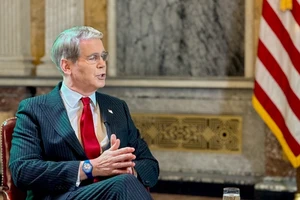
Officials had taken “a very important decision to break this siege,” he said, and tankers would soon set sail from Kharg for China.
“Our armed forces have warned the Americans that if a single shot is fired at them, all oil centers in the Persian Gulf countries will be Iran’s legitimate target,” he said.
In Tehran, Friday prayer leader Mohammad-Javad Haj-Aliakbari said the armed forces were ready “at sea, on land, in the air, everywhere,” with orders “to take unlimited, unrestricted action, at a time of our own choosing.” “If they want to test us, they can go ahead and test us,” he said.
In Khorramabad, in the west, Friday prayer leader Ahmadreza Shahrokhi urged the armed forces not to let the blockade continue, and said that if any attack came from the territory of the Persian Gulf states, the armed forces should target “the palaces” of their rulers.
In Yasuj, in the southwest, Nasir Hosseini said Iranians wanted the blockade broken “with the power of the nation and the armed forces” and spoke of nuclear deterrence. In Tabriz, Ahmad Motahari-Asl warned that Iran had “not yet closed” the Bab el-Mandeb strait at the mouth of the Red Sea.
The Guards’ commander, Ahmad Vahidi, said: “Today we have put part of a great battle behind us, and part of it lies ahead.”
The blockade has cut Iran off from its main source of foreign currency. Iran loaded about 2 million barrels of crude and condensate a day in March, Reuters reported, citing Kpler and Vortexa. By September, Kpler recorded no loadings at all, the first full month without any since the 1979 revolution. Production has fallen to about 1.8 million barrels a day, roughly half its prewar level.
Chinese refiners usually pay one to two months after delivery, so payments for Iran’s last cargoes could arrive by mid-December, Homayoun Falakshahi, Kpler’s head of crude oil analysis, has told Iran International. After that, Tehran stands to lose $3 billion to $6 billion a month.

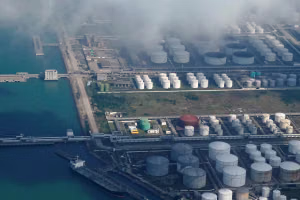
Alihossein Ghazizadeh, an Iran International analyst, said Tehran had concluded that time was against it. Washington wants to keep the blockade in place until the state is weak enough to collapse, give in or face mass protest, he said, and fighting later would cost the United States less.
“If a war is going to happen in three months, it’s better that it happens today,” he said, describing Tehran’s thinking. Iran could provoke a clash, he said, but the decision to start a full-scale war would rest with the United States and Israel.
The United States has moved the other way. On Wednesday, US Central Command widened the blockade to cover ship-to-ship transfers at sea. “Such ships may be stopped, boarded, diverted, captured, or directed to proceed to the Iranian port where the cargo originated,” it said, warning that ships failing to comply could face force. CENTCOM says it has redirected 150 merchant vessels and disabled five since June, and in September US forces struck several Iranian tankers near Kharg and Jask after the Guards fired missiles at a US warship.
President Donald Trump has signaled patience. He told Axios this week that he was in no rush to decide on Iran and would see what happened after the new year.
On Thursday he said he could end the war “immediately,” but that Saudi Arabia had asked him “to please just let it be the way it is now for a while, because [Iran is] disintegrating.”
Treasury Secretary Scott Bessent, who runs the economic campaign, told CNBC this month that death threats against him from Iran’s leadership showed the pressure was working. Of the Guards, he said: “They’re like a dangerous cornered animal.”
Israel has pressed the other way. Mossad chief Roman Gofman was in Washington last week to urge a resumption of joint strikes, Axios and the Wall Street Journal reported.
If the tankers sail, Washington faces a choice it has so far avoided: let the blockade break, or fire on Iranian ships and test whether Tehran will carry out its threat against the Persian Gulf states.
Iraqi forces began deploying on Friday in Jurf al-Sakhar, a town south of Baghdad held for more than a decade by Iran’s most powerful militia ally in Iraq, under a deal brokered by Shiite leaders days after the head of Iran’s Quds Force arrived in Baghdad.
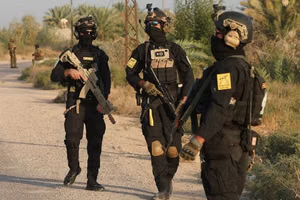
A convoy flying Iraqi flags drove toward Jurf al-Sakhar on Friday, and hundreds of soldiers took up positions on the outskirts.
The yellow flags of Kataib Hezbollah were still flying farther inside the town, and none of the group’s fighters were visible. A security headquarters is due to open on Saturday to oversee the handover, with a unit assigned to protect energy facilities.
Under the deal, Kataib Hezbollah fighters are to withdraw to other parts of Iraq, Reuters reported, citing security officials. Al Arabiya, citing sources, said the withdrawal would be phased over a month. A joint command of the army, federal police, energy police and units of the Popular Mobilization Forces is taking over the town.
The standoff began on Monday, when Prime Minister Ali al-Zaidi ordered troops to prepare to enter Jurf al-Sakhar after an investigation accused Kataib Hezbollah of running a network that siphoned off hundreds of millions of dollars’ worth of state oil through tampered pipelines.
Nine senior security and oil officials were dismissed, and arrests linked to the case raised fears of an armed confrontation. The group denies the accusations and had warned it would resist any attempt to enter the town.
The same day, Esmail Qaani, commander of the Revolutionary Guards’ Quds Force, which runs Iran’s network of allied armed groups abroad, arrived in Baghdad to help defuse the crisis, Iraqi Shiite political sources told Reuters. Kataib Hezbollah said its leader, Abu Hussein al-Hamidawi, met Qaani and Hadi al-Amiri, head of the Iran-backed Badr Organization, in the talks that led to the deal.
Jurf al-Sakhar, a Sunni farming town on the Euphrates about 50 kilometers south of Baghdad, was retaken from Islamic State in 2014 by the army and Shiite militias, Kataib Hezbollah among them. Its residents were never allowed back. More than 100,000 people from the town and surrounding villages remain displaced, Shafaq News reported, and even government officials have rarely been let in.


The town sits near the roads linking Baghdad with Karbala and Anbar province, and has served as a financial hub for evading sanctions on Iran, said Omar Mohammed, an Iraqi historian known for documenting life under Islamic State as Mosul Eye. He called the move “a theatrical show.”
“I think maybe the Iranian-backed militias will allow them some cosmetic gains, but there’s no way that Iran is going to allow its footprint in Iraq to disappear,” David Patrikarakos, a journalist and author of a book on Iran’s nuclear program, told Iran International earlier this week.
Kataib Hezbollah was founded after the 2003 US-led invasion of Iraq by Abu Mahdi al-Muhandis, who was killed alongside Quds Force commander Qassem Soleimani in a US drone strike at Baghdad airport in January 2020. Washington designated it a terrorist organization in 2009 and blamed it for a January 2024 drone attack that killed three US soldiers at a base in Jordan.
It is among the most influential members of the Islamic Resistance in Iraq, an umbrella of Iran-backed factions that has claimed more than 150 attacks on US forces since the Gaza war began in 2023, and more recently on US troops in the Persian Gulf states.
The militias report directly to Iran’s Revolutionary Guards. Their arsenals include anti-tank guided missiles, precision-guided rockets, armed drones and some short-range ballistic and cruise missiles, according to Iraqi security officials.
Kataib Hezbollah has thousands of fighters and no announced leadership structure. It forms several battalions of the Popular Mobilization Forces, an umbrella of mostly Shiite armed factions set up in 2014 to fight Islamic State and later made an official state force.
Its fighters draw state salaries, and some of its members designated as terrorists by the United States hold senior posts in the PMF. It also has a political party, Huquq, with five lawmakers, and business interests in construction, housing, trade and currency exchange, according to an Iraqi official report. The group denies these.
Since the United States and Israel went to war with Iran on February 28, Iraqi militias have struck US troops and facilities in Saudi Arabia and the United Arab Emirates. President Donald Trump has pressed Zaidi to disarm them, and the factions have refused to hand over their weapons.
Moving against the militias carries a price. In November 2021, after then-Prime Minister Mustafa al-Kadhimi ordered a crackdown, his Baghdad home was hit by an armed drone in what officials called an assassination attempt.
In August, Iraqi special forces arrested the intelligence chief of another Iran-aligned faction, Harakat al-Nujaba, over drone attacks on US targets. He was released 48 hours later after threats of retaliation and the intervention of senior Shiite politicians.
Iraq is also tied to Iran in ways that a single town cannot change. It imports Iranian gas and electricity, and the militias’ access to dollars and to trade has made Iraq one of Iran’s main routes around sanctions. The US Treasury barred 14 Iraqi banks from dollar transactions in 2023 over suspected links to Iran, and in 2025 it sanctioned a businessman accused of smuggling Iranian oil disguised as Iraqi crude.
John Craig, a former US ambassador, called Baghdad’s move “about 10 years overdue.” Whether Zaidi can do more, he said, would show how serious he is.
Britain is carrying out offensive cyber operations against Iran, Russia, China and North Korea, the commander in charge of its military cyber force told Sky News, a rare public admission that comes as Iran-linked plots and hacks hit Britain and its allies.
Asked whether the National Cyber Force was conducting offensive operations, General Sir Rob Magowan said, “Absolutely, and we’ve been clear about that.” Russia, China, Iran and North Korea “are a threat to our way of life and they are conducting operations in the cyber domain,” he said.
“And they need to be really clear that there’s going to be a cost to them conducting operations in the cyber domain and that’s what our cyber force is about.”
British officials almost never discuss the force’s offensive missions in public. Set up in 2020, it brings together the signals intelligence agency GCHQ, the Ministry of Defense, the foreign intelligence service MI6 and the Defense Science and Technology Laboratory. King Charles opened its new headquarters in Samlesbury, in northwest England, on Monday.
Magowan, a Royal Marines officer who heads the military’s Cyber and Specialist Operations Command, said the force could map an adversary’s networks “and ensure that we can achieve effect inside that network.” Its operations were succeeding, he said, though he gave no details.


“I wouldn’t say we’re at war, but we’re not at peace either,” he said. “We’re in this hybrid zone, this grey zone, below the threshold of conflict.”
His message to adversaries was blunt. “If you’re going to try to operate in the cyber domain, then you’re going to meet us. You’re going to meet that threat with threat,” he said.
Britain’s National Cyber Security Centre, part of GCHQ, tracked 1,831 reported cyber attacks in the past year, 80 of them nationally significant.
The admission comes after a run of Iran-linked threats against British soil, several of them aimed at the US military presence there.
In September, police arrested five men near RAF Fairford in western England, which US bombers had used to strike Iran. Washington pulled all 12 of its B-1B bombers from the base in early October, and two men were charged in October under the National Security Act, one accused of assisting Iranian intelligence. Prime Minister Andy Burnham said the plot was “almost certainly” directed by the Revolutionary Guards.


Earlier in November, a US indictment and an ITV News investigation tied the Fairford plot to a network run from Baghdad on behalf of Iranian intelligence, which Western officials blame for about 18 attacks across Europe, seven of them in Britain, many aimed at Jewish targets.
The same week, the US military moved tankers and aircraft out of RAF Mildenhall in eastern England over a threat from Iran, and raised the alert level there and at nearby RAF Lakenheath to the second-highest.
Iran’s top security official, Mohsen Rezaei, has since warned that Iran would strike US bases in Europe if attacked again. Last week, two men were convicted in London of spying on Iran International journalists for Iranian intelligence. Iran-linked operations have led to more than 50 arrests in Britain in the past year, according to MI5.
Iranian hackers have also gone after civilian infrastructure.
In July, Iran-linked hackers took over the controls of a small gas power plant in Britain and forced it offline for about four days, the Telegraph and Guardian reported. British officials confirmed a cyber incident but have not publicly attributed it.


In October, hackers took control of refrigeration systems at about 700 supermarkets in France, letting fridges and freezers warm up. France blamed Shahid Kaveh, an offensive cyber unit of the Revolutionary Guards working behind front groups including one calling itself CyberAveng3rs.
On the night of November 1, supermarkets in at least nine European countries reported similar attacks, and hackers tampered with freezers storing blood for patients at France’s national blood service, which is now under judicial investigation.
The CyberAveng3rs name echoes a group that US authorities linked to the Guards after it hacked control systems at American water utilities in 2023. Iran-linked hackers were also blamed for attacks on US water systems in July.
Iraqi authorities have reached a deal with Iran-backed Kataib Hezbollah to avert a confrontation over its stronghold south of Baghdad, with government forces expected to enter the area Friday, Reuters reported Thursday, citing three senior security officials.
Under the agreement, brokered by senior Shiite political leaders, Kataib Hezbollah fighters would relocate from Jurf al-Sakhar to other areas, Lieutenant General Saad Maan, head of Iraq's Security Media Cell, told Reuters.
The deal follows days of escalating tensions after Prime Minister Ali al-Zaidi ordered preparations for government forces to take control of Jurf al-Sakhar, a Kataib Hezbollah stronghold in Babil province, about 60 kilometers southwest of Baghdad.
Al Arabiya separately reported, citing sources, that the agreement provides for a phased withdrawal of the militia within a month, alongside the deployment of Iraqi security forces.
The militia warned Tuesday that it would resist any attempt by government forces to enter the area, which it has controlled for more than a decade.
The dispute intensified after Iraqi authorities investigated allegations that Kataib Hezbollah operated an oil-smuggling network that diverted hundreds of millions of dollars' worth of state-owned oil, Reuters reported. The militia denied the allegations.
Esmail Qaani, commander of the Revolutionary Guards' Quds Force, arrived in Baghdad on Monday to help defuse the standoff, according to Iraqi Shiite political sources cited by Reuters.
A Kataib Hezbollah spokesperson said the group's leader, Abu Hussein al-Hamidawi, met Qaani, Badr Organization chief Hadi al-Amiri and other figures in talks aimed at preventing a confrontation. Participants described the outcome as positive Thursday.
Iraq also announced that a joint security command would begin operating in Jurf al-Sakhar on Friday, bringing together army, federal police, energy police and Popular Mobilization Forces units.
Iraqi armed forces were placed on heightened alert Thursday ahead of the deployment, according to the state-run Iraqi News Agency.
Kataib Hezbollah subsequently ordered its fighters to resume normal duties after days of heightened tensions, according to a statement by the group's leader, Abu Hussein al-Hamidawi.
The standoff has tested Zaidi's efforts to bring Iran-backed militias under state authority. Kataib Hezbollah operates within Iraq's officially recognized Popular Mobilization Forces but has frequently challenged government authority.
The United States has designated Kataib Hezbollah a foreign terrorist organization since 2009.