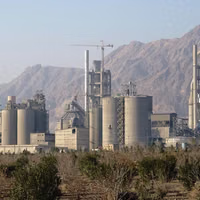
A tough winter for Iran's cement industry, a tougher one for steel

The question facing Iran’s steel and cement industries this winter is not simply whether their gas supplies are cut, but how much they can continue producing afterward.

The question facing Iran’s steel and cement industries this winter is not simply whether their gas supplies are cut, but how much they can continue producing afterward.
Iran faces a peak gas deficit of about 430 million cubic meters daily, compared with 300 million before US-Israeli strikes damaged its energy infrastructure.
Households take priority, but how much of the shortfall will fall on either industry remains uncertain.
Cement needs heat, which can come from alternative fuels. Much of Iranian steelmaking, however, needs gas to transform iron ore itself.
A cement factory that loses natural gas may still have a working kiln tomorrow. A steel plant that loses the gas feeding its iron-reduction unit may not.
Cement: The challenge of getting fuel
Iran's grey-cement producers were receiving only five to eight million cubic meters of gas daily against normal industry demand of 28 million before losing the remainder in late October, according to Tasnim. Most had already turned to mazut, a heavy fuel oil.
Iran nevertheless produced 6.44 million tonnes of clinker in October. That provides a baseline before the cutoff, not evidence that production continued at the same rate afterward.
Using the International Energy Agency's energy benchmark, maintaining October's clinker output without gas would require approximately 19 million liters of mazut daily, equivalent to about 760 deliveries by 25,000-liter tankers.
These are estimates, not forecasts. Kilns differ in efficiency, and the fuel must actually arrive. Losing 200 tanker deliveries would mean losing enough heat to produce roughly 54,000 tonnes of clinker daily, assuming no backup fuel.
Cost is another obstacle. Tasnim reported mazut transport charges of 2,000–2,500 tomans per liter. At 19 million liters, trucking alone would cost 38–47.5 billion tomans daily, excluding fuel purchases. Power plants also compete for the same tankers and mazut.
Iran International reported that 22 cement factories stopped their kilns in December 2024. Tehran Cement could not burn mazut because of pollution restrictions near populated areas. A 2026 report described Lamerd Cement operating at around 60 percent of capacity over the preceding two years because its distance from fuel suppliers made reliable mazut deliveries uneconomic.
Having an alternative fuel, in other words, does not guarantee that a factory can use it.
Cement can outlast its kilns, briefly
Even when a kiln stops, a grinding mill can turn stored clinker into finished cement, provided electricity remains available. This can conceal the scale of disruption.
In July, clinker production fell nearly 39 percent year-on-year, while cement production rose 5 percent.
October cement output averaged approximately 214,000 tonnes daily. Assuming clinker accounts for 80 percent of finished cement, sustaining that rate with every kiln stopped would consume about 171,000 tonnes of stored clinker each day.
At that pace, one million tonnes of accessible clinker would last fewer than six days. Maintaining production for a month would require more than five million tonnes. National inventories are not publicly verified.
October's exports included 668,000 tonnes of cement and 285,000 tonnes of clinker, adding to competition for available supplies. Slower production can stretch stocks but reduces sales, while electricity shortages can stop grinding mills even sooner.
Steel: Gas is an ingredient
Iran's electric-furnace steel industry is particularly exposed because much of it relies on direct-reduced iron, also known as sponge iron.
In these plants, natural gas is converted into hydrogen and carbon monoxide to remove oxygen from iron ore.
Iran produced about 14 million tonnes of sponge iron during January–June 2026. Using a published benchmark of 265 cubic meters of gas per tonne of sponge iron, maintaining that production rate would require approximately 20.5 million cubic meters of gas daily.
A daily gas reduction of five million cubic meters could put roughly 19,000 tonnes of sponge-iron production at risk; a ten-million-cubic-meter cut could put 38,000 tonnes at risk.
These are estimates of potential exposure, not predictions of actual production losses.
Plants also cannot necessarily operate at half capacity when their gas supply is halved. Iron-reduction units require specific gas flows, temperatures and chemical conditions. Below certain levels, an entire unit may have to shut down.
Where the alternatives run out
Steelmakers can keep their furnaces running for a time by using stored sponge iron, purchasing other iron materials or increasing their use of scrap metal. Iran's smaller blast-furnace operations also rely on a different production process.
Replacing just ten days of Iran's recent sponge-iron output would require around 770,000 tonnes of suitable material. Finding that much would be difficult when supplies are tight, prices are high and electricity shortages are already disrupting operations.
Some steel production could therefore continue after gas supplies are cut, but maintaining normal output would become difficult as available materials run low.
Cement producers have more flexibility, but their experience shows that fuel substitution depends on delivery, cost and permission to burn alternative fuels. Neither industry's losses can be reliably forecast without knowing how much fuel and material individual factories have in reserve.
Both industries may continue producing after gas supplies are cut, but their output will depend on the availability and cost of alternative fuels and raw materials.
What matters this winter is not simply whether factories remain open, but how much they can produce, at what cost and for how long.
The death of Iranian Shiite cleric Hossein Vahid Khorasani at 105 has drawn ridicule and anger on social media, with Iranians questioning the longevity of prominent religious authorities and criticizing perceived clerical privilege following his death on Tuesday.
Responses to Iran International's post on X ranged from jokes about the ayatollah's advanced age to criticism of the religious establishment, with some contrasting his long life with their own health and economic difficulties.
“How did this bastard live to be 105? I'm 23 and there isn't a healthy part left in my body. I feel like I won't make it past 30,” one person wrote, adding laughing emojis.
The frustration comes against a backdrop of economic hardship, with some Iranians offering their organs for sale to pay debts and cover basic living expenses.
A recent Iran International examination of more than 600 online organ-sale advertisements found that roughly one-third offered multiple organs or body tissues, including kidneys, liver tissue and bone marrow. Some prospective sellers described struggling to afford housing, support their children or repay debts.
The longevity of senior clerics also stands in contrast to the lives of young Iranians killed during the Islamic Republic's January crackdown on nationwide protests. More than 36,500 people were killed by security forces on January 8 and 9, according to an Iran International
Vahid Khorasani died on November 17 after being hospitalized. Born in 1921, he spent decades teaching Islamic jurisprudence in the religious city of Qom.
Social media reactions target clerical privilege
Several comments portrayed Vahid Khorasani's long life as a reflection of the comfortable conditions associated with senior religious figures.
“From day one, all he did was live in idleness and comfort, without working, while benefiting from ordinary people's money,” one X account wrote.
Other responses used sarcasm to express resentment toward the clerical establishment.
“You finally managed it, Angel of Death! Congratulations!” read another post, accompanied by dancing emojis.
“The only useful thing the men of the seminary do is die, and they don't even do that on time,” another commenter wrote.
The announcement of a weeklong closure of the religious seminary also drew a celebratory response from one account, which welcomed both the cleric's death and the suspension of classes.
“Then why didn't your prayers to keep this mullah alive work?” another person asked.
One post joked that Vahid Khorasani had survived until the final moments of the Islamic Republic.
Why do some ayatollahs live so long?
Vahid Khorasani was among several prominent Shiite religious authorities who reached an advanced age.
Grand Ayatollah Lotfollah Safi Golpayegani died in 2022 at 102. Other senior Iranian clerics include Nasser Makarem Shirazi, 99, Hossein Nouri Hamedani, 101, and Ahmad Jannati, 99, who remains secretary of the Guardian Council, a powerful body that vets election candidates and reviews legislation.
Jannati, who has held the position since 1992, has become a frequent target of jokes about longevity in Iran. His advanced age and continued presence in power have repeatedly drawn ridicule on social media.
Iran's life expectancy at birth was approximately 78 years in 2024, according to World Bank figures. However, that figure does not represent the expected lifespan of people who have already reached old age.
While genetics and lifestyle can influence longevity, the advanced ages of prominent clerics have also drawn attention to their access to healthcare and relatively secure living conditions.
Senior Shiite clerics often spend decades within established religious institutions, where they are not required to undertake conventional employment and their standing can provide financial stability and institutional support.
For Iranians reacting to Vahid Khorasani's death at 105, his longevity highlighted the contrast between the lives of senior clerics and the hardships facing ordinary people, fueling criticism of the religious establishment and its perceived privileges.
Iran could carry out a radiological or chemical-weapons attack in the United States, but operational hurdles and retaliation risks make it unlikely, experts told Iran International following reports of plots targeting senior US officials.
The assessments followed a CNN report citing seven US officials who said intelligence indicated Iran was developing plans to potentially target senior Trump administration officials in Washington with a dirty bomb or chemical weapon.
"Dirty bomb is not typically what you would use to assassinate someone," said David Albright, a physicist and president of the Institute for Science and International Security.
Farzin Nadimi, a senior fellow at the Washington Institute specializing in Iran's military affairs, assessed the likelihood of an attack as "low to very low," citing operational difficulties and the prospect of US retaliation.
Two sources cited by CNN said the planning included specific locations and targets, although there was no evidence that Iranian leaders had decided to proceed. Officials differed over whether personnel were already in place.
The White House said there were "no credible threats to the homeland" at the time. President Donald Trump said Tuesday that Washington was investigating the information and taking the possibility seriously.
Iran denied the allegations, while Homeland Security Secretary Markwayne Mullin described the planning as "aspirational."
Iran's chemical-weapons history
Iran's history of acquiring and transferring unconventional weapons provides grounds for taking the warnings seriously, Behnam Ben Taleblu, senior director of the Foundation for Defense of Democracies' Iran Program, said.
"These are threats that do need to be taken seriously," Taleblu said. "Conversely, the intelligence leaks and the sources should also be scrutinized."
Taleblu cited Iran's past transfers of chemical weapons to Muammar Gaddafi's Libya.
US State Department compliance reports have identified Iran's failure to declare chemical-weapons transfers during the Libya-Chad war as a violation of the Chemical Weapons Convention.
A 2019 report cited chemical-filled artillery projectiles and aerial bombs transferred to Libya, alongside chemical mortar rounds assessed to be of Iranian origin found in Iraq, as evidence supporting Washington's assessment that Iran had filled and possessed chemical weapons.
A subsequent report identified Iran's pursuit of pharmaceutical-based agents for offensive purposes as another compliance violation.
Despite that history, Taleblu did not regard the latest warnings as necessarily signaling a change in Iran's military doctrine.
"I think this is a lot more of the same," he said.
Would a dirty bomb be effective?
The alleged assassination objective raises questions about the choice of weapon, particularly whether a radiological device would be effective against individual targets.
A dirty bomb combines conventional explosives with radioactive material. The US Centers for Disease Control and Prevention says its primary immediate danger generally comes from the explosion, although radioactive contamination can create additional health risks.
Such a device could force evacuations and spread fear, but would be less suited to killing a particular individual, Albright said.
"In terms of an assassination method, I wouldn't consider it very effective," he said.
Chemical agents could be more effective for targeting individuals, Albright argued, citing research published by his institute in 2024 identifying evidence of Iranian work on delivering pharmaceutical-based agents using drones.
Whether that work produced an operational capability or was connected to a specific US attack plan remained unclear.
"I think it's also important to keep in mind that the story said there was no imminent threat," Albright added.
Operational obstacles and retaliation risks
Beyond the choice of weapon, carrying out an attack would require access to materials, reliable personnel and the ability to evade US security measures.
Iranian intelligence services could potentially construct a crude radiological device if they obtained the necessary material inside the United States, Nadimi assessed.
"The likelihood I believe is low to very low, given the risks associated with such an action and the high possibility of retaliation," he said.
Questions about operational readiness also concerned Mark Fowler, a former CIA operations officer with extensive experience involving Iran, who questioned who was discussing the alleged attack and how far preparations had advanced.
"It's not clear to me that they actually have that in hand at this point," Fowler said, referring to the required materials.
CNN reported that Iranian communications suggested bomb-making materials were already inside the United States. Officials disputed the credibility of that information, although some considered it likely that materials had been positioned in advance.
Nadimi considered domestic acquisition theoretically possible, while Albright emphasized US accounting and security measures that make obtaining radioactive material more difficult.
A 2021 National Academies study identified vulnerabilities involving some civilian radioactive sources and warned that even relatively small radioactive releases could have lasting socioeconomic consequences.
The warnings could also strain US security resources even without an attack, Mike Pregent, a former intelligence officer who has testified before Congress about Iran's overseas terrorism networks, said.
"They've already got everybody spinning up on it," Pregent said.
Any radiological or chemical-weapons attack could also harden American public opinion against the Islamic Republic and provoke severe retaliation, Nadimi said.
The reported consideration of such an operation, however, "does not show a decision is made to act," he added.
Bread rationing has been introduced without public notice in two Iranian provinces, triggering queues and disputes at bakeries, the hardline daily Kayhan reported, as government officials confirmed a nationwide bread purchase management system on Tuesday, November 17.
Kayhan, published under the supervision of a representative of Iran's Supreme Leader, reported that the restrictions had been introduced in Khuzestan province in southwestern Iran and Zanjan province in the northwest without informing bakers or consumers in advance.
The measures prompted residents to rush to bakeries and led to verbal confrontations, the newspaper reported.
Under the system described by Kayhan, each person receives a monthly allocation equivalent to approximately eight kilograms of subsidized flour, priced at 23,000 rials ($0.009) per kilogram.
Purchases exceeding the allocation are charged at the commercial rate of 126,500 rials ($0.047), more than five times the subsidized price, with the additional payments transferred to government accounts, Kayhan reported.
The newspaper questioned why the measures had been introduced without informing bakers or consumers and accused “elements within the government” of contributing to “public anxiety” through simultaneous changes affecting bread, gasoline and electronic food vouchers.
Local media had previously reported restrictions in Shadegan, Andimeshk, Omidiyeh and Zeydun in Khuzestan province, where daily bread allocations were set at between two and 2.5 loaves per person.
Purchases exceeding those amounts were priced at 131,500 rials ($0.049), according to the local reports.
Officials confirm nationwide rollout, deny household restrictions
The bread purchase management system is being implemented across Iran, but ordinary households face no restrictions on their daily purchases, Omid Jahannejadian, director-general of Khuzestan's Grain and Commercial Services Department, told the official IRNA news agency on Tuesday.
The program is intended to regulate subsidized flour consumption, prevent potential misuse and identify purchases exceeding normal household needs, Jahannejadian said.
Consumption thresholds are calculated using purchasing data collected over the past two years, taking account of differences between urban and rural areas.
The system calculates allocations at the household level, with purchases by family members counted toward a combined household allowance, Jahannejadian added.
In Zanjan province, Ali Eyvazi, director-general of the provincial Grain and Commercial Services Department, also confirmed that unusually large bread purchases would be charged at commercial rates.
Ordinary household purchases would not face higher prices, Eyvazi told IRNA.
The guidelines were issued on November 15, with the system subsequently updated at bakeries and flour mills.
Although the average monthly flour allocation per Iranian is approximately eight kilograms, applying an identical limit to every person without accounting for household circumstances and regional differences would be inaccurate, Eyvazi said.
The program was initially tested in Markazi province before authorities decided to expand its implementation to other provinces following an evaluation.
In a separate interview with the Mehr news agency, Eyvazi rejected descriptions of the measures as a two-tier bread pricing system, saying ordinary household consumption would remain unrestricted despite the introduction of purchasing thresholds.
Supermarkets must obtain bread from bakeries operating without government subsidies, while commercial purchases from subsidized bakeries must comply with the new rules, Eyvazi added.
Rising food costs put pressure on households
The introduction of bread purchase controls comes as Iranians face increasing difficulties affording basic food products.
Iran's minimum monthly base wage stands at about 166 million rials ($62), following a 60 percent increase in March. The cost of a basic monthly basket of goods for a working-class family had reached approximately 906 million rials ($337) by July, more than five times the minimum base wage, according to calculations cited by Iranian media.
Accounts sent to Iran International describe households turning to installment payments to purchase essential items, including bread, meat, chicken and eggs.
In a video showing a bakery queue in Tehran, one resident described shortages alongside rising prices and shrinking loaf sizes.
"Bread has become scarce, and we have to stand in line to buy it. At the same time, the loaves have become smaller and more expensive. Can someone tell us how we are supposed to feed our children?" the resident said.
Other citizens have described reductions in flour allocations and changes in the taste and color of bread.
Economic hardship is also affecting social relations as more households struggle to meet their basic needs, sociologist Hossein Ghazian told Iran International.
When survival becomes people's primary concern, competition increasingly replaces cooperation, potentially contributing to domestic violence, street confrontations and crime, Ghazian said.
The economic pressures can also contribute to depression, suicide, declining marriage and birth rates, and migration, reflecting diminishing confidence in the future, Ghazian added.
The nationwide bread controls introduce new purchasing thresholds for a staple food even as officials insist that ordinary household consumption will remain unaffected.
Iraq’s attempt to reclaim a stronghold of Iran-backed militia could test Baghdad’s authority over armed factions while leaving much of Tehran’s influence over the country’s politics, security forces and economy intact, experts told Iran International.
Baghdad ordered troops on Monday to enter Jurf al-Sakher, south of the capital, following an investigation into suspected oil smuggling. The faction has been given until Friday to withdraw, according to a security source cited by AFP.
The move comes amid US pressure to rein in Iran-backed militias, but taking control of the town would not necessarily dismantle the political and financial networks that sustain their power.
“It’s going to be once again a theatrical show,” said Omar Mohammed, an Iraqi historian who documented life under Islamic State through his blog Mosul Eye.
Senior Iraqi officials told Reuters that Kataib Hezbollah had operated an oil-smuggling network for years, generating hundreds of millions of dollars since 2021. The US-designated terrorist organization, which has attacked American forces in the region, has long controlled Jurf al-Sakher, also known as Jurf al-Nasr, in Babil province south of Baghdad. Kataib Hezbollah denied the smuggling allegations, Anadolu reported.
Why Jurf al-Sakher matters
Mohammed described Jurf al-Sakher as a financial hub Iran has used to evade sanctions. He said the town’s location near roads linking Baghdad with Karbala and Anbar gives whoever controls it strategic leverage over the capital. He also pointed to the displacement of Sunni residents, whose prolonged exclusion has fueled sectarian tensions.
More than 100,000 people from Jurf al-Sakher and surrounding communities remain unable to return more than a decade after Iraqi forces retook the area from Islamic State in 2014, Shafaq News reported. Government committees have entered the area in recent months, but such visits have been unusual and required high-level security and political coordination, the outlet said.
Prime Minister Ali al-Zaidi “ordered the armed forces to enter” Jurf al-Sakher, government spokesman Haidar al-Aboudi told the Iraqi News Agency, adding that “a deadline has been set for the armed faction to exit the area.” A security source told AFP the deadline was Friday.
Al-Aboudi said investigators found evidence of pipeline tampering. Nine security and oil officials were dismissed following the investigation, Reuters reported.
Sources told The New Arab that fighting between Iraqi forces and Iran-backed factions was possible. A senior Iraqi official told the outlet that the government had deployed armored vehicles to the town’s outskirts.
The militias’ reach beyond the town
David Patrikarakos, a special correspondent for the Daily Mail and author of Nuclear Iran: The Birth of an Atomic State, recalled seeing a separate line of commercial trucks at a checkpoint outside Mosul when he reported from Iraq a few years ago. His local contacts told him the truck drivers had to pay Iran-backed militias a levy to enter the city.
Patrikarakos welcomed Baghdad’s attempt to push back but said the government had limited room to maneuver. He pointed to the factions’ political wings and their role in the Popular Mobilization Forces, a state-funded security body that formally answers to the prime minister. Some factions, he said, retain their own weapons, separate chains of command and ties to Iran.
“I think maybe the Iranian-backed militias will allow them some cosmetic gains, but there’s no way that Iran is going to allow its footprint in Iraq to disappear,” he told Iran International.
Patrikarakos said Tehran sees Iraq as part of its strategic depth and that Iran-backed factions could make limited concessions while retaining much of their power. He said clashes were possible and questioned whether the Iraqi government could prevail in an armed confrontation.
Mohammed, whose recent memoir is Mosul Eye: A Scholar’s Clandestine War Against ISIS, said al-Zaidi’s reach was limited by how deeply the militias were embedded in Iraq’s economy and politics. He cited their access to US dollars and what he described as their grip on commerce in Mosul. In his view, taking Jurf al-Sakher would leave much of that influence intact.
Even if al-Zaidi is sincere, Mohammed said, his government lacks the political will and institutional capacity to rein in the Iran-backed factions. “Militias are still in control,” he said.
US pressure puts al-Zaidi to the test
Former US Ambassador John Craig called Baghdad’s move “about 10 years overdue.” He said Washington was putting significant pressure on al-Zaidi and that the prime minister appeared to understand that Iraq’s stability depended on reining in Iran-backed militias.
Craig questioned whether Iraqi forces had the training and resources to push back against factions that have had years to entrench themselves. He said some doubt al-Zaidi’s independence from the militias and see the order as an effort to satisfy Washington. The prime minister’s actions, Craig said, would show how serious he was.
Al Arabiya, citing unnamed sources, reported that al-Zaidi left a meeting of the ruling Shiite Coordination Framework after disagreements over Jurf al-Sakher.
An Iranian delegation arrived in Baghdad on Monday for talks aimed at defusing the standoff, Al Arabiya reported, citing sources. The delegation was expected to meet Iraqi officials, Shiite Coordination Framework leaders and armed factions to prevent a military confrontation.
Some Coordination Framework leaders proposed replacing Kataib Hezbollah fighters with Popular Mobilization Forces units affiliated with Iraq's religious shrines as a compromise, according to the report.
Mohammed said the troop order gave Baghdad something to show Washington. He argued that sustained pressure from the United States and Iraq’s neighbors could push the government toward more substantive action.
A lasting crackdown, he said, would require political will, a clear strategy and institutions capable of carrying it out.
The depth of hardship in Iran is evident even in messages published by the Revolutionary Guards-affiliated Fars news agency, which is airing accounts of families struggling to survive without examining the responsibility of its powerful patron.
Children leaving education to support their families, teachers struggling to afford their commute and a disabled parent awaiting assistance feature in the complaints, echoing what Iran International audiences have long described in its Voices from Iran coverage.
Their appearance in Fars brings those grievances into an outlet aligned with an institution that holds extensive political and economic power, and whose own role goes unexamined in the roundup.
Published under the heading “Messages you sent to Fars,” the accounts describe a recurring gap between promised support and what people say they can actually obtain.
The selection offers a bleak picture of daily life even through the accounts an establishment outlet chooses to publish.
The writers were not named in the roundup, and their individual accounts have not been independently verified by Iran International.
Children working, assistance falling short
One contributor, identifying himself as a painter, said his children had been unable to continue their education because the family could no longer afford it.
“Because I am a simple painter, my children had to work, and we pool our earnings to keep things going,” he wrote.
He said he paid 120 million rials (nearly $45) a month in rent and questioned his household’s placement in the fifth and sixth income deciles under the classification system used to determine eligibility for state assistance.
Iran's minimum monthly base wage stands at around 166 million rials ($62).
“For God’s sake, is it fair?” he asked, citing his rental deposit, several loans and two children of marriageable age.
Another contributor said shops were refusing electronic food vouchers, undermining assistance intended to help households buy essential goods.
“Most shops that supplied meat and chicken through food vouchers have stopped accepting them because they have not received their money,” the message said.
A parent with a severe physical disability said payments for care, living expenses and hygiene supplies had still not arrived.
“I am the head of a household with two schoolchildren and have a severe physical and mobility disability, meaning that even if I wanted to work, I could not,” the contributor wrote.
The accounts raise questions not only about the adequacy of assistance, but also whether it reaches recipients and can be used when they need it.
Struggling to get to work
Two teachers described the difficulty of meeting basic expenses despite being employed.
“I am a permanent teacher with 14 years of service. I earn 245 million rials ($91), part of which goes on commuting,” one wrote. “How can I live on this salary? How can I get married? How can I buy a car?”
Another, teaching in a nomadic community, said traveling to school and back required driving about 100 kilometers (62 miles) a day in a private vehicle.
“Without the stations’ fuel cards, how can I do this?” the teacher asked. “How much monthly gasoline allowance do I have to cover my car’s fuel needs?”
The complaint comes amid tighter restrictions on access to gasoline. Iran International reported on November 15 that shared station fuel cards, which allow motorists to refuel without using their personal cards, had been withdrawn in 11 provinces. A parliamentary energy committee official acknowledged that the restrictions had fueled public dissatisfaction.
Elsewhere, contributors described public services failing and officials passing responsibility between agencies.
A resident of a village in Bushehr province said fixed internet service had been disconnected for more than a month.
“Nobody answers. They keep putting us off until tomorrow.”
A resident of Rafsanjan in southeastern Iran described drinking-water pipes left broken for months despite persistent water shortages. The village administration referred residents to the water utility, which the writer said also failed to respond.
Grievances without accountability
The messages largely appeal to authorities for help. One contributor explicitly invoked what they described as workers’ support for the political system.
“The biggest supporters of this system are workers, the poor and the middle class,” the message said, before questioning why employers were not paying workers’ insurance contributions and why arduous jobs were not receiving special pension treatment.
The appeal highlights the contradiction in Fars’s role: it offers a platform for people seeking relief while being affiliated with an institution deeply embedded in the structures governing their lives.
The Revolutionary Guards’ influence extends beyond military and security affairs. Reports and investigations by Iran International, Reuters and many other outlets have documented its sprawling business empire across oil, construction, shipping, telecommunications and ports, alongside its growing political power.
Yet the roundup does not examine how that power is exercised, how the Guards’ economic interests affect ordinary Iranians or what responsibility the institution bears for public policy. Nor does it include responses from the agencies concerned or evidence that the complaints have been resolved.
The selection alone cannot establish whether Fars is seeking to pressure the government, retain readers’ trust or compete with independent media as a channel for public grievances.
Whatever the intention, the presentation allows an outlet tied to a major center of power to cast itself as an advocate for people seeking help, while leaving that center of power outside its scrutiny.