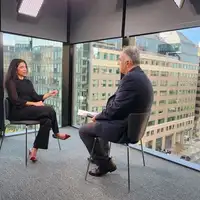
"I just don't see a pathway to rehabilitation," said Kamran Bokhari, a strategic forecaster and senior resident fellow at the Middle East Policy Council.
“This regime cannot go back to what it was.”
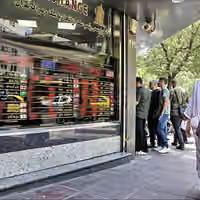
The pressure is coming from every direction. The rial fell past 2.5 million to the dollar this week, a record low; at that rate the minimum monthly wage of 166 million rials is worth about $66.
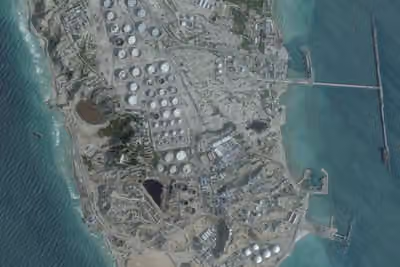
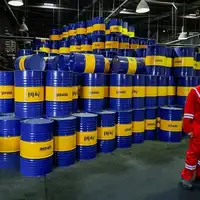
On Wednesday, Washington extended sanctions to Iran's auto and rail industries, on top of a naval blockade of Iranian ports and a campaign against sanctions evasion that have already cut deep into oil revenue and access to foreign currency.
At home, two people detained after January's nationwide protests were executed this week, and four others arrested during the unrest have recently been sentenced to death.
An appeals court upheld sentences of 74 lashes against the singer Parastoo Ahmadi and seven musicians and organizers over a concert she performed without a headscarf, filmed and posted online.
Human Rights Watch and the Abdorrahman Boroumand Center documented 29 executions between March and the end of August of people arrested in connection with the protests. Five were carried out in public.
'They want to show they're in charge'
Alberto Fernandez, a former US diplomat and vice president of the Middle East Media Research Institute, said the repression should be read alongside the economic pressure.
"They want to show they're in charge," he said. Extreme violence, he said, is one way of demonstrating to Iranians and to the world that the state can still impose its will. The more it relies on that, the more it shows both the power it has left and the pressure it is trying to hold down.
"The challenge of the regime is not the war," Bokhari said. "The challenge is governance and economic statecraft."
Three senior Iranian sources told Reuters last month that the US campaign against oil exports and sanctions evasion was becoming increasingly hard to withstand. The average monthly wage now covers less than a third of a household's basic costs, Reuters reported.
Even if Tehran wins some sanctions relief, Bokhari said, he sees little prospect of it recovering what it had.
"Regimes take a long time to undergo a meltdown," he said. "That meltdown was happening even before this war."
The price of eggs
David Patrikarakos, a special correspondent for the Daily Mail and an author, said he watches one basic indicator.
"I have become a keen watcher of the price of Iranian eggs," he said.
When he spoke with people inside Iran during the war, he said, the conversation kept returning to the cost of necessities.
"When the basics become too expensive, no government can deal with that," he said. "You can only terrorize people back into their homes for so many things. If they're starving, they can't afford food, there's nothing you can do."
The authorities appear to know it. More than 6,000 people have been arrested since the war began, Reuters reported this week, as officials worry about renewed protests.
But repression has limits. Bokhari called it a "precision instrument" that can backfire when used too broadly.
"You can oppress people, but if you start to do it at scale, then it can backfire," he said. "At some point, your own security forces will say, 'Where is this going?'"
'The butter part is going out'
If the Islamic Republic survives, Fernandez said, one model is what he called the "North Koreanization" or "Houthization" of Iran: a poorer, more predatory state that can still repress at home and project force abroad while its economy and institutions are hollowed out.
That was never the plan. The Islamic Republic wanted revolutionary and military power abroad and a functioning society and middle class at home, Fernandez said, the old combination of guns and butter.
"Well, the butter part is going out," he said.
Without a reversal, he said, Iran could become "a more ramshackle predatory state." "It still can bite, but it becomes much more fragile, much more fractious."
That trajectory would run against Iran's own sense of itself and the aspirations of its educated population, Patrikarakos said. "The Iranian self-image is wanting to take part in the world."
Even the Islamic Republic, for all its decades of confrontation with the West, never sought North Korea's isolation, he said.
"They don't want to go down the North Korea path," Bokhari said. "The question is, can they avoid it?"
As the options narrow, he said, survival is overriding everything else. "Regime survival is now more than ever before the primary imperative."
What to watch
Bokhari said he is watching for infighting that can no longer be contained. "I'm also watching for signs of infighting, where different elements of the regime start to disagree to a point where the disagreement isn't behind closed doors," he said.
Fernandez said the visible divisions are no longer mainly between moderates and conservatives, the old frame for Iranian politics, but among hardline factions themselves.
He is also watching the currency, and how long Tehran can hold out without real relief. Iran's leaders may be looking to the US midterm elections and the next Congress in the hope that politics in Washington will ease the pressure, he said. If that hope fails, they face a long period of no war and no peace while the squeeze continues.
The Islamic Republic has survived periods when it looked weaker, more isolated and less popular than before. Survival and recovery are not the same thing. The price of food, the value of the rial, unrest in the streets, fractures at the top and the loyalty of the security forces will show how far the meltdown has gone.
"This situation is untenable," Bokhari said.
You can watch Eye for Iran on YouTube or listen on any podcast platform.