• العربية
  • فارسی
Brand
  • Iran Insight
  • Politics
  • Economy
  • Analysis
  • Special Report
  • Opinion
  • Podcast
  • Live TV
  • Iran Insight
  • Politics
  • Economy
  • Analysis
  • Special Report
  • Opinion
  • Podcast
  • Live TV
  • Theme
  • Language
    • العربية
    • فارسی
  • Iran Insight
  • Politics
  • Economy
  • Analysis
  • Special Report
  • Opinion
  • Podcast
  • Live TV
All rights reserved for Volant Media UK Limited
volant media logo
PODCAST

Islamic Republic's 'slow meltdown' leaves it fewer ways out, analysts say

Oct 3, 2026, 15:11 GMT+1

The Islamic Republic is in a "slow meltdown" that may not bring it down soon but is narrowing its options as the economy sinks, repression deepens and divisions open up among its own hardliners, analysts told Iran International's Eye for Iran podcast.

"I just don't see a pathway to rehabilitation," said Kamran Bokhari, a strategic forecaster and senior resident fellow at the Middle East Policy Council.

“This regime cannot go back to what it was.”

The pressure is coming from every direction. The rial fell past 2.5 million to the dollar this week, a record low; at that rate the minimum monthly wage of 166 million rials is worth about $66.

Most Viewed

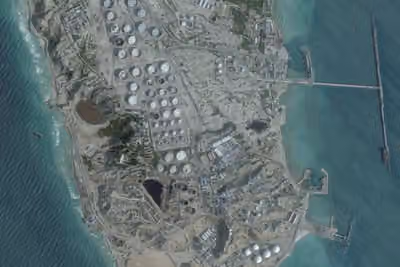
Iran oil exports vanish as regional flows surpass prewar levels
1

Iran oil exports vanish as regional flows surpass prewar levels

2

US targets Iran auto, rail and metals sectors in new sanctions blitz

3
INSIGHT

Iranian press sees diplomacy alive but narrowing after US response

4
ANALYSIS

Iran's rhetoric against UAE hardens after Netanyahu visit

5

Officials trade blame as Iran’s economy sinks deeper

Banner
Banner

Spotlight

  • Islamic Republic's 'slow meltdown' leaves it fewer ways out, analysts say
    PODCAST

    Islamic Republic's 'slow meltdown' leaves it fewer ways out, analysts say

  • Officials trade blame as Iran’s economy sinks deeper

    Officials trade blame as Iran’s economy sinks deeper

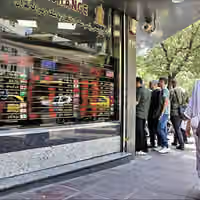
  • As the rial sinks, Iranians seek shelter in almost anything else
    INSIGHT

    As the rial sinks, Iranians seek shelter in almost anything else

  • Shot in leg, forced into hiding: Iran protester recounts January crackdown

    Shot in leg, forced into hiding: Iran protester recounts January crackdown

  • Al-Qaeda is Iran's quiet backup if the war turns, expert says

    Al-Qaeda is Iran's quiet backup if the war turns, expert says

  • Can the Caspian give Iran a way around Hormuz?
    ANALYSIS

    Can the Caspian give Iran a way around Hormuz?

  • A Mossad spy in Iran: From banking infiltration to nuclear and missile sabotage
    SPECIAL REPORT

    A Mossad spy in Iran: From banking infiltration to nuclear and missile sabotage

Banner
Banner
Banner
•
•
•

More Stories

Islamic Republic's 'slow meltdown' leaves it fewer ways out, analysts say

Oct 3, 2026, 08:49 GMT+1
•
Negar Mojtahedi
100%

The Islamic Republic is in a "slow meltdown" that may not bring it down soon but is narrowing its options as the economy sinks, repression deepens and divisions open up among its own hardliners, analysts told Iran International's Eye for Iran podcast.

"I just don't see a pathway to rehabilitation," said Kamran Bokhari, a strategic forecaster and senior resident fellow at the Middle East Policy Council.

“This regime cannot go back to what it was.”

The pressure is coming from every direction. The rial fell past 2.5 million to the dollar this week, a record low; at that rate the minimum monthly wage of 166 million rials is worth about $66.

On Wednesday, Washington extended sanctions to Iran's auto and rail industries, on top of a naval blockade of Iranian ports and a campaign against sanctions evasion that have already cut deep into oil revenue and access to foreign currency.

At home, two people detained after January's nationwide protests were executed this week, and four others arrested during the unrest have recently been sentenced to death.

An appeals court upheld sentences of 74 lashes against the singer Parastoo Ahmadi and seven musicians and organizers over a concert she performed without a headscarf, filmed and posted online.

Human Rights Watch and the Abdorrahman Boroumand Center documented 29 executions between March and the end of August of people arrested in connection with the protests. Five were carried out in public.

'They want to show they're in charge'

Alberto Fernandez, a former US diplomat and vice president of the Middle East Media Research Institute, said the repression should be read alongside the economic pressure.

"They want to show they're in charge," he said. Extreme violence, he said, is one way of demonstrating to Iranians and to the world that the state can still impose its will. The more it relies on that, the more it shows both the power it has left and the pressure it is trying to hold down.

"The challenge of the regime is not the war," Bokhari said. "The challenge is governance and economic statecraft."

Three senior Iranian sources told Reuters last month that the US campaign against oil exports and sanctions evasion was becoming increasingly hard to withstand. The average monthly wage now covers less than a third of a household's basic costs, Reuters reported.

Even if Tehran wins some sanctions relief, Bokhari said, he sees little prospect of it recovering what it had.

"Regimes take a long time to undergo a meltdown," he said. "That meltdown was happening even before this war."

The price of eggs

David Patrikarakos, a special correspondent for the Daily Mail and an author, said he watches one basic indicator.

"I have become a keen watcher of the price of Iranian eggs," he said.

When he spoke with people inside Iran during the war, he said, the conversation kept returning to the cost of necessities.

"When the basics become too expensive, no government can deal with that," he said. "You can only terrorize people back into their homes for so many things. If they're starving, they can't afford food, there's nothing you can do."

The authorities appear to know it. More than 6,000 people have been arrested since the war began, Reuters reported this week, as officials worry about renewed protests.

But repression has limits. Bokhari called it a "precision instrument" that can backfire when used too broadly.

"You can oppress people, but if you start to do it at scale, then it can backfire," he said. "At some point, your own security forces will say, 'Where is this going?'"

'The butter part is going out'

If the Islamic Republic survives, Fernandez said, one model is what he called the "North Koreanization" or "Houthization" of Iran: a poorer, more predatory state that can still repress at home and project force abroad while its economy and institutions are hollowed out.

That was never the plan. The Islamic Republic wanted revolutionary and military power abroad and a functioning society and middle class at home, Fernandez said, the old combination of guns and butter.

"Well, the butter part is going out," he said.

Without a reversal, he said, Iran could become "a more ramshackle predatory state." "It still can bite, but it becomes much more fragile, much more fractious."

That trajectory would run against Iran's own sense of itself and the aspirations of its educated population, Patrikarakos said. "The Iranian self-image is wanting to take part in the world."

Even the Islamic Republic, for all its decades of confrontation with the West, never sought North Korea's isolation, he said.

"They don't want to go down the North Korea path," Bokhari said. "The question is, can they avoid it?"

As the options narrow, he said, survival is overriding everything else. "Regime survival is now more than ever before the primary imperative."

What to watch

Bokhari said he is watching for infighting that can no longer be contained. "I'm also watching for signs of infighting, where different elements of the regime start to disagree to a point where the disagreement isn't behind closed doors," he said.

Fernandez said the visible divisions are no longer mainly between moderates and conservatives, the old frame for Iranian politics, but among hardline factions themselves.

He is also watching the currency, and how long Tehran can hold out without real relief. Iran's leaders may be looking to the US midterm elections and the next Congress in the hope that politics in Washington will ease the pressure, he said. If that hope fails, they face a long period of no war and no peace while the squeeze continues.

The Islamic Republic has survived periods when it looked weaker, more isolated and less popular than before. Survival and recovery are not the same thing. The price of food, the value of the rial, unrest in the streets, fractures at the top and the loyalty of the security forces will show how far the meltdown has gone.

"This situation is untenable," Bokhari said.

You can watch Eye for Iran on YouTube or listen on any podcast platform.

Trump may be buying time on Iran until after the midterms

Sep 26, 2026, 03:24 GMT+1
•
Negar Mojtahedi
100%
US President Donald Trump speaks to reporters in front of the Marine One

President Donald Trump may be putting off a difficult choice over Iran until after the US midterm elections, a former senior US diplomat told Iran International.

Trump used his address to the United Nations General Assembly this week to call for Iran's “complete economic isolation,” while saying he believed a deal could come after the November midterm elections.

Iranian President Masoud Pezeshkian, meanwhile, said Tehran would not surrender to US pressure but remained open to diplomacy.

The two sides held their first indirect talks in months on the sidelines of the UN gathering but remained far apart on how to end the war, including over Iran’s conditions for reopening the Strait of Hormuz.

Ludovic Hood, a senior fellow at the Hudson Institute who spent two decades as a US diplomat and previously served as special adviser for the Middle East to Vice President Mike Pence, told Iran International's Eye for Iran that the approaching elections may help explain the current pause.

“We have elections coming up in America that I think have partly bounded President Trump’s willingness to be more confrontational at this point in time,” Hood said.

He described the conflict as a “standoff” with “more chapters to be written,” saying Trump could face a decision over whether to escalate again after the midterms or as the United States enters the new year.

“He may seek to escalate again militarily,” Hood said.

Potential targets could include commercial and economic assets inside Iran owned by or directly linked to the Islamic Revolutionary Guard Corps, he said, if Trump chooses to intensify the campaign.

Pressure without political change

Iran has suffered major military losses while contending with a US naval blockade and an expanding sanctions campaign. Yet nearly seven months into the war, those pressures have not produced fundamental political change in Tehran.

Hood cautioned against assuming that battlefield losses automatically translate into political change. Instead, he pointed to the cumulative impact of declining revenues, sanctions, domestic discontent and potential strains within the institutions responsible for protecting the state.

He described the Islamic Republic as “about as vulnerable as it’s been in 47 years,” pointing in particular to questions about the government's ability to continue paying salaries, including those of security forces.

“To me, a fifth uprising is a question of when, not if,” he said.

Hood said some people advising Trump have made the case that the collapse of the Islamic Republic is possible, while emphasizing that he was not predicting whether or when that would happen.

Washington has continued tightening economic pressure even as negotiations resumed in New York. New US restrictions on Iran's aviation sector have contributed to the loss of international routes, with additional Iraqi destinations restricting Iranian connections this week.

Saudi Arabia and the United Arab Emirates are also urging Washington to maintain sanctions and the naval blockade rather than make concessions prematurely, according to a Wall Street Journal report.

Both governments nevertheless oppose further US military escalation, according to the report.

  • Iran threatens regional air travel as US sanctions cut its flight links

    Iran threatens regional air travel as US sanctions cut its flight links

Hood said the significance of Washington's economic campaign lies not simply in announcing additional sanctions, but in enforcing existing measures and steadily reducing the resources available to Tehran.

Despite the resumption of diplomacy in New York, no breakthrough has emerged. A senior Iranian official told Reuters this week that the two sides remained far apart.

That leaves Washington confronting a larger question: whether the pressure already imposed can fundamentally alter Tehran’s behavior, or whether the current pause will ultimately give way to another round of military escalation.

The answer may become clearer after November—when both Washington and Tehran appear to believe the political calculus could change.

Death-row Iran protester denied hospital treatment, family says

Sep 19, 2026, 03:40 GMT+1
•
Negar Mojtahedi
100%
Twin sisters: one sentenced to death, the other to decades in prison in Iran.

An Iranian woman sentenced to death over January’s anti-government protests is struggling to walk but has been denied hospital treatment despite a prison doctor saying she urgently needs an MRI, her family told Iran International.

Taraneh Rahimi, 20, is being held alongside her twin sister Romina at Dowlatabad Prison in Isfahan. Their cousin, Masoud Nourmohammadi, told Iran International’s Eye for Iran that Taraneh’s condition has deteriorated as her lawyers race to appeal her death sentence.

“Taraneh could not walk,” Nourmohammadi said. “The (hospital) doctor says you have to go to the hospital and be hospitalized and get an MRI to see what’s going on with your leg because it is in bad shape,” he said.

Nourmohammadi said the doctor considered the treatment urgent, but prison authorities refused to allow Taraneh to leave for hospital.

Her family also purchased medical equipment and medication for her and brought the supplies to the prison, he said, but authorities did not allow them to reach her.

The allegations come days after Nourmohammadi told Iran International that prison authorities had stopped providing Taraneh with food, forcing her to rely on leftovers shared by other prisoners.

“They stopped giving Taraneh food a few days back,” he said. “They ask her to use other people’s leftovers and eat those. Who does that?”

‘If you don’t confess, we’re going to rape your sister’

The new allegations come as lawyers for the twins have finally been given access to their case file after months of waiting, according to Nourmohammadi.

He said the lawyers found no substantive evidence tying Taraneh or Romina to violence during the January protests and are now preparing an appeal.

“Their consensus is that there’s no evidence against those two girls in the case,” he said. “The only thing that is left … is basically their confession.”

The family says those confessions were obtained through torture and threats of sexual violence.

“They told Taraneh, ‘If you don’t confess, we’re going to rape your sister in front of you,’” Nourmohammadi said.

He said lawyers are also filing a complaint over the alleged torture and sexual abuse of the sisters while in custody.

Human Rights Watch and the Abdorrahman Boroumand Center for Human Rights in Iran have documented allegations of torture, coerced confessions and serious due-process violations involving defendants in the Shohada Square case.

Taraneh and Romina were among 16 defendants prosecuted over events surrounding protests in Isfahan in January. Ten of the defendants, including Taraneh, received death sentences, while Romina was sentenced to decades in prison.

The defendants faced charges including moharebeh, or “waging war against God,” destruction of public property, assembly and collusion against national security and propaganda against the state.

Rights groups have said none of the 16 defendants was charged with murder, despite prosecutors linking the case to incidents in which two people died.

100%

‘A few days left’ to appeal

Nourmohammadi said the family believes only days remain in the formal window for lawyers to appeal Taraneh’s death sentence, adding that the family remains deeply concerned that authorities could move more quickly.

“You never know with that regime,” he said. “Anything can happen. It’s unpredictable.”

The sisters were 19 when security forces arrested them separately on January 24, weeks after they joined demonstrations around Isfahan’s Shohada Square. They have since turned 20 in prison.

Before her arrest, Taraneh was an equestrian and horse trainer. She had previously undergone surgery on her leg following a riding injury, according to her family.

Nourmohammadi alleges interrogators knew about the injury and deliberately targeted the same leg during torture.

When the twins’ mother was eventually permitted to see her daughters after roughly three months without knowing where they were being held, Nourmohammadi said Taraneh was already limping.

He said she also had broken fingers and knuckles and alleged that both sisters had lost much of their hair after being dragged between cells by their hair.

‘She wanted a life for her kids’

The twins’ mother raised Taraneh and Romina as a single parent.

For roughly three months after their arrests, she did not know where her daughters were being held. Family members searched hospitals, courthouses and prisons, at times waiting outside detention facilities seeking information.

When their mother was eventually allowed to see them, Nourmohammadi said the twins had swollen faces, bruises and significant hair loss.

After Taraneh was sentenced to death, he said his aunt was so devastated that she has barely been able to speak.

Instead, she wrote a message about raising her daughters and working to give them a future.

“She was a single mom. She worked really hard for her kids,” Nourmohammadi said. “She wanted a life for her kids. She didn’t want a prison or execution and a rope around their neck.”

Trump again tells Iranians to take their government. This time nobody blinked

Sep 12, 2026, 10:13 GMT+1
•
Negar Mojtahedi
100%
US President Donald Trump

US President Donald Trump this week repeated the boldest promise of the Iran war, that when Washington is "finished," Iranians should take over their government. In February the sentence stunned. On Wednesday it barely registered, and the silence is the story.

"To the great, proud people of Iran, the hour of your freedom is at hand," Trump says in a video posted on X, drawing on remarks he first delivered on February 28, the day the US campaign began. "When we are finished, take over your government. It will be yours to take."

Six months ago, that was an extraordinary signal from an American president at the opening of a war with the Islamic Republic. This time there was no accompanying policy, no explanation of what "when we are finished" means, and no sign that Washington is preparing to help Iranians seize anything.

"I don't think the Iranian regime is going to care," Eric Mandel, founder of the Middle East Political Information Network, told Iran International's Eye for Iran podcast, whose conversation with him forms the basis of this analysis. "I think they've heard these messages before."

A war shaped by a calendar

Trump said this week that Iran was "limping along" and predicted the conflict would end "immediately after" November's midterm elections. He also acknowledged, in the same week, that electoral considerations may be influencing decisions about whether to escalate military action against Iran.

That is an American president saying, in public, that the pace of a war is being set partly by a domestic election.

His own senior advisers appear to be planning for something very different. Vice President JD Vance, Secretary of State Marco Rubio and others have privately discussed the possibility that Tehran could withstand US pressure and that the conflict could run through the end of Trump's presidency in January 2029, according to the Wall Street Journal.

So the same week produced three incompatible timelines: freedom "at hand," an end "immediately after" the midterms, and a war that may outlast the administration. If Trump is again telling Iranians their government will soon be theirs to take, what has changed since he first said it? Mandel's answer was blunt: "I haven't heard a new policy."

The gap between the promise and the means

For Mandel, the problem is not the stated objective but the distance between the promise and any way of achieving it.

"They can't ask the Iranian people to go out again into the streets and be slaughtered," he said. The last time people came out in their millions, in January, security forces killed tens of thousands in two days.

If Washington genuinely wants the Islamic Republic to fall, Mandel argued, it would have to go far beyond encouragement: bring together Iran's fragmented opposition, finance strike funds so workers can stay home rather than face security forces in the street, tighten secondary sanctions on the countries helping Tehran evade pressure, and give material support to parts of the opposition.

"The Iranian people can't take over if they're unarmed and they are not having coordination," he said. "If we're saying to the Iranian people to take over at that point, that just doesn't make any sense to me."

The operation that lost its name

Trump's original February message came as the White House described Operation Epic Fury as an effort to destroy Iran's nuclear and missile capabilities, degrade its proxy network and cripple its navy, and tied the campaign to decades of confrontation between the two countries.

Even the name has since receded. The Pentagon said Epic Fury officially ended on May 5, and military personnel were later told to stop using it for the continuing operations against Iran. The war did not end with the name.

Nearly seven months on, oil is back above $100 a barrel, the political cost of the conflict is increasingly visible ahead of the midterms, and Trump's advisers are contemplating a far longer confrontation than the president publicly predicts. That is what makes the decision to resurrect the February message striking, and it raises the question Mandel kept returning to: who was it for?

Not Tehran, he thought, which he described as in "survival mode" and betting it can outlast the administration. Not a weary American public either. "If it is for the American people, to my mind, it's the wrong way to present this," he said.

Trump would need to explain why bringing down the Islamic Republic serves US security and why Americans should prepare for a long campaign, and he has not.

Without that, ever more dramatic language loses its force. "To the regime, it's like the boy who cried wolf," Mandel said. "He keeps saying this every month."

The video appeared deliberately produced, he noted, which makes it hard to dismiss as an impulsive post. But he could not say what new message it carried. "I don't get the message yet of what it is."

That may be why an extraordinary sentence received such an ordinary response. A US president once again told more than 90 million Iranians that their government may soon be theirs to take. What remains unclear is whether Washington was announcing an objective, offering encouragement, applying pressure, or repeating a promise the world has heard before.

Why did Iran let back a singer who mocked its ‘sacred’ symbols?

Sep 9, 2026, 05:03 GMT+1
•
Negar Mojtahedi
100%
Iranian musician Mohsen Namjoo, who returned to Iran in 2026 after nearly two decades abroad.

Mohsen Namjoo mocked the Quran, ridiculed religious figures and crossed political red lines that have brought severe punishment for others in Iran. Now back in the country, his return contrasts sharply with restrictions still imposed on female singers.

The contradiction is hard to miss. A government that has demanded ideological conformity from Iranians appears willing to overlook Namjoo’s past transgressions at a time when the Islamic Republic is under extraordinary military, economic and domestic pressure and is openly seeking to encourage some prominent Iranians abroad to return.

Rather than a sign of moderation, his return may reveal how flexible the Islamic Republic can become when its own rules are no longer useful.

Siavash Rokni, an expert on Iranian popular culture, and historian Shahram Kholdi told Iran International’s Eye for Iran that the apparent opening serves several purposes. It can distract from executions and political prisoners, project an image of a more tolerant Iran and send a message to the diaspora that even former critics may be able to return — although the state still decides who gets through the door.

“Diversion. I’m going to make this quite simple,” Rokni said.

Kholdi questioned whether the rules were really changing at all.

“Are they bending their own rules and principles?” he asked. “Or are they temporarily deactivating them?”

Namjoo is an extraordinary figure around whom to test that question.

The Mashhad-born musician left Iran in 2007 and was later sentenced in absentia to five years in prison for “insulting sanctities” over his use of Quranic verses in his music. It remains unclear publicly what became of that sentence before his return. Outside the country, he continued to ridicule religious and political symbols, including former Supreme Leader Ali Khamenei.

He has also faced multiple allegations of sexual misconduct and abuse, which he denies.

And yet he has been allowed home.

His return was also highlighted by Iranian state media, which praised what it described as his “patriotic” opposition to US and Israeli attacks. Namjoo himself said he had encountered considerable kindness since returning.

Who gets to break the rules?

The contrast is particularly stark when Namjoo’s treatment is compared with that of female musicians inside Iran.

Singer Parastoo Ahmadi drew international attention after performing without the compulsory hijab in an online concert in 2024. She was briefly detained after the performance. In June 2026, she and members of her production team were reported to have been sentenced to 74 lashes, along with two-year bans on travel and artistic activity.

Rokni also pointed to Hiva Seyfizadeh, another female singer who was arrested during a live performance in Tehran in 2025.

The juxtaposition gets to the heart of the controversy surrounding Namjoo. A male musician known for ridiculing symbols the Islamic Republic considers sacred — and who has faced sexual misconduct allegations abroad can return, while women continue to face state pressure over their clothing and their voices.

“Why are female singers not able to sing and an alleged sexual abuser is back, is invited back to the country?” Rokni asked. “What is this double standard happening in this country?”

Namjoo’s return has generated precisely the kind of attention such a contradiction might be expected to produce. Iranians have argued over his decision to return, his past and what his presence in Tehran means.

That noise may itself be useful.

Rokni described the use of popular culture as part of a sophisticated communications strategy capable of shifting attention away from far more damaging issues for the state — among them executions, political prisoners, economic hardship and the repression of women.

“Namjoo is not, in my opinion, an important subject of conversation,” he said.

The point is not that his return is insignificant. It is that the spectacle surrounding one musician can swallow up the conversation about thousands of people who do not have the luxury of choosing whether to engage with the Islamic Republic.

An invitation with conditions

Namjoo’s homecoming also carries a message beyond Iran.

If someone who mocked the Quran and the country’s former supreme leader can return, other members of the diaspora may reasonably wonder whether the rules have changed for them too. That question is no longer hypothetical. Culture Minister Abbas Salehi has said his ministry compiled a list of more than 100 cultural, artistic and intellectual figures abroad whose return it wants to facilitate.

But the door does not open equally.

“Returning to one’s country has become a game of preferential treatment,” Rokni said.

The Islamic Republic effectively retains the power to determine which Iranians can come home, which critics can be forgiven and what compromises are required to make that possible.

History gives reason to be wary of assuming that an open door will remain open.

Kholdi recalled the experience of writer and dissident Saidi Sirjani, a prominent critic of the Islamic Republic. Following the death of its founder, Ruhollah Khomeini, Sirjani believed a different political era might be emerging and encouraged other Iranian intellectuals abroad to consider returning, Kholdi said.

Sirjani was arrested in 1994 and died in custody later that year under circumstances that remain disputed.

Kholdi also pointed to Iranian-Canadian scholar Ramin Jahanbegloo, who was arrested in Tehran in 2006 and detained for months before eventually leaving the country.

“I would not consider such moves a sign of the fact that they have become more moderate,” he said.

The history even gives Kholdi reason to worry about Namjoo himself.

“As a human who deserves the security and safety of life like any other normal person, I am worried for his safety,” he said.

Today’s welcome, in other words, does not guarantee tomorrow’s protection.

The power of an open door

That uncertainty carries particular weight for millions of Iranians abroad who still have family, professional and emotional ties to the country.

Kholdi said he was warned as a young academic that outspoken criticism of the Islamic Republic could cost him access to Iran, its archives and the field research needed for his career.

The threat did not have to be explicit. Access itself became leverage.

The same calculation can apply to artists, journalists, academics and ordinary diaspora Iranians who want to see parents or relatives. The state controls the door, and the possibility of losing access can shape behavior long before anyone attempts to cross the border.

Namjoo’s return makes that door appear wider.

It also gives the Islamic Republic a useful image to present to the outside world: a former critic who once violated some of its most sensitive taboos is back in Iran. How intolerant can the system be if someone like him is allowed to return?

Kholdi warned that there is another side to that calculation. Iran has repeatedly detained dual and foreign nationals who later became subjects of negotiations or prisoner exchanges, a practice critics of Tehran describe as hostage diplomacy.

The same state that can invite people in retains the power to prevent them from leaving.

That is why Namjoo’s return matters less as a story of one controversial musician coming home than as a glimpse of how the Islamic Republic behaves when under pressure.

It can enforce religious morality against a woman who sings without a hijab while overlooking the past of a man who mocked the Quran. It can imprison critics while advertising the return of another. And it can present selective tolerance as evidence of change without surrendering the power to reverse that tolerance later.

Namjoo’s return also appears to be part of a broader effort to selectively reopen the door to prominent Iranians abroad while the state retains the power to decide who may return and under what conditions.

The Islamic Republic’s red lines have not disappeared.

What Namjoo’s return exposes is that those lines were never equally rigid for everyone and that when the regime sees an advantage in moving them, even the principles it calls sacred can suddenly become negotiable.