• العربية
  • فارسی
Brand
  • Iran Insight
  • Politics
  • Economy
  • Analysis
  • Special Report
  • Opinion
  • Podcast
  • Live TV
  • Iran Insight
  • Politics
  • Economy
  • Analysis
  • Special Report
  • Opinion
  • Podcast
  • Live TV
  • Theme
  • Language
    • العربية
    • فارسی
  • Iran Insight
  • Politics
  • Economy
  • Analysis
  • Special Report
  • Opinion
  • Podcast
  • Live TV
All rights reserved for Volant Media UK Limited
volant media logo

Iran threatens regional air travel as US sanctions cut its flight links

Sep 25, 2026, 12:25 GMT+1
An Iranian passenger carrying luggage leaves Najaf International Airport after arriving on an AVA Airlines flight, in Najaf, Iraq, September 23, 2026.

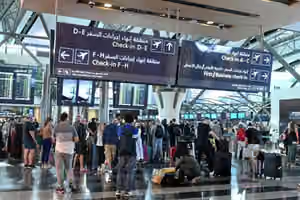
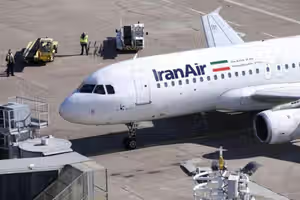
Iran threatened to disrupt regional air travel if its airlines lose access to flights and airport services, as Iraq's Najaf, Erbil and Sulaimaniya joined other destinations restricting Iranian connections under mounting US sanctions pressure.

“If Iran cannot fly and receive airport services, no country in the region will have that possibility either,” supreme leader adviser Mohammad Mokhber wrote in a post on Friday. He did not explain how Tehran would enforce the threat.

His remarks echoed Supreme National Security Council secretary Mohsen Rezaei, who warned Wednesday that neighboring airports would be unable to operate if they cooperated with Washington’s campaign. Rezaei also warned neighboring countries against joining further US military action.

Airports in Najaf, Erbil and Sulaymaniyah have suspended flights to and from Iran, further narrowing air links with Iraq following restrictions at Baghdad airport. Najaf’s suspension took effect at 2 a.m. Friday until further notice, closing an alternative Iranian authorities had considered for diverted Baghdad-bound services.

Flights to Baghdad and Muscat were canceled on September 23. Iraqi aviation sources told Reuters that Baghdad’s suspension followed government instructions; Iranian aviation spokesman Majid Akhavan said Tehran was discussing Muscat’s restrictions with Oman.

The UAE suspended Iranian airlines’ flights Thursday, explicitly citing US sanctions. Azerbaijan halted services by Iranian carriers Tuesday, while affected airlines stopped flying to Georgia from September 21.

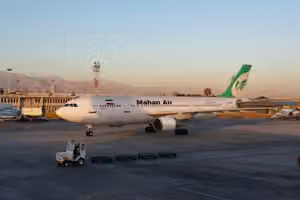
A Tehran-Dushanbe flight also turned back Thursday after Turkmenistan denied permission to cross its airspace. Mahan Air suspended Turkey and Oman services; travel agencies said it had lost ground-handling access in Turkey.

Washington sanctioned 36 aviation-related targets on September 8, including 27 carriers it described as Iran’s remaining unsanctioned airlines and three Turkey-based companies accused of serving Mahan. Treasury says Iranian aviation networks transport weapons, military personnel and illicit cargo.

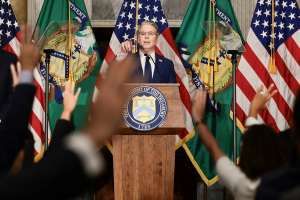
Treasury Secretary Scott Bessent warned that foreign airports, fuel suppliers, ground handlers and ticket sellers servicing sanctioned carriers risked US penalties, including exclusion from the dollar system. He said Iranian airlines would effectively lose international operations from September 23.

Those measures do not automatically close foreign airspace. Their effect depends on governments and service providers, and some flights continued. Bloomberg reported at least six departures Wednesday to destinations including Bangkok, Phuket, Shanghai and Kabul.

Foreign carriers have separately withdrawn services. Turkish Airlines told Iran International it had no Iran flights scheduled before March 2027, with no guaranteed restart. Earlier Iranian announcements of continuing Istanbul flights referred to other carriers.

Emirates no longer serves Tehran. Lufthansa and Austrian suspended Iran flights through October 24, while Qatar Airways cited airspace restrictions and tentatively listed November 29 for resumption. Those dates remain uncertain.

Four travel agencies contacted September 21 reported unavailable services across several other routes. Some Pegasus bookings were subsequently canceled, although booking-platform listings were not guarantees of operation.

The disruption affects family visits, business and pilgrimage to Najaf and Karbala. Agencies described travelers flying to Turkey, then taking roughly 17 hours by bus to Van and another 16–17 hours onward to Tehran, excluding border delays.

The UAE also barred Bank Melli branches from Iran-related transactions Wednesday, including trade finance and transfers.

Rezaei linked the aviation warning to Tehran’s broader negotiating position, giving Washington four to five days to accept conditions already sent to mediators before talks or Hormuz’s reopening. He did not list them, saying Foreign Minister Abbas Araghchi would convey them again in New York, and presented control of the strait as negotiating leverage.

  • Flying to or from Iran? What to know as US pressure squeezes air links

    Flying to or from Iran? What to know as US pressure squeezes air links

  • Iran warns it would disrupt regional airports if its flights are barred

    Iran warns it would disrupt regional airports if its flights are barred

Most Viewed

US-Iran talks focused on phased deal to reopen Hormuz
1

US-Iran talks focused on phased deal to reopen Hormuz

2
INSIGHT

Pezeshkian straddles Iran’s divide at UN as US talks test balance

3

China shipments help sustain Iran’s weapons programs despite US pressure - WSJ

4
ANALYSIS

New US-Iran talks run into old question of who speaks for Tehran

5
VOICES FROM IRAN

'Bully at home, victim abroad': Iranians on Pezeshkian's UN speech

Banner
Banner

Spotlight

  • From Hormuz to Indian Ocean: Iran threatens to redraw the map of the war
    ANALYSIS

    From Hormuz to Indian Ocean: Iran threatens to redraw the map of the war

  • 'Bully at home, victim abroad': Iranians on Pezeshkian's UN speech
    VOICES FROM IRAN

    'Bully at home, victim abroad': Iranians on Pezeshkian's UN speech

  • Pezeshkian gets the generals' applause, and no word from the man above them

    Pezeshkian gets the generals' applause, and no word from the man above them

  • War deepens Iran’s energy crunch ahead of winter
    ANALYSIS

    War deepens Iran’s energy crunch ahead of winter

  • Threats and counter-threats complicate new US-Iran diplomacy
    INSIGHT

    Threats and counter-threats complicate new US-Iran diplomacy

  • They can erase you without arresting you
    TEHRAN INSIDER

    They can erase you without arresting you

Banner
Banner
  • Iran cancels Baghdad, Muscat flights as regional restrictions tighten

    Iran cancels Baghdad, Muscat flights as regional restrictions tighten

  • UAE says it suspended Iranian airline flights over US sanctions

    UAE says it suspended Iranian airline flights over US sanctions

  • China shipments help sustain Iran’s weapons programs despite US pressure - WSJ

    China shipments help sustain Iran’s weapons programs despite US pressure - WSJ

•
•
•

More Stories

Saudi Arabia, UAE urge Trump to maintain pressure on Iran - WSJ

Sep 25, 2026, 08:54 GMT+1
100%
A US Navy sailor walks across the flight deck of the USS George Washington in the Arabian Sea, September 11, 2026. The aircraft carrier, capable of carrying more than 5,000 personnel, is enforcing a US naval blockade against Iran and providing cover for commercial vessels transiting the Strait of Hormuz.

Saudi Arabia and the United Arab Emirates are urging Washington to maintain sanctions and its naval blockade of Iran, complicating efforts to restart peace talks as attacks threaten their oil exports, The Wall Street Journal reported.

Mediators including Qatar are seeking talks in Oman as early as next week to reopen the Strait of Hormuz and begin winding down the war, the newspaper reported, citing people familiar with the discussions. President Donald Trump said Tuesday he expected the two sides to meet again soon.

While Persian Gulf countries generally oppose further US military escalation, Saudi Arabia and the UAE want Washington to withhold concessions on sanctions and the blockade.

Saudi Crown Prince Mohammed bin Salman recently told US officials the blockade should remain until Iran is compelled to sign a new agreement, people familiar with the discussions told the Journal.

  • US-Iran talks focused on phased deal to reopen Hormuz

    US-Iran talks focused on phased deal to reopen Hormuz

The position marks a shift from the summer, when Saudi Arabia and other Arab states pressed for negotiations and were prepared to consider an agreement recognizing some Iranian influence over Hormuz.

Iranian attacks on Saudi ships and Tehran’s encouragement of Houthi efforts to restrict the alternative export route through the Red Sea have since weakened confidence in Iran’s willingness to reach a deal, the report said.

UAE officials have similarly lowered expectations for negotiations, arguing that renewed violence and attacks on shipping show Tehran is in no hurry to return to diplomacy. They said Persian Gulf states should not accept permanent Iranian control of Hormuz.

  • From Hormuz to Indian Ocean: Iran threatens to redraw the map of the war

    From Hormuz to Indian Ocean: Iran threatens to redraw the map of the war

Behnam Ben Taleblu, an Iran specialist at the Foundation for Defense of Democracies, told the Journal that renewed Houthi threats, following months of disruption in Hormuz, were pushing regional governments toward compliance with US sanctions.

Oman and Qatar favor a different approach, arguing that a phased reopening of Hormuz and an end to attacks on Persian Gulf countries offer the only viable path out of a war that has already inflicted substantial regional damage.

Qatar has pursued mediation around the UN General Assembly. Iran’s foreign minister visited Doha on Sunday to discuss proposals including a seven-day pause in fighting that could lead to an end to Iranian attacks on shipping in exchange for Washington lifting its blockade.

But US officials have repeatedly told Qatar that Trump has no intention of lifting the maritime embargo, according to the report.

A White House official said sanctions and the blockade had strengthened Washington’s position. “While President Trump is open to talking with Iran under the right circumstances, he has no need to negotiate with the Iranians,” the official said.

Talks also face resistance inside Iran. Tehran fears Washington could use negotiations to delay action until after the US midterm elections before resuming attacks, while hardliners have adopted a more confrontational tone as economic pressure intensifies, the Journal reported.

Arab mediators said Iranian diplomats had offered proposals and acknowledged the worsening economic crisis, but the Revolutionary Guards had rejected new negotiating formulas and expressed readiness for a prolonged war.

The Guards, which dominate Iran’s power structure, want terms closer to the preliminary June agreement: relief from oil sanctions, access to frozen assets and recognition of an Iranian role in administering Hormuz in exchange for reopening the waterway.

Washington has told mediators it will not return to that agreement, believing sustained economic pressure will force Tehran to accept terms more favorable to the United States and its Persian Gulf partners.

US-Iran talks focused on phased deal to reopen Hormuz

Sep 24, 2026, 18:55 GMT+1
100%
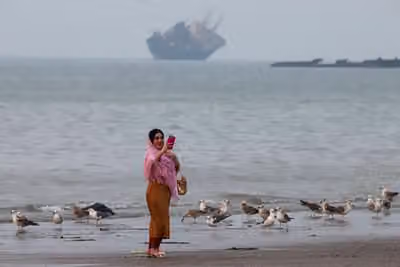
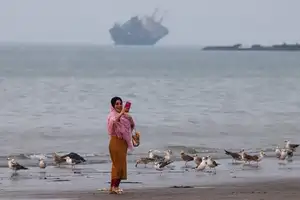
A woman takes a photo on the shores of Iran’s Persian Gulf, with ships visible in the distance, July 2026

US and Iranian negotiators are exploring a phased agreement that could reopen the Strait of Hormuz in exchange for Washington lifting its economic blockade of Iran, Reuters reported Thursday, citing Iranian, regional and Western sources.

The emerging proposal reflects a problem that has repeatedly frustrated attempts to revive diplomacy: neither side wants to surrender its main source of leverage before the other acts.

Two Iranian sources, two regional officials and two Western diplomatic sources familiar with the discussions told Reuters the strait had become the central bargaining chip in talks taking place around the UN General Assembly in New York.

Iran wants relief from the US blockade, which has sharply restricted its trade and intensified pressure on its economy. Washington, meanwhile, is seeking the restoration of free passage through Hormuz, a crucial route for global energy supplies.

“One way forward would be to solve the crisis in stages,” a senior Iranian official said on the sidelines of the General Assembly. “The first would be to end the blockade and reopen Hormuz.”

A coalition of 80 countries called Thursday for the urgent reopening of the strait, accusing Iran and its Houthi allies of threatening navigation and disrupting international trade and energy supplies.

“We call for the full restoration of navigational rights and principles without delay,” Bahrain’s Foreign Minister Abdullatif bin Rashid Al Zayani said in a joint statement at the General Assembly.

But the US-Iran talks remain far from an agreement.

A senior European official said Iran had “a very long list of demands”, while the White House insisted that President Donald Trump was under no pressure to make concessions.

Iranian President Masoud Pezeshkian put responsibility for the repeated breakdown of diplomacy on Washington during a meeting with Dutch Prime Minister Dick Schoof on Thursday.

“We have been and remain willing to engage in dialogue, but if there is any advice to be given, it should be conveyed to the American side,” Pezeshkian said, arguing that previous rounds of negotiations had been disrupted by Washington and ultimately followed by war.

The difficulty for negotiators is therefore not only finding a sequence in which both sides relinquish leverage, but convincing each that concessions made by the other will last.

An earlier understanding reached in June collapsed the following month, leaving both sides wary of another temporary arrangement.

Trump has said he believes an agreement with Iran could be reached after the November 3 congressional midterm elections.

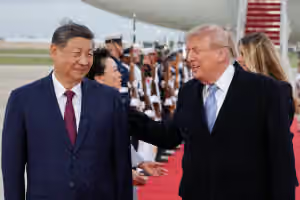
President Xi Jinping told Trump during their White House meeting Thursday that Beijing supported Washington and Tehran returning to the June arrangement intended to end the war and reopen Hormuz, according to China’s state-run Xinhua news agency.

From Hormuz to Indian Ocean: Iran threatens to redraw the map of the war

Sep 24, 2026, 17:48 GMT+1
•
Behrouz Turani
100%
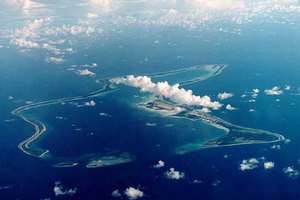
An undated file photo shows Diego Garcia, the largest island in the Chagos archipelago, in the middle of the Indian Ocean, which hosts a joint military facility operated by the United States and the United Kingdom

Tehran is signalling that its response to US pressure may be to widen the conflict, turning restrictions on its shipping and aviation into risks for airports and waterways stretching from the Persian Gulf to the Red Sea and potentially the Indian Ocean.

The emerging pattern is one of horizontal escalation: rather than confining its response to the point of pressure, Iranian officials are increasingly warning that action in one arena could produce retaliation elsewhere.

IRGC spokesman Hossein Mohebbi made that logic explicit on September 23, declaring that “Iran will certainly change the geography of the war” and adding that “our targets will no longer necessarily be the same as before”.

A day later, Yahya Rahim Safavi, military adviser to Iranian Supreme Leader Mojtaba Khamenei, gave the clearest indication yet of how far that geography might extend.

In a video released by the IRGC-linked Fars News Agency, Safavi said the front could expand further in response to continued warfare, “reaching the Indian Ocean and perhaps beyond”.

He added that linking Hormuz and Bab el-Mandeb “will change the battlefield”.

Fars noted that it was the first time an adviser to Khamenei had explicitly mentioned the Indian Ocean, home to the US-British base at Diego Garcia, nearly 4,000 kilometres from Iran.

In an earlier interview reported by Fararu, Safavi said Houthi advances mean the United States now faces a new challenge at Bab el-Mandeb and in the Red Sea.

IRGC Aerospace Force commander Majid Mousavi warned that “if you make the sacred Strait of Hormuz unsafe, we will turn the entire region into hell for you from across Iran”.

From shipping to aviation

The same logic has increasingly appeared outside the maritime arena.

Secretary of the Supreme National Security Council Mohsen Rezaei addressed Iran’s neighbouring Arab states in an interview with state broadcaster IRINN on September 23, saying: “If you stand with America, we will not just watch you.”

He warned that if Iranian flights were banned with their cooperation, “their airports will have no flights”. He did not specify any country, airport or method of disruption.

Rezaei linked the warning to the Hormuz standoff.

He also said Foreign Minister Abbas Araghchi was due to convey Iran’s seven conditions through mediators and that, until they were met, neither the strait would reopen nor negotiations resume.

Tehran had given the Americans “four to five days” to meet the conditions, he asserted.

A widening map of pressure

The statements suggest Tehran is increasingly answering different elements of Washington’s pressure campaign with threats or measures in corresponding domains.

Safavi’s framing of Hormuz and Bab el-Mandeb as a connected theatre suggests Tehran increasingly sees pressure around the two strategic chokepoints as interconnected.

The most immediate audience for many of these warnings is Iran’s Arab neighbours, whose airports, ports and territory are exposed to the consequences of US-Iran escalation.

Rezaei’s remarks appear designed to raise the potential cost for those states of cooperating with Washington’s pressure campaign.

Iran has already demonstrated a willingness during the conflict to target regional aviation infrastructure, repeatedly striking Kuwait International Airport and damaging terminals and a radar system.

The Indian Ocean references extend this widening map further.

For now, the shift is clearest at the level of rhetoric: none of the statements reviewed sets out a specific Iranian plan for operations there.

But combined with threats against regional airports and repeated references to Bab el-Mandeb, they point to an increasingly explicit message from Tehran that further US pressure could carry risks well beyond the Strait of Hormuz.

'Bully at home, victim abroad': Iranians on Pezeshkian's UN speech

Sep 24, 2026, 11:59 GMT+1
•
Saba Heidarkhani
100%
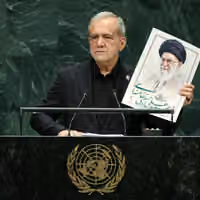
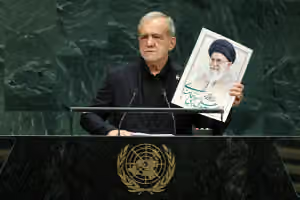
Iran's President Masoud Pezeshkian addresses the 81st United Nations General Assembly (UNGA) at UN headquarters in New York City, US, September 23, 2026.

Masoud Pezeshkian told the UN that Iran would not accept the language of force. Iranians writing to Iran International had one reply: that is the only language his government uses at home. Their messages picked apart what he said, what he left out, and how he said it.

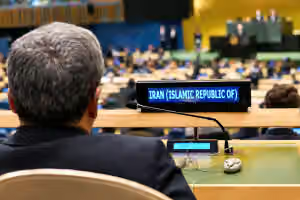
Speaking at the 81st General Assembly on Wednesday, the president said Tehran was ready for dialogue but rejected "the language of force," called Donald Trump's words a sign of "the character of a bully and the logic of force," and held up photographs of the late Ali Khamenei and of schoolchildren killed in the strike on Minab in the war's first hours.

Three things drew the messages: the gap between the president's posture abroad and the state's conduct at home; the crackdown of January that he did not name; and the way he spoke.

  • Pezeshkian gets the generals' applause, and no word from the man above them

    Pezeshkian gets the generals' applause, and no word from the man above them

'Only brave in front of us'

The most frequent reaction set the president's words in New York beside the state's words in Iran.

"The Islamic Republic wants dialogue with anyone stronger than itself," one wrote, "and bullies its own defenseless people."

Another pointed to Pezeshkian's repeated use of the word force: inside Iran the state threatens America, he wrote, and in New York it asks "why are you bullying us."

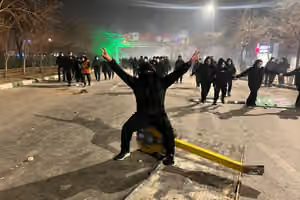
The president's own language on the January protests was not far from writers' minds. In August he called the protests a "riot" and described those who reported the killings as "cowards and traitors," remarks that had drawn an earlier wave of messages. On January 11, days after the killings, he had called the protesters "terrorists" and demanded a "decisive" response from the security forces.

One writer put it in a single line: for 47 years the Islamic Republic has been busy with terror, and now Pezeshkian comes to play the victim.

Another watched the delivery rather than the text. "People like Pezeshkian only claim power and swagger in front of us," he wrote. "From the trembling voice, the stumbles and the level of stress in his speech, it was clear how brave he is in front of real superpowers."

  • 'Killers in suits': Iranians ask New York's mayor why Pezeshkian walks free

    'Killers in suits': Iranians ask New York's mayor why Pezeshkian walks free

What he left out

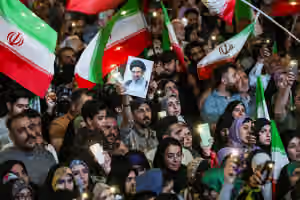
Pezeshkian never used the word protests. The Iranians he described in the streets these past seven months were the crowds at the state's own rallies, organized by the Revolutionary Guards and the Basij, out at night, in his telling, to defend the country against people "America and Israel had incited and put guns in the hands of."

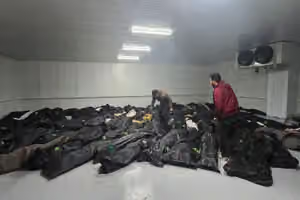
The millions who came out against the state, and the tens of thousands killed, did not appear in the speech at all.

A writer from Qeshm, the island in the Strait of Hormuz, said the president had repeated the state's version of the protests instead of speaking about Iran's own victims, including those killed on January 8 and 9 and in earlier crackdowns.

Others treated the speech as an occasion to list what it omitted: the protests of December 2017 and January 2018, Bloody November in 2019, the Woman, Life, Freedom uprising of 2022, the January 2026 uprising, and the poisoning of girls' schools in 2022 and 2023.

  • UN says Iran committed crimes against humanity, US committed war crimes

    UN says Iran committed crimes against humanity, US committed war crimes

  • UN says Iran crackdown amounted to crimes against humanity

    UN says Iran crackdown amounted to crimes against humanity

  • Iran used state machinery to crush 2022 uprising, Amnesty says

    Iran used state machinery to crush 2022 uprising, Amnesty says

The messages came days after the UN fact-finding mission on Iran presented its latest report. Its chair, Sara Hossain, said the January crackdown had met protests with an "extremely violent" response, and that many of the violations, including killings and imprisonment, amounted to crimes against humanity.

Several writers said that Iranians themselves had been pushed to the margins of the speech. "Pezeshkian was more a defender of the Revolutionary Guards and of Palestine," one wrote, "than someone who wanted to say anything about the people of his own country."

How he said it

The third and most personal thread was the president's manner: his walk, his delivery, his command of his own text.

Many described his bearing as a street tough's swagger and compared him to Shaban Bi-Mokh, the Tehran strongman whose mobs helped bring down the government in the 1953 coup and whose nickname means "the brainless." Writers said his grip on the speech was so weak that a passerby pulled off the street and put at the UN lectern would have spoken more fluently and said more.

  • Iran’s nightly pro-state rallies become factional battleground

    Iran’s nightly pro-state rallies become factional battleground

  • Pezeshkian squeezed at home over meeting Trump in New York

    Pezeshkian squeezed at home over meeting Trump in New York

A writer from Tehran said he had been ashamed to watch Pezeshkian represent Iran, in a speech he found empty of manners, culture or "any diplomatic decorum."

"Why can't he speak properly?" another asked. "He talked as if someone had a gun to his head."

One writer compared the speech to those of Mohammad Reza Shah Pahlavi and said the level of language from the president of the Islamic Republic had left him astonished.

Several concluded that the delivery reflected the office. Pezeshkian, they wrote, has no authority of his own; he reads what is written for him and handed to him.

"That is why they made him president," one wrote. "The text they write for him usually has a fixed structure, and it is on file at the foreign ministry and the presidency."

China shipments help sustain Iran’s weapons programs despite US pressure - WSJ

Sep 24, 2026, 06:41 GMT+1
100%
US President Donald Trump and Chinese President Xi Jinping react as Xi arrives ahead of a state visit at Joint Base Andrews, Maryland, US, September 23, 2026.

Chinese suppliers sent around 1,300 shipments of dual-use components to Iran’s defense ministry in the first half of 2026, helping sustain its weapons programs, The Wall Street Journal reported.

Iranian customs records showed one delivery arriving on June 17, when Washington and Tehran signed a 60-day truce and China promoted its peacemaking role. More than a dozen shipments followed two days later, carrying over $6 million in parts usable in drones.

The findings put Chinese support for Tehran at the center of Xi Jinping’s Washington visit this week, alongside trade, artificial-intelligence safety and Taiwan. Trump told aides that preserving relations with Xi was a priority, the Journal reported.

  • Iranian airlines continue foreign flights after US sanctions deadline - Bloomberg

    Iranian airlines continue foreign flights after US sanctions deadline - Bloomberg

  • Iran warns it would disrupt regional airports if its flights are barred

    Iran warns it would disrupt regional airports if its flights are barred

Records supplied by ImportGenius, covering January 2025 through June 2026, listed thousands of shipments to Iranian companies and the defense ministry, including GPS devices, motors and aircraft engine parts. Many cited Article 119, which exempts defense imports from tariffs.

Days before war began on February 28, China delivered 300 tons of chemical compounds to the ministry. Trade initially collapsed, and April’s US naval blockade restricted supplies further. Iran responded by expanding air connections.

US-sanctioned Mahan Air increased flights from Beijing, Shanghai and Guangzhou to Tehran from four weekly in early March to about 27 by late April, FlightRadar24 data showed. It operated 39 China–Iran flights in September’s first week, twice its prewar level. Several were unavailable for passenger bookings. China services continued despite announced suspensions to Oman and Turkey.

  • What Operation Economic Outcast means for Iran, and for everyone trading with

    What Operation Economic Outcast means for Iran, and for everyone trading with

CSIS researcher Kate Koren identified Chinese companies advertising sensitive electronics used in Shahed drones. Suppliers cultivated Iranian customers through trade fairs and Persian-language marketing.

Chinese chemical supplies also helped replenish missile production damaged by Israeli attacks in 2024. After reports of those exports in 2025, US forces raided a ship carrying dual-use components from China to Iran.

In a December letter, sanctioned Chinese company Haokun Energy said it had coordinated confidential export licensing for sodium perchlorate, used in missile propellant, and created a Beijing shell company for the transaction. The Journal verified the company’s registration but could not establish whether the deal proceeded.

  • Iran bets on China to blunt Trump’s economic offensive

    Iran bets on China to blunt Trump’s economic offensive

  • Xi’s BRICS peace call sparks debate in Iran over China’s role in war

    Xi’s BRICS peace call sparks debate in Iran over China’s role in war

Washington also targeted networks seeking newer Chinese shoulder-fired missile systems for Iran, which manufactures versions based on older Chinese designs. One unsuccessful effort sought delivery through Belarus to conceal Iran’s Center for Innovation and Technology Cooperation as the recipient. Tasnim separately published footage of IRGC personnel training with portable launchers.

Iran's biggest buyer

China became Iran’s dominant oil buyer after Trump’s 2018 “maximum pressure” campaign; the countries signed a 25-year pact in 2021. US lawmakers put China’s share above 80% of Iranian crude exports. Banks and shell companies have facilitated payments, including in yuan, US officials and other sources told the Journal.

One arrangement involved Iranian petrochemical sales to Egypt through Banque Misr’s UAE branch. After US objections to dollar payments, proposed transactions shifted to yuan through China’s Cross-Border Interbank Payment System. Washington intervened, stopping the plan, and later moved to restrict the branch’s dollar access.

  • Iran routed up to $2.5 billion via China sanctions workaround in past year - Reuters

    Iran routed up to $2.5 billion via China sanctions workaround in past year - Reuters

  • Tehran sees ‌Beijing as potential bridge to Washington

    Tehran sees ‌Beijing as potential bridge to Washington

Egypt and the bank said they were engaging US authorities; the bank affirmed regulatory compliance. Beijing suspected Egyptian officials had shared information with Washington, and Xi raised the matter in Cairo on September 1, the Journal reported.

US officials also linked Chinese satellite imagery obtained before and after a July 17 Iranian strike to the attack, which killed three American troops in Jordan. Washington had sanctioned three Chinese imagery companies in May.

Despite hundreds of sanctions, disagreements persisted inside Trump’s administration. Hegseth said China and Russia enabled Iran; Trump cited Xi’s assurances against weapons deliveries, saying: “I trust them.” Rubio said Chinese assistance had not changed the war’s trajectory.

July measures targeted Mahan-linked entities, including a Chinese sales agent. Late-August Operation Economic Outcast targeted a Chinese-owned tanker and procurement networks, but no major Chinese companies. Kpler recorded roughly four million barrels reaching China the following week.

  • Xi snub reignites Iran’s doubts about China

    Xi snub reignites Iran’s doubts about China

Lawmakers from both parties urged tougher action; Senator Elissa Slotkin called for Iran to become central to the summit. Rubio promised frank talks, while Treasury and the White House defended their enforcement efforts.

China rejected accusations of improper support, citing export controls and opposition to unilateral sanctions. Hong Kong said it implements UN sanctions only.