• العربية
  • فارسی
Brand
  • Iran Insight
  • Politics
  • Economy
  • Analysis
  • Special Report
  • Opinion
  • Podcast
  • Live TV
  • Iran Insight
  • Politics
  • Economy
  • Analysis
  • Special Report
  • Opinion
  • Podcast
  • Live TV
  • Theme
  • Language
    • العربية
    • فارسی
  • Iran Insight
  • Politics
  • Economy
  • Analysis
  • Special Report
  • Opinion
  • Podcast
  • Live TV
All rights reserved for Volant Media UK Limited
volant media logo

Israel says co-pilot may have tried to crash Dubai-Tel Aviv flight

Sep 30, 2026, 15:17 GMT+1

Preliminary information indicates the attacker aboard a Flydubai flight from Dubai to Tel Aviv intended to crash the aircraft and kill everyone on board, Israeli Defense Minister Israel Katz said Wednesday.

Israeli UN Ambassador Danny Danon said on X that Israeli passengers helped prevent a major disaster and praised the injured captain, who fought the suspected attacker and tried to protect those aboard. “Thank you to the heroic Emirati pilot, who fought like a lion and protected the lives of the passengers,” Danon wrote. The aircraft later landed safely in Tabuk, Saudi Arabia.

Israeli sources told CNN on Wednesday that they suspect the co-pilot tried to hijack the Israel-bound flight after stabbing the captain, forcing the aircraft to make an emergency landing in Saudi Arabia.

Most Viewed

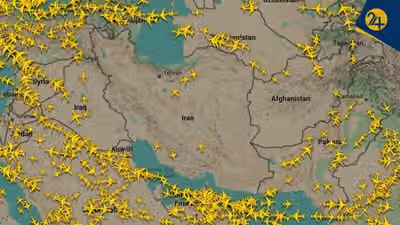
Iran’s shrinking air links raise costs, strain regional ties
1

Iran’s shrinking air links raise costs, strain regional ties

2
EXCLUSIVE

Key IRGC intelligence figure in Iran’s oil sales identified: Who is Mostafa Ahadi?

3
INSIGHT

Iranian hardliners turn on Ghalibaf and judiciary after lawmaker’s sentencing

4

US-Iran contacts continue as terms of possible deal remain disputed

5

Iran's Guards urge Americans to vote out their leaders in 26-page letter

Banner
Banner

Spotlight

  • US ‘feedback’ leaves Iran debating the price of diplomacy
    INSIGHT

    US ‘feedback’ leaves Iran debating the price of diplomacy

  • ‘I never asked about regime change’: Student speaks out after El-Sayed exchange

    ‘I never asked about regime change’: Student speaks out after El-Sayed exchange

  • Iranian hardliners turn on Ghalibaf and judiciary after lawmaker’s sentencing
    INSIGHT

    Iranian hardliners turn on Ghalibaf and judiciary after lawmaker’s sentencing

  • The body as a battleground: Iran's resistance etched in ink and blood
    SPECIAL REPORT

    The body as a battleground: Iran's resistance etched in ink and blood

  • Khamenei’s vision of Iranian power faces a test of reality
    ANALYSIS

    Khamenei’s vision of Iranian power faces a test of reality

  • Why Trump said no to Iran’s Hormuz proposal
    ANALYSIS

    Why Trump said no to Iran’s Hormuz proposal

Banner
Banner
•
•
•

More Stories

Iran takes US response to cabinet, Hormuz clashes continue

Sep 30, 2026, 13:05 GMT+1
100%
Cargo vessels transit the Strait of Hormuz

Iran took a US response to its latest diplomatic proposal to cabinet, a tanker was struck in the Strait of Hormuz and two January protesters were executed among the key developments on Wednesday.

Foreign Minister Abbas Araghchi received US feedback on Iran’s seven-day proposal during talks with Qatari mediators in Doha on Tuesday night, Reuters reported, citing an official briefed on the talks.

The main disagreement concerns the sequencing of the plan rather than its elements, the official said. The proposal outlines a seven-day process to build trust and return to an enhanced version of a memorandum of understanding reached by Iran and the United States in June.

Araghchi presented the US proposal at Wednesday’s cabinet meeting and briefed ministers on his trip to New York, including Iran’s conditions for reopening the Strait of Hormuz, government spokesperson said.

  • Iran’s shrinking air links raise costs, strain regional ties

    Iran’s shrinking air links raise costs, strain regional ties

US President Donald Trump, meanwhile, said Iran would eventually “give up,” but suggested that point had not yet been reached.

Tanker struck in Strait of Hormuz

The diplomatic exchanges came with shipping risks persisting in the waterway at the center of the negotiations.

A tanker heading into the Strait of Hormuz was struck by an unknown projectile, the United Kingdom Maritime Trade Operations said, citing a verified source. Authorities were investigating the strike.

Separately, the Revolutionary Guards described near-daily confrontations with vessels in the strait. Guards spokesman Hossein Mohebi said Iranian forces were targeting ships every 24 hours but had received no US response for some time.

The disruption has also affected neighboring Iraq. Parliament speaker Haibat al-Halbousi said Iran had given Iraqi tankers no exemption from restrictions on navigation through Hormuz.

  • UAE outmaneuvers Iran’s Hormuz strategy, state TV analysts say

    UAE outmaneuvers Iran’s Hormuz strategy, state TV analysts say

Iran expands military and civilian preparations

Beyond the strait, Iranian officials described efforts to strengthen the country’s military capabilities and prepare civilian infrastructure for further conflict.

Iran is rapidly expanding its missile, drone and air defense capabilities, deputy Revolutionary Guards commander Mostafa Izadi said.

“We are present in the Strait of Hormuz with strength. We are rapidly expanding our missile, drone and air defense capabilities,” Izadi said.

Iran will also hold drills covering schools, hospitals, banks, mobile phone operators, airports, ports, bridges, roads and aviation networks to prepare civilian infrastructure for wartime threats, Passive Defense Organization chief Gholamreza Jalali said.

Jalali said Iran had prepared for possible attacks on the Fordow, Natanz and Isfahan nuclear facilities before the war and conducted drills for such scenarios.

Two January protesters executed

Away from the military confrontation and negotiations, Iran carried out two more executions stemming from the January protests.

Ali Hemmati and Majid Nikandish were executed over demonstrations in Mashhad, with the judiciary accusing them of involvement in the deaths of four security personnel.

The judiciary said the two participated in protests in the city’s Tabarsi district on January 8 and accused them of attacking security personnel, setting buildings on fire and damaging public property.

  • Iran says awaiting US response on Hormuz proposal

    Iran says awaiting US response on Hormuz proposal

Sources previously told Iran International that Nikandish was tortured and forced to confess after his arrest and transfer to Vakilabad Prison.

Wednesday thus brought movement in indirect diplomacy with Washington without an end to confrontations in Hormuz, while Iranian authorities prepared for further conflict and continued executions stemming from January’s protests.

Iran death-row protester shot, tortured in custody

Sep 30, 2026, 12:19 GMT+1
•
Farnoosh Faraji
100%
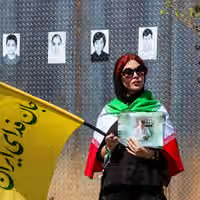
Iranians take part in anti-government protests in January 2026.

Iranian security forces shot death-row protester Alireza Sepahi four times during his arrest at home before subjecting him to weeks of torture in custody, according to a former cellmate who described his treatment.

Sepahi, detained over protests in January and sentenced to death in Isfahan, now has his case before the sentence enforcement office, raising concerns over his execution.

“I personally saw the four places where the pellets had hit his legs,” the former prisoner told Iran International, adding that Sepahi told him his initial recovery took about two months.

  • Iran court sentences 10 protesters to death in Isfahan

    Iran court sentences 10 protesters to death in Isfahan

Held in a security ward at Dastgerd Prison in Isfahan, Sepahi suffered a stroke on July 28, when two other prisoners were executed, including his cousin Abolfazl Sepahi. He was hospitalized before being returned to prison.

He was sentenced to death in the Alikhani Square case, a mass prosecution of protesters accused of involvement in unrest in Isfahan in which the Islamic Republic says four security personnel were killed.

Shot during arrest

Security forces arrested Sepahi at home following the January protests, ordering his family onto the floor before going upstairs to his room.

One officer restrained him before another said, “Hold him. I want to shoot him.”

The officers shot him in both lower legs, with two more pellets striking his thighs as he was taken away. One remained lodged in his thigh bone and required surgery.

100%
Death-row protester Alireza Sepahi

After two days in hospital, he was transferred to another detention facility. His mother, brother and teenage sister were also detained.

Torture during interrogation

Sepahi spent about 26 days undergoing interrogation and torture at the facility, according to the former prisoner.

His mother was at times brought into an adjoining room so she could hear or witness the torture. Interrogators struck him in the face and hit the wounds on his legs with a hose until they began bleeding again.

“I will sign whatever you tell me to,” Sepahi shouted during the torture, based on the account.

Civil rights activist Mehdi Mahmoudian said on September 12 that Sepahi and several other defendants in the case were tortured in detention.

  • Executions in Isfahan renew calls to end German city partnership

    Executions in Isfahan renew calls to end German city partnership

Several defendants told the court they had faced torture, sexual assault and threats of rape to extract statements against one another, Mahmoudian said, adding that a significant part of the case and resulting sentences rested on those statements.

Statements challenged in court

Sepahi told the judge during his trial that security forces had shot him during his arrest, his former cellmate said.

When the judge suggested the shots might have been fired as he tried to escape, Sepahi responded: “What escape? They shot me inside my own room.”

Other defendants who had previously made statements against him also told the court that their accounts had been extracted under torture.

  • Iran executes two protesters amid heavy security in Isfahan

    Iran executes two protesters amid heavy security in Isfahan

Some were beaten and subjected to mock executions after returning from court and forced to write new statements against Sepahi and other defendants.

Sepahi’s mother, Somayeh, is serving a five-year sentence at Dowlatabad Prison on charges including “assembly and collusion,” “acting against national security” and “rebellion.”

Flydubai flight diverts to Saudi Arabia after suspected cockpit stabbing

Sep 30, 2026, 12:03 GMT+1
100%

Both pilots of a flydubai flight from Dubai to Tel Aviv were injured after what Israeli officials said may have been an attempted terror attack in the cockpit, forcing the aircraft to make an emergency landing in Saudi Arabia on Wednesday.

Prince Sultan bin Abdulaziz International Airport in Tabuk said it was alerted at 8:44 a.m. local time after air traffic control received a distress call from flydubai flight FZ1073 requesting an emergency landing.

The Boeing 737 landed safely at 9:45 a.m., the airport said. The captain and first officer were taken to hospital, while passengers were assisted at the terminal.

Flydubai was working to arrange a replacement aircraft, the airport said, adding that the relevant authorities were investigating the incident.

What happened in the cockpit?

Three Israeli officials said the co-pilot was believed to have stabbed the captain in what was being investigated as a possible attempted terror attack.

The officials said cabin crew entered the cockpit and took control of flydubai flight FZ1073 before it diverted to Saudi Arabia while flying over Jordanian airspace. One of the officials identified the co-pilot as an Omani national.

Israeli authorities were still investigating the circumstances and had not reached a final conclusion about the motive.

Flydubai said the aircraft had experienced an "incident" while flying to Tel Aviv and diverted to Tabuk. The airline said all passengers were safe and accounted for but gave no details about what had happened.

Neither Saudi authorities nor flydubai had publicly explained the cause of the incident.

Passenger reports screaming and knife

Yasmin Abu Kasis, whose daughter Miriam was among the passengers, told Reuters that her daughter had heard screaming and said a man holding a knife forced one of the pilots to the floor.

She also said there was blood inside the aircraft.

Israeli media published a photograph said to have been taken aboard the plane showing what appeared to be a passenger with blood on his shirt. Reuters could not independently verify the image or the passenger's account.

The airport statement confirmed that both pilots had been injured but did not say how they were hurt.

Emergency signals and sudden descent

The flight had been traveling from Dubai to Tel Aviv when it diverted from Jordanian airspace toward Saudi Arabia, according to flight-tracking website Flightradar24.

The aircraft first transmitted a general emergency signal and several minutes later sent another signal indicating possible unlawful interference, Flightradar24 said. It later transmitted the general emergency signal again.

Flight data also appeared to show the plane dropping nearly 14,000 feet in less than 30 seconds before the first emergency alert, according to Flightradar24.

The signals prompted a major security response in Israel.

Israeli media said about 150 Israeli passengers were aboard the flight. The Israeli prime minister's office said the situation was "under control" and that authorities were taking steps to bring the passengers back to Israel.

Iran debtors face prison, hiding and suicide attempts

Sep 30, 2026, 04:22 GMT+1
100%
Prisoners are seen behind bars in Iran, where thousands have been imprisoned over unpaid financial obligations.

Years in prison or hiding, suicide attempts and severe financial hardship are among the consequences of Iran’s imprisonment of people over unpaid financial obligations, according to an IHRDC report published Tuesday.

According to a report published Tuesday by the Iran Human Rights Documentation Center (IHRDC), the findings draw on 10 confidential interviews conducted between March 2024 and July 2026 with debtors and close relatives of people subjected to financial enforcement.

All requested anonymity because of the stigma and other risks associated with imprisonment for debt.

One case concerns a man identified by the pseudonym Borna, whose sister told IHRDC that he spent two years in hiding after falling behind on payments linked to a marital financial obligation of 300 gold coins. He attempted suicide by jumping from a fourth-floor building and later spent about three years in prison.

His sister said a trial court found that Borna lacked the means to pay and ordered his release, but an appellate court required him to first pay 14 gold coins in arrears. IHRDC cited the case as evidence that people recognized as unable to pay can nevertheless remain exposed to detention.

The report also recounts the case of a young woman who was arrested at about 16 for theft and remained imprisoned for nearly three years after completing her sentence because she could not repay 400,000 tomans, which the report put at about $400 at the time. According to testimony cited by IHRDC, she attempted suicide in prison by swallowing depilatory powder and suffered lasting internal injuries.

The individual accounts are set against official figures showing that an average of 10,087 people were held in “imprisonment until payment” for civil financial judgments on any given day in 2022-23, representing 4.3% of Iran’s average prison population. The figure excludes people held over blood money and those on day release.

IHRDC’s open-source database separately recorded at least 88,078 releases of imprisoned debtors across all 31 provinces between 2016 and 2026. The organization said available figures represent minimums and do not capture everyone affected by financial detention.

Under Article 3 of Iran’s Law on the Enforcement of Financial Judgments, a debtor can be imprisoned at a creditor’s request until the judgment is satisfied, a court accepts an insolvency claim or the creditor consents to release. IHRDC said people genuinely unable to pay can still face detention because of procedural and evidentiary barriers, including missed deadlines and difficulties securing witnesses, collateral or legal assistance.

Iran told the United Nations during its 2025 Universal Periodic Review that no one is imprisoned merely for failing to fulfill a contractual obligation and that detention is reserved for people who have the means to pay but refuse. IHRDC said its examination of the law, statistics and witness accounts found that assurance “does not hold.”

IHRDC called for abolishing imprisonment for genuine inability to pay and replacing it with measures including asset tracing, wage attachment and installment plans based on a debtor’s ability to pay, while retaining sanctions for proven fraud, concealment or deliberate refusal to pay despite having the means.

Iranian hardliners turn on Ghalibaf and judiciary after lawmaker’s sentencing

Sep 30, 2026, 01:48 GMT+1
•
Maryam Sinaiee
100%
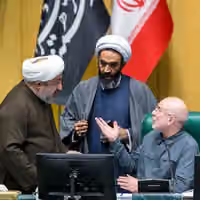
Hardline lawmaker Hamid Rasaei (left) speaking with Speaker Mohammad-Bagher Ghalibaf (right) in this file photo from July 2026.

Attacks by hardliners on Parliament Speaker Mohammad-Bagher Ghalibaf and Chief Justice Gholam-Hossein Mohseni-Ejei following hardline lawmaker Hamid Rasaei’s imprisonment have intensified the rift among Iran’s conservatives.

Rasaei said during an online parliamentary session on Sunday that Ghalibaf, former president Hassan Rouhani, President Masoud Pezeshkian and the Secretariat of the Supreme National Security Council had filed complaints against several lawmakers.

He said one of those complaints had resulted in a 10-month prison sentence against him. Rasaei described the ruling as “non-legal” and “political,” but said he would report to prison to serve the sentence.

Rasaei was elected third in Tehran in the parliamentary election three years ago, when around 80 percent of eligible voters in the capital boycotted the election.

He is the first sitting lawmaker to be sent to prison during his term in office.

The complaint dates to before Rasaei was elected to parliament and concerns a case brought by Ghalibaf against the weekly 9 Dey, where Rasaei was managing director. The complaint followed an article published in January 2024 under the headline “Ghalibaf’s Manipulation of Parliamentary Documents.”

The judiciary announced on Monday that Rasaei had appeared at Tehran’s Special Clerical Court and was sent to the clerics’ section of Evin Prison the same day to begin serving his sentence. According to the judiciary’s statement, Rasaei had more than 18 months to resolve the case by apologizing to Ghalibaf.

Rasaei’s positions are closely aligned with those of the Paydari Party and former nuclear negotiator Saeed Jalili.

Hardliners react to the sentence

Rasaei’s supporters have accused Ghalibaf of “silencing the voices of critics” and criticized him for pursuing the complaint against Rasaei rather than focusing on the country’s economic and security problems.

Figures associated with these groups and their media outlets also attacked Mohseni-Ejei. The criticism has spilled over into some recent nightly pro-government gatherings.

Mohammad-Manan Raeisi, a Qom lawmaker who headed Saeed Jalili’s presidential campaign in the city two years ago, sharply criticized Ghalibaf and other officials and warned of a possible popular backlash against them.

“I doubt that, under these circumstances, people will allow you to appear in any mosque, gathering, public square or religious ceremony, and you may face a popular backlash,” he wrote.

Meysam Nili, managing director of the Raja News website and a figure associated with the Paydari Party, accused the judiciary of injustice and political bias, claiming that a “coup” was being organized against media and political figures belonging to the faction.

Hardline social media user Mohsen Maghsoudi, referring to arguments in favour of negotiations with the United States, wrote: “When it is possible to negotiate with the killer of the martyred Imam (Ali Khamenei) in the national interests and still talk about negotiations despite receiving insult, humiliation and aggression, why can’t we, in order to preserve unity, drop a three-year-old complaint over the headline of a weekly newspaper so that a revolutionary representative does not go to prison and hundreds of thousands of people’s votes do not become ineffective for 10 months?”

Other conservatives push back

Other conservative figures have sharply criticized the controversy generated by Rasaei’s supporters and the hardline groups.

The IRGC-affiliated Tasnim news agency published an article headlined “On Mr Rasaei’s Strange Fallacies!” and described his objections to the ruling as “slander against a judicial ruling.”

Tasnim said Rasaei had effectively challenged the validity of the ruling by describing it as “strange” and “contrary to procedure,” while accusing the judiciary of political conduct by calling the ruling “political and non-legal.” The agency characterized his statements as criminal.

The Tabnak website published a video showing hardliners chanting in support of Rasaei and against Ghalibaf at one of the nightly gatherings. It called them “infiltrators” and said a small number of people were using the gatherings to “advance factional objectives.”

The conservative Khorasan newspaper said Rasaei’s refusal to apologize had led the court to conclude that he was not only unrepentant about the allegations he had made against Ghalibaf, but was also refusing to resolve the case and defying a judicial order.

Mojtaba Zarei, a member of parliament’s National Security and Foreign Policy Committee, wrote that turning a judicial case into a political and media confrontation during wartime would only deepen divisions among political forces.

Deepening confrontation

Hardliners have stepped up attacks in recent days against political rivals who support resolving the dispute with the United States through negotiations and returning to the Islamabad understanding.

They have gathered outside the home of former President Hassan Rouhani, whom they accuse of being subservient to the West, and called for him and his former foreign minister, Mohammad-Javad Zarif, to be prosecuted.

They also chanted against President Masoud Pezeshkian and called him an “infiltrator” as he returned from New York, where he attended the UN General Assembly. Hardliners have also registered an impeachment motion against Foreign Minister Abbas Araghchi over his meeting with Steve Witkoff, US President Donald Trump’s special envoy for Iran, and launched an online campaign calling for Pezeshkian’s removal.