• العربية
  • فارسی
Brand
  • Iran Insight
  • Politics
  • Economy
  • Analysis
  • Special Report
  • Opinion
  • Podcast
  • Live TV
  • Iran Insight
  • Politics
  • Economy
  • Analysis
  • Special Report
  • Opinion
  • Podcast
  • Live TV
  • Theme
  • Language
    • العربية
    • فارسی
  • Iran Insight
  • Politics
  • Economy
  • Analysis
  • Special Report
  • Opinion
  • Podcast
  • Live TV
All rights reserved for Volant Media UK Limited
volant media logo

‘I never asked about regime change’: Student speaks out after El-Sayed exchange

Negar Mojtahedi
Negar Mojtahedi

Iran International

Sep 30, 2026, 15:54 GMT+1
Iman Dashti is a Senior at The University of Michigan College of Engineering

An Iranian-American student who pressed Michigan Democratic US Senate nominee Abdul El-Sayed to state his position on Iran’s Revolutionary Guards says he and his family have faced threats and harassment after a video of the exchange went viral.

At a University of Michigan town hall, Iman Dashti said his cousin had been pursued through the streets over her hijab and his uncle sentenced to death and given 50 lashes under the Islamic Republic, before asking whether El-Sayed stood “unequivocally against the IRGC.”

El-Sayed responded that he would “always stand with movements for freedom and democracy” and later told Dashti, “I want freedom and democracy for the people of Iran, no question,” while stressing that political change should come from Iranians themselves rather than through US-led regime change.

He did not directly answer Dashti’s question about whether he stood unequivocally against the IRGC.

Dashti told Iran International he shares El-Sayed’s opposition to US-imposed regime change, but said that was never the question he was asking.

“I never asked about regime change. I never asked about his stance on the war,” Dashti said. “I asked him about the people.”

“I wanted to hear from him. I wanted to hear that he stood with us, I really did want to,” he said. “If Abdul were to win, at least we’d have an advocate for the Persian people, for the American people in the US Senate.”

El-Sayed’s campaign has defended his response.

“As he noted in his response, Abdul will always stand with movements for freedom and democracy and he condemns government anti-free speech violence,” campaign spokesperson Roxie Richner told Fox News.

The campaign also reiterated El-Sayed’s opposition to US-funded regime-change wars.

Iran International separately contacted El-Sayed’s campaign seeking an interview or written response about the exchange and his position on the IRGC but did not receive a response before publication.

Threats after the exchange

Dashti said the atmosphere inside the town hall became tense, with audience members applauding when El-Sayed rejected US-led regime change, a position Dashti said he agreed with.

“The tension was very high in that room,” he said. “You could cut it with a knife.”

Since the exchange spread online, Dashti says he has received threats and that his friends and family have been targeted.

“Since that day, people have threatened me, doxxed my friends, even harassed my family,” he said in a video posted after the town hall.

Dashti told Iran International the past several days had been anxious but said the hostile reaction had also been accompanied by considerable support.

“For every negative comment I’ve gotten, for every negative sort of threat, I’ve gotten a lot of beautiful positive messages,” he said.

Scrutiny of Dashti’s politics

The attention has also brought scrutiny of Dashti’s own politics. He describes himself as a “proud Christian conservative,” belongs to the College Republicans and has previously met Mike Rogers, the Republican nominee running against El-Sayed in November.

Dashti said he does not work for Rogers and was not sent to the town hall on behalf of his campaign.

“Am I a Zionist plant? Do I work for the Rogers campaign?” he said in his follow-up video, recounting accusations circulating online. “I don’t work for anyone. I’m just a Persian student and my family was hunted in the streets of Iran.”

The son of Iranian immigrants, Dashti said he sees speaking about repression in Iran as a way of advocating for people who cannot freely do so themselves.

“The least I can do is give a voice to the people who literally don’t have a voice,” he said. “I love my people, my heritage. It’s a beautiful, beautiful culture.”

Washington designated the IRGC a Foreign Terrorist Organization in 2019. The force is a central part of the Islamic Republic’s security apparatus and has been involved in suppressing anti-government protests.

Dashti said the criticism has not deterred him from continuing to raise the issue during the remaining weeks of the Senate campaign.

“I’m going to keep going, whether that means showing up at future events, mobilizing friends,” he said. “This is just the beginning.”

Most Viewed

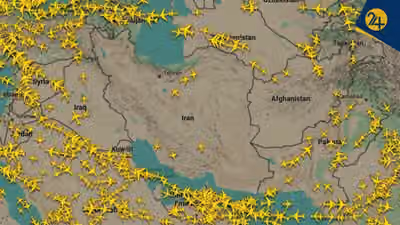
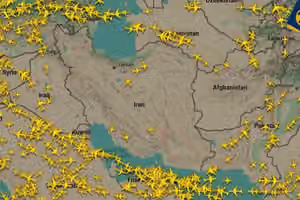
Iran’s shrinking air links raise costs, strain regional ties
1

Iran’s shrinking air links raise costs, strain regional ties

2
EXCLUSIVE

Key IRGC intelligence figure in Iran’s oil sales identified: Who is Mostafa Ahadi?

3
INSIGHT

Iranian hardliners turn on Ghalibaf and judiciary after lawmaker’s sentencing

4

IRGC outlet accuses reformists of feeding Trump's pressure campaign

5

US-Iran contacts continue as terms of possible deal remain disputed

Banner
Banner

Spotlight

  • ‘I never asked about regime change’: Student speaks out after El-Sayed exchange

    ‘I never asked about regime change’: Student speaks out after El-Sayed exchange

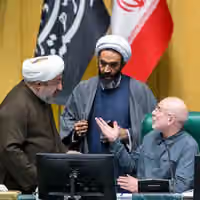
  • Iranian hardliners turn on Ghalibaf and judiciary after lawmaker’s sentencing
    INSIGHT

    Iranian hardliners turn on Ghalibaf and judiciary after lawmaker’s sentencing

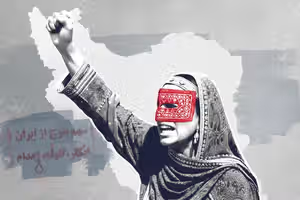
  • The body as a battleground: Iran's resistance etched in ink and blood
    SPECIAL REPORT

    The body as a battleground: Iran's resistance etched in ink and blood

  • Khamenei’s vision of Iranian power faces a test of reality
    ANALYSIS

    Khamenei’s vision of Iranian power faces a test of reality

  • Why Trump said no to Iran’s Hormuz proposal
    ANALYSIS

    Why Trump said no to Iran’s Hormuz proposal

Banner
Banner
•
•
•

More Stories

Iran takes US response to cabinet, Hormuz clashes continue

Sep 30, 2026, 13:05 GMT+1
100%
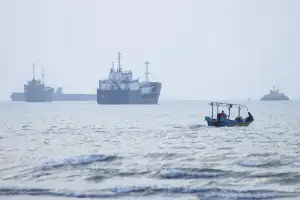
Cargo vessels transit the Strait of Hormuz

Iran took a US response to its latest diplomatic proposal to cabinet, a tanker was struck in the Strait of Hormuz and two January protesters were executed among the key developments on Wednesday.

Foreign Minister Abbas Araghchi received US feedback on Iran’s seven-day proposal during talks with Qatari mediators in Doha on Tuesday night, Reuters reported, citing an official briefed on the talks.

The main disagreement concerns the sequencing of the plan rather than its elements, the official said. The proposal outlines a seven-day process to build trust and return to an enhanced version of a memorandum of understanding reached by Iran and the United States in June.

Araghchi presented the US proposal at Wednesday’s cabinet meeting and briefed ministers on his trip to New York, including Iran’s conditions for reopening the Strait of Hormuz, government spokesperson said.

  • Iran’s shrinking air links raise costs, strain regional ties

    Iran’s shrinking air links raise costs, strain regional ties

US President Donald Trump, meanwhile, said Iran would eventually “give up,” but suggested that point had not yet been reached.

Tanker struck in Strait of Hormuz

The diplomatic exchanges came with shipping risks persisting in the waterway at the center of the negotiations.

A tanker heading into the Strait of Hormuz was struck by an unknown projectile, the United Kingdom Maritime Trade Operations said, citing a verified source. Authorities were investigating the strike.

Separately, the Revolutionary Guards described near-daily confrontations with vessels in the strait. Guards spokesman Hossein Mohebi said Iranian forces were targeting ships every 24 hours but had received no US response for some time.

The disruption has also affected neighboring Iraq. Parliament speaker Haibat al-Halbousi said Iran had given Iraqi tankers no exemption from restrictions on navigation through Hormuz.

  • UAE outmaneuvers Iran’s Hormuz strategy, state TV analysts say

    UAE outmaneuvers Iran’s Hormuz strategy, state TV analysts say

Iran expands military and civilian preparations

Beyond the strait, Iranian officials described efforts to strengthen the country’s military capabilities and prepare civilian infrastructure for further conflict.

Iran is rapidly expanding its missile, drone and air defense capabilities, deputy Revolutionary Guards commander Mostafa Izadi said.

“We are present in the Strait of Hormuz with strength. We are rapidly expanding our missile, drone and air defense capabilities,” Izadi said.

Iran will also hold drills covering schools, hospitals, banks, mobile phone operators, airports, ports, bridges, roads and aviation networks to prepare civilian infrastructure for wartime threats, Passive Defense Organization chief Gholamreza Jalali said.

Jalali said Iran had prepared for possible attacks on the Fordow, Natanz and Isfahan nuclear facilities before the war and conducted drills for such scenarios.

Two January protesters executed

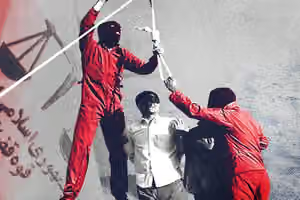
Away from the military confrontation and negotiations, Iran carried out two more executions stemming from the January protests.

Ali Hemmati and Majid Nikandish were executed over demonstrations in Mashhad, with the judiciary accusing them of involvement in the deaths of four security personnel.

The judiciary said the two participated in protests in the city’s Tabarsi district on January 8 and accused them of attacking security personnel, setting buildings on fire and damaging public property.

  • Iran says awaiting US response on Hormuz proposal

    Iran says awaiting US response on Hormuz proposal

Sources previously told Iran International that Nikandish was tortured and forced to confess after his arrest and transfer to Vakilabad Prison.

Wednesday thus brought movement in indirect diplomacy with Washington without an end to confrontations in Hormuz, while Iranian authorities prepared for further conflict and continued executions stemming from January’s protests.

Iran debtors face prison, hiding and suicide attempts

Sep 30, 2026, 04:22 GMT+1
100%
Prisoners are seen behind bars in Iran, where thousands have been imprisoned over unpaid financial obligations.

Years in prison or hiding, suicide attempts and severe financial hardship are among the consequences of Iran’s imprisonment of people over unpaid financial obligations, according to an IHRDC report published Tuesday.

According to a report published Tuesday by the Iran Human Rights Documentation Center (IHRDC), the findings draw on 10 confidential interviews conducted between March 2024 and July 2026 with debtors and close relatives of people subjected to financial enforcement.

All requested anonymity because of the stigma and other risks associated with imprisonment for debt.

One case concerns a man identified by the pseudonym Borna, whose sister told IHRDC that he spent two years in hiding after falling behind on payments linked to a marital financial obligation of 300 gold coins. He attempted suicide by jumping from a fourth-floor building and later spent about three years in prison.

His sister said a trial court found that Borna lacked the means to pay and ordered his release, but an appellate court required him to first pay 14 gold coins in arrears. IHRDC cited the case as evidence that people recognized as unable to pay can nevertheless remain exposed to detention.

The report also recounts the case of a young woman who was arrested at about 16 for theft and remained imprisoned for nearly three years after completing her sentence because she could not repay 400,000 tomans, which the report put at about $400 at the time. According to testimony cited by IHRDC, she attempted suicide in prison by swallowing depilatory powder and suffered lasting internal injuries.

The individual accounts are set against official figures showing that an average of 10,087 people were held in “imprisonment until payment” for civil financial judgments on any given day in 2022-23, representing 4.3% of Iran’s average prison population. The figure excludes people held over blood money and those on day release.

IHRDC’s open-source database separately recorded at least 88,078 releases of imprisoned debtors across all 31 provinces between 2016 and 2026. The organization said available figures represent minimums and do not capture everyone affected by financial detention.

Under Article 3 of Iran’s Law on the Enforcement of Financial Judgments, a debtor can be imprisoned at a creditor’s request until the judgment is satisfied, a court accepts an insolvency claim or the creditor consents to release. IHRDC said people genuinely unable to pay can still face detention because of procedural and evidentiary barriers, including missed deadlines and difficulties securing witnesses, collateral or legal assistance.

Iran told the United Nations during its 2025 Universal Periodic Review that no one is imprisoned merely for failing to fulfill a contractual obligation and that detention is reserved for people who have the means to pay but refuse. IHRDC said its examination of the law, statistics and witness accounts found that assurance “does not hold.”

IHRDC called for abolishing imprisonment for genuine inability to pay and replacing it with measures including asset tracing, wage attachment and installment plans based on a debtor’s ability to pay, while retaining sanctions for proven fraud, concealment or deliberate refusal to pay despite having the means.

German-based aid worker gets 10-year prison sentence in Iran

Sep 29, 2026, 23:26 GMT+1
•
Negar Mojtahedi
100%
Serkan Eren, founder of the Stuttgart-based humanitarian organization STELP.

A German-based humanitarian worker has been sentenced to 10 years in prison in Iran after entering the country to help vulnerable Iranians, Stuttgart-based aid organization STELP said.

Serkan Eren, the 42-year-old founder of STELP, was convicted over alleged contacts with a country Iran considers hostile, according to the organization. STELP has not identified the country or disclosed further details, citing concerns for Eren and others involved.

Eren, a Turkish citizen and longtime resident of Germany, has been in Iranian custody for more than a year.

He entered Iran in late June 2025 as the 12-day war was drawing to a close. Five days later, after a ceasefire had taken effect, he headed toward the Iraqi border to leave the country. He never made it out.

STELP called the verdict unjustified and said the sentence did not reflect the circumstances of his case.

“The ten-year prison sentence given to Serkan Eren is not about what he has done. It is about what the Islamic Republic wants,” Shahin Milani, executive director of the Iran Human Rights Documentation Center, told Iran International.

Milani said Eren's charitable work offered little protection from what he described as Tehran's established practice of using foreign detainees as political leverage.

“Even working for a charitable organization does not protect foreign nationals,” he said.

Contemporaneous German reporting provides a detailed account of why Eren went to Iran and the precautions he took before entering.

German-Iranians had approached STELP seeking help for relatives inside the country, according to the Stuttgarter Zeitung. Eren said he was in contact with seven elderly Iranians, some of them ill, whom he hoped to help reach Turkey. He also intended to bring food into Tehran.

The risks were apparent before he crossed the border.

Eren deliberately left behind a satellite phone, bulletproof vest and helmet, fearing such equipment could cause Iranian authorities to mistake him for an agent or saboteur. Instead, he crossed from Turkey into Iran on foot with little more than a backpack.

Once inside, those concerns intensified. Eren later described armed checkpoints on his route to Tehran where he was forced to strip naked during searches.

More than a year later, an Islamic Republic court convicted him over alleged contacts with a hostile country.

Human rights lawyer Gissou Nia said humanitarian status has not historically insulated either foreign aid workers or Iranian charities from pressure by the authorities.

“Unfortunately, being a humanitarian aid worker is not a shield when it comes to the Islamic Republic detaining and arbitrarily imprisoning individuals,” Nia told Iran International.

She cited the case of Belgian humanitarian worker Olivier Vandecasteele, who was detained in Iran in 2022 and later sentenced to a lengthy prison term before being released in 2023 in a prisoner exchange involving Assadollah Assadi, an Iranian diplomat imprisoned in Belgium over a foiled bomb plot.

“This is a pattern that we've seen before,” Nia said.

Nia also pointed to the treatment of humanitarian organizations operating inside Iran. The Imam Ali Popular Students Relief Society, a prominent independent charity that worked with impoverished families and vulnerable children, was dissolved following years of pressure from Iranian authorities.

The Center for Human Rights in Iran reported in 2022 that an appeals court upheld an order dissolving the organization after authorities arrested several of its members and accused its founder of offenses including insulting Iran's leadership and acting against national security.

The case, Nia said, illustrates how work designed to remain outside politics can itself become politically charged in Iran.

“Even the sort of non-politicized work of humanitarian aid organizations has been politicized in some ways,” she said.

Eren's Turkish citizenship adds another layer to efforts to secure his release.

Despite living in Germany and running a Stuttgart-based organization, Eren does not hold German citizenship. Germany's Foreign Office has said it is aware of his case but that responsibility rests with Turkish authorities because he is a Turkish national. STELP says it has been working closely with Ankara since his detention.

Nia said his ties to Germany nevertheless give Berlin reason to remain engaged.

“I anticipate that Germany will raise the case, especially because he was working for a German-based organization,” she said. “And the Turkish government will probably be involved as well, because he is a Turkish citizen.”

The sentence has already drawn calls for Eren's release in Germany. Baden-Württemberg Minister-President Cem Özdemir said he would continue pushing for Eren to be freed immediately.

Eren has spent years working in humanitarian crises. He began aid work during Europe's 2015 refugee crisis and received Germany's Federal Order of Merit in 2023 for his humanitarian service.

Before entering Iran, he openly questioned whether authorities would allow him into the country at all.

“It’s arbitrary,” Eren told the Stuttgarter Zeitung at the time.

He nevertheless hoped his status as a humanitarian worker would help protect him.

It did not.

Iran says awaiting US response on Hormuz proposal

Sep 29, 2026, 13:28 GMT+1
100%
Vessels transit the Strait of Hormuz, a key route for global oil shipments.

Iran said on Tuesday it is awaiting a US response to its proposal for reopening the Strait of Hormuz, as regional oil flows continued to recover and the rial sank past 2.5 million to the dollar.

The developments put Iran’s efforts to secure relief for maritime trade alongside mounting economic pressure at home and warnings from Iranian and US officials over further confrontation.

“We are awaiting an official response from the United States through the mediators,” Foreign Minister Abbas Araghchi said.

Qatar was expected to relay Iran’s proposals to Washington and return with a response, possibly by Wednesday, Araghchi said. Iran had made no concessions and reopening Hormuz remained conditional on its demands being met, he added.

“At present, the only issue is the Strait of Hormuz,” Araghchi said. “Iran’s conditions are entirely fair and reasonable. If the Americans say they want an agreement or a peaceful solution, we have presented that solution.”

Oil flows recover despite risks in Hormuz

Persian Gulf oil exports have recovered despite disruption around Hormuz, potentially reducing the impact of restrictions on one of the world’s most important energy routes.

Oil shipments through the strait and alternative routes have returned to nearly 80% of pre-war regional levels, the Wall Street Journal reported Monday.

Crude exports from major Middle Eastern producers including Saudi Arabia, Iraq and the United Arab Emirates have climbed to almost 13 million barrels per day this month, their highest level since February, according to ship-tracking data cited by the Journal.

Risks to shipping persist. A vessel transiting Hormuz was struck by a suspected unknown projectile Monday evening, causing a fire that was later extinguished, the UK Maritime Trade Operations said. The crew was safe.

Against that backdrop, Iran tied the security of regional energy infrastructure to its own ability to export oil. “If we do not sell oil in a region, no one will sell oil there, and if our security is not guaranteed, no infrastructure will be safe,” parliament speaker Mohammad Bagher Ghalibaf said Tuesday.

Rial crosses 2.5 million per dollar

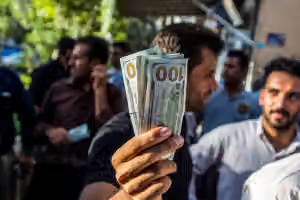
Iran’s free-market exchange rate crossed 2.5 million rials to the dollar Tuesday, extending a currency decline that has increased import costs and eroded household purchasing power.

The dollar had reached 2.418 million rials Monday before gaining more than 80,000 rials, or over 3%, in less than 24 hours.

The decline comes alongside inflation, falling production, trade restrictions, foreign-currency shortages and difficulties transferring money.

Iran is seeking alternatives to maritime trade. Rail freight from China has increased tenfold since the US naval blockade began, lawmaker Meisam Zohourian said.

Three rail routes and expanded capacity at northern ports could provide overland capacity equivalent to about 400,000 barrels of oil a day, though they could not fully replace maritime trade, Zohourian said.

Revolutionary Guards prepare message to Americans

The Islamic Revolutionary Guards have addressed the American public in a letter portraying Iran as the victor in the war with the United States and crediting Mojtaba Khamenei’s leadership for the outcome.

“This is a letter, not a propaganda effort to shape the media narrative,” IRGC spokesman Hossein Mohebbi said Tuesday.

The letter said Khamenei’s “unparalleled command” had left “the world’s two leading military powers” unable to prevail and argued that his leadership gave Iran an advantage the United States lacked.

“A God-fearing and just leader, a wise scholar and a pure and courageous ascetic — this is what your armed forces and your country lack and do not have,” the Revolutionary Guards wrote in the letter to Americans.

Mohebbi also called US President Donald Trump “a big liar” and said Washington had no choice but to acknowledge failure and leave the region.

Washington, for its part, warned Iran against targeting US interests beyond the confrontation over Hormuz. US Secretary of State Marco Rubio said Iran had openly threatened American interests around the world and would face repercussions for any attack or attempted attack.

Iran’s government, however, coupled its readiness for further conflict with an openness to diplomacy. “We are not afraid of war and we do not run away from negotiations,” government spokesperson Fatemeh Mohajerani said.

Iran's Guards urge Americans to vote out their leaders in 26-page letter

Sep 29, 2026, 12:58 GMT+1
•
Niloufar Goudarzi
100%

A designated terrorist organization has written to American voters. Iran's Revolutionary Guards sent a 26-page letter to US scholars, students and media describing a government in decline and telling Americans they have the power to change it at the ballot box in November.

The letter, published by Iranian media on Tuesday in English and Persian, presents the Islamic Revolutionary Guard Corps as a force for the people, portrays Iran as victorious and the United States as a power in decline, and returns repeatedly to a single instruction: that Americans turn against the politicians they elected.

The Guards and their Basij volunteer force led the suppression of nationwide protests in January, in which security forces killed tens of thousands of people in two days. A UN fact-finding mission said this month that the crackdown involved crimes against humanity.

Signs of 'decline'

"Tyranny, an excessive tendency to behave violently and murderously, relying on and promoting falsehoods, giving precedence to the vulgar elements of society over the wiser elements in occupying positions of power, and an inordinate preoccupation with inessential matters at the expense of society's essential affairs" are the signs of a state in decline, the letter says.

"The United States government today exemplifies all of these flaws."

  • UN rights chief urges Iran to halt executions over protests

    UN rights chief urges Iran to halt executions over protests

  • At least 916 executed in Iran since January - rights group

    At least 916 executed in Iran since January - rights group

  • UN experts say Iran steps up repression of ethnic minorities

    UN experts say Iran steps up repression of ethnic minorities

'Not a single verifiable instance'

The United States designates the Guards as a foreign terrorist organization. The letter rejects the label.

"There is not a single verifiable instance where the IRGC has committed an act of violence against civilians," it says. "In fact, it would not be an overstatement to assert that the Guards are the world's most effective organization in combating terrorism."

Amnesty International said this month that Iranian authorities carried out a systematic campaign of killings, torture and sexual violence to crush the Woman, Life, Freedom uprising of 2022. It named 87 officials, including senior Guards and police commanders, whom it said should be investigated for crimes against humanity, and documented 377 protest-related deaths, 56 of them children.

The UN fact-finding mission's report on the January 2026 crackdown cited unlawful killings, torture, arbitrary detention and enforced disappearances, and said the scale of the violence was a sharp escalation from earlier repression.

The Guards' Quds Force arms and funds Hezbollah in Lebanon, the Houthis in Yemen and militias in Iraq. Since the war began in February, Guards naval forces have attacked commercial shipping in the Strait of Hormuz.

  • Oslo rights conference urges concrete dialogue for Iran’s democratic future

    Oslo rights conference urges concrete dialogue for Iran’s democratic future

  • Experts say Iran entering era of constant unrest

    Experts say Iran entering era of constant unrest

'Take back control'

The letter tells Americans they are responsible for their government.

"You are the ones who empower, with your votes, the government and allow it to do what it does," it says. "Although American politicians often win your votes through deception and false promises, as Trump did, you can change the makeup of the government."

"The United States of America is a great nation," it adds. "To allow vulgar and immoral individuals to continue steering your politics and policies will only further humiliate and undermine the US. Take back control."

In Iran, candidates for president and parliament are vetted by the Guardian Council, an unelected body, before they can stand. The supreme leader is not elected by voters. Official turnout in the 2024 presidential election was about 40 percent.

The letter also explains the slogan "Death to America." "The true meaning of 'Death to America' is 'Death to the crimes perpetrated by the American elite,'" it says. "It is, in a word, not an expression of ill will toward the American people."

The slogan is chanted at state-organized rallies and Friday prayers across Iran and appears on murals maintained by the state in central Tehran, including on the walls of the former US embassy.

  • Iran’s rial hits another record low under economic and military pressure

    Iran’s rial hits another record low under economic and military pressure

  • War deepens Iran’s energy crunch ahead of winter

    War deepens Iran’s energy crunch ahead of winter

  • Iranians say basic food slipping beyond reach as bread prices soar

    Iranians say basic food slipping beyond reach as bread prices soar

'The dam will break'

The letter attacks Donald Trump and tells Americans their economy is failing.

"The US economy is on the precipice of collapse, and yet he keeps on telling Americans that the economy is booming and the prices will soon start coming down," it says. "This is, perhaps, his biggest lie. Soon, the dam will break, and the economy will implode, causing, unfortunately, great pain for Americans for many many years."

"The US economy will be hit by a massive economic earthquake that will affect the lives of all Americans," it adds. "You, the American people, have the power to forestall this grim fate."

On the day the letter circulated, the dollar traded above 2.5 million rials on Iran's open market. Iran's minimum monthly wage of 166 million rials is worth about $66 at that rate.

'We can live together'

The letter closes by asking Americans to press Washington to distance itself from Israel.

"We can live together in peaceful coexistence," it says. "Remove from power the evil, deceitful, and violent politicians who are responsible for America's current state. Entrust your affairs to the wise, not the wily. Make sure your politicians understand that the world has changed."