Flydubai flight diverts to Saudi Arabia after suspected cockpit stabbing
Both pilots of a flydubai flight from Dubai to Tel Aviv were injured after what Israeli officials said may have been an attempted terror attack in the cockpit, forcing the aircraft to make an emergency landing in Saudi Arabia on Wednesday.
Prince Sultan bin Abdulaziz International Airport in Tabuk said it was alerted at 8:44 a.m. local time after air traffic control received a distress call from flydubai flight FZ1073 requesting an emergency landing.
The Boeing 737 landed safely at 9:45 a.m., the airport said. The captain and first officer were taken to hospital, while passengers were assisted at the terminal.
Flydubai was working to arrange a replacement aircraft, the airport said, adding that the relevant authorities were investigating the incident.
What happened in the cockpit?
Three Israeli officials said the co-pilot was believed to have stabbed the captain in what was being investigated as a possible attempted terror attack.
The officials said cabin crew entered the cockpit and took control of flydubai flight FZ1073 before it diverted to Saudi Arabia while flying over Jordanian airspace. One of the officials identified the co-pilot as an Omani national.
Israeli authorities were still investigating the circumstances and had not reached a final conclusion about the motive.
Flydubai said the aircraft had experienced an "incident" while flying to Tel Aviv and diverted to Tabuk. The airline said all passengers were safe and accounted for but gave no details about what had happened.
Neither Saudi authorities nor flydubai had publicly explained the cause of the incident.
Passenger reports screaming and knife
Yasmin Abu Kasis, whose daughter Miriam was among the passengers, told Reuters that her daughter had heard screaming and said a man holding a knife forced one of the pilots to the floor.
She also said there was blood inside the aircraft.
Israeli media published a photograph said to have been taken aboard the plane showing what appeared to be a passenger with blood on his shirt. Reuters could not independently verify the image or the passenger's account.
The airport statement confirmed that both pilots had been injured but did not say how they were hurt.
Emergency signals and sudden descent
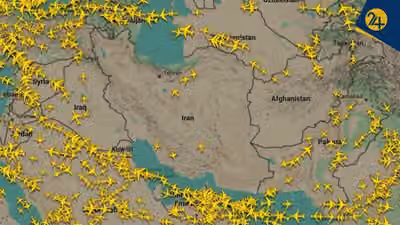
The flight had been traveling from Dubai to Tel Aviv when it diverted from Jordanian airspace toward Saudi Arabia, according to flight-tracking website Flightradar24.
The aircraft first transmitted a general emergency signal and several minutes later sent another signal indicating possible unlawful interference, Flightradar24 said. It later transmitted the general emergency signal again.
Flight data also appeared to show the plane dropping nearly 14,000 feet in less than 30 seconds before the first emergency alert, according to Flightradar24.
The signals prompted a major security response in Israel.
Israeli media said about 150 Israeli passengers were aboard the flight. The Israeli prime minister's office said the situation was "under control" and that authorities were taking steps to bring the passengers back to Israel.
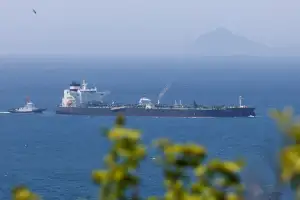
Vessels transit the Strait of Hormuz, a key route for global oil shipments.
Iran said on Tuesday it is awaiting a US response to its proposal for reopening the Strait of Hormuz, as regional oil flows continued to recover and the rial sank past 2.5 million to the dollar.
The developments put Iran’s efforts to secure relief for maritime trade alongside mounting economic pressure at home and warnings from Iranian and US officials over further confrontation.
“We are awaiting an official response from the United States through the mediators,” Foreign Minister Abbas Araghchi said.
Qatar was expected to relay Iran’s proposals to Washington and return with a response, possibly by Wednesday, Araghchi said. Iran had made no concessions and reopening Hormuz remained conditional on its demands being met, he added.
“At present, the only issue is the Strait of Hormuz,” Araghchi said. “Iran’s conditions are entirely fair and reasonable. If the Americans say they want an agreement or a peaceful solution, we have presented that solution.”
Oil flows recover despite risks in Hormuz
Persian Gulf oil exports have recovered despite disruption around Hormuz, potentially reducing the impact of restrictions on one of the world’s most important energy routes.
Oil shipments through the strait and alternative routes have returned to nearly 80% of pre-war regional levels, the Wall Street Journal reported Monday.
Crude exports from major Middle Eastern producers including Saudi Arabia, Iraq and the United Arab Emirates have climbed to almost 13 million barrels per day this month, their highest level since February, according to ship-tracking data cited by the Journal.
Risks to shipping persist. A vessel transiting Hormuz was struck by a suspected unknown projectile Monday evening, causing a fire that was later extinguished, the UK Maritime Trade Operations said. The crew was safe.
Against that backdrop, Iran tied the security of regional energy infrastructure to its own ability to export oil. “If we do not sell oil in a region, no one will sell oil there, and if our security is not guaranteed, no infrastructure will be safe,” parliament speaker Mohammad Bagher Ghalibaf said Tuesday.
Rial crosses 2.5 million per dollar
Iran’s free-market exchange rate crossed 2.5 million rials to the dollar Tuesday, extending a currency decline that has increased import costs and eroded household purchasing power.
The dollar had reached 2.418 million rials Monday before gaining more than 80,000 rials, or over 3%, in less than 24 hours.
The decline comes alongside inflation, falling production, trade restrictions, foreign-currency shortages and difficulties transferring money.
Iran is seeking alternatives to maritime trade. Rail freight from China has increased tenfold since the US naval blockade began, lawmaker Meisam Zohourian said.
Three rail routes and expanded capacity at northern ports could provide overland capacity equivalent to about 400,000 barrels of oil a day, though they could not fully replace maritime trade, Zohourian said.
Revolutionary Guards prepare message to Americans
The Islamic Revolutionary Guards have addressed the American public in a letter portraying Iran as the victor in the war with the United States and crediting Mojtaba Khamenei’s leadership for the outcome.
“This is a letter, not a propaganda effort to shape the media narrative,” IRGC spokesman Hossein Mohebbi said Tuesday.
The letter said Khamenei’s “unparalleled command” had left “the world’s two leading military powers” unable to prevail and argued that his leadership gave Iran an advantage the United States lacked.
“A God-fearing and just leader, a wise scholar and a pure and courageous ascetic — this is what your armed forces and your country lack and do not have,” the Revolutionary Guards wrote in the letter to Americans.
Mohebbi also called US President Donald Trump “a big liar” and said Washington had no choice but to acknowledge failure and leave the region.
Washington, for its part, warned Iran against targeting US interests beyond the confrontation over Hormuz. US Secretary of State Marco Rubio said Iran had openly threatened American interests around the world and would face repercussions for any attack or attempted attack.
Iran’s government, however, coupled its readiness for further conflict with an openness to diplomacy. “We are not afraid of war and we do not run away from negotiations,” government spokesperson Fatemeh Mohajerani said.
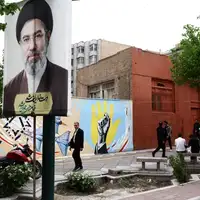
A large portrait of Iran’s Supreme Leader Mojtaba Khamenei hangs above a street in Iran.
Iran’s Supreme Leader Mojtaba Khamenei has portrayed the country as stronger after successive wars and pressures and among the world’s foremost powers, a vision that key economic and military indicators and recent regional events put to the test.
Khamenei described Iran as enjoying “progress, dignity and independence” and its highest standing in the Muslim world and beyond in a written message marking the anniversary of the Iran-Iraq War on Monday.
“Today, some consider us the world’s fourth superpower,” Khamenei wrote. He went further, saying that according to “divine calculations,” Iran is the “world’s top power.”
The depiction comes more than six months after Khamenei became supreme leader without making a public appearance.
No new photograph, video or audio recording of Khamenei has been released since his elevation to the post. Islamic Republic officials have said he remains in charge and has stayed out of public view for security reasons.
His absence extended to the days-long funeral and burial ceremonies for his father and predecessor, Ali Khamenei.
That absence creates a contrast at the heart of a message centered on national strength and retreating adversaries. Khamenei invokes “millions” of Iranians taking to the streets and a country growing in power while remaining unseen by the public himself.
The ‘fourth superpower’ by what measure?
Khamenei does not identify those who regard Iran as the world’s fourth superpower or explain what measure produces that ranking.
Military spending offers one measurable comparison.
Iran spent an estimated $7.4 billion on its military in 2025, according to the Stockholm International Peace Research Institute. The United States spent about $954 billion, China $336 billion and Russia $190 billion.
SIPRI says Iran also finances some military activities outside its regular budget, meaning actual expenditure could be higher. Even allowing for that, the available figures leave a wide gap between Iran and the world’s largest military spenders.
Economic measures offer another comparison. The International Monetary Fund estimates Iran will account for around 0.8% of the global economy on a purchasing-power-parity basis in 2026.
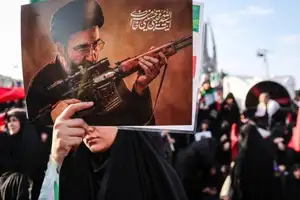
A large portrait of Mojtaba Khamenei is displayed alongside Iranian flags at a public venue.
Khamenei moves his larger assertion outside such measurable criteria by invoking “divine calculations” to describe Iran as the world’s top power.
Military expenditure, economic output, trade, industrial capacity and the outcome of military operations can be measured. “Divine calculations” provide no equivalent benchmark for determining what outcome would confirm or contradict the assertion.
‘Progress’ meets inflation and contraction
Khamenei portrays pre-revolutionary Iran as an era of “backwardness, humiliation and disgrace,” contrasting it with a present filled with “progress, dignity and independence.”
Measured through economic conditions and everyday living standards, however, progress presents a more complicated picture.
The IMF projects average inflation of 68.9% in Iran in 2026 and a 5.4% contraction in the economy.
The World Bank has also pointed to pressure from war and sanctions, water and energy shortages, weak investment and rising poverty.
Those indicators raise a basic question about Khamenei’s broad description of progress: what is being measured, and for which part of Iranian society?
The enemy that supposedly stops at the Arabian Sea
One of the most readily testable parts of Khamenei’s message concerns foreign military activity in waters around Iran.
Waters south of the country were once a domain for enemy forces, Khamenei wrote, but “painful blows” by Iranian forces and the “defenders of the Strait of Hormuz” mean those adversaries now advance no further than the Arabian Sea.
Military activity in recent months presents a more complicated geographical picture.
US officials told Axios in August that the American military had established a shipping route through the Strait of Hormuz, with around 15 to 20 tankers entering or leaving each night. The operation allowed roughly 10 million barrels of oil to move through the waterway each day, according to the officials.
The US military presence in waters around Iran continued in September.
The Revolutionary Guards fired ballistic missiles toward a US aircraft carrier and destroyer in early September, according to US military accounts. American forces also struck Iranian oil tankers near Kharg Island and in the Gulf of Oman.
US Central Command said on September 8 that an American warship continued patrolling regional waters after being targeted twice by Iranian missiles over two days. US forces struck five Iranian tankers during the same operation in the Gulf of Oman and near Kharg Island.
The maritime pressure has also become part of negotiations between the two countries. Iran would be prepared to reopen the Strait of Hormuz if Washington reduced military pressure and lifted its blockade of Iranian ports, a senior Iranian official told Reuters on September 22.
A woman holds a portrait of Mojtaba Khamenei, with his father Ali Khamenei pictured in the background.
US operations in the Strait of Hormuz, Gulf of Oman and waters close to Iran therefore do not fit an absolute geographical reading of Khamenei’s assertion that adversaries no longer advance beyond the Arabian Sea.
‘Millions of supporters’ and the Iranians left out
Khamenei also presents pro-establishment mobilization over the past seven months as evidence of domestic strength and cohesion.
“More than 30 million Iranians have declared themselves ready for self-sacrifice,” he wrote, adding that more than 500,000 people filled the available capacity of one registration drive in just 100 minutes.
Even if those figures are accepted, mobilizing millions of people does not by itself measure support across Iranian society.
Iran during the same period witnessed nationwide protests that began over economic grievances in late December 2025, spread rapidly across the country and developed into direct protests against the political establishment. The demonstrations subsided after a sweeping crackdown.
The government put the death toll at 3,117. Iran International’s Editorial Board estimated that more than 36,500 people were killed, based on classified security documents, field reports and information from medical workers, with most deaths occurring on January 8 and 9.
In Khamenei’s account, government supporters filling streets provide evidence of national unity and strength. Opponents occupying those same public spaces are not given comparable weight in assessing the state of Iranian society.
Khamenei’s own absence again becomes relevant. He invokes millions of Iranians gathering in streets and squares, but more than six months after becoming supreme leader has yet to appear among them or release a public video or audio message.
‘Victory’ and Hezbollah’s losses
Khamenei applies a similar conception of power to Iran’s regional allies.
He describes “victory and triumph” as the constant companions of late Hezbollah leader Hassan Nasrallah and presents his successor, Naim Qassem, as continuing the same path.
Hezbollah’s present position complicates a narrative of uninterrupted victory.
Nasrallah was killed and Hezbollah lost a significant number of senior commanders. Israel’s operation against the group’s communications network also exposed the extent of Israeli intelligence penetration into its structures.
Inside Lebanon, Hezbollah’s weapons have become central to one of the country’s major political disputes. The Lebanese government has pursued a process aimed at bringing the group’s weapons under state control, which Hezbollah opposes.
The death of a leader and senior commanders, combined with political pressure to transfer control of a group’s weapons to the state, sits uneasily alongside a historical description centered on permanent “victory and triumph.”
A definition of power with little room for defeat
The central issue in Khamenei’s message may be less any single assertion than the way power itself is defined.
In his account, the Islamic Republic emerged stronger from the eight-year Iran-Iraq War. Subsequent pressure, he said, made it stronger. More recent wars have made the Islamic Republic’s “phoenix” larger, while its future will be “far more glorious.”
Such a framework can absorb sharply different outcomes without altering its conclusion.
If an adversary retreats, that demonstrates strength. If fighting continues, that demonstrates resistance. Economic pressure becomes the cost of independence. If a regional ally loses leaders and commanders, the continuation of its cause takes precedence. Government supporters in the streets demonstrate popular backing, while opponents filling those streets are given no equivalent role in measuring political strength.
Within such a definition, defeat becomes increasingly difficult to identify.
National power can also be examined through observable outcomes: a country’s capacity to protect its territory and infrastructure, influence an adversary’s behavior, maintain economic stability, achieve foreign policy objectives, preserve regional influence and retain domestic support.
Measured against such indicators, Iran’s ability to impose costs on its adversaries does not by itself establish the status invoked by Khamenei when he describes the country as the “fourth superpower” or, according to “divine calculations,” the world’s top power.
That leaves the central question running through his message: if decades of war, pressure and confrontation have elevated Iran to such a position, which military, economic, social or regional measures demonstrate it?
The question takes on additional weight when this portrait of national power comes not from a leader addressing the public, but through a written message from a supreme leader who, more than six months after taking Iran’s highest office, has yet to be seen or heard by Iranians in a public appearance.
Illustration: US and Iranian flags amid renewed diplomatic contacts
The United States and Iran remained in contact through mediators Monday as efforts continued toward a possible agreement, but conflicting accounts left the terms of any deal unclear.
Iranian Foreign Minister Abbas Araghchi said a Qatari mediator held another meeting with Iran’s delegation to discuss ideas on how Tehran’s conditions could be met. He said those ideas would be raised with the US side before Qatar conveyed Washington’s response to Iran, which he hoped would happen by Tuesday.
President Donald Trump also confirmed Monday that US officials had spoken with mediators, without giving details of the discussions. Reuters reported that the separate contacts centered on an amended version of a seven-day proposal Iran presented last week.
The proposal seeks an end to hostilities, the release of frozen Iranian assets, sanctions relief and an end to the US blockade of Iranian ports. Iran would reopen the Strait of Hormuz and the two sides would resume negotiations over Tehran’s nuclear program and highly enriched uranium, according to Reuters.
But accounts of how much progress had been made diverged during the day. CNN cited an unnamed US official as describing the discussions as “positive and constructive” and saying Iran had shown flexibility on nuclear issues. An Iranian official later told state-run Press TV that Tehran’s nuclear position had not changed.
The uncertainty also extended to what Washington might offer. Axios reported, citing a US official, that Trump was willing to provide sanctions relief and release frozen Iranian funds in return for concrete nuclear concessions.
Trump later denied the report.
“Axios just released a story that ‘Trump’ offered Sanctions Relief and Frozen Funds to Iran. This is untrue. I offered them NOTHING!” he wrote on Truth Social.
Despite the dispute over the terms of a possible agreement, contacts continued through mediators.
Araghchi said exchanges of messages through Qatari and Pakistani mediators had continued throughout the process but had become more serious following Iran’s latest proposal. He said he hoped Washington’s final response would be conveyed by Tuesday.
Araghchi said he would return to Tehran rather than remain in New York awaiting the response.
“The Qataris know how to reach us whenever they have the response,” he said.
A man displays US dollar banknotes on a street in Tehran, Iran.
Iran’s rial fell to another record low on Monday, with the dollar reaching 2.45 million rials as economic and military pressures persisted and efforts took shape for possible new indirect talks with the United States.
Mediators are expected to hold separate talks with the United States and Iran on Monday or Tuesday over an amended version of a seven-day proposal Tehran presented on the sidelines of the UN General Assembly, sources briefed on the negotiations told Reuters.
Iranian Foreign Minister Abbas Araghchi and Qatari mediators remained in the United States for the discussions, an official briefed on the negotiations said.
The diplomatic effort comes with divisions visible inside Iran over negotiations and the country’s nuclear policy, while military officials continue to warn about another confrontation with Washington.
Diplomacy meets resistance at home
A group of serving and former Iranian officials called Monday for an immediate halt to cooperation under the Nuclear Non-Proliferation Treaty and withdrawal from the pact “as soon as possible.”
“Continued membership in this treaty is not in the country’s interest, and we call for withdrawal from it as a strategic necessity,” the signatories said.
Former intelligence minister Heydar Moslehi and other former officials from the administrations of Ebrahim Raisi and Mahmoud Ahmadinejad signed the statement alongside serving lawmakers.
Hardline newspaper Kayhan also criticized Iran’s diplomatic approach, saying officials had shown excessive enthusiasm for negotiations during President Masoud Pezeshkian’s visit to New York and sent Washington “a signal of weakness.”
Supreme Leader Mojtaba Khamenei, meanwhile, emphasized Iran’s military position, describing the country as the “world’s top power” according to what he called “divine calculations” and saying enemy forces had been pushed back from waters near Iran.
Military pressure centers on Hormuz
Iranian officials continued to point to the Strait of Hormuz in their warnings to Washington.
“We are acting with authority in the northern Arabian Sea and east of the Strait of Hormuz, and we will not let anyone pass. On the other side, our IRGC brothers are also standing firm,” army deputy coordinator Habibollah Sayyari said.
Lawmaker Salar Velayatmadar said Iran could close the Strait of Hormuz and Bab al-Mandab if the United States launched another attack.
Rial falls under trade and oil pressure
The economic backdrop to the negotiations has also deteriorated, with the US dollar listed at 2.45 million rials on Iran’s open market Monday.
Iranian businesses are facing higher costs in trade with neighboring Iraq as banks tighten checks and anti-money-laundering requirements, head of the Iran-Iraq Joint Chamber of Commerce, said.
The main danger was not a complete halt in trade but a gradual loss of Iran’s share of the Iraqi market, Jahangbakhsh Sanjabi Shirazi, said.
Washington is also seeking to restrict Iran’s oil income more. Iran could have “nothing left to trade for anything” within two weeks after completing its remaining oil deliveries to China, US Treasury Secretary Scott Bessent said Sunday.
About 15 million barrels remained out for delivery, Bessent estimated.
Pressure on Iranian financial operations extends into Europe. Italy’s central bank told Iran International on Monday that the Rome branch of Iran’s Bank Sepah has remained under special administration since October 2025 following the European Union’s adoption of restrictive measures against Iran.
The weakening rial and growing obstacles to trade are adding to Iran’s economic pressure, while warnings over Hormuz and recent military exchanges keep the risk of renewed conflict hanging over the country and the region.
Drone view of oil tanker HELGA berthed at one of Iraq's southern offshore oil terminals near Basra as it prepares to load crude oil, becoming the second vessel to arrive since the closure of the Strait of Hormuz, April 24, 2026.
The UAE has found ways to blunt Iran’s ability to disrupt oil traffic through the Strait of Hormuz by exploiting its maritime tactics, Iranian state television commentators said in a recent broadcast.
Four people appeared on IRIB’s Be Vaght-e-Iran (Iran Time) program, with three speaking during an exchange on how Abu Dhabi has adapted its oil shipments to Iran’s approach to the strategic waterway.
One participant suggested Iran could target the smaller shuttle vessels moving through the strait or strike their point of origin. Another rejected that approach as insufficient.
“It makes no sense to just hit these vessels. That is not an adequate response to this change in logic,” he said.
A third participant laid out the central argument: Abu Dhabi has sought to change the economics behind Iran’s maritime leverage rather than directly challenge its military capabilities.
“The UAE has attacked the logic of closing the Strait of Hormuz,” he said.
Cheap ships change the calculation
Iran’s strategy, according to the panel, had relied partly on the vulnerability of very large crude carriers, or VLCCs, whose high value meant the prospect of an Iranian strike could make voyages commercially prohibitive as insurers withdrew coverage.
The UAE has sought to remove that pressure by creating a state-backed logistics chain and using smaller, cheaper vessels that can be readily replaced.
“It is defining a battlefield that has been designed to its advantage,” the commentator said. “It says: fight me here. You hit these small ones, and I keep replacing them.”
Abu Dhabi is also using ageing VLCCs that would otherwise be destined for scrapping because they no longer meet environmental or safety standards required at many ports, according to the discussion.
The ships can be worth considerably less than the oil they carry, reducing the economic loss if Iran damages them.
The broadcast also described a pattern in Iranian operations that the UAE could anticipate. Iranian forces radio vessels, fire warning shots if they continue and then target the bridge rather than immediately sinking the ship, giving crews around 30 to 40 minutes to evacuate.
Abu Dhabi has responded by positioning tugboats to recover damaged vessels and tow them to Sohar in Oman, where their cargo can still be unloaded, the main contributor said.
“The tugboat comes and attaches itself right there to the ship that has been hit,” he said. “They tow it to Sohar and unload it there on the Omani coast.”
The result, he argued, is that Iran can damage a vessel without preventing its oil from reaching port.
Iran’s military logic questioned
Simply striking greater numbers of replaceable vessels would not restore Iran’s leverage, the discussion suggested.
“They have attacked our military logic,” the main contributor said. “You have to hit this logic.”
The participant who opened the exchange said Iran’s problem was not a lack of political will, but its continued reliance on an approach that was no longer producing the intended outcome.
“There really is the political will to confront them. But because we are confronting them within the previous framework, we are not getting the result we want,” he said.
The main contributor described the problem as a “cognitive error.”
Another researcher and Middle East commentator Mustafa Najafi separately accused the UAE on X of spending weeks trying to reduce Iran’s leverage over the Strait of Hormuz and seeking to move oil belonging to other countries through the waterway.
Najafi also accused Abu Dhabi of obstructing an Iran-Oman agreement on managing the strait and lobbying in the United States and Israel for attacks on Iran.
“After Israel, no actor dreams of weakening and disintegrating Iran as much as the UAE does,” Najafi wrote, arguing that Tehran should move beyond a solely political and diplomatic response.
The remarks reflect concern among Iranian pro-system experts that the UAE is seeking not to overcome Iran’s military power in the Strait of Hormuz, but to diminish the strategic leverage that power is intended to provide.