UK PM says ‘strong indications’ Iran tied to airbase 'bomb plot'


There are “strong indications” Iran played a role in a suspected plot near RAF Fairford, a British airbase used by US bombers in operations against Iran, Prime Minister Andy Burnham said on Wednesday.
“But of course, it remains an ongoing, complex and serious police investigation, and of course we are working closely with our colleagues in the United States of America,” Burnham told the BBC.
Iran has denied involvement. RAF Fairford has been used for US operations against Iran, and the IRGC said in July that bases used for attacks on Iranian territory could be considered legitimate targets.
Five UK nationals in their 20s were arrested near the base Sunday on suspicion of preparing a terrorist attack and explosives offenses after three suspicious vans were reported in the area. Police later said no explosive devices were found, though petrol was recovered from the vehicles. The suspects have been released on bail and remain under investigation.



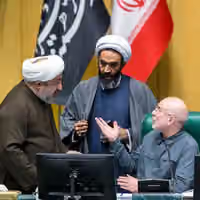

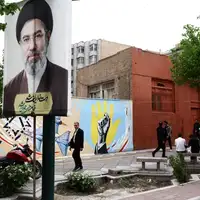
Iran’s receipt of Washington’s response to its seven-point proposal for ending the Strait of Hormuz crisis has sharpened divisions in Tehran over whether to pursue further compromise or intensify pressure on the United States.
The response was reportedly delivered through Qatar and has been described as US “feedback” rather than acceptance or rejection of the Iranian plan.
Hardline voices have portrayed Washington’s position as evidence that further diplomacy is futile, while more pragmatic commentators argue that the fact the US responded at all shows negotiations remain alive.
President Donald Trump had publicly dismissed Iran’s proposal as insufficient. Iranian diplomats said reopening the Strait and lifting the naval blockade were discussed in indirect talks mediated by Qatar.
The dispute in Tehran is increasingly about what it should do next.
Jame Jam, affiliated with state television, published an op-ed Wednesday by hardliner Abbas Salimi-Namin titled “America’s Fear of Admitting Defeat Against Iran.”
Salimi-Namin argued that Washington’s resistance to the seven-point plan, rooted in the earlier Islamabad talks, reflected the White House’s unwillingness to acknowledge that framework as a strategic setback.
US policymakers, he wrote, still cling to the prospect of delivering a “crippling blow” to Iran and fear the domestic political cost of acknowledging failure more than continued escalation.
Kayhan went considerably further.
Editor-in-chief Hossein Shariatmadari portrayed US demands for verifiable nuclear concessions as evidence that Washington never intended to negotiate in good faith.
He argued that linking freer navigation through the Strait to nuclear concessions was an attempt to strip Iran of its principal leverage while maintaining US economic and military pressure.
Kayhan criticized what it described as the Foreign Ministry’s excessive “patience” and called for non-attributable maritime interdictions, deployment of coastal anti-ship batteries and expanded targeting of Western-escorted vessels.
Global energy markets, it argued, must face an “unbearable cost” before Washington lifts its blockade.
The moderate daily Sharq offered an almost opposite prescription.
In a commentary, Ahmad Zeidabadi argued that despite the rigidity of the US response, Washington’s decision to send detailed feedback through Qatar showed that a diplomatic off-ramp remained open.
He urged the government to preserve the Qatari channel and proposed a two-stage approach under which Iran could offer targeted technical assurances, including temporary IAEA monitoring protocols, in return for an immediate, phased easing of restrictions on commercial transit under the Islamabad memorandum.
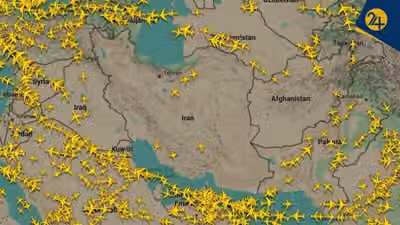
Zeidabadi rejected calls for military escalation, warning that abandoning shuttle diplomacy as restrictions on Iranian aviation and banking intensify would push the country towards deeper economic and civilian isolation.
The contrasting reactions show how Washington’s response has shifted the argument in Tehran from whether diplomacy should continue to what price Iran should be prepared to pay for it.
Jame Jam occupies a space somewhere between the positions represented by Kayhan and Sharq: deeply skeptical of Washington’s intentions, but portraying the impasse as a product of US reluctance to acknowledge Iran’s leverage rather than as grounds for immediately abandoning negotiations.
With an actual US response now before Tehran, those competing interpretations are no longer arguments about a hypothetical deal. They are becoming arguments over how Iran should answer.
An Iranian-American student who pressed Michigan Democratic US Senate nominee Abdul El-Sayed to state his position on Iran’s Revolutionary Guards says he and his family have faced threats and harassment after a video of the exchange went viral.
At a University of Michigan town hall, Iman Dashti said his cousin had been pursued through the streets over her hijab and his uncle sentenced to death and given 50 lashes under the Islamic Republic, before asking whether El-Sayed stood “unequivocally against the IRGC.”
El-Sayed responded that he would “always stand with movements for freedom and democracy” and later told Dashti, “I want freedom and democracy for the people of Iran, no question,” while stressing that political change should come from Iranians themselves rather than through US-led regime change.
He did not directly answer Dashti’s question about whether he stood unequivocally against the IRGC.
Dashti told Iran International he shares El-Sayed’s opposition to US-imposed regime change, but said that was never the question he was asking.
“I never asked about regime change. I never asked about his stance on the war,” Dashti said. “I asked him about the people.”
“I wanted to hear from him. I wanted to hear that he stood with us, I really did want to,” he said. “If Abdul were to win, at least we’d have an advocate for the Persian people, for the American people in the US Senate.”
El-Sayed’s campaign has defended his response.
“As he noted in his response, Abdul will always stand with movements for freedom and democracy and he condemns government anti-free speech violence,” campaign spokesperson Roxie Richner told Fox News.
The campaign also reiterated El-Sayed’s opposition to US-funded regime-change wars.
Iran International separately contacted El-Sayed’s campaign seeking an interview or written response about the exchange and his position on the IRGC but did not receive a response before publication.
Threats after the exchange
Dashti said the atmosphere inside the town hall became tense, with audience members applauding when El-Sayed rejected US-led regime change, a position Dashti said he agreed with.
“The tension was very high in that room,” he said. “You could cut it with a knife.”
Since the exchange spread online, Dashti says he has received threats and that his friends and family have been targeted.
“Since that day, people have threatened me, doxxed my friends, even harassed my family,” he said in a video posted after the town hall.
Dashti told Iran International the past several days had been anxious but said the hostile reaction had also been accompanied by considerable support.
“For every negative comment I’ve gotten, for every negative sort of threat, I’ve gotten a lot of beautiful positive messages,” he said.
Scrutiny of Dashti’s politics
The attention has also brought scrutiny of Dashti’s own politics. He describes himself as a “proud Christian conservative,” belongs to the College Republicans and has previously met Mike Rogers, the Republican nominee running against El-Sayed in November.
Dashti said he does not work for Rogers and was not sent to the town hall on behalf of his campaign.
“Am I a Zionist plant? Do I work for the Rogers campaign?” he said in his follow-up video, recounting accusations circulating online. “I don’t work for anyone. I’m just a Persian student and my family was hunted in the streets of Iran.”
The son of Iranian immigrants, Dashti said he sees speaking about repression in Iran as a way of advocating for people who cannot freely do so themselves.
“The least I can do is give a voice to the people who literally don’t have a voice,” he said. “I love my people, my heritage. It’s a beautiful, beautiful culture.”
Washington designated the IRGC a Foreign Terrorist Organization in 2019. The force is a central part of the Islamic Republic’s security apparatus and has been involved in suppressing anti-government protests.
Dashti said the criticism has not deterred him from continuing to raise the issue during the remaining weeks of the Senate campaign.
“I’m going to keep going, whether that means showing up at future events, mobilizing friends,” he said. “This is just the beginning.”
Iran took a US response to its latest diplomatic proposal to cabinet, a tanker was struck in the Strait of Hormuz and two January protesters were executed among the key developments on Wednesday.
Foreign Minister Abbas Araghchi received US feedback on Iran’s seven-day proposal during talks with Qatari mediators in Doha on Tuesday night, Reuters reported, citing an official briefed on the talks.
The main disagreement concerns the sequencing of the plan rather than its elements, the official said. The proposal outlines a seven-day process to build trust and return to an enhanced version of a memorandum of understanding reached by Iran and the United States in June.
Araghchi presented the US proposal at Wednesday’s cabinet meeting and briefed ministers on his trip to New York, including Iran’s conditions for reopening the Strait of Hormuz, government spokesperson said.
US President Donald Trump, meanwhile, said Iran would eventually “give up,” but suggested that point had not yet been reached.
Tanker struck in Strait of Hormuz
The diplomatic exchanges came with shipping risks persisting in the waterway at the center of the negotiations.
A tanker heading into the Strait of Hormuz was struck by an unknown projectile, the United Kingdom Maritime Trade Operations said, citing a verified source. Authorities were investigating the strike.
Separately, the Revolutionary Guards described near-daily confrontations with vessels in the strait. Guards spokesman Hossein Mohebi said Iranian forces were targeting ships every 24 hours but had received no US response for some time.
The disruption has also affected neighboring Iraq. Parliament speaker Haibat al-Halbousi said Iran had given Iraqi tankers no exemption from restrictions on navigation through Hormuz.
Iran expands military and civilian preparations
Beyond the strait, Iranian officials described efforts to strengthen the country’s military capabilities and prepare civilian infrastructure for further conflict.
Iran is rapidly expanding its missile, drone and air defense capabilities, deputy Revolutionary Guards commander Mostafa Izadi said.
“We are present in the Strait of Hormuz with strength. We are rapidly expanding our missile, drone and air defense capabilities,” Izadi said.
Iran will also hold drills covering schools, hospitals, banks, mobile phone operators, airports, ports, bridges, roads and aviation networks to prepare civilian infrastructure for wartime threats, Passive Defense Organization chief Gholamreza Jalali said.
Jalali said Iran had prepared for possible attacks on the Fordow, Natanz and Isfahan nuclear facilities before the war and conducted drills for such scenarios.
Two January protesters executed
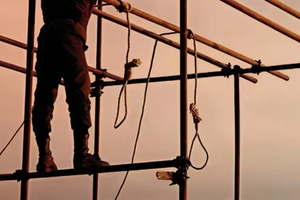
Away from the military confrontation and negotiations, Iran carried out two more executions stemming from the January protests.
Ali Hemmati and Majid Nikandish were executed over demonstrations in Mashhad, with the judiciary accusing them of involvement in the deaths of four security personnel.
The judiciary said the two participated in protests in the city’s Tabarsi district on January 8 and accused them of attacking security personnel, setting buildings on fire and damaging public property.
Sources previously told Iran International that Nikandish was tortured and forced to confess after his arrest and transfer to Vakilabad Prison.
Wednesday thus brought movement in indirect diplomacy with Washington without an end to confrontations in Hormuz, while Iranian authorities prepared for further conflict and continued executions stemming from January’s protests.
Iranian security forces shot death-row protester Alireza Sepahi four times during his arrest at home before subjecting him to weeks of torture in custody, according to a former cellmate who described his treatment.
Sepahi, detained over protests in January and sentenced to death in Isfahan, now has his case before the sentence enforcement office, raising concerns over his execution.
“I personally saw the four places where the pellets had hit his legs,” the former prisoner told Iran International, adding that Sepahi told him his initial recovery took about two months.
Held in a security ward at Dastgerd Prison in Isfahan, Sepahi suffered a stroke on July 28, when two other prisoners were executed, including his cousin Abolfazl Sepahi. He was hospitalized before being returned to prison.
He was sentenced to death in the Alikhani Square case, a mass prosecution of protesters accused of involvement in unrest in Isfahan in which the Islamic Republic says four security personnel were killed.
Shot during arrest
Security forces arrested Sepahi at home following the January protests, ordering his family onto the floor before going upstairs to his room.
One officer restrained him before another said, “Hold him. I want to shoot him.”
The officers shot him in both lower legs, with two more pellets striking his thighs as he was taken away. One remained lodged in his thigh bone and required surgery.
After two days in hospital, he was transferred to another detention facility. His mother, brother and teenage sister were also detained.
Torture during interrogation
Sepahi spent about 26 days undergoing interrogation and torture at the facility, according to the former prisoner.
His mother was at times brought into an adjoining room so she could hear or witness the torture. Interrogators struck him in the face and hit the wounds on his legs with a hose until they began bleeding again.
“I will sign whatever you tell me to,” Sepahi shouted during the torture, based on the account.
Civil rights activist Mehdi Mahmoudian said on September 12 that Sepahi and several other defendants in the case were tortured in detention.
Several defendants told the court they had faced torture, sexual assault and threats of rape to extract statements against one another, Mahmoudian said, adding that a significant part of the case and resulting sentences rested on those statements.
Statements challenged in court
Sepahi told the judge during his trial that security forces had shot him during his arrest, his former cellmate said.
When the judge suggested the shots might have been fired as he tried to escape, Sepahi responded: “What escape? They shot me inside my own room.”
Other defendants who had previously made statements against him also told the court that their accounts had been extracted under torture.
Some were beaten and subjected to mock executions after returning from court and forced to write new statements against Sepahi and other defendants.
Sepahi’s mother, Somayeh, is serving a five-year sentence at Dowlatabad Prison on charges including “assembly and collusion,” “acting against national security” and “rebellion.”
Both pilots of a flydubai flight from Dubai to Tel Aviv were injured after what Israeli officials said may have been an attempted terror attack in the cockpit, forcing the aircraft to make an emergency landing in Saudi Arabia on Wednesday.
Prince Sultan bin Abdulaziz International Airport in Tabuk said it was alerted at 8:44 a.m. local time after air traffic control received a distress call from flydubai flight FZ1073 requesting an emergency landing.
The Boeing 737 landed safely at 9:45 a.m., the airport said. The captain and first officer were taken to hospital, while passengers were assisted at the terminal.
Flydubai was working to arrange a replacement aircraft, the airport said, adding that the relevant authorities were investigating the incident.
What happened in the cockpit?
Three Israeli officials said the co-pilot was believed to have stabbed the captain in what was being investigated as a possible attempted terror attack.
The officials said cabin crew entered the cockpit and took control of flydubai flight FZ1073 before it diverted to Saudi Arabia while flying over Jordanian airspace. One of the officials identified the co-pilot as an Omani national.
Israeli authorities were still investigating the circumstances and had not reached a final conclusion about the motive.
Flydubai said the aircraft had experienced an "incident" while flying to Tel Aviv and diverted to Tabuk. The airline said all passengers were safe and accounted for but gave no details about what had happened.
Neither Saudi authorities nor flydubai had publicly explained the cause of the incident.
Passenger reports screaming and knife
Yasmin Abu Kasis, whose daughter Miriam was among the passengers, told Reuters that her daughter had heard screaming and said a man holding a knife forced one of the pilots to the floor.
She also said there was blood inside the aircraft.
Israeli media published a photograph said to have been taken aboard the plane showing what appeared to be a passenger with blood on his shirt. Reuters could not independently verify the image or the passenger's account.
The airport statement confirmed that both pilots had been injured but did not say how they were hurt.
Emergency signals and sudden descent
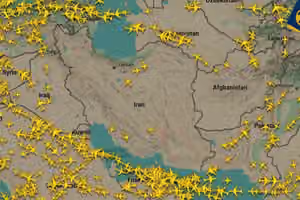
The flight had been traveling from Dubai to Tel Aviv when it diverted from Jordanian airspace toward Saudi Arabia, according to flight-tracking website Flightradar24.
The aircraft first transmitted a general emergency signal and several minutes later sent another signal indicating possible unlawful interference, Flightradar24 said. It later transmitted the general emergency signal again.
Flight data also appeared to show the plane dropping nearly 14,000 feet in less than 30 seconds before the first emergency alert, according to Flightradar24.
The signals prompted a major security response in Israel.
Israeli media said about 150 Israeli passengers were aboard the flight. The Israeli prime minister's office said the situation was "under control" and that authorities were taking steps to bring the passengers back to Israel.