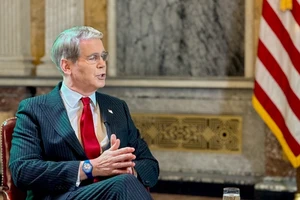
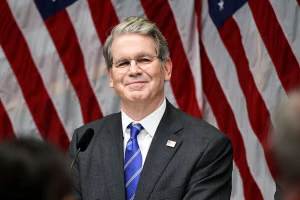
“Most importantly, Qatar, Saudi Arabia, UAE, Bahrain, Kuwait and others would prefer the status quo, that we remain as is,” Trump told reporters at the White House on Monday after meeting Qatar’s prime minister.
He described that approach as continuing the US naval blockade, while keeping American forces ready for renewed military action.
Speaking to reporters in Paris after meetings with G7 counterparts on Tuesday, Secretary of State Marco Rubio said US sanctions and the naval blockade were inflicting growing economic damage on Iran, reducing the need for further major combat operations.
Regional analysts disagree over whether that policy offers Arab states across the Persian Gulf their safest option or prolongs a confrontation that threatens their security and economies.
Pressure without stability
Ghaith al-Omari, a senior fellow at the Washington Institute and former executive director of the American Task Force on Palestine, offered the opposite assessment to Trump’s. Regional governments want a weaker Islamic Republic, he said, but that does not mean they favor an indefinite blockade.
“They would like to see the regime weakened, but they don't believe that the blockade serves their interests,” he told Iran International.
Even where oil continues to flow, insurance costs and the risk of further attacks weigh on regional economies. Prolonged uncertainty also threatens the stability underpinning investment, tourism, finance and logistics, he said.
“No war, no peace equals uncertainty, equals instability,” al-Omari said.
He argued that Arab governments across the Persian Gulf doubt Washington’s willingness to sustain the policy.Trump’s midterm setback has intensified concerns that domestic pressure could prompt an abrupt change, leaving neighboring countries to manage the consequences.
Without an agreement reopening the Strait of Hormuz and ending the conflict, some governments could seek separate arrangements with Tehran to reduce their exposure, he said.
Between a rock and a hard place
Dalia Ziada of the Institute for the Study of Global Antisemitism and Policy (ISGAP) described the Arab states of the Persian Gulf as caught “between a rock and a hard place”: fearful of a resurgent Islamic Republic, yet harmed by the instability of a prolonged standoff.
“They don't want the Iranian regime to get strong again,” she told Iran International.
But continued insecurity carries its own economic consequences, threatening the region’s appeal to investors and confidence in its future.
“The biggest loss for the wealthy Gulf states is the lack of stability,” Ziada said.
She argued that differences among regional governments, combined with doubts about the reliability of American protection, complicate their choices. Their concerns cannot be reduced to a simple preference for war or continued restraint, she said.
One incident could break the standoff
Mohamed Fahmy, a journalist and Middle East political analyst, also sees significant differences among Iran’s Arab neighbors.
“There is no unified Gulf position on how long the blockade should continue,” he told Iran International.
Saudi Arabia and the UAE see value in maintaining American pressure until Tehran makes meaningful concessions, Fahmy said, while Qatar and Oman place greater emphasis on mediation.
Their shared interest in reducing the Iranian military threat does not eliminate the costs of prolonged confrontation.
“The UAE, Saudi Arabia and Qatar have invested heavily in presenting themselves as stable international hubs for business, tourism, finance and logistics. Prolonged confrontation threatens those ambitions,” he said.
Those concerns reflect damage already sustained. An October 15 Reuters investigation documented at least 135 missile and drone attacks by Iran and allied groups against at least 84 infrastructure sites across seven Arab countries since US-Israeli attacks on Iran began on February 28. The tally covered infrastructure attacks, rather than every launch or attempted strike.
Fahmy said the standoff could continue for some time because Washington and Tehran both appear to believe waiting will improve their negotiating positions. But an attack killing American personnel or seriously damaging Persian Gulf energy infrastructure could trigger renewed military action.
“It takes only one serious incident involving American forces, a commercial tanker or a Gulf energy installation to undermine the current restraint,” he said.
Growing pressure in Washington over financial costs, military commitments and the absence of a clear exit strategy could instead encourage a negotiated settlement, he argued.
The case for staying the course
Saad bin Tefla Al-Ajmi, Kuwait’s former information minister, argues that maintaining the status quo remains the least harmful choice.
“The solution is to keep the status quo as is. That’s the best solution,” he told Iran International, referring to an article he supplied outlining his position.
Renewed war could bring further Iranian attacks on neighboring countries, he argues, while American withdrawal could leave them exposed.
“The third option is the safest and best for us, for the region and for the beleaguered peoples of Iran,” he wrote in the article.
Al-Ajmi advocates sustained naval and economic pressure alongside efforts to constrain Tehran’s regional armed allies. He predicts that pressure could eventually bring down the regime, although that outcome remains uncertain.
He acknowledges the costs to neighboring states.
“The Gulf states are indeed paying a price under this scenario. Their trade is disrupted, tensions persist in their airspace and their projects are delayed,” he wrote.
His support for maintaining that pressure rests on the judgment that the alternatives would be worse. The question is whether Washington and its regional partners can sustain it without an escalation that forces them back into war.