• العربية
  • فارسی
Brand
  • Iran Insight
  • Politics
  • Economy
  • Analysis
  • Special Report
  • Opinion
  • Podcast
  • Live TV
  • Iran Insight
  • Politics
  • Economy
  • Analysis
  • Special Report
  • Opinion
  • Podcast
  • Live TV
  • Theme
  • Language
    • العربية
    • فارسی
  • Iran Insight
  • Politics
  • Economy
  • Analysis
  • Special Report
  • Opinion
  • Podcast
  • Live TV
All rights reserved for Volant Media UK Limited
volant media logo

UAE says it suspended Iranian airline flights over US sanctions

Sep 24, 2026, 16:22 GMT+1
An Emirati stands in front of a FlyDubai aircraft at the Dubai Airshow, in Dubai, United Arab Emirates, November 15, 2021.

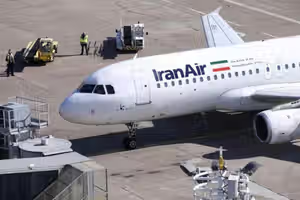
The United Arab Emirates said on Thursday it had suspended all flights operated by Iranian airlines to and from the country from Thursday until further notice, citing US sanctions targeting Iran’s aviation sector.

The UAE General Civil Aviation Authority said the measure was based on US sanctions affecting Iranian airlines using airports in the country, marking the latest restriction on Iran’s shrinking international air links.

The decision comes a day after a US deadline aimed at cutting Iranian carriers off from foreign airport services took effect.

The US Treasury sanctioned 27 Iranian airlines on September 8, bringing what it described as all remaining Iranian carriers under sanctions and warning foreign companies against providing them with aviation services.

Iraq this week ordered the suspension of Iranian airline flights to Baghdad after Washington warned that airports continuing to service sanctioned Iranian carriers could themselves face penalties.

Oman has also stopped accepting flights operated by Iranian airlines, while Mahan Air suspended services to Turkey and Oman amid the growing restrictions.

A Tehran-Dushanbe flight was also forced to return to Imam Khomeini International Airport after Turkmenistan did not grant Iranian airlines permission to cross its airspace, Iran's Civil Aviation Organization said on Thursday.

Turkish Airlines, meanwhile, told Iran International that it has no flights to Iran scheduled until at least March 2027, further narrowing one of the most heavily used international routes for Iranian travelers.

The UAE had already tightened economic restrictions on Tehran. On Wednesday, its central bank barred branches of Iran’s Bank Melli from conducting transactions to and from Iran, including trade finance and money transfers.

Most Viewed

Tehran sets out terms as US-Iran talks intensify in New York
1

Tehran sets out terms as US-Iran talks intensify in New York

2

Trump sees ‘momentum’ for Iran deal after New York meetings

3

Iranian airlines continue foreign flights after US sanctions deadline - Bloomberg

4
ANALYSIS

Freeway sign hack aims to frighten Iranians in Los Angeles, experts say

5

Khamenei adviser says Tehran can negotiate, hardliners say it must not

Banner
Banner

Spotlight

  • 'Bully at home, victim abroad': Iranians on Pezeshkian's UN speech
    VOICES FROM IRAN

    'Bully at home, victim abroad': Iranians on Pezeshkian's UN speech

  • Pezeshkian gets the generals' applause, and no word from the man above them

    Pezeshkian gets the generals' applause, and no word from the man above them

  • War deepens Iran’s energy crunch ahead of winter
    ANALYSIS

    War deepens Iran’s energy crunch ahead of winter

  • Threats and counter-threats complicate new US-Iran diplomacy
    INSIGHT

    Threats and counter-threats complicate new US-Iran diplomacy

  • New US-Iran talks run into old question of who speaks for Tehran
    ANALYSIS

    New US-Iran talks run into old question of who speaks for Tehran

  • They can erase you without arresting you
    TEHRAN INSIDER

    They can erase you without arresting you

  • Iran executed IT expert after months in isolation and forced confession
    EXCLUSIVE

    Iran executed IT expert after months in isolation and forced confession

  • Freeway sign hack aims to frighten Iranians in Los Angeles, experts say
    ANALYSIS

    Freeway sign hack aims to frighten Iranians in Los Angeles, experts say

Banner
Banner
•
•
•

More Stories

China shipments help sustain Iran’s weapons programs despite US pressure - WSJ

Sep 24, 2026, 06:41 GMT+1
100%
US President Donald Trump and Chinese President Xi Jinping react as Xi arrives ahead of a state visit at Joint Base Andrews, Maryland, US, September 23, 2026.

Chinese suppliers sent around 1,300 shipments of dual-use components to Iran’s defense ministry in the first half of 2026, helping sustain its weapons programs, The Wall Street Journal reported.

Iranian customs records showed one delivery arriving on June 17, when Washington and Tehran signed a 60-day truce and China promoted its peacemaking role. More than a dozen shipments followed two days later, carrying over $6 million in parts usable in drones.

The findings put Chinese support for Tehran at the center of Xi Jinping’s Washington visit this week, alongside trade, artificial-intelligence safety and Taiwan. Trump told aides that preserving relations with Xi was a priority, the Journal reported.

  • Iranian airlines continue foreign flights after US sanctions deadline - Bloomberg

    Iranian airlines continue foreign flights after US sanctions deadline - Bloomberg

  • Iran warns it would disrupt regional airports if its flights are barred

    Iran warns it would disrupt regional airports if its flights are barred

Records supplied by ImportGenius, covering January 2025 through June 2026, listed thousands of shipments to Iranian companies and the defense ministry, including GPS devices, motors and aircraft engine parts. Many cited Article 119, which exempts defense imports from tariffs.

Days before war began on February 28, China delivered 300 tons of chemical compounds to the ministry. Trade initially collapsed, and April’s US naval blockade restricted supplies further. Iran responded by expanding air connections.

US-sanctioned Mahan Air increased flights from Beijing, Shanghai and Guangzhou to Tehran from four weekly in early March to about 27 by late April, FlightRadar24 data showed. It operated 39 China–Iran flights in September’s first week, twice its prewar level. Several were unavailable for passenger bookings. China services continued despite announced suspensions to Oman and Turkey.

  • What Operation Economic Outcast means for Iran, and for everyone trading with

    What Operation Economic Outcast means for Iran, and for everyone trading with

CSIS researcher Kate Koren identified Chinese companies advertising sensitive electronics used in Shahed drones. Suppliers cultivated Iranian customers through trade fairs and Persian-language marketing.

Chinese chemical supplies also helped replenish missile production damaged by Israeli attacks in 2024. After reports of those exports in 2025, US forces raided a ship carrying dual-use components from China to Iran.

In a December letter, sanctioned Chinese company Haokun Energy said it had coordinated confidential export licensing for sodium perchlorate, used in missile propellant, and created a Beijing shell company for the transaction. The Journal verified the company’s registration but could not establish whether the deal proceeded.

  • Iran bets on China to blunt Trump’s economic offensive

    Iran bets on China to blunt Trump’s economic offensive

  • Xi’s BRICS peace call sparks debate in Iran over China’s role in war

    Xi’s BRICS peace call sparks debate in Iran over China’s role in war

Washington also targeted networks seeking newer Chinese shoulder-fired missile systems for Iran, which manufactures versions based on older Chinese designs. One unsuccessful effort sought delivery through Belarus to conceal Iran’s Center for Innovation and Technology Cooperation as the recipient. Tasnim separately published footage of IRGC personnel training with portable launchers.

Iran's biggest buyer

China became Iran’s dominant oil buyer after Trump’s 2018 “maximum pressure” campaign; the countries signed a 25-year pact in 2021. US lawmakers put China’s share above 80% of Iranian crude exports. Banks and shell companies have facilitated payments, including in yuan, US officials and other sources told the Journal.

One arrangement involved Iranian petrochemical sales to Egypt through Banque Misr’s UAE branch. After US objections to dollar payments, proposed transactions shifted to yuan through China’s Cross-Border Interbank Payment System. Washington intervened, stopping the plan, and later moved to restrict the branch’s dollar access.

  • Iran routed up to $2.5 billion via China sanctions workaround in past year - Reuters

    Iran routed up to $2.5 billion via China sanctions workaround in past year - Reuters

  • Tehran sees ‌Beijing as potential bridge to Washington

    Tehran sees ‌Beijing as potential bridge to Washington

Egypt and the bank said they were engaging US authorities; the bank affirmed regulatory compliance. Beijing suspected Egyptian officials had shared information with Washington, and Xi raised the matter in Cairo on September 1, the Journal reported.

US officials also linked Chinese satellite imagery obtained before and after a July 17 Iranian strike to the attack, which killed three American troops in Jordan. Washington had sanctioned three Chinese imagery companies in May.

Despite hundreds of sanctions, disagreements persisted inside Trump’s administration. Hegseth said China and Russia enabled Iran; Trump cited Xi’s assurances against weapons deliveries, saying: “I trust them.” Rubio said Chinese assistance had not changed the war’s trajectory.

July measures targeted Mahan-linked entities, including a Chinese sales agent. Late-August Operation Economic Outcast targeted a Chinese-owned tanker and procurement networks, but no major Chinese companies. Kpler recorded roughly four million barrels reaching China the following week.

  • Xi snub reignites Iran’s doubts about China

    Xi snub reignites Iran’s doubts about China

Lawmakers from both parties urged tougher action; Senator Elissa Slotkin called for Iran to become central to the summit. Rubio promised frank talks, while Treasury and the White House defended their enforcement efforts.

China rejected accusations of improper support, citing export controls and opposition to unilateral sanctions. Hong Kong said it implements UN sanctions only.

War deepens Iran’s energy crunch ahead of winter

Sep 24, 2026, 04:30 GMT+1
•
Dalga Khatinoglu
100%
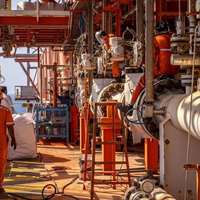
Workers carry out maintenance at Platform 18A of Iran’s South Pars gas field, August 2026

Iran’s economy contracted sharply in the spring as war hit its oil and gas sectors, with new data pointing to an energy crunch that could force Tehran to balance gas exports against rising domestic demand as winter approaches.

Iran’s Statistical Center reported that gross domestic product contracted 10.1% year on year in the spring, with almost every major sector shrinking except agriculture.

The value added of the oil and gas extraction sector, measured at constant 2021 prices, fell 26.4%. Its share of Iran’s economy also declined from 26% in the spring of last year to 21% in the same period this year.

International Energy Agency data show that Iran produced an average of about 2.6 million barrels of crude oil per day between April and June, roughly corresponding to the spring quarter. That was more than 20% below the same period last year.

Average daily oil production fell further to around 2.3 million barrels in the summer. With the United States imposing a naval blockade on Iran from mid-July, the contraction in GDP is expected to be significantly sharper in the summer than in the spring.

Gas distribution

Statistical Center data show that the value added of the gas distribution sector, measured at constant 2021 prices, fell by more than 21% in the spring from a year earlier.

Israel targeted gas-processing facilities at South Pars, the field that accounts for around 70% of Iran’s gas production, on March 18. Since then, Iranian officials have given varying estimates of the decline in gas production, ranging from 100 million to 230 million cubic meters per day.

The International Energy Agency’s initial estimates, published in May, suggested that Iran’s daily gas production may have fallen by around 100 million cubic meters.

The Statistical Center did not specify the exact daily volume of gas distributed during the spring. However, an earlier report showed that Iran produced and injected around 726 million cubic meters per day of processed gas into the distribution network in the spring of last year.

Given the 21% decline in the sector’s value added at constant prices, this suggests that gas supplied to the domestic network fell by roughly 152 million cubic meters per day this spring, to around 573 million cubic meters.

The decline is particularly significant ahead of winter. Iran faces a severe natural gas deficit during the cold months, with the daily shortfall reaching as much as 250 million cubic meters during periods of peak demand.

The government has consequently been forced to restrict supplies to industries, power plants and the petrochemical sector to meet rising residential demand.

The gas export puzzle

Despite the decline in gas supplied to the domestic network, Iran increased exports to one of its two gas customers.

Data from Turkey’s energy market regulator (EMRA) show that Iranian gas exports to Turkey increased 27% between April and June to 30 million cubic meters per day. Iran also exports gas to Iraq, although comparable data for the same period have not been published.

The increase in exports to Turkey may have two main explanations.

First, domestic gas demand is lower during the warmer months than in autumn and winter. Second, Iran’s industrial and petrochemical sectors may have experienced a significant decline in gas consumption because of the war.

According to earlier Statistical Center data, Iran’s petrochemical sector and industries consumed about 82 million and 397 million cubic meters of gas per day, respectively, in the spring of last year.

Combined, that represented roughly 75% of domestic gas sales, excluding exports, transmission and distribution losses, and gas used to operate the network itself. The combined figure was equivalent to about 66% of the total processed gas injected into the network that spring.

Israel targeted parts of Iran’s petrochemical complexes in Asaluyeh and Mahshahr during the spring. Together, those facilities account for around 70% of Iran’s petrochemical production. Israel also targeted the Mobarakeh and Khuzestan steel complexes, which together account for about half of Iran’s steel production.

It is therefore likely that gas consumption by these industries fell sharply during and after the attacks, freeing up some gas for exports.

But the situation could change rapidly as temperatures fall.

Household gas consumption rises to roughly twice its spring and summer levels in autumn and more than three times the warm-season level in winter. Households accounted for 49% of Iran’s total gas consumption last winter, according to the Statistical Center.

It remains unclear whether Iran will be able to maintain gas exports to Turkey and Iraq once domestic demand surges in the coming months.

Iran warns it would disrupt regional airports if its flights are barred

Sep 23, 2026, 16:31 GMT+1
100%
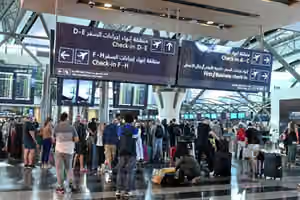
Passengers wait at Muscat International Airport as the Sultanate of Oman facilitates the return of passengers to their home countries amid the U.S.-Israeli conflict with Iran, in Muscat, Oman, March 5, 2026

Iran threatened to disrupt airports in neighboring countries that comply with a US campaign to ground Iranian airlines, escalating its response to new sanctions that have already begun cutting some of the country’s remaining air links.

“If neighboring countries cooperate with the United States in stopping Iranian flights, their airports will not be able to operate either,” Mohsen Rezaei, secretary of Iran’s Supreme National Security Council, said in an interview with state television on Wednesday.

Rezaei did not specify how Iran would prevent the airports from operating. He separately warned neighboring countries against participating in any further US military action against Iran.

“I am telling neighboring countries from now: do not enter this adventure,” he said.

The Treasury Department this month sanctioned 36 targets connected to the sector and warned companies providing services to Iranian carriers that they risked secondary sanctions.

Washington says Iranian aviation networks have been used to transport weapons, personnel and other cargo for the government.

The pressure has already begun to disrupt Iranian air travel. Flights to Baghdad and Muscat were canceled after authorities there stopped accepting Iranian flights, while Iranian carriers have also faced restrictions or cancellations affecting destinations including Turkey and Georgia.

Some international services continued operating on Wednesday despite the US deadline.

‘Hormuz is our dignity’

Rezaei coupled the airport warning with a deadline for Washington to respond to Tehran’s terms for further negotiations and reopening the Strait of Hormuz, which has been severely disrupted during the war.

“We have given the Americans four to five days to comply with Iran’s conditions,” he said. “Until Iran’s conditions are accepted, there will be no negotiations and the Strait of Hormuz will not be reopened.”

Rezaei did not spell out the conditions in the interview. He said they had already been communicated to mediators and would be conveyed again during the UN General Assembly gathering in New York by Foreign Minister Abbas Araghchi.

“We are not going back to the diplomacy of the past,” he said. “The diplomacy we have started is completely different from the past.”

He described control over the Strait of Hormuz as a source of leverage in negotiations.

“The Strait of Hormuz is our dignity. The Strait of Hormuz is our power,” Rezaei said. “The Strait of Hormuz is the Iranian people’s tool for obtaining their rights.”

Iran warns oil pollution spreading along southern coast could last years

Sep 23, 2026, 12:30 GMT+1
100%

Oil pollution has spread along parts of Iran’s Hormozgan coast and reached the entrances of shrimp farming channels in Sirik, with environmental officials warning that some of the contamination could remain in the marine environment for years.

Tar balls have been reported in several parts of Hormozgan province, including Soro and Golshahr in Bandar Abbas, with additional sightings reported in Hormuz and Minab, ISNA said.

Habib Masihi Taziani, head of Hormozgan’s environmental protection department, told ISNA that the amount found in Sirik was substantial and that experts were still assessing the extent of the contamination.

“The volume of tar balls in Sirik is significant,” he said, adding that authorities had begun work to manage the pollution with fisheries officials, port authorities, the Sirik governor’s office and the provincial crisis management agency.

Pollution reaches shrimp farming channels

The spread to the entrances of shrimp farming channels in Sirik has raised concern because aquaculture facilities there are directly connected to coastal waters.

Masihi Taziani told ISNA that conventional suction equipment was not effective for removing the tar balls.

“Collecting these oil masses with suction equipment is difficult,” he said. “Efforts are continuing to contain them and collect them using absorbent pads and other equipment.”

Tar balls are weathered remnants of petroleum products that can travel across the sea before washing ashore.

Officials warn pollution could persist for years

Ahmadreza Lahijanzadeh, deputy head of Iran’s Department of Environment for marine affairs, told ISNA the tar balls could cause significant damage to coastal and marine ecosystems.

“These oil masses can cause considerable environmental damage, and the resulting pollution can affect coastal and marine ecosystems,” he said.

Lahijanzadeh said organic compounds and heavy metals contained in the material could gradually enter the water and spread through the marine environment.

“The effects of this type of pollution are not limited to the period when the tar balls are visible on the coast,” he told ISNA.

“The entry and accumulation of these materials can cause pollution to remain in the sea for a long time, even for years,” he added, calling for continued monitoring and measures to identify and contain it.

  • Oil slicks hit Qeshm mangroves and Oman coast in mounting war fallout

    Oil slicks hit Qeshm mangroves and Oman coast in mounting war fallout

The latest sightings follow several oil pollution incidents along Iran’s southern coastline in recent weeks.

In August, Iranian state news agency IRNA reported that oil had reached mangrove forests on Qeshm island after slicks appeared near Suza and Shib Deraz. Authorities said at the time that the source had not been determined.

Mehr news agency reported that the pollution had initially been detected along about one kilometer of coast near Suza before spreading toward Shib Deraz.

TankerTrackers.com later said the Qeshm pollution appeared to have come from an Iranian attack on the bulk carrier Minoan Pioneer off Oman on August 3, with the spill drifting across the Strait of Hormuz toward Iran. Iranian authorities did not confirm that assessment.

Tanker spills add to pollution concerns

A separate spill was reported off Oman after the tanker Caroline Bezengi, carrying Russian crude, ran aground.

The UN’s International Maritime Organization said oil from the vessel had begun reaching Oman’s mainland, while Oman’s Environment Authority said the slick covered about 150 square miles near the Hallaniyat Islands.

Reuters, citing maritime security sources, reported that the vessel’s crew had first reported difficulties off Yemen in June and that initial assessments pointed to an onboard blast.

The price of US pressure moves up Iran’s social ladder

Sep 23, 2026, 07:59 GMT+1
•
Saba Heidarkhani
100%
File photo: Passengers check in for flights at Tehran’s Imam Khomeini International Airport

Expanding US pressure on Iran's aviation sector is bringing a class dimension to the debate over the costs of the country's growing isolation, with some Iranians welcoming restrictions they say are finally reaching the better-off.

Washington has threatened sanctions against airports and companies that provide services to Iranian carriers as international travel options are already narrowing.

Mahan Air has suspended flights to Turkey and Oman, while Georgia has announced a halt to flights by all Iranian airlines.

Iran International asked its Instagram audience what they thought about the growing restrictions. Responses ranged from support for measures seen as increasing pressure on the state to concern about their consequences for medicine, essential goods and family travel.

“At last, the water has reached the upper decks,” one respondent wrote.

The phrase captured a recurring argument among those who welcomed the restrictions: hardships that have long affected ordinary Iranians may now be reaching wealthier or better-connected sections of society.

Others argued that air travel had already become unaffordable for much of the population and said they were prepared to tolerate further restrictions if they increased the economic and political cost for the authorities or made it more difficult for officials and those close to them to travel abroad.

The responses do not constitute a representative survey of Iranian public opinion, but they point to a revealing tension over who bears the cost of external pressure.

‘The issue isn't just travel’

US Treasury Secretary Scott Bessent said Iranian airlines would effectively be shut out of international operations from September 23, warning that airports and companies providing them with services could themselves face US sanctions.

The restrictions do not amount to the closure of Iranian airspace or automatically prohibit foreign airlines from flying to Iran. But the threat of sanctions could make it increasingly difficult for Iranian carriers to operate abroad.

For some respondents, that raised concerns extending well beyond passenger travel to medicine, raw materials, spare parts and other goods entering Iran by air.

“Everyone is thinking about passenger flights, but the real problem that will emerge is cargo flights,” one wrote.

“The issue isn't just travel,” another respondent wrote. “A lot of goods reached Iran by air, such as medicine … what is supposed to happen to patients now?”

Others pointed to higher ticket prices, longer journeys involving indirect routes and increasing difficulties visiting relatives abroad. Some feared higher import costs would feed into inflation, further squeezing household finances.

“In the war and confrontation between the government and America, it is the people who are being crushed,” one respondent wrote.

Some also pointed to congestion at land crossings such as Bazargan and Razi, fearing that further disruption to air travel would push more passengers onto already strained overland routes.

Where does tolerance for pressure end?

The responses also revealed differing interpretations of what Washington is trying to achieve.

Some saw the aviation restrictions as another sign of escalating confrontation, while others interpreted them as an attempt to increase pressure on Tehran to reach an agreement.

Several said years of sanctions and economic crisis had left society increasingly accustomed, or even numb, to new restrictions.

Measures perceived as restricting officials, state institutions or wealthier Iranians attracted support from many of those who responded to Iran International.

But that support became less straightforward when people contemplated medicine and essential goods becoming harder to obtain, more expensive travel, separation from relatives or further increases in household costs.

The responses suggest tolerance for outside pressure can be easier to sustain when its costs appear concentrated on the state. Once those costs become tangible in everyday life, the calculation becomes more complicated—even among Iranians who want greater pressure on Tehran.