US House passes Iran sanctions as Trump signals war may be nearing end
Ukraine's President Volodymyr Zelenskiy welcomes US Senator Lindsey Graham (R-SC) before their meeting in Kyiv on July 10, 2026.
The US House of Representatives passed the Lindsey O. Graham Sanctioning Russia and Iran Act of 2026, clearing the sweeping measure for President Donald Trump’s signature as Washington also signaled that the Iran war could be approaching a diplomatic turning point.
The House approved the sweeping sanctions legislation by a vote of 262-159 on Wednesday, after the Senate passed it 86-11 last month. Fifty-eight Democrats supported the bill, while seven Republicans opposed it.
The legislation would authorize the president to impose tariffs of up to 100% on the largest purchasers of Russian oil and natural gas and sanction senior Russian officials, oligarchs, banks and financial institutions. At Trump’s request, lawmakers also expanded the measure to include sanctions targeting Iran’s energy and weapons sectors.
Republican Representative Joe Wilson welcomed its passage and said lawmakers were looking forward to Trump signing it into law.
The measure could affect major importers of Iranian and Russian energy. India said Thursday that it had noted the bill’s passage while emphasizing that it remained committed to securing energy supplies through diversified sourcing and in response to changing market conditions.
The sanctions push came alongside indications that Washington and Tehran may be exploring a path toward ending the war. Trump said on Wednesday after arriving in North Carolina that he hoped the conflict was nearing its conclusion, adding that Iran was seeking an agreement.
“Well, hopefully we’re toward the end of the war,” Trump told reporters. “Iran is very much wanting to make a deal. We’ll see how that works out.”
Trump is also expected to meet leaders or foreign ministers from the six Persian Gulf states on the sidelines of the UN General Assembly in New York next Tuesday, Axios reported. The meeting is expected to address the next phase of the war and US proposals for a postwar strategy.
Iranian Foreign Minister Abbas Araghchi, meanwhile, said consultations during his visit to China had been successful and endorsed Chinese President Xi Jinping’s proposals for ending the conflict.
China’s Foreign Ministry said Araghchi told Foreign Minister Wang Yi that Iran did not want the hostilities to continue and hoped to return to diplomacy. Wang urged Iran and the United States to revive the negotiating framework established under the Islamabad memorandum, called for the reopening of the Strait of Hormuz and backed dialogue between Iran and Persian Gulf states.
Araghchi also held separate telephone calls from Beijing with Turkish Foreign Minister Hakan Fidan and Pakistan’s army chief, Field Marshal Asim Munir, to discuss regional developments.
A parallel diplomatic channel emerged in Oman, where US officials met senior representatives of Yemen’s Iran-backed Houthis over the weekend, Reuters reported. The Houthis said they had no intention of attacking American vessels and remained committed to their 2025 ceasefire with Washington, according to the report.
Two sources told Reuters that the group promised not to target US ships. A Yemeni source said the Houthis also pledged not to attack Israeli or other commercial vessels, with the exception of Saudi ships.
The discussions took place against a backdrop of continued fighting between the Houthis and Saudi Arabia. Riyadh said it intercepted a Houthi drone near Mecca this week, an allegation the group denied. Saudi Arabia has also sought air-defense assistance from France, Britain, Pakistan and Egypt as its interceptor stocks decline, the Associated Press reported.
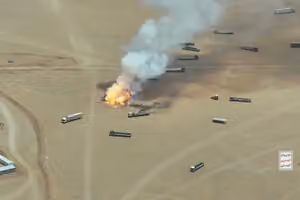
Houthi-run media said Saudi strikes in Yemen on Thursday hit telecommunications towers in Taiz and killed one person in Abs. The Houthis also released footage they said showed the downing of a Saudi F-15, a claim that Saudi Arabia had not confirmed.
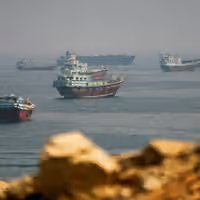
Maritime traffic through the Strait of Hormuz remained severely constrained despite the diplomatic activity. Only three commodity vessels transited the waterway on Wednesday, down from 12 a day earlier and far below the 10-day average of about 17, Reuters reported, citing preliminary ship-tracking data.
US Central Command maintained that commercial traffic was still moving and that Iran did not control the strait. Its spokesperson said US forces had helped vessels carrying more than 900 million barrels of crude pass through the waterway since early May and had cleared mines from internationally recognized shipping lanes.
The sanctions bill, diplomatic contacts and continuing disruptions at Hormuz and in Yemen left Washington applying further economic pressure while testing whether negotiations could reduce the regional fighting.
A cancer patient receives treatment at a hospital in Iran.
Some cancer patients in Iran are selling essential household goods or abandoning medication as soaring drug prices and gaps in insurance coverage put treatment beyond the reach of low-income families, a charity director said on Thursday.
Families have sold refrigerators and televisions to buy cancer drugs, while some patients have stopped taking medication because they can no longer afford it, Hossein Zehtaban, the head of a cancer support charity in the western province of Kermanshah, told Iran's ILNA news agency.
“We are facing patients who explicitly say they cannot afford their medication, that they are no longer taking it and are waiting to see what happens,” he said.
The warning comes during a sharp rise in pharmaceutical costs across Iran. Producer inflation in the pharmaceutical, chemical and herbal products sector reached 114% year-on-year, according to Iranian economic outlet Zooman.
A recently published price list from Iranian pharmaceutical manufacturer Loghman showed increases of more than 500% for some medicines. Donepezil, used to treat symptoms of Alzheimer's disease, rose 543% for a 10-milligram dose, while the price of clarithromycin increased 308%.
Workers struggle with treatment bills
Zehtaban cited one family with three cancer patients whose main breadwinner is a worker. Medication for each patient can cost 400 million to 500 million rials ($174-$217 at an exchange rate of 2.3 million rials to the dollar) a month, he said.
A healthcare worker tends to a patient in an intensive care unit at a hospital in Iran.
Iran’s minimum base wage for workers is about 166 million rials a month, meaning the medication for just one of the three patients could cost roughly two-and-a-half to three times a minimum-wage worker’s monthly pay.
The charity has about 1,700 cancer patients registered for support, though the charity director said the figure does not represent the total number of cancer patients in Kermanshah province because other organizations also provide assistance.
Insurance problems are adding to the financial pressure, he said. Pharmacies facing unpaid insurance reimbursements have reduced provision of some medicines, forcing cancer patients to search multiple pharmacies for prescribed drugs, he added.
Drug prices surge
The financial strain described by Zehtaban extends beyond cancer treatment.
Loghman's published price changes show increases across dozens of medicines, with 23 products rising by at least 100%. Donepezil rose by 427% for the five-milligram dose and 543% for the 10-milligram dose, while Tadalafil, which is used to treat erectile dysfunction, enlarged prostates and pulmonary arterial hypertension, had the largest increase at about 706%, according to reports citing the company's regulatory disclosure.
Rising medicine costs have combined with food and other household expenses to make supporting cancer patients increasingly difficult, Zehtaban said. Vitamins and nutritional supplements recommended during treatment are also often excluded from insurance coverage.
The charity provides financial assistance as well as weekly psychological and physical rehabilitation sessions, but he said its resources cannot cover the mounting treatment costs.
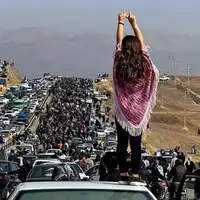
A masked protester raises both hands in victory signs as crowds gather on a smoke-filled road during protests in Mashhad, Iran, on January 9, 2026.
Iranian security forces committed crimes against humanity in their crackdown on nationwide protests, a UN fact-finding mission said on Thursday, citing mass killings, torture and arbitrary detention.
The Independent International Fact-Finding Mission on Iran said its report examined the 2025-2026 protests and found that killings by state security forces took place across all 31 provinces. It described the repression as an unprecedented escalation from previous crackdowns.
At least 221 children were reported killed, some as young as two, while tens of thousands of people were detained, according to the report submitted to the UN Human Rights Council.
Security forces fired at crowds
The mission said security forces positioned themselves on rooftops and other elevated locations and fired assault rifles into crowds.
In Karaj, forces used tear gas to trap demonstrators in narrow alleys before shooting at them, the report said. Protesters suffered severe injuries to the head, chest and eyes from metal shotgun pellets, with some left permanently blind.
Security forces also attacked healthcare facilities, beating and arresting wounded protesters and detaining some healthcare workers, according to the mission. It said the actions deterred injured people from seeking treatment.
Five-month internet shutdown
Iranian authorities imposed a nationwide internet and communications blackout on January 8, at the height of the violence, the mission said.
The shutdown lasted more than five months, which the mission described as the longest nationwide communications shutdown on record, restricting access to information and emergency coordination.
The report said tens of thousands of people were arbitrarily detained and that some faced torture, solitary confinement and denial of access to lawyers. Families were in some cases left without information about detainees' whereabouts, raising concerns of enforced disappearances.
Authorities also delayed or refused to return bodies to some families, demanded payments and pressured relatives to sign statements falsely describing victims as state agents, the mission said.
The mission said Iran also intensified its use of the death penalty against people linked to the protests.
At least 29 men were executed between March and August 2026 following expedited trials, including five who were executed publicly.
More than 70 people, including five women and three boys, remained at imminent risk of execution, it said.
The mission concluded that violations including murder, imprisonment, torture and other inhumane acts amounted to crimes against humanity because they formed part of a widespread and systematic attack against civilians.
US strikes also examined
The report separately found reasonable grounds to believe the United States committed war crimes in two strikes during the conflict with Iran.
It said US Tomahawk missiles struck the Shajareh Tayyebeh Primary School in Minab, killing more than 150 people, including about 120 children.
A separate US strike in Lamerd dispersed tungsten pellets over a sports complex and nearby residential area, killing 22 civilians, the mission said.
The mission said the attacks amounted to indiscriminate strikes resulting in civilian deaths and damage to civilian objects.
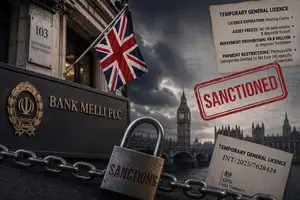
Turkey has stepped in to take control of shareholder rights at a bank accused by Washington of helping Tehran turn oil revenues into cash and gold: the latest chapter in a decades-long story linking Turkish banking, US sanctions and Iranian money.
Golden Global Investment Bank was built largely by veterans of state-owned Halkbank, which itself inherited longstanding Iranian banking relationships when Turkey transferred the troubled Pamukbank to it two decades ago.
The same state fund that took control of Pamukbank in 2002 is now exercising shareholder rights covering nearly all of Golden Global.
The US Treasury sanctioned Golden Global, alleging it facilitated tens of millions of dollars in transactions for the Islamic Revolutionary Guard Corps’ Quds Force (IRGC-QF) and was established to help move Iranian oil revenues from China to Turkey for conversion into cash and gold.
Golden Global denies the allegations.
Turkey’s banking regulator moved on September 16 to put shareholder rights covering nearly all of Golden Global under the control of the country’s Savings Deposit Insurance Fund (TMSF).
The decision covers stakes held by three shareholders and excludes dividend rights. It comes three days before a US authorization to wind down dealings involving the bank expires.
Corporate filings show Golden Global drew its founding and subsequent leadership heavily from Halkbank. The bank opened in Istanbul in June 2020 with former Halkbank bankers as chairman and general manager, then recruited other veterans as chief executive, vice chairman, board member and compliance head.
Treasury’s designation does not name any of the Halkbank veterans personally. Their career connections are documented in corporate filings and published biographies; the US allegations concern Golden Global and its subsidiaries.
The sanctions came less than three months after a federal judge dismissed the US criminal case against Halkbank on June 17. That prosecution concerned alleged Iranian sanctions evasion between 2012 and 2016 and ended under a deferred prosecution agreement, without an admission of wrongdoing by Halkbank.
Golden Global faces a separate administrative sanctions action.
From Pamukbank to Halkbank
Pamukbank was a privately owned Turkish deposit bank founded in 1955. It established a representative office in Tehran in 1984 to support business between Turkey and Iran, two decades before becoming part of Halkbank.
Reporting on its opening, the Turkish newspaper Milliyet cited Pamukbank general manager Ibrahim Betil as saying inadequate banking links were hampering trade between the two countries. The bank said its Tehran presence would help financing and communication with Turkish businesses.
Pamukbank came under TMSF control in 2002 and was transferred to Halkbank in November 2004. Its assets, liabilities and branches passed to the state-owned lender, including the Tehran office and accounts Iranian banks already held at Pamukbank.
By 2005, Halkbank was publicly promoting its access to Iran’s oil business. Its annual report described it as the only Turkish bank authorized to open letters of credit directly to the National Iranian Oil Company. The Turkish edition also said its Tehran office helped handle large foreign-trade transactions with Iran.
Former Halkbank executive Hakan Atilla later testified in a US trial that the bank initially made only a preliminary assessment of the Iranian relationships inherited from Pamukbank and returned to them after its 2007 initial public offering. Halkbank itself later dated its Iran-related foreign-trade activity to 2004.
In January 2008, US Treasury Under Secretary Stuart Levey pressed Halkbank’s senior management over those Iranian ties. A US diplomatic cable records him urging the bank to close Iranian correspondent accounts and warning against expanding relationships with Iranian financial institutions seeking international partners.
The pressure continued in 2009, when Treasury officials warned Halkbank about Iranian efforts to disguise transactions. Halkbank officials said they financed documented trade and did not handle third-party, transit or cash-for-goods transactions.
From Halkbank to Golden Global
Golden Global later recruited bankers who had built their careers at Pamukbank and Halkbank, including in international banking, foreign operations and compliance.
The bank received its operating licence in early 2020 and opened for business on June 1. Its founding chairman, Mustafa Akin, had begun his career at Pamukbank in 1986 and managed branches for Pamukbank and Halkbank between 1994 and 2011.
Golden Global’s first general manager, Ozay Balta, had started at Halkbank as an assistant inspector in 2004 and served as a branch manager from 2012 to 2016. His published biography lists no other employer before Golden Global.
Yavuz Yeter became general manager in May 2024. He had joined Pamukbank’s Board of Inspectors in 1996 and moved to Halkbank in the 2004 merger, later serving in senior roles in its International Banking and Structured Finance department.
Yeter was therefore in senior international-banking roles during the period when Halkbank advertised its access to the National Iranian Oil Company and received Levey’s warning. That chronology does not establish that he handled the Iranian business. Atilla assigned responsibility for the Iranian accounts and Tehran office to a separate department.
Yeter later moved into senior central-bank roles. From 2016 to 2019 he held a banking-and-financial-institutions post at Turkey’s central bank. From 2020 to 2023 he served as its representative and economic attaché in Frankfurt, then advised its Istanbul office before joining Golden Global.
Coskun Cabuk joined Halkbank in the 2004 merger and worked across inspection, corporate banking and regional coordination, according to Golden Global’s 2025 annual report. The report gives no dates for those individual posts.
Cabuk stayed at Halkbank until 2017, then ran its leasing subsidiary, Halk Finansal Kiralama, until 2024. Golden Global shareholders elected him to the board for two years in March 2025 but his seat ended only a year later. Cabuk became general manager of Turkland Bank in July 2026.
The Halkbank connection also extended to compliance. Golden Global’s 2025 annual report identifies Cigdem Sefer as head of regulation and compliance. She began at Halkbank in 1996 and worked in its foreign operations, international banking and compliance units before joining Golden Global in November 2025.
Her unit’s responsibilities include evaluating correspondent relationships, screening customers and transactions against national and international sanctions, and overseeing obligations relating to money laundering, terrorism financing and proliferation financing.
Gold, cash and correspondent banking
Correspondent banking—the use of other banks to process payments and gain access to financial systems abroad—is central to Treasury’s allegations against Golden Global.
Treasury alleges the bank knowingly provided such services to Iranian financial institutions, enabling transactions through accounts controlled by the IRGC-QF and its proxies. It places Golden Global within Iran’s rahbar system, which it describes as a network of companies coordinating overseas payments for Iranian banks through foreign accounts and money exchangers.
The alleged network used correspondent banking, gold and cash to move funds.
The Treasury identifies Turkish businessman Sitki Ayan and his companies among the networks involved. OFAC sanctioned that network in 2022. Golden Global says it has had no direct or indirect dealings with those individuals..
Golden Global’s own figures show substantial growth in those areas of its business. Its 2025 report lists 45 accounts held at 20 banks in 17 countries and 66 accounts hosted for 25 banks from 16 countries. Those 25 banks are not identified.
Fees paid for foreign settlement services rose 56 percent in 2025 to 482 million lira. The bank also reported playing a critical role in settling $1.8 billion in gold transactions in 2025, nearly three times the $613 million reported a year earlier.
Physical banknote trading reached $4.4 billion, an increase of about 70%. Golden Global also reported $21.9 billion in interbank foreign-exchange trades, nearly double the previous year, and $14.5 billion in currency swaps, more than twice the 2024 total.
The reports document substantial activity in the same types of services Treasury says the Iranian network used. Those aggregate figures do not, on their own, establish which transactions involved sanctioned parties.
The September 19 deadline
Treasury designated Golden Global under Executive Order 13902, which targets specified sectors of Iran’s economy, including finance. It placed the action within Operation Economic Outcast, a campaign announced in August to intensify pressure on Iran’s remaining financial and trading channels.
The sanctions are already in effect. OFAC’s General License CC provides limited authorization for transactions ordinarily necessary to wind down dealings involving Golden Global and other covered entities. That authorization expires at 12:01 a.m. Eastern time on September 19.
The license carries conditions, including a requirement that payments to blocked persons go into blocked, interest-bearing accounts in the United States. When it expires, transactions covered by the licence lose that authorization.
Treasury has also warned that foreign financial institutions conducting or facilitating certain significant transactions on behalf of designated entities could face prohibitions or restrictions on their US correspondent accounts.
For Golden Global, whose business reaches counterparties across more than a dozen countries, the immediate pressure therefore extends beyond its Istanbul office to the institutions connecting it to the international financial system.
Iran-aligned Houthi fighters pose next to a captured vehicle following what the source described as an attack on Saudi-backed forces in the location given by the source as al Jawf governorate, Yemen, in this screengrab taken from a video released by Houthi Military Media on September 15, 2026
US officials met representatives of Yemen's Iran-aligned Houthis in Oman over the weekend, Reuters reported on Wednesday, citing five sources familiar with the matter, days after the group seized a strategic stretch of Yemen's Red Sea coast.
The previously undisclosed meeting was held at the US Embassy in Muscat, three of the sources told Reuters. Two said Oman, a longtime regional mediator, helped organize the talks.
One source said the meeting took place on Sunday. US embassy personnel represented Washington, while the Houthi delegation included senior official Mohammad Abdulsalam, who is under US sanctions, and Abdelmalik al-Ajiri, according to Reuters.
The Houthis told US officials they did not intend to attack American vessels and remained committed to a ceasefire reached with Washington in 2025, two sources told Reuters.
A Yemeni source said the group also said it would not attack Israeli ships or other commercial vessels, except those belonging to Saudi Arabia.
The State Department did not confirm the meeting but said protecting freedom of navigation in the Red Sea and preventing terrorism from spreading from the Middle East were core US interests.
President Donald Trump said on Saturday that the Houthis had contacted his administration and asked Washington to stay out of the Yemen war. Vice President JD Vance said on Monday that the United States was in direct contact with the group.
The Trump administration designated the Houthis a "foreign terrorist organization" in March 2025.
Washington nevertheless negotiated with the group later that year and reached a ceasefire in May after two months of US strikes aimed at stopping attacks on Red Sea shipping.
The latest talks came after the Houthis seized effective control of Yemen's Red Sea coastline, including the port of Mocha and Perim Island in the Bab el-Mandeb Strait, a key route for international shipping.
Saudi-Houthi fighting intensifies
Later on Wednesday, Houthi military spokesman Yahya Saree said that the group had attacked an airbase in Khamis Mushait as well as Aramco facilities in Yanbu. Saudi Arabia did not confirm either of the attacks.
The Houthis have fought a Saudi-led coalition for more than a decade after seizing Yemen's capital, Sanaa, in 2014.
Fighting had largely eased under a ceasefire but resumed in July after the Houthis declared a blockade of Saudi shipping in the Red Sea in response to a Saudi blockade of Yemeni ports.
Saudi warplanes have since struck Houthi positions as the group has advanced along the Red Sea coast and launched attacks toward Saudi Arabia.
Riyadh sought US help
Saudi Crown Prince Mohammed bin Salman called Trump last week seeking US military support as the Houthi offensive accelerated, Reuters reported.
Washington told Riyadh it would not become directly involved in the fighting, according to Reuters.
The escalation has also increased pressure on global energy supplies already disrupted by the Iran war and reduced shipping through the Strait of Hormuz.
Iranian state authorities organized a systematic, high-level campaign of murder, torture, and sexual violence to crush the 2022 Woman, Life, Freedom uprising, according to a 1,000-page investigation published by Amnesty International on Wednesday.
The report states that senior officials directed, executed, and subsequently covered up acts that constitute crimes against humanity.
The findings are based on interviews with 270 witnesses, analysis of over 2,000 videos, and leaked official Iranian government documents.
"Amnesty International unequivocally opposes violations of international law by all parties and rejects any attempt to instrumentalize the suffering of victims of human rights violations in Iran to justify unlawful attacks that inflict further civilian harm," said Secretary General Agnès Callamard at the report's press launch, addressing both state repression and broader regional conflict.
Amnesty International identified 87 Iranian officials, including top IRGC and police commanders, who it said should be investigated for crimes against humanity under superior responsibility principles. Amnesty said that it shared its findings and the list of identified officials with Iran's leadership prior to publication but received no response.
"This investigation exposes the layers of command and coordination behind the Iranian authorities' deadly protest crackdowns," Callamard said. "The agents on the streets operated within a hierarchical and coordinated chain of command linking them to officials who directed, enabled, facilitated and supported crimes committed on a massive scale. It is beyond time to establish an international criminal justice mechanism for Iran before another protest massacre."
The report warned that impunity for the 2022 crackdown directly enabled subsequent mass atrocities, warning that state suppression of demonstrations earlier this year bore the same hallmarks on an even wider and deadlier scale. Amnesty urged the UN General Assembly to establish an independent international criminal justice mechanism to prosecute responsible officials.
High-ranking officials named for criminal investigation
Among the top-tier officials listed for criminal investigation under command responsibility principles are Supreme Leader Ali Khamenei, who was killed on February 28, 2026, during military strikes, and former Armed Forces Chief of Staff Mohammad Bagheri, who died on June 13, 2025.
Other key figures identified in the report include Ahmad Vahidi, who served as Minister of Interior during the 2022 crackdown and was subsequently appointed General Commander of the IRGC, Deputy Interior Minister for Security Majid Mir-Ahmadi, Tehran IRGC Commander Hassan Hassanzadeh, and Tehran Deputy Prosecutor Mohammad Shahriari.
Leaked documents show early surveillance directives
Minutes from confidential security meetings show that within 48 hours of Mahsa Amini’s death in custody on September 16, 2022, state officials focused on controlling the public narrative and suppressing online protests. Security chiefs discussed strategies to secure public statements from Amini's father to support the official explanation of her death.
A government resolution dated September 18, 2022, assigned the Islamic Revolutionary Guard Corps (IRGC) intelligence unit to monitor athletes and political figures. The same document tasked the Ministry of Intelligence with tracking actors, artists, and opposition movements.
Written orders drove escalation of lethal force
Written instructions issued by the General Staff of the Armed Forces on September 21, 2022, ordered security forces nationwide to deliver a "firm and severe response" to demonstrations. Of the 326 fatalities documented during protest dispersals or in militarized zones, 178 occurred within the first two weeks of the crackdown.
Amnesty documented a total of 377 protest-related deaths, including 56 children. State authorities have officially acknowledged only 202 deaths and falsely attributed most fatalities to "rioters" or "armed terrorists" despite overwhelming evidence to the contrary.
Security forces used assault rifles, machine guns, and shotguns loaded with metal pellets at close range, while kinetic impact munitions caused severe long-term physical injuries and loss of vision among survivors.
Disproportionate impact on ethnic minorities
Baluchi and Kurdish protesters and bystanders accounted for 62% of all recorded deaths during protest dispersals, despite representing a much smaller share of Iran's overall population.
Operational guidelines detailed the deployment of Basij militia units and motorcycle patrols of up to 40 vehicles per battalion to maintain street control and prevent anti-government slogans from being written in urban centers.
The investigation documented widespread torture, beatings, rape, and sexual assault against detained protesters, including minors. Internal judicial communications show that prosecutors classified formal rape complaints against IRGC agents as "completely secret" and instructed staff to close files over time without citing security agencies.
When lower courts delivered murder convictions against security personnel, higher authorities intervened to overturn the verdicts, reclassify the killings as unintentional, or reduce prison sentences. State courts also penalized bereaved families by withholding statutory financial compensation and attempting to coerce false television confessions attributing deaths to opposition groups.