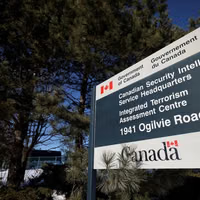
A view shows a Canadian Security Intelligence Service Headquarters and Integrated Terrorism Assessment Centre sign in Ottawa, Ontario, Canada February 26, 2025. REUTERS/Blair Gable/File Photo
The Canadian Security Intelligence Service told Iran International that in more than one case its efforts to counter Iranian intelligence services and their proxies involved detecting, investigating and disrupting potentially lethal threats in Canada.
CSIS said it assesses that “Iranian threat-related activities directed at Canada and its allies are likely to continue in 2026.”
The agency declined to discuss specific investigations or operational details, citing the need to protect its sources, tradecraft and methods.
Iranian intelligence services and their proxies have targeted individuals they perceive as threats to the Iranian government, according to CSIS.
“In more than one case this involved detecting, investigating, and disrupting potentially lethal threats against individuals in Canada,” the agency said.
It added that it works with foreign partners and domestic law enforcement to counter such activity and engages communities across Canada to strengthen their resilience against potential threats.
The Royal Canadian Mounted Police (RCMP) also told Iran International that it was aware of reporting and allegations about possible foreign involvement in the incidents but declined to attribute them to Iran or another state while investigations remain underway.
“As these matters remain under investigation, the RCMP is not in a position to comment on specific intelligence, investigative findings, or potential attribution,” the force said.
The RCMP said it was aware of foreign interference activity in Canada involving several states, including Iran, and takes allegations of foreign interference, transnational repression and foreign state-linked criminal activity seriously.
The RCMP said it works with Canadian and international partners through intelligence sharing, threat assessments, coordinated investigations and enforcement actions.
Gun-for-hire investigations
The responses come amid investigations into suspected gun-for-hire networks operating in the Greater Toronto Area.
Toronto police say young people are being recruited through encrypted messaging apps to carry out attacks for payment, while investigators are still working to determine who is directing and financing the violence.
Police have identified a recurring pattern in some of the attacks involving stolen vehicles, encrypted messaging apps and gunmen recording shootings on their phones.
Police say recruits are required to record the attacks as proof in order to receive payment.
Toronto police said ballistic evidence linked two firearms seized during the investigation to numerous shootings across the Greater Toronto Area, including the attack on the US Consulate.
Iran International previously reported in June that an armed assailant fired 17 rounds at a Toronto athletic facility owned by Iranian-Canadian opposition activist Salar Gholami, hours after the killing of senior Iranian officials in Tehran.
The facility has served as a gathering place for opponents of the Islamic Republic and a hub for anti-regime demonstrations.
Surveillance footage captured an assailant whose physical profile was described in the report as consistent with young individuals allegedly recruited in other shootings.
The attack has not been publicly established as part of the same criminal network involved in other shootings under investigation in Toronto.
Conservatives call for action
Conservative Party leader and opposition leader Pierre Poilievre has warned that foreign-backed networks are exploiting criminal groups to carry out attacks in Canada.
"Iran's terrorist regime is suspected of financing gun-for-hire shootings on Canadian soil. Synagogues, a school, businesses, and the U.S. Consulate targeted. Jewish Canadians and Iranian dissidents are being terrorized," Poilievre said.
He called on the federal government to identify and deport Iranian Revolutionary Guard operatives unlawfully present in Canada.
Canada and more than two dozen other countries said earlier this month that they condemned Iran’s use of violent attacks, including lethal plotting, arson, sabotage, cyberattacks and other hostile activities, and pledged to identify, investigate and disrupt such activity.
An illustration of the networks controlling Iran’s sanctioned oil trade.
Documents reviewed and information obtained by Iran International indicate that the IRGC Intelligence Organization orchestrated a quasi-coup to revive its corruption network and take control of Iran's sanctioned oil trade.
On Monday, October 26, Hossein Ghorbanzadeh, a board member of Persian Gulf Petrochemical Company and a figure close to Parliament Speaker Mohammad Bagher Ghalibaf, told Fars News Agency that the dismissal of Oil Minister Mohsen Paknejad, who left office three weeks earlier, had originally been planned for March.
He said Masoud Pezeshkian had told a cabinet meeting that Ali Khamenei, the Islamic Republic’s then-leader, had asked him to dismiss the oil minister over his inability to manage the crisis involving the trustees. However, Khamenei’s killing and the outbreak of the 40-day war delayed the change.
Shamkhani’s secret letter to Khamenei
But according to a document reviewed by Iran International, it was Ali Shamkhani, Khamenei’s political adviser, who asked him in a confidential letter to dismiss the oil minister.
In a confidential report submitted to Khamenei in late 2025, Shamkhani wrote that Pezeshkian’s government was selling oil at a discount of $6 a barrel, compared with a discount of 50 cents under Ebrahim Raisi’s government.
Khamenei’s political adviser claimed that oil sales under the current government were far below production levels and that the Oil Ministry had stopped accepting gold in exchange for oil.
A source familiar with the matter at the Oil Ministry and another at an oversight body told Iran International that the main reason for Shamkhani’s anger with the ministry was the exclusion of Hossein Shamkhani, owner of a 51-vessel “ghost fleet” used to circumvent sanctions, from sanctioned oil sales.
How the trustee network took shape
Beginning in 2018, following US President Donald Trump’s decision to withdraw from the nuclear deal and impose a policy of maximum pressure, the Islamic Republic entrusted sanctioned oil sales to the Supreme National Security Council’s so-called “Cover Committee,” which operated under Ali Shamkhani’s supervision. The justification was to prevent the emergence of major debtors such as Babak Zanjani.
Representatives of the IRGC Intelligence Organization were supposed to work alongside Intelligence Ministry representatives on the committee to prevent corruption in sanctioned oil sales. The committee decided which oil shipments would be entrusted to the government’s trusted oil brokers, known as trustees.
The key decision-makers were Shamkhani and Mohammad Javad Bavand, the IRGC Intelligence Organization’s representative on the committee. Bavand served as deputy head of the organization’s economic directorate under Mostafa Ahadi, sources familiar with the matter told Iran International.
Their decisions made Hossein Shamkhani one of the main trustees handling Iranian oil sales, among intermediaries who failed to return hundreds of millions of dollars in oil proceeds.
According to a confidential document reviewed exclusively by Iran International, a unit of the IRGC Intelligence Organization wrote to Tehran’s revolutionary prosecutor in 2021, requesting the arrest of Ali Akbar Pour-Ebrahim, then managing director of the Oil Trading Company, and a ban on his leaving the country. The large volume of customers’ outstanding debts and the creation of preferential arrangements for trustees were among the issues raised against him.
After Ebrahim Raisi took office, Bavand became a special aide to then-Oil Minister Javad Owji, while Mostafa Ahadi took charge of the Supreme National Security Council's economic directorate, helping maintain the IRGC Intelligence network's role in oil sales.
In an interview with the Iranian Labour News Agency, Ali Akbar Pour-Ebrahim confirmed that trustees had failed to return $11 billion in oil revenues during this period.
But after Masoud Pezeshkian won the election in 2024, Bavand was removed, and the oil minister handed oil sales to another security network: an Intelligence Ministry corruption network headed by a man known as Shayan, the ministry’s former director general for petroleum products.
IRGC Intelligence moves against the new oil-sales network
Starting in October 2025, after trustees failed to return a substantial portion of oil revenues, the IRGC Intelligence Organization, working with Ali Shamkhani and Mohammad Javad Bavand, also blamed the Pezeshkian government’s Oil Ministry for $11 billion in missing proceeds dating from Raisi’s presidency, two informed sources told Iran International.
IRGC Intelligence then infiltrated Shayan’s network by pressuring Mohammad Hadi Momenin, a former IRGC trustee who had since joined it, according to a source at an oversight body. Momenin was detained for a period but released after cooperating with IRGC Intelligence and subsequently went to China.
The Revolutionary Guards sought to conceal the identities of several key members of the Oil Ministry network who were relatives of senior Islamic Republic officials.
However, Iran International reported in an exclusive investigation that a child of current Supreme National Security Council Secretary Mohsen Rezaei, as well as the son and son-in-law of two former intelligence ministers, were among the trustees who had failed to return $11 billion in oil revenues.
Paknejad seeks a lifeline; Bavand steps in
Oil Minister Mohsen Paknejad faced pressure to leave office over the scale of the corruption. He brought Mohammad Javad Bavand back to the Oil Ministry and appointed him as his aide for oil sales on 8 June. At the same time, Mostafa Ahadi was appointed to IRGC Intelligence's Directorate 600 to control the media narrative.
In late July, Shayan was removed as director general of the Intelligence Ministry’s petroleum products unit. A month earlier, at Paknejad’s request, Hamid Bovard, managing director of the National Iranian Oil Company and the ministry’s current acting head, had appointed Ali Akbar Pour-Ebrahim as acting head of NICO.
According to a document first published by Iran International, Bavand and Pour-Ebrahim entrusted the sale of 86 million barrels of Iranian oil, at a substantial discount of $8 a barrel, to four trustees in mid-2026, all of whom had failed to return billions of dollars in oil revenues. The shipments had left the Persian Gulf during the implementation of the Islamabad memorandum of understanding. Hossein Shamkhani and Mohammad Hadi Momenin were two of those trustees. The move, according to Iran International's investigation, marked the full revival of the IRGC Intelligence-linked corruption network in oil sales.
The final step: Pour-Ebrahim returns to NICO
The final figure in the network was Ali Akbar Pour-Ebrahim, who returned as NICO's managing director after three years. Many conservatives portrayed him as a protégé of Bijan Zanganeh, the oil minister under Hassan Rouhani, and as affiliated with moderate and reformist political factions. But according to Iran International’s sources, he took charge of the Oil Trading Company at the age of 31 on the orders of IRGC Intelligence and subsequently retained the position under Raisi despite multiple corruption cases against him.
According to a confidential document obtained by Iran International, he was one of the main suspects in corruption involving the barter of two oil and gas shipments with Venezuela’s government.
A General Inspection Organization report found that NICO, under Pour-Ebrahim’s management, bartered two shipments of Iranian gas condensate and crude oil worth about $3 billion with Venezuela, but more than $1 billion of the difference in the cargoes’ value was never recovered.
Another section of the report stated that Venezuela did not deliver the replacement cargoes to Iran, and the tankers that had carried gas condensate and crude oil to Caracas returned empty.
The Oil Ministry’s trustees in the deal were Mohammad Hadi Momenin, who Iran International previously reported had failed to return $2 billion in oil revenues, and Hossein Shamkhani, known as Hector.
Venezuela’s oil minister was arrested in connection with the deal, but in Iran, Pour-Ebrahim, Shamkhani and Momenin continued their work.
A suspicious ship deal and a $550 million loss
Iran International has obtained a confidential document showing that, in the spring of this year, Pour-Ebrahim submitted a report to a security agency accusing the former head of the Oil Trading Company and the Oil Ministry of negligence that led to sanctions on 12 Iranian tankers and losses of $900 million for Iran.
However, an expert assessment by the oversight body found that Pour-Ebrahim himself had ordered the purchase of the 12 vessels even though they were expected to be sanctioned. The Islamic Republic uses chartered vessels to avoid that risk. The deal resulted in a $550 million loss for Iran.
The sellers and intermediaries in the 12-vessel deal were all trustees belonging to Bavand and Pour-Ebrahim’s network. One was a Chinese national known as William, whose real name is Wang Zhijing, a 65-year-old broker sanctioned by the United States.
According to a source at the Oil Ministry and another at an oversight body, Pour-Ebrahim arranged the ship purchases with several trustees and received a substantial percentage of the deal’s value in bribes.
Iran International's investigation indicates that, following Pour-Ebrahim's return to NICO's management, he and Mohammad Javad Bavand took control of Iranian oil sales to restore the IRGC Intelligence-linked trustee network.
The quasi-coup resulted in the dismissal of an oil minister, the removal of an Intelligence Ministry director general and responsibility for sanctioned oil sales being handed to Hossein Shamkhani, Mohammad Hadi Momenin and other IRGC-trusted intermediaries.
Court sketch from Woolwich Crown Court. Credit: SWNS/Julia Quenzler
Two men accused of assisting Iranian intelligence knowingly helped prepare attacks on Iran International journalists, a prosecutor told a London court on Tuesday, citing photographs and videos of addresses linked to them.
At Woolwich Crown Court, prosecutors alleged that Shapoor Qalehali Khani Noori, 57, and Farhad Javadi Manesh, 46, knowingly assisted Mostafa Sepahvand, 41, in targeting Iran International journalists Mojtaba Pourmohsen and Kambiz Hosseini.
All three defendants deny the charges brought under Britain's National Security Act. Prosecutors allege they gathered information for Iranian intelligence to prepare for serious violence against at least one target, with Sepahvand expected to carry out an attack.
Prosecutor Bill Emlyn Jones accused Noori of being a trusted member of Sepahvand's surveillance team, citing photographs, messages and mobile phone location data. Noori denied knowingly participating in the alleged plot, saying he had taken photographs and videos at Sepahvand's request without understanding their purpose.
Late-night filming and repeated visits
Jones questioned Noori about a video filmed on St Dunstan's Avenue, an address linked to Hosseini, and sent to Sepahvand via WhatsApp at 11:56 p.m. on December 12, 2024.
Noori acknowledged taking the video but said they had gone for a drive because they were bored. He said Sepahvand asked him to film near a park, send the recording and delete it.
Jones challenged that account, suggesting the camera had deliberately focused on a particular house rather than randomly filming the area.
The prosecutor also cited phone and vehicle location data indicating repeated visits to the Malthouse Court area, linked to Pourmohsen, arguing that the movements were part of coordinated surveillance.
Noori said he did not know the significance of the locations and believed the recordings might have been connected to Sepahvand's business activities.
Jones also questioned him about four videos recorded over more than three hours in Kingston upon Thames on March 4, 2025, near premises associated with a business called Need a Fixer.
The prosecutor cited messages discussing recordings at hourly intervals to demonstrate Sepahvand's presence at a location, suggesting Noori knowingly participated in reconnaissance intended to help identify and ultimately attack targets.
Noori denied the allegation, saying he had never suspected Sepahvand of planning violence.
Prosecutor challenges Noori over police interviews
Jones questioned why Noori had not identified Sepahvand as a friend or explained the recordings during police interviews following his arrest in May 2025.
The prosecutor suggested Noori had remained silent because he had not yet developed an innocent explanation for his activities.
Noori said he had followed his solicitor's advice and was distressed by accusations that he had assisted a government he had fled.
He told the court he had been imprisoned three times in Iran and fled the country in 2019 because he feared for his life. During questioning by his defense lawyer, the court heard that Noori was granted asylum in Britain in 2024.
Earlier hearing examined £150,000 payment for alleged attack
During Monday's hearing, prosecutors challenged Sepahvand's claim that he had been deceiving the Revolutionary Guards, arguing that he was motivated by money and assistance with a criminal case in Iran.
Sepahvand acknowledged that a proposed £150,000 payment was conditional on harming a journalist but maintained that he demanded the sum to deter the IRGC and never intended to carry out an attack.
Noori and Javadi Manesh accept visiting locations and taking photographs or videos but deny knowing they were assisting Iranian intelligence.
A Kuwaiti court sentenced three men to death after convicting them of collaborating with Iran and Hezbollah and plotting to assassinate senior officials, including First Deputy Prime Minister and Interior Minister Sheikh Fahad Al-Yousef Al-Sabah.
Kuwait Times reported that the State Security Criminal Court’s anti-terrorism division handed down the sentences on Monday over charges including espionage, planning attacks against Kuwait, membership in an outlawed organization and actions deemed harmful to national interests.
The death sentences are not final and are subject to review by Kuwait’s Court of Appeals.
Explosives alleged in assassination plan
Prosecutors accused some of the defendants of preparing to use explosives in the assassination plot, while one was accused of attempting to smuggle explosives into Kuwait for use in the planned attacks.
The court said the defendants sought to undermine state security, create instability and weaken public confidence in the authorities’ ability to maintain order, according to Kuwait Times.
AFP, citing two judicial sources, identified one of those sentenced to death as Hussein Abdallah al-Maatouq, a religious figure and secretary-general of the National Islamic Alliance. The sources said another of the three had previously been convicted on terrorism charges in 2016, later pardoned by Kuwait’s emir and arrested again in April.
Similar cases in Kuwait
The ruling follows another Iran- and Hezbollah-linked espionage case in Kuwait earlier this year.
In July, Kuwait’s State Security Court of Appeal sentenced a Kuwaiti citizen to life imprisonment after overturning an earlier 10-year term. Local reporting said he had been convicted of cooperating with Iran’s Revolutionary Guards and Hezbollah and had traveled to Qom, where prosecutors said he received weapons and drone training.
The allegations in that case included meetings with security figures linked to Iran and Hezbollah and preparations for activity deemed harmful to Kuwait’s national security.
Bahrain has also prosecuted alleged IRGC networks
Bahrain has brought several similar cases this year involving alleged cooperation with Iran’s Revolutionary Guards.
In May, a Bahraini court sentenced nine defendants to life imprisonment and two others to three years after convicting them of collaborating with the IRGC in what authorities described as hostile and terrorist activities against the kingdom.
Bahrain’s Interior Ministry had earlier said it arrested dozens of people it linked to the IRGC as authorities investigated alleged networks operating during the wider regional conflict.
The cases have unfolded amid heightened tensions between Iran and states across the Persian Gulf, with governments in the region increasing scrutiny of alleged Iranian-linked security and espionage networks.
Court sketch from Woolwich Crown Court. Credit: SWNS/Julia Quenzler
A man accused of plotting attacks on Iran International journalists faced a prosecution challenge to his claim that he was deceiving the Revolutionary Guards, with prosecutors arguing he acted for money and help resolving his criminal case in Iran.
At Woolwich Crown Court on Monday, prosecutor Bill Emlyn Jones challenged contradictions between Mostafa Sepahvand’s testimony and his messages to a contact in Iran, accusing him of being a “skilled liar.”
Sepahvand later acknowledged that a proposed £150,000 payment was conditional on harming a journalist, but maintained that he had demanded the sum to deter the IRGC and never intended to carry out an attack.
Sepahvand, 41, is on trial alongside Farhad Javadi Manesh, 46, and Shapoor Qalehali Khani Noori, 57. All three deny charges under Britain’s National Security Act.
Prosecutors allege they gathered information for Iranian intelligence to prepare for serious violence against at least one target, with Sepahvand expected to carry out an attack. The alleged targets included Iran International journalists Mojtaba Pourmohsen and Kambiz Hosseini.
Jones put it to Sepahvand that either his messages to Mostafa Ghorbani or his account to the jury was untrue. Following the prosecutor’s accusation that he was a skilled liar, Sepahvand shouted in English: “I never did this.” The court then took a break.
When the hearing resumed, his defense barrister, Tyrone Smith, asked him to confirm that the £150,000 discussed in his messages related to causing harm to a journalist. Sepahvand answered yes.
Smith revisited a March 20, 2025, voice message in which Sepahvand discussed the payment, locating a target and carrying out the task when the money was ready.
Asked whether he believed the money would ever be paid, Sepahvand said no. He maintained that his demands were intended to scare off the IRGC.
“I never wanted to harm anyone,” he told the court, saying he had been deceiving the group throughout because he hated it. Asked whether he had ever seen or harmed any of the journalists, he answered no.
Earlier questioning examined Sepahvand’s repeated attempts to reach Ghorbani in late December 2024 and January 2025.
Sepahvand said he was anxious about his criminal case in Iran and wanted Ghorbani and another contact, Amin, to enlist the help of a man referred to as “Haji.”
He said Amin had told him the case had been stopped or canceled, but that this was a lie.
A translated Iranian judicial document examined in court indicated that Sepahvand’s sister appeared on his behalf on January 7, 2025, to appeal convictions dating from 2014 for 32 burglary offenses. The appeal was unsuccessful, although the judge altered the sentence.
Sepahvand said his sister appealed again and that he also pleaded guilty. He maintained that repeated calls to Ghorbani concerned efforts to resolve the case.
He attributed other exchanges about money to car trading, a bodywork workshop and loans that had to be repaid with interest.
During the defense questioning, Sepahvand reaffirmed that threats against his family had prompted his actions. Smith referred to his account that he had sought to appear cooperative without actually assisting a foreign intelligence service or intending to harm anyone.
Smith also asked whether Sepahvand’s solicitor had contacted counterterrorism police several times between July and December 2025 to say he had information to provide, and whether police had declined to speak to him until he pleaded guilty. Sepahvand answered yes.
He confirmed that he had asked his solicitor to pass on the name of Navid, a contact previously discussed during the trial.
Prosecutors reject Sepahvand’s claim that he acted under duress and deliberately performed the surveillance poorly.
According to the prosecution’s account of their defenses, Javadi Manesh and Noori accept visiting locations and taking photographs and videos but say they did not know they were assisting Iranian intelligence.
US Treasury Secretary Scott Bessent speaks during an interview with Iran International's Kambiz Tavana in Washington DC on Oct. 26, 2026.
US Treasury Secretary Scott Bessent, in an interview with Iran International, warned Iranians to stock up on gasoline and heating fuel ahead of expected shortages, predicting the economy would shrink by more than a quarter in the year ending March 2027.
Bessent said Iran was running short of foreign currency, oil production was beginning to falter and the next eight weeks of Washington's Operation Economic Outcast would be “even more intense.”
“I would predict that from March of '26 until March of '27, the economy would contract more than 25 percent, which is more than the Soviet Union contracted after its collapse,” Bessent told Iran International’s Kambiz Tavana on Monday.
The Treasury secretary said the campaign was intended to pressure Iran's leadership rather than its population, while warning of severe fuel shortages this winter.
“My advice to the Iranian people would be: don't pay your taxes because you're not going to get anything back from the government,” Bessent said.
“You should start stocking up on heating fuel. There's going to be a big heating fuel shortage. In terms of gasoline, everyone should fill up their tanks now.”
Asked about the impact on ordinary Iranians, Bessent said humanitarian channels remained open for food and medicine, but the government was running out of dollars to pay for imports.
He also said authorities were printing money, failing to pay salaries and would continue cutting social benefits.
Bessent said economic pressure was exposing disagreements among Iranian politicians, the Revolutionary Guards and the supreme leader. He described some IRGC commanders as isolated from the public and unaware of the extent of the economic deterioration.
‘More intense’ pressure ahead
Iran's economy has come under mounting pressure from two rounds of war with the United States and Israel, a US naval blockade that has sharply curtailed its oil exports and an expanding sanctions campaign targeting its remaining sources of foreign currency.
“Iran, for the first time, probably since oil was discovered, has no oil on the water,” Bessent said. “There have been no loadings at Kharg Island. Production is starting to falter.”
“We've been going for eight weeks, and I can tell you the next eight weeks is going to get even more intense,” he said.
Bessent said Washington remained prepared to negotiate, but insisted Iran could not have a nuclear weapon and must stop financing regional armed groups.
Diplomatic efforts have intensified in recent days, with Qatari mediators in Tehran on Sunday followed on Monday by senior officials from Saudi Arabia, Pakistan and Turkey seeking to de-escalate tensions and revive negotiations.
US Treasury Secretary Scott Bessent (left) and Iran International's Kambiz Tavana during an interview in Washington DC on Oct. 26, 2026.
Tehran, however, has shown little sign of softening its core demands under mounting economic pressure. Iranian officials insist Washington must meet its conditions, including lifting the naval blockade.
Targeting Iran's middlemen
Bessent also appealed directly to people involved in moving Iranian government money overseas, saying some financial intermediaries were already refusing to return funds to Tehran.
Iranian officials commonly refer to such intermediaries as “trustees,” who handle oil revenues and other transactions outside the formal banking system to circumvent sanctions.
“We are seeing the regime go bankrupt,” Bessent said. “So many of the people who are holding money outside of Iran do not want to send it back in.”
He said Iranians inside the country, members of the diaspora and employees of embassies and consulates could provide information to Treasury under its whistleblower program, with rewards of up to 30% of recovered funds.
“We are happy to unsanction individuals who work with us,” he said, adding that cooperating intermediaries could potentially claim 30% of funds they were holding for Tehran.
Bessent said Treasury was also tracking Iran's attempts to move money through cryptocurrency and foreign banks.
“There are numerous banks… We shut the Dubai branches of an Egyptian bank. We closed a Turkish bank, the second-largest Russian bank, VTB. We discovered that their external branches outside of Russia were aiding the regime,” he said.
‘Nothing like this’
Bessent rejected suggestions that Iran could wait for the US midterm elections in the hope that Washington's approach would change.
“Nothing will change in terms of President Trump's calculus, in terms of how resolute we are here at Treasury, in terms of the blockade,” he said.
Asked whether the combination of sanctions and a naval blockade had any historical precedent, Bessent said the closest comparison was Washington's campaign against Venezuela, but argued that the measures imposed on Iran went substantially further.
“There's been nothing like this,” he said.
US Treasury Secretary Scott Bessent (left) and Iran International's Kambiz Tavana during an interview in Washington DC on Oct. 26, 2026.