Turkey has stepped in to take control of shareholder rights at a bank accused by Washington of helping Tehran turn oil revenues into cash and gold: the latest chapter in a decades-long story linking Turkish banking, US sanctions and Iranian money.
Golden Global Investment Bank was built largely by veterans of state-owned Halkbank, which itself inherited longstanding Iranian banking relationships when Turkey transferred the troubled Pamukbank to it two decades ago.
The same state fund that took control of Pamukbank in 2002 is now exercising shareholder rights covering nearly all of Golden Global.
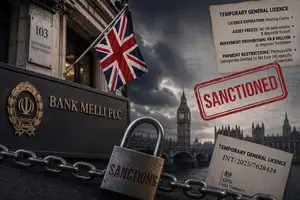
The US Treasury sanctioned Golden Global, alleging it facilitated tens of millions of dollars in transactions for the Islamic Revolutionary Guard Corps’ Quds Force (IRGC-QF) and was established to help move Iranian oil revenues from China to Turkey for conversion into cash and gold.
Golden Global denies the allegations.
Turkey’s banking regulator moved on September 16 to put shareholder rights covering nearly all of Golden Global under the control of the country’s Savings Deposit Insurance Fund (TMSF).
The decision covers stakes held by three shareholders and excludes dividend rights. It comes three days before a US authorization to wind down dealings involving the bank expires.
Corporate filings show Golden Global drew its founding and subsequent leadership heavily from Halkbank. The bank opened in Istanbul in June 2020 with former Halkbank bankers as chairman and general manager, then recruited other veterans as chief executive, vice chairman, board member and compliance head.
Treasury’s designation does not name any of the Halkbank veterans personally. Their career connections are documented in corporate filings and published biographies; the US allegations concern Golden Global and its subsidiaries.
The sanctions came less than three months after a federal judge dismissed the US criminal case against Halkbank on June 17. That prosecution concerned alleged Iranian sanctions evasion between 2012 and 2016 and ended under a deferred prosecution agreement, without an admission of wrongdoing by Halkbank.
Golden Global faces a separate administrative sanctions action.
From Pamukbank to Halkbank
Pamukbank was a privately owned Turkish deposit bank founded in 1955. It established a representative office in Tehran in 1984 to support business between Turkey and Iran, two decades before becoming part of Halkbank.
Reporting on its opening, the Turkish newspaper Milliyet cited Pamukbank general manager Ibrahim Betil as saying inadequate banking links were hampering trade between the two countries. The bank said its Tehran presence would help financing and communication with Turkish businesses.
Pamukbank came under TMSF control in 2002 and was transferred to Halkbank in November 2004. Its assets, liabilities and branches passed to the state-owned lender, including the Tehran office and accounts Iranian banks already held at Pamukbank.
By 2005, Halkbank was publicly promoting its access to Iran’s oil business. Its annual report described it as the only Turkish bank authorized to open letters of credit directly to the National Iranian Oil Company. The Turkish edition also said its Tehran office helped handle large foreign-trade transactions with Iran.
Former Halkbank executive Hakan Atilla later testified in a US trial that the bank initially made only a preliminary assessment of the Iranian relationships inherited from Pamukbank and returned to them after its 2007 initial public offering. Halkbank itself later dated its Iran-related foreign-trade activity to 2004.
In January 2008, US Treasury Under Secretary Stuart Levey pressed Halkbank’s senior management over those Iranian ties. A US diplomatic cable records him urging the bank to close Iranian correspondent accounts and warning against expanding relationships with Iranian financial institutions seeking international partners.
The pressure continued in 2009, when Treasury officials warned Halkbank about Iranian efforts to disguise transactions. Halkbank officials said they financed documented trade and did not handle third-party, transit or cash-for-goods transactions.
From Halkbank to Golden Global
Golden Global later recruited bankers who had built their careers at Pamukbank and Halkbank, including in international banking, foreign operations and compliance.
The bank received its operating licence in early 2020 and opened for business on June 1. Its founding chairman, Mustafa Akin, had begun his career at Pamukbank in 1986 and managed branches for Pamukbank and Halkbank between 1994 and 2011.
Golden Global’s first general manager, Ozay Balta, had started at Halkbank as an assistant inspector in 2004 and served as a branch manager from 2012 to 2016. His published biography lists no other employer before Golden Global.
Yavuz Yeter became general manager in May 2024. He had joined Pamukbank’s Board of Inspectors in 1996 and moved to Halkbank in the 2004 merger, later serving in senior roles in its International Banking and Structured Finance department.
Yeter was therefore in senior international-banking roles during the period when Halkbank advertised its access to the National Iranian Oil Company and received Levey’s warning. That chronology does not establish that he handled the Iranian business. Atilla assigned responsibility for the Iranian accounts and Tehran office to a separate department.
Yeter later moved into senior central-bank roles. From 2016 to 2019 he held a banking-and-financial-institutions post at Turkey’s central bank. From 2020 to 2023 he served as its representative and economic attaché in Frankfurt, then advised its Istanbul office before joining Golden Global.
Coskun Cabuk joined Halkbank in the 2004 merger and worked across inspection, corporate banking and regional coordination, according to Golden Global’s 2025 annual report. The report gives no dates for those individual posts.
Cabuk stayed at Halkbank until 2017, then ran its leasing subsidiary, Halk Finansal Kiralama, until 2024. Golden Global shareholders elected him to the board for two years in March 2025 but his seat ended only a year later. Cabuk became general manager of Turkland Bank in July 2026.
The Halkbank connection also extended to compliance. Golden Global’s 2025 annual report identifies Cigdem Sefer as head of regulation and compliance. She began at Halkbank in 1996 and worked in its foreign operations, international banking and compliance units before joining Golden Global in November 2025.
Her unit’s responsibilities include evaluating correspondent relationships, screening customers and transactions against national and international sanctions, and overseeing obligations relating to money laundering, terrorism financing and proliferation financing.
Gold, cash and correspondent banking
Correspondent banking—the use of other banks to process payments and gain access to financial systems abroad—is central to Treasury’s allegations against Golden Global.
Treasury alleges the bank knowingly provided such services to Iranian financial institutions, enabling transactions through accounts controlled by the IRGC-QF and its proxies. It places Golden Global within Iran’s rahbar system, which it describes as a network of companies coordinating overseas payments for Iranian banks through foreign accounts and money exchangers.
The alleged network used correspondent banking, gold and cash to move funds.
The Treasury identifies Turkish businessman Sitki Ayan and his companies among the networks involved. OFAC sanctioned that network in 2022. Golden Global says it has had no direct or indirect dealings with those individuals..
Golden Global’s own figures show substantial growth in those areas of its business. Its 2025 report lists 45 accounts held at 20 banks in 17 countries and 66 accounts hosted for 25 banks from 16 countries. Those 25 banks are not identified.
Fees paid for foreign settlement services rose 56 percent in 2025 to 482 million lira. The bank also reported playing a critical role in settling $1.8 billion in gold transactions in 2025, nearly three times the $613 million reported a year earlier.
Physical banknote trading reached $4.4 billion, an increase of about 70%. Golden Global also reported $21.9 billion in interbank foreign-exchange trades, nearly double the previous year, and $14.5 billion in currency swaps, more than twice the 2024 total.
The reports document substantial activity in the same types of services Treasury says the Iranian network used. Those aggregate figures do not, on their own, establish which transactions involved sanctioned parties.
The September 19 deadline
Treasury designated Golden Global under Executive Order 13902, which targets specified sectors of Iran’s economy, including finance. It placed the action within Operation Economic Outcast, a campaign announced in August to intensify pressure on Iran’s remaining financial and trading channels.
The sanctions are already in effect. OFAC’s General License CC provides limited authorization for transactions ordinarily necessary to wind down dealings involving Golden Global and other covered entities. That authorization expires at 12:01 a.m. Eastern time on September 19.
The license carries conditions, including a requirement that payments to blocked persons go into blocked, interest-bearing accounts in the United States. When it expires, transactions covered by the licence lose that authorization.
Treasury has also warned that foreign financial institutions conducting or facilitating certain significant transactions on behalf of designated entities could face prohibitions or restrictions on their US correspondent accounts.
For Golden Global, whose business reaches counterparties across more than a dozen countries, the immediate pressure therefore extends beyond its Istanbul office to the institutions connecting it to the international financial system.
US prosecutors are seeking the forfeiture of about $61 million in cryptocurrency that came from black-market sales of sanctioned Iranian crude oil and petroleum products and was intended to finance Iran's government and military, including the Revolutionary Guards.
The US Attorney's Office for the Southern District of New York said on Monday it had filed a civil forfeiture complaint over the assets, which prosecutors said were linked to a network that moved more than $1.5 billion in proceeds from Iranian oil sales.
The IRGC is designated by the United States as a terrorist organization.
Prosecutors target oil payment network
"Today's action demonstrates our determination to deprive the Government of Iran and its terrorist proxies of the illegal money they rely on to threaten the lives and safety of the citizens of the United States and elsewhere," Deputy US Attorney Sean S. Buckley said.
Buckley said Iran relied on black-market sales of sanctioned crude oil to fund its military and other activities.
"As alleged in the complaint filed today, the Government of Iran used a network of cryptocurrency actors in China and elsewhere to launder more than $1.5 billion in illicit oil money intended to benefit the Iranian military and the terror-designated IRGC," he said.
Chinese companies named in complaint
The complaint said two Chinese companies, Blessed Trust and Hexa Whale, used accounts at cryptocurrency exchange Binance in the United Arab Emirates to move proceeds from Iranian oil sales.
Prosecutors said Blessed Trust presented itself as a wealth management or virtual asset custodial services firm but received and transferred proceeds from Iranian crude oil and petroleum product sales. They said it also helped convert traditional currency into cryptocurrency, including through US-based cryptocurrency issuers.
Hexa Whale presented itself as a commodities broker but provided similar services and worked with Blessed Trust and related entities, according to the complaint.
More than $1.5 billion moved through addresses
The complaint said a group of linked, unhosted cryptocurrency addresses identified as "Entity A" received and distributed more than $1.5 billion in proceeds from Iranian oil sales.
Prosecutors said the addresses sent funds to money services businesses and cryptocurrency addresses linked to the IRGC, as well as to an Iranian cryptocurrency exchange.
They said transactions involving Blessed Trust, Hexa Whale and people associated with the companies were structured to conceal the source, ownership and nature of the funds. The complaint also said the two companies used the US financial system to send or receive tens of millions of dollars.
FBI says action cuts funding
"Today's complaint demonstrates the FBI's ability to follow the money, root out illicit schemes, and halt the stream of cryptocurrency to any government attempting to evade sanctions or committing terrorist activities," said James C. Barnacle Jr., assistant director in charge of the FBI's New York field office.
"By cutting off funds raised by the black-market sale of crude oil, the Iranian military and terrorists are weakened," Barnacle said.
The US Attorney's Office said a civil forfeiture complaint contains allegations that money or property was involved in, or represents proceeds from, a crime. The allegations have not been proven, and a court must rule in favor of the United States before the assets can be forfeited.
The image shows the sign for Russia's VTB Bank at its representative office located at the Vira Building in Tehran, Iran.
The United States on Monday imposed new Iran-related sanctions on Russia’s VTB Bank on Monday, accusing the already heavily sanctioned lender of helping Tehran evade restrictions through banking relationships and payment arrangements.
The Treasury Department’s Office of Foreign Assets Control designated VTB under Executive Order 13902 for operating in Iran’s financial sector, expanding Operation Economic Outcast to one of Russia’s largest banks. The action follows measures targeting banking channels in Turkey and the United Arab Emirates.
Treasury said VTB established correspondent relationships with sanctioned Iranian financial institutions over the past three years, took steps to move billions of dollars in frozen Iranian assets and created a settlement system using rial- and ruble-denominated accounts to increase trade between Russia and Iran.
VTB has also had a presence in Tehran since 2023, when it became the first Russian bank to open a representative office in Iran. The bank stressed at the time that the Tehran operation was a representative office rather than a full branch. Treasury said VTB began taking steps in January 2025 to expand its presence in the Iranian capital.
“Under Operation Economic Outcast, Treasury will continue to target and disrupt those who provide material, technological, or financial support that allows the Iranian regime to sustain its terrorist enterprise,” Treasury Secretary Scott Bessent said.
“Treasury will not tolerate any support to the regime and will continue to identify, expose, and isolate Iran’s enablers,” he added.
VTB sanctioned again
Monday’s action does not mark the first time Washington has sanctioned VTB.
The bank was subjected to US sectoral restrictions in 2014 following Russia’s actions in Ukraine and was fully blocked by OFAC in February 2022 under Executive Order 14024 following Russia’s invasion of Ukraine. Treasury also designated VTB in January 2025 under Executive Order 13662. The new action adds an Iran-specific sanctions authority targeting its activities in Iran’s financial sector.
Treasury said the Iran designation creates additional sanctions exposure for foreign financial institutions conducting certain transactions with VTB and urged institutions that continue dealing with the Russian lender to sever those relationships.
The move was foreshadowed by Bessent on September 10, when he said Washington would sanction an unidentified “large bank” on Monday as it continued ratcheting up pressure on Iran.
“We are just going to continue with this process until everyone stops dealing with this regime,” Bessent told Real America’s Voice.
“We will make it so unprofitable that if you want to risk an extinction-level event for your company or for your person, your personal finances, then have at it. But we are coming for you,” he said.
Bessent had earlier warned financial institutions on X after Washington sanctioned Turkey’s Golden Global Bank on September 4.
“Financial institutions continue to find out the hard way that we are serious about Operation Economic Outcast,” he wrote, adding: “We know who you are, we know where you are.”
Economic D-Day
Bessent launched Operation Economic Outcast on August 24, describing it as an economic “D-Day” aimed at severing the remaining financial lifelines sustaining Iran.
The initiative goes beyond imposing restrictions on Iranian entities themselves by threatening foreign companies and financial institutions with loss of access to the US market and financial system if they continue doing business with Tehran.
The VTB action follows two significant moves against foreign banking channels used by Iran.
On September 4, Treasury sanctioned Turkey’s Golden Global Bank and two subsidiaries, alleging the lender facilitated tens of millions of dollars in transactions for the Revolutionary Guards’ Quds Force and helped move Iranian oil revenue from China into Turkey, where money exchangers could convert funds into cash and gold. Golden Global denied the allegations.
On August 28, US authorities took a different approach against the UAE operations of Egypt’s Banque Misr. The Financial Crimes Enforcement Network proposed cutting the branches off from US correspondent banking after identifying them as a “primary money laundering concern.”
The measure was not an OFAC asset-freezing sanction and applied to Banque Misr’s UAE operations rather than the Egyptian parent bank more broadly.
FinCEN estimated that Banque Misr UAE processed approximately $1.8 billion between January 2024 and June 2026 for 103 companies potentially connected to Iranian shadow-banking networks.
Based on leaked Bank Parsian correspondence and transaction records spanning November 2022 to May 2023, the investigation identified 15 banks in the UAE and China through which Iranian financial institutions conducted international transactions. Thirteen had faced no publicly recorded US penalties or enforcement action over their involvement at the time of publication.
The records included 33 payment instructions worth roughly $36 million. One showed Bank Parsian directing Bank Shahr to transfer 3.06 million UAE dirhams purchased from Iran’s central bank from a trustee account to an account at Banque Misr.
Iran International found no evidence that the UAE and Chinese banks knowingly helped Iran circumvent US sanctions.
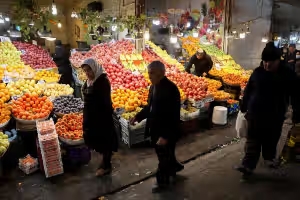
Iranians are struggling to afford basic food as bread prices rise sharply and citizens describe soaring costs for vegetables, snacks and other everyday purchases, according to an local media report and messages sent to Iran International on Monday.
Bread prices in the Iranian capital have risen sharply without official authorization, putting even bread and cheese beyond the means of some workers, labor-focused ILNA news agency reported.
“Things are very bad with bread, and the unofficial increase in bread prices has become staggering. There was a time when a worker could at least count on bread and cheese, but today they can no longer afford even that,” Ali Torkashvand, executive secretary of the Workers’ House, told ILNA.
The pressure comes as Iran’s official minimum wage stands at about 166.3 million rials per month, equivalent to roughly $72 at the open-market exchange rate.
Messages sent separately to Iran International describe sharp increases across basic food and household purchases. One citizen said several kilograms of vegetables had cost 25 million rials, equivalent to about 15% of the monthly minimum wage.
“Damn the Islamic Republic for making people suffer this much. We really can’t afford to buy anything anymore,” the citizen said.
A packet of meat-flavored instant noodles cost 900,000 rials, another citizen said.
“I bought a few food and hygiene products and it came to 20 million rials,” another citizen told Iran International, a sum equivalent to about 12% of the monthly minimum wage.
Bread moves beyond reach
ILNA linked the rising cost of essentials to repeated currency depreciation and increases in energy prices, saying shocks to fuel and foreign-exchange costs feed through to food, medicine, housing and other necessities.
Wages and pension payments had failed to keep pace with rising prices, leaving workers struggling to meet basic household expenses, Torkashvand said.
The latest pressure follows the government’s decision to double Iran’s third-tier gasoline price to 100,000 rials per liter from September 8.
Higher gasoline prices could drive up the cost of other goods and services through increased transportation and production expenses, Torkashvand said.
Iran’s economy has come under mounting pressure from international sanctions and restrictions on trade and finance, the economic fallout from war and US efforts to block Iranian oil exports and other revenue streams, alongside declining investment and domestic economic mismanagement.
Workers were struggling with rising prices even before the latest gasoline increase, Ali Zamiri, a labor activist, told ILNA.
“Under the present circumstances, there is no longer any clear order or pattern to prices, while workers’ incomes have not changed in line with these rising costs,” Zamiri said.
Food prices outpace wages
Prices for some staples have risen far faster than overall inflation, with rice increasing by more than 200% and cooking oil by more than 300%, Majid Rahmati, a member of Tehran province’s Islamic Labor Councils board, told ILNA.
Rahmati called for increased food subsidies and higher wages and benefits during the second half of the Iranian year to offset some of the loss in purchasing power.
The strain has also forced some families to seek credit for basic food. ILNA reported on Sunday that people in poorer areas of Tehran were asking neighborhood stores to let them buy groceries, meat, prepared meals and even bread on credit.
Shopkeepers themselves were finding it increasingly difficult to continue extending credit as their own costs rose, according to ILNA.
Members of the Iraqi armed group Kataib Hezbollah attend the funeral of their members in Baghdad, Iraq, March 2, 2026
The United States on Thursday sanctioned networks it said were helping Iran finance and support allied armed groups across Iraq, Lebanon, the United Arab Emirates and Turkey.
The Treasury Department said the measures targeted individuals and businesses supporting Iraq’s Kata’ib Hezbollah and Lebanese Hezbollah, including militia members, arms dealers, procurement companies, money exchangers and alleged sanctions-evasion networks.
“Whether they finance terror, launder money, or help Iran evade sanctions, we will find them, cut them off from the U.S. financial system, and dismantle the networks keeping the regime aflotat,” Treasury Secretary Scott Bessent said.
Among those sanctioned were four alleged Kata’ib Hezbollah commanders and members.
The Treasury also targeted figures connected to Iraq’s Popular Mobilization Forces, saying Iran-aligned factions had used their positions within the state-backed umbrella organization to obtain military equipment and channel resources to networks linked to Iran’s Revolutionary Guards.
One of those targeted was a UAE-based Iraqi arms dealer whose company, according to the Treasury, supplied goods and services to the Popular Mobilization Forces, including maintenance for Russian-made helicopters.
Another Iraqi procurement company was accused of helping acquire foreign defense equipment and components through dealings involving Russia, Iran and China, and of participating in attempted purchases of US defense articles through sanctions-evasion networks.
The sanctions also targeted Dubai-based Shams and Bahr Trading Company and two Iraqi businessmen associated with it. The Treasury said the exchange had been used to transfer millions of dollars from Iraq to Iran through the UAE.
In Lebanon, Washington focused on what it described as a cash-smuggling network used to move proceeds from Iranian oil sales to Hezbollah.
The Treasury said the Revolutionary Guards’ Quds Force used front companies and regional exchange houses to transfer the money, alleging that two Lebanese businessmen moved hundreds of millions of dollars from the Quds Force to Hezbollah between May and September 2025.
It also targeted gold and currency exchange businesses that it said formed part of the network, including operations involving the purchase of gold in Dubai and its movement into Lebanon by couriers.
The measures are part of Operation Economic Outcast, announced by Bessent on August 24 as Washington sought to sever Iran’s remaining sources of revenue, increase the cost of sanctions evasion and expand secondary sanctions exposure for companies continuing to do business with Tehran.
Alongside the new designations, the Treasury tightened its Iran licensing policy, saying applications for specific licenses covering otherwise prohibited Iran-related transactions would now generally face a presumption of denial, except in limited circumstances.
OFAC also announced a separate $1.43 million settlement with an individual accused of violating Iran sanctions by providing consulting and advisory services to an Iranian software company, receiving Iranian-origin dividends through US bank accounts and acquiring property in Iran.
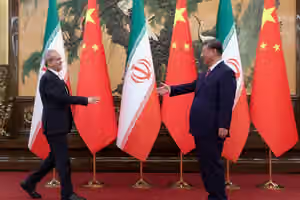
Chinese President Xi and Iranian President Pezeshkian meet in Beijing, File photo.
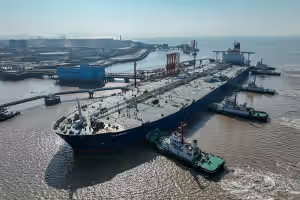
Iran routed an estimated $2 billion to $2.5 billion through a China-based trade mechanism over the past year, using proceeds from oil sales to pay for Chinese goods and, at least once, contracts for military equipment, Reuters reported on Thursday.
The barter-like arrangement allowed Tehran to turn payments for Iranian oil into credits for Chinese imports without sending money directly through international banking channels, Reuters said, citing two senior Iranian sources and three other people familiar with the mechanism.
Iran used the system to buy medicines, vehicles and communications equipment, while it was also used in connection with contracts worth millions of dollars to supply Iran with air defense equipment over the past year, the sources said.
The mechanism has been operating since at least 2021 but has become more important as Washington tightened sanctions on Iran and companies doing business with Tehran, according to the report.
A buyer acting on behalf of Chinese state-owned oil trader Zhuhai Zhenrong had, at least until this year, deposited hundreds of millions of dollars a month with a China-based financial entity known as ChuXin, three people familiar with the arrangement told Reuters.
Those payments covered Iranian oil purchases. ChuXin then sent funds to Chinese exporters and companies involved in infrastructure projects in Iran, likely through other Chinese financial institutions, Reuters reported.
Around 70% of the Iranian oil proceeds handled through the arrangement went to infrastructure projects, while the rest entered accounts belonging to a special purpose vehicle, or SPV, used to pay suppliers of goods to Iran, the sources said.
The two Iranian sources confirmed the existence of the SPV, which Reuters said had not previously been reported.
Oil exchanged for access to Chinese goods
The SPV is managed by two entities, one acting on behalf of China's Ministry of Commerce and another linked to Iran's central bank, according to all five sources.
When Iran's central bank approves an importer to use funds held in the SPV, the Iran-linked entity informs its Chinese counterpart so payments can be made to suppliers, three of the sources said.
The structure gives Chinese manufacturers access to payment without dealing directly with Iran, according to the report. Reuters said there was no indication that the Chinese manufacturers supplying civilian goods had broken sanctions.
Reuters could find no record of a financial institution called ChuXin in Chinese corporate registries, and one source said it may exist only on a spreadsheet.
China's foreign ministry told Reuters it was "not familiar with the situation you describe" when asked about the mechanism.
"China has consistently opposed unilateral sanctions that have no basis in international law and have not been authorized by the United Nations Security Council," the ministry said.
Iran's UN missions in New York and Geneva did not respond to Reuters requests for comment. Iran's central bank, China's commerce ministry, the National Iranian Oil Company and Zhuhai Zhenrong also did not respond to questions about their reported roles.
China has long been the main buyer of Iranian oil. More than 80% of Iran's shipped crude went to China in 2025, averaging around 1.4 million barrels per day, according to Kpler data cited by Reuters.
The arrangement has helped Tehran keep trade flowing despite years of sanctions, while giving China access to discounted Iranian crude.
Its importance has grown as the United States has increased economic pressure on Iran during the six-month-old war. Treasury Secretary Scott Bessent warned countries in August to cut business ties with Tehran or risk losing access to the dollar-based financial system.
Reuters said it could not determine how the US naval blockade on Iranian oil exports had affected the China trade mechanism. No Iranian crude cargoes had successfully passed through the Strait of Hormuz to China since the blockade was reinstated on July 14, according to the news agency.
A UN embargo on exports of most major conventional weapons to Iran was restored in September 2025 along with other sanctions.
Andrea Ghiselli, an international politics lecturer at the University of Exeter who studies China's relations with the Middle East, told Reuters that Beijing wanted to resist US pressure without putting major Chinese banks and companies at risk of exclusion from the international financial system.