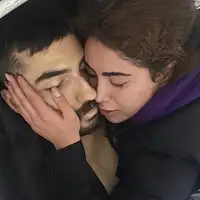
The sisters were 19 when they were arrested after joining January’s nationwide uprising in Isfahan. They turned 20 behind bars and remain imprisoned in Isfahan’s Dowlatabad Prison.
Taraneh has been sentenced to death, while Romina received prison sentences totaling 36 years. They were among 16 defendants tried by Branch 1 of the Isfahan Revolutionary Court in the Shohada Square case, 10 of whom received death sentences.
Masoud Nourmohammadi, the twins’ cousin who lives in the United States, told Iran International that prison authorities have recently begun denying Taraneh food, forcing her to rely on leftovers shared by other prisoners.
He said Taraneh was told the treatment was connected to his efforts to raise awareness about the sisters’ case outside Iran.
“They said your cousin has been talking outside of Iran,” Nourmohammadi said, recounting what Taraneh was told.
“This is the cost you have to pay.”
Nourmohammadi said he has also received daily death threats since speaking publicly about his cousins.
He said messages sent to him include his address and information about his family and warn him to remain silent.
“This is your address. This is your house. This is information about your family. We know where you live,” he said, recounting the threats. “Stop talking or something’s going to happen to your kids.”
Four months without knowing where they were
The sisters’ ordeal began after they joined protests around Isfahan’s Shohada Square during the nationwide uprising in January.
Taraneh and Romina were working at a shoe shop in the area when they closed the store and joined protesters outside, according to Nourmohammadi.
“They came out. They chanted,” he said. “The bravest Iranian people came out that night.”
About a week later, masked security forces broke into the home of a friend where Taraneh was staying, according to the family.
“They broke down the doors,” Nourmohammadi said. “They had masks on. They did not show any warrants.”
He said security forces bound Taraneh’s hands and feet, placed a bag over her head and took her away.
Romina was arrested separately at the family home. Nourmohammadi said security forces raided the house in the middle of the night and took her away in similar circumstances.
For roughly four months, their family did not know where either sister was being held.
Their mother, who raised Taraneh and Romina on her own, searched hospitals, courts and prisons for her only children.
“They were searching all of the hospitals, the courts, the prisons,” Nourmohammadi said.
Family members spent hours outside prisons demanding information, he said.
“No one answered them.”
For Nourmohammadi, thousands of miles away in the United States, the uncertainty was compounded by Iran’s internet blackout, which made communicating with relatives inside the country extremely difficult.
Eventually, his aunt received a phone call telling her the twins were being held at Dowlatabad Prison and that she could visit them.
She was given an appointment roughly two weeks later.
When she finally saw her daughters after months of not knowing where they were, Nourmohammadi said she could barely recognize them.
“Their faces were swollen, bruises all over their faces, their body was malnourished, they were limping,” he said.
“They had basically no hair on their head.”
It was only when the sisters began speaking that their mother realized the young women in front of her were her daughters.
“God, it was hard,” he said. “She only could recognize them when they started speaking ... she recognized them through their voices.”
Nourmohammadi said the sisters spent their first four months in solitary confinement.
‘The only evidence is the confession’
The family says both sisters were subjected to severe physical and psychological abuse during interrogation and coerced into confessing.
Before her arrest, Taraneh worked as an equestrian trainer and dreamed of opening her own riding academy.
Years earlier, she had suffered a serious horseback-riding injury that required orthopedic plates and screws in her leg. Her family alleges interrogators deliberately targeted the existing injury and repeatedly struck her damaged leg.
Romina had undergone stomach surgery before her arrest and was experiencing stomach problems around the time of the protests, according to Nourmohammadi.
The family also alleges that interrogators exploited the twins’ close relationship to pressure Taraneh into confessing.
The sisters had rarely been apart. During detention, relatives say, Taraneh could hear Romina screaming.
Interrogators then threatened to rape Romina unless Taraneh signed a confession, according to the family.
Taraneh later told the court that her confession had been extracted under torture, according to reports on the case.
Human Rights Watch and the Abdorrahman Boroumand Center for Human Rights in Iran have documented allegations that defendants in the Shohada Square case were tortured and coerced into confessing, as well as serious violations of their due-process rights.
Nourmohammadi said there was no substantive evidence against his cousins beyond confessions he says were obtained through torture.
“There is basically zero evidence on the case,” he said. “The only evidence that they have is the confession.”
The Shohada Square case
Taraneh and Romina were prosecuted alongside 14 other defendants over events surrounding the January protests in Isfahan.
Ten of the 16 defendants, including Taraneh, received death sentences.
The defendants faced charges including moharebeh, or “waging war against God,” destruction of public property, assembly and collusion against national security and propaganda against the state.
Human Rights Watch and the Boroumand Center said the prosecution relied heavily on confessions that defendants said were obtained under torture. They also documented restrictions on access to lawyers and other due-process violations.
The rights groups said defendants were accused of involvement in incidents in which two people died, but none of the 16 was charged with murder.
They also reported that defense lawyers sought to introduce mobile-phone videos they said could exonerate defendants, but the material was not admitted as evidence.
Crackdown continues beyond the streets
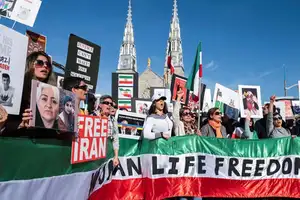
The mass demonstrations that swept Iran in January are no longer visible on the same scale, but the crackdown that followed has continued in prisons and courtrooms.
Protesters arrested during the uprising continue to face lengthy prison terms, death sentences and execution.
At least 29 people arrested in connection with the January protests had been executed by the end of August, according to Human Rights Watch and the Boroumand Center.
Amnesty International said in July that it had identified 60 people, including three children, at risk of execution in connection with the protests. Iran Human Rights has reported that more than 70 protesters were at risk of execution in Isfahan Prison alone.
The actual number could be substantially higher.
The crackdown has also extended to lawyers representing protesters. The Boroumand Center documented the arrests of at least 19 lawyers in the month following the January crackdown, while other lawyers taking protest-related cases have faced threats of arrest, renewed prosecution or disbarment.
For Nourmohammadi, what is happening to his cousins shows that the crackdown did not end when large protests disappeared from Iran’s streets.
“The crisis didn’t stop at January 8th and 9th,” he said. “The massacre didn’t stop there. It is still continuing and it’s happening right now in the prisons.”
“These kids are the best versions of Iranians,” he added. “They’re the bravest, brightest ... Iranian kids, and they don’t deserve that.”