• العربية
  • فارسی
Brand
  • Iran Insight
  • Politics
  • Economy
  • Analysis
  • Special Report
  • Opinion
  • Podcast
  • Live TV
  • Iran Insight
  • Politics
  • Economy
  • Analysis
  • Special Report
  • Opinion
  • Podcast
  • Live TV
  • Theme
  • Language
    • العربية
    • فارسی
  • Iran Insight
  • Politics
  • Economy
  • Analysis
  • Special Report
  • Opinion
  • Podcast
  • Live TV
All rights reserved for Volant Media UK Limited
volant media logo

Women face forced undressing, breast touching at Iran's Evin Prison

Sep 15, 2026, 13:39 GMT+1
Women enter a detention facility under the supervision of a guard in Iran.

Female political prisoners at Iran's Evin Prison face increasingly invasive body searches involving forced undressing and breast touching, leading some to forgo medical treatment and visits, sources told Iran International.

“In some cases, prisoners have been forced to lift their shirts and the guards have also touched their breasts,” one source said.

Body searches have become routine in Evin's women's ward in recent months. Female guards search political prisoners before they leave for family visits, medical treatment or court appearances.

The searches take place in a cubicle recently designated for the purpose. Guards touch different parts of prisoners' bodies and sometimes order them to move or remove clothing, according to the account.

100%
The visitation area of the women’s ward at Evin Prison in Tehran - Photo by Maggie Parvaneh

Families and children searched

Relatives visiting prisoners are also facing more intrusive searches under tighter security measures that differ from previous procedures, another source told Iran International.

Guards force relatives to remove their shoes, inspect the inside of their mouths and touch different parts of their bodies. Children and teenagers visiting imprisoned family members are not exempt and are also touched during searches.

Twenty-two female political and ideological prisoners at Evin demanded an investigation into what they called “sexual harassment” during body searches in a letter in October 2024.

Transgender prisoner Ghazal Marzban also wrote from Evin on August 21 that she was raped following her arrest in May 2023 at an Intelligence Ministry detention facility and threatened into silence.

Sexual violence against detainees has been documented in Iranian prisons since the aftermath of the 1979 revolution, with former prisoners and rights groups describing its use as a means of torture and humiliation.

Searches deter treatment and visits

The increasingly invasive searches have led many women to forgo medical transfers or meetings with relatives and lawyers rather than undergo the procedures, the sources said.

100%
A women’s ward at Qarchak Prison in Iran.

Pressure over prisoners' clothing when leaving the ward has also increased. Women have in some cases been forced to wear slippers and handcuffs.

Iran's Prisons Organization regulations permit searches without clothing only when necessary and under specified conditions. They also require body searches to be conducted with electronic equipment wherever possible.

The sources questioned why scanning equipment was not being used, describing the current procedures as a means of harassment rather than necessary security measures.

More than 40 women imprisoned for financial offenses were recently transferred to Evin's women's ward, and restrictions increased following their arrival, another source told Iran International.

Prison authorities have justified some of the tighter rules by pointing to the presence of non-political prisoners. Women imprisoned for financial offenses now make up around half of those held in the ward.

Iran International reported on July 12 that women protested the transfer over overcrowding and the failure to separate prisoners according to offense. Special prison guards entered the ward and beat several protesters with batons.

100%
A file photo of a women's prison in Iran.

Some political prisoners view the mixing of political and financial prisoners as a deliberate policy intended to weaken collective resistance to restrictions.

Evin's women's ward has become a center of political prisoner activism in recent years, with women staging protests and hunger strikes over executions and other political and social issues.

Most Viewed

US pilot rescue inside Iran draws mockery of Guards
1

US pilot rescue inside Iran draws mockery of Guards

2
VOICES FROM IRAN

Iranians say basic food slipping beyond reach as bread prices soar

3

Eight women face execution in Iran, rights group warns

4
ANALYSIS

Foreign investment in Iran hits zero after war

5

US, Iran hint at talks even as sanctions tighten and Hormuz tensions stay high

Banner
Banner
Banner

Spotlight

  • Iran's Saudi leverage could become its liability
    ANALYSIS

    Iran's Saudi leverage could become its liability

  • Rushed trials, public hangings: Iran courts race to crush dissent
    INSIGHT

    Rushed trials, public hangings: Iran courts race to crush dissent

  • Israeli envoy says no victory until Islamic Republic falls

    Israeli envoy says no victory until Islamic Republic falls

  • Russia may fill Iran gap if support for Yemen Houthis falters
    ANALYSIS

    Russia may fill Iran gap if support for Yemen Houthis falters

  • Bid to oust Pezeshkian exposes rift among Iran conservatives
    INSIGHT

    Bid to oust Pezeshkian exposes rift among Iran conservatives

  • Iran’s hardliners bet on escalation as options narrow
    ANALYSIS

    Iran’s hardliners bet on escalation as options narrow

  • Female political prisoners demand accountability for sexual abuse

    Female political prisoners demand accountability for sexual abuse

  • Iran’s prisoners endure worsening conditions amid bitter winter cold

    Iran’s prisoners endure worsening conditions amid bitter winter cold

  • Trans woman prisoner says she was raped in Iran Intelligence Ministry detention

    Trans woman prisoner says she was raped in Iran Intelligence Ministry detention

•
•
•

More Stories

Islamic Republic asks public to identify opponents abroad

Sep 15, 2026, 10:34 GMT+1
•
Hooman Abedi
100%
Photos published by Iran’s Alaj platform show Iranians abroad targeted by the project, which asks members of the public to help identify and report overseas opponents of the Islamic Republic.

The Islamic Republic has launched a platform asking citizens to identify and report opponents living abroad. Iranians met it with ridicule, pointing to how deeply the state's own security apparatus has been infiltrated.

The Alaj platform – whose name means “remedy” or “cure” in Persian – accepts information through its website, a Telegram bot and Iran's Bale messaging service.

“Alaj operates with the aim of safeguarding national security against anti-Iranian currents,” the Guards-affiliated Fars News Agency said in announcing the project on Monday.

State television also promoted Alaj, giving wider exposure to a system Iranian media had previously discussed but not promoted on the same scale.

Alaj says it has identified and monitored 1,600 people, including 600 identified through reports from members of the public, according to Iranian state media.

Its website publishes information about Iranians abroad, including names and photographs and, in some cases, national identification numbers, dates of birth and fathers' names.

  • Iran uses embassies abroad for surveillance and subterfuge, ex-staff say

    Iran uses embassies abroad for surveillance and subterfuge, ex-staff say

The platform says it targets people outside Iran who act “against the country's interests and security,” including those advocating sanctions or military action and members of separatist groups.

Alaj also lists potential measures against people it identifies, including freezing assets and withdrawing access to consular and citizenship services.

The project's name carries a pointed connotation. Alaj translates as “remedy” or “cure,” framing the people targeted by the platform as a problem to be treated.

People ridicule campaign

Responses to the post promoting Alaj ranged from mockery of Iran's security establishment to explicit warnings that people who inform on opponents could themselves be identified and punished in the future.

One commenter predicted the platform would be hacked and the identities of those submitting reports made public, arguing that previous breaches of major Iranian institutions gave little reason to trust Alaj with sensitive information.

100%

Another suggested the government's turn could eventually come, writing that authorities appeared to have little hope left even of securing future amnesty.

Others portrayed the campaign as a tactic opponents of the Islamic Republic could use themselves. One user said supporters of the Revolutionary Guards and Hamas abroad had already been publicly identified by opponents and several had lost their jobs as a result.

Several responses contrasted the effort to identify ordinary Iranians overseas with Israel's apparent intelligence penetration inside Iran.

“Start with the infiltrators inside your own ranks,” one person wrote, arguing that Israeli intelligence appeared to have extensive knowledge of Iranian officials.

Another mocked the limits of Iran's controls over information, asking whether authorities intended to “nationalize the internet outside the country” to prevent overseas opposition activity.

  • Iran International journalists face escalating threats from Tehran - Forbes

    Iran International journalists face escalating threats from Tehran - Forbes

Other comments were considerably more explicit, threatening revenge against people who cooperate with Alaj after any future change of government.

Pezeshkian targets Iranians abroad

The campaign coincides with sharper official rhetoric toward politically active Iranians overseas.

“Some Iranians abroad, aligning themselves with the enemy, seek to incite the public within the country,” President Masoud Pezeshkian said during a social event on Monday, according to state media.

Pezeshkian accused Washington of seeking “to cause social collapse through the problems and restrictions they have imposed,” and said preserving domestic unity would prevent Iran from yielding to US pressure.

Guards used similar model at home

Alaj follows a similar crowdsourcing project launched by the Revolutionary Guards Intelligence Organization in June to identify citizen journalists and social-media users inside Iran.

Known as Jasous-Yab, or “Spy Finder,” the project used channels on the Iranian Eitaa and Bale messaging platforms to ask members of the public to identify people photographing or filming missile strikes and other sensitive locations.

“This time, you identify the spies,” the campaign told users.

100%
A large gathering of Iranians in Munich, Germany, in February 2026, with participants waving Lion and Sun flags.

People were instructed to scrutinize buildings, roads, sounds, distances and other details visible in photographs and videos to determine where material had been recorded and submit information to Revolutionary Guards intelligence.

The project also sought to identify social-media users opposing the Islamic Republic, extending its scope beyond people recording events on the ground.

Alaj takes that crowdsourcing model beyond Iran's borders, asking citizens to help identify overseas opponents and feeding the resulting information into a system that advertises consequences for those it identifies.

Overseas operations

Iranian intelligence activity targeting dissidents and journalists overseas has previously prompted criminal investigations, sanctions and warnings from Western governments.

  • Western powers condemn Iran over targeting opponents abroad

    Western powers condemn Iran over targeting opponents abroad

Authorities in the United States and Europe have accused Iranian security bodies and people working on their behalf of conducting surveillance and plotting abductions or killings of opponents abroad.

Activities linked to Alaj could therefore face scrutiny under espionage, foreign-interference or transnational-repression laws in countries where targets live, depending on how information is gathered and subsequently used.

Iran's Saudi leverage could become its liability

Sep 15, 2026, 03:28 GMT+1
•
Negar Mojtahedi
100%
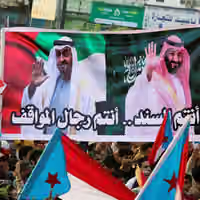
People hold a banner with images of the Emirati President Sheikh Mohamed bin Zayed Al Nahyan and Saudi Crown Prince Mohammed bin Salman during a rally organised by Yemen’s Southern Transitional Council in Aden, December 21, 2025.

Iran has gained leverage over Saudi Arabia as Houthi advances and attacks put pressure on the kingdom’s territory and oil routes. But Riyadh is responding more forcefully, raising the risk that Tehran’s advantage could provoke a military backlash that ultimately weakens it.

Saudi Arabia is taking a harder military posture after efforts to defuse tensions with Tehran stalled. Riyadh had sought de-escalation, wary that a wider conflict could threaten the regional stability on which its economic ambitions depend.

A meeting planned for Monday between Iran and several Persian Gulf states over arrangements for the Strait of Hormuz was postponed after Saudi Arabia requested a delay, amid Riyadh’s growing frustration over attacks by Iran-aligned groups.

That leaves Riyadh with options, none of them ideal.

Saudi Arabia does not want an all-out war. But the Houthis may be testing how long the kingdom can afford to avoid one.

Saad bin Tefla Al Ajmi, Kuwait's former information minister, said Saudi Arabia has so far exercised patience but its military options remain open.

That restraint reflects what the kingdom has at stake. Saudi Arabia has spent years trying to avoid being dragged back into direct conflict with the Houthis, while its economic transformation depends heavily on regional stability.

"There is no stability, there is no development. There is no stability, there is no prosperity," Al Ajmi told Iran International.

But Houthi attacks on Saudi territory and advances along Yemen’s Red Sea coast are making that restraint increasingly difficult to maintain. The Saudi-led coalition said Houthi missile and drone attacks on Khamis Mushait, Abha and Taif on Monday injured 13 civilians.

Al Ajmi believes some of the Houthis' recent territorial gains could be reversed, particularly if Saudi Arabia decides to deploy its overwhelming advantage in air power. He described Houthi forces operating along the flat Tihamah coastal plain as "sitting ducks."

Saudi Arabia led a military intervention against the Houthis beginning in 2015, with direct hostilities largely subsiding after a UN-brokered truce began in 2022. Years of bombardment failed to eliminate the movement, and Riyadh subsequently spent years trying to avoid being pulled back into a full-scale Yemen war.

The question now is whether the Houthis are pushing that restraint too far.

Houthis risk overplaying their hand

The battlefield in Yemen remains fluid. The Houthis have seized Mokha, Dhubab and Perim Island and expanded their control along Yemen’s Red Sea coast, while Saudi-backed government forces have regrouped and vowed to retake lost territory. That leaves open the question of how durable the Houthis’ gains will prove.

"The Houthis fought the Saudis and the Saudi militias for years. They also have a history of being overextended," Alberto Fernandez, a former senior US diplomat, told Iran International.

Fernandez said the Houthis may have pushed too far.

"I think we could see them lose some of the territory that they've gained," he said.

"They're arrogant. Yes, they're motivated by ideology. And when you're motivated by ideology and you're arrogant, you tend to sometimes overextend," Fernandez said.

But the Houthis are also betting on reluctance from both Saudi Arabia and the United States to become drawn more deeply into the conflict.

Saudi Arabia's attempt to remain outside the wider Iran war has already "certainly backfired on them," Fernandez said.

The uncertainty over how much the kingdom can rely on its allies only complicates its options.

Fernandez described the relationship between Washington and Riyadh as increasingly complicated. The Saudis, he said, felt blindsided by the United States launching the Iran war, while Washington in turn felt unsupported by Riyadh.

That strain has become more visible as Crown Prince Mohammed bin Salman sought direct US military action against the Houthis, while Trump declined requests for US strikes and Washington limited its support to intelligence and targeting assistance.

That uncertainty also extends to the Makkah Joint Defense Agreement, signed by Saudi Arabia, Turkey and Pakistan on August 7. The pact says an armed attack against any one of the three countries will be regarded as an attack against all.

"So far [it] has turned out to be a paper tiger," Fernandez said, joking that the arrangement appeared to have the equivalent of a health insurance "pre-existing condition clause."

Saudi Arabia looks elsewhere for help

As Washington hesitates, Saudi Arabia is looking elsewhere.

British Prime Minister Andy Burnham is considering Saudi requests for diplomatic and military support to counter the Houthis, Bloomberg reported Monday, as London grows increasingly concerned about the economic consequences of another expanding front in the Iran war.

The requests come as Britain has backed Saudi Arabia’s right to defend itself against Houthi attacks and stressed the importance of protecting freedom of navigation and global trade through the Red Sea.

The widening conflict has raised the stakes beyond Yemen. Houthi gains along the Red Sea coast and around Bab el-Mandeb, combined with attacks on Saudi energy infrastructure, are putting pressure on westward export routes that have become more important while shipping through the Strait of Hormuz remains constrained.

The Houthi offensive and attacks on Saudi energy infrastructure have added further pressure to oil markets already strained by the Iran war. Brent crude climbed above $108 a barrel Monday after attacks shut down Saudi Arabia’s East-West pipeline, a crucial alternative export route while shipping through the Strait of Hormuz remains constrained.

"It gets to push up oil prices a little more," Fernandez said.

"For them, every dollar that prices go up, for them they see that as a plus for the regime, putting a little more pressure on the Americans and the Europeans."

The paradox for Tehran is that the greater the disruption caused by the widening conflict, the stronger the incentive may become for governments outside the region to help Saudi Arabia contain the threat.

Iran does not need to control the Houthis

"The broader strategic danger is that Iran does not need to control the Houthis completely to benefit from their actions," Mohamed Fahmy, a journalist and Middle East political analyst, told Iran International.

"It only needs the movement to retain sufficient military capability, autonomy and motivation to pressure critical maritime routes while Tehran maintains distance from the confrontation."

Fahmy cautioned against reducing the Houthis to an Iranian proxy.

They are "an intensely nationalist movement with their own domestic agenda and deeply rooted local interests," he said.

Their relationship with Tehran is nevertheless exceptionally close. Iran has provided weapons, military technology, intelligence and other support, Fahmy said, while the strategic interests of the two sides increasingly converge.

That convergence has become particularly consequential around the Red Sea and Bab el-Mandeb.

"One of the Houthis' strategic objectives is to exert control over Yemen's Red Sea coast and the northern Red Sea, where they can increasingly influence who is permitted to transit and who is not," Fahmy said.

For Tehran, the Houthis therefore provide an additional source of pressure on its adversaries without requiring direct Iranian military involvement.

But Saudi Arabia's military answer is not straightforward.

Fahmy pointed to Saada, the Houthis' traditional stronghold and geographical heart of their power, which has been repeatedly targeted by Saudi forces since the intervention began in 2015. Despite years of Saudi-led bombardment and military pressure, the Houthis survived and retained significant military capabilities.

"A limited campaign of additional strikes is therefore unlikely to fundamentally diminish their ability to threaten shipping or project power across the Red Sea," Fahmy said.

That leaves Saudi Arabia confronting a difficult choice.

Continued restraint risks allowing the Houthis to impose greater costs on the kingdom and giving Tehran additional leverage. But a renewed military campaign carries risks Riyadh knows well after years of fighting failed to eliminate the movement.

Iran has gained leverage as the war reaches Saudi Arabia. But the more Houthi attacks raise the costs for Riyadh, the greater the risk that Tehran’s leverage provokes the response that ultimately erodes it.

Resistance born from Mahsa Amini’s death endures, UN rapporteur says

Sep 14, 2026, 16:35 GMT+1
100%
The front page of Iranian newspaper Jahan-e Sanat shows a portrait of Mahsa “Jina” Amini over a map of Iran.

UN Special Rapporteur on Iran Mai Sato said the movement born from Mahsa “Jina” Amini’s death in Iran’s morality police custody remains alive four years on, despite another deadly crackdown and continued enforcement of mandatory hijab rules.

Sato said the Woman, Life, Freedom movement brought together women and men across Iran’s ethnic groups and provinces to demand equal rights for women and girls.

Authorities responded with lethal force in 2022 and again during the nationwide protests of December 2025 and January 2026, she wrote on X.

She said mandatory hijab enforcement had also continued despite the suspension in December 2024 of the Law on Protecting the Family through the Promotion of the Culture of Chastity and Hijab. Cafes, restaurants and shops are still being closed when employees or customers appear without hijab, with arrests reported in some cases.

Mahsa “Jina” Amini, a 22-year-old woman from Saqqez, was detained while visiting Tehran with her brother on Sept. 13, 2022, for allegedly wearing her headscarf improperly. She collapsed after being taken to a morality police detention center and died in hospital three days later.

Iranian authorities denied that she had been beaten and attributed her death to an underlying medical condition, a claim rejected by her family. A UN fact-finding mission later concluded that Amini’s death was unlawful and caused by physical violence while she was in state custody.

Medical documents obtained by Iran International showed skull fractures, hemorrhaging and brain swelling consistent with severe trauma.

Protests began at Amini’s funeral in Saqqez on Sept. 17 and spread to more than 160 cities and towns, with women burning their headscarves and demonstrators chanting “Woman, Life, Freedom.”

At least 551 protesters, including 68 children, were killed, hundreds suffered blinding eye injuries and more than 20,000 people were arrested. The UN mission found that parts of the crackdown, including killings, torture, rape and other sexual violence, amounted to crimes against humanity.

Women continued appearing unveiled in public after the protests subsided, prompting authorities to turn to surveillance cameras, drones, vehicle impoundments and the Nazer reporting application. A 74-article hijab law introducing heavier fines, prison terms and other severe punishments was due to take effect in December 2024 but was halted following widespread opposition.

The next nationwide protest wave began over the collapsing rial and rising prices in late December 2025 before becoming an anti-government uprising.

Documents reviewed by Iran International showed that more than 36,500 people were killed during the crackdown on Jan. 8 and 9, while authorities acknowledged 3,117 deaths. A communications blackout and restrictions on independent reporting complicated verification.

Ahead of Mahsa’s fourth anniversary, people in Isfahan, Rasht, Fouman, Mashhad and Neyshabur told Iran International that morality police, hijab enforcers and plainclothes agents had returned to the streets.

Reports included women being detained for appearing without headscarves and vehicles being stopped or having their license plates removed.

“Four years on, the resistance Jina’s death gave rise to has not been extinguished,” Sato said. “Those rights will not stay deniable forever.”

Iran blocks restaurant page over ‘Bibi cutlet’ post

Sep 14, 2026, 14:55 GMT+1
100%

Iranian authorities blocked the Instagram account of a Tehran restaurant after it posted an apparent play on two terms that have become politically charged for the Islamic Republic: “Bibi” and “cutlet.”

The restaurant, Dastpokht-e Bibi (Bibi’s Cooking), posted an Instagram story reading “Nothing beats Bibi’s cutlet” alongside Iranian pop star Moein’s song Bibi Gol.

Shortly after the post went viral, the restaurant’s account was blocked by judicial order for what authorities described as “publishing criminal content.”

100%
The restaurant's page on Instagram was shut down by the Iranian authorities

On its face, the post advertised one of the restaurant’s dishes. But both words carry meanings in Iran’s increasingly coded political vocabulary.

“Bibi” is an old-fashioned Persian term for one’s grandmother. But it is also the widely used nickname of Israeli Prime Minister Benjamin Netanyahu and has become politically charged in Iran, particularly after the wars with Israel and the United States, as the nickname appeared in anti-government memes and expressions of support for Israeli attacks on the Islamic Republic.

  • Israeli Killings Of IRGC Generals Unleash Mockery Among Iranians

    Israeli Killings Of IRGC Generals Unleash Mockery Among Iranians

“Cutlet,” meanwhile, has been a political taunt since Qasem Soleimani was killed in a US drone strike in Baghdad in January 2020. Opponents of the Islamic Republic began referring to the former Quds Force commander as “cutlet” or “kotlet”, mocking the condition of his body after the strike.

The term subsequently became a broader euphemism on Persian social media for senior regime figures killed in military attacks.

The combination of the two words therefore allowed the restaurant’s slogan — “Nothing beats Bibi’s cutlet” — to be read as a reference to Netanyahu and Iranian officials killed by Israel, although the restaurant did not explicitly make such a political statement.

Authorities have acted over similar wordplay before. Celebrity chef Navab Ebrahimi was arrested in January 2023 after posting a recipe for cutlets on Instagram on the anniversary of Soleimani’s killing. His restaurant was also sealed and his Instagram account taken offline.

  • Iranian Professor Arrested For Mocking IRGC Commander's Death

    Iranian Professor Arrested For Mocking IRGC Commander's Death

In January 2024, an Iranian doctor and university professor from the city of Bojnourd in the northeast was detained after posting a picture of "cutlet" on the night of the death of IRGC commander Razi Mousavi.

In June 2024, the Iranian judiciary initiated a legal case against Hossein Pakdel, a playwright and theater director, for allegedly "disrupting the psychological security of society". Pakdel's Instagram post suggested that politics transform "stupid men into special diet cutlets".

The sensitivity surrounding references to Israel has intensified further during the current war.

Iranian authorities said in March that more than 1,000 people had been arrested over accusations including sharing anti-government material online or cooperating with Israel and the United States, while the judiciary warned that some forms of assistance to hostile states could carry the death penalty.

  • Khamenei ‘rat’ taunt spills from social media onto Iran’s campuses

    Khamenei ‘rat’ taunt spills from social media onto Iran’s campuses

IAEA raises alarm over Iran access as Hormuz tensions mount

Sep 14, 2026, 13:23 GMT+1
100%
Pedestrians walk past a billboard promoting Iran’s nuclear program in Tehran.

Concern over Iran’s nuclear program intensified on Monday as the UN nuclear watchdog said it had conducted almost no inspections in the country for more than six months, while tensions surrounding Hormuz deepened and Yemen’s Iran-backed Houthis claimed another attack on Saudi.

The developments centered on the loss of international oversight of Iran’s nuclear material, mounting restrictions and threats involving shipping through Hormuz, and a new round of regional military activity that prompted Saudi emergency alerts and high-level talks with the head of US Central Command.

IAEA warns of serious proliferation concern

The International Atomic Energy Agency has carried out no in-field verification activities in Iran for more than six months, except for an inspection of the Bushehr nuclear power plant in June, Director General Rafael Grossi said at the agency’s General Conference in Vienna.

Grossi said the IAEA withdrew its inspectors after renewed attacks on Iran in late February, worsening a decline in oversight of Tehran’s nuclear program during 2026.

The agency has also lacked continuity of knowledge for more than a year regarding Iran’s previously declared inventories of low- and highly enriched uranium, including material enriched to 60% purity, at nuclear facilities affected by attacks in June 2025.

“The Agency’s lack of information about this nuclear material and access to facilities to verify it is a matter of serious proliferation concern and needs to be addressed with the utmost urgency,” Grossi said.

He called a return to diplomacy and negotiations over Iran’s nuclear program “imperative,” warning that the situation had consequences for the wider global non-proliferation system.

The remarks came as Iran summoned Austria’s chargé d’affaires over Vienna’s failure to issue a visa to Mohammad Eslami, the head of the Atomic Energy Organization of Iran. Foreign Ministry spokesperson Esmail Baghaei called the decision “completely unjustified” and said Tehran had formally protested.

Bloomberg reported earlier that Austria denied Eslami entry after pressure from the Trump administration, preventing him from addressing the IAEA conference. A US official cited by Bloomberg said Washington had urged Austria not to grant a UN-requested sanctions waiver that would have permitted the visit.

Iran threatens restrictions against 77 vessels

Maritime tensions also escalated as Iran’s Persian Gulf Strait Authority published an updated list of 77 vessels it accused of violating Iranian protocols governing passage through the Strait of Hormuz.

The authority warned that the vessels could face restrictions on future passage, including fines, detention or confiscation. Ships cooperating with vessels on the list would also be added, it said, while companies and other entities were warned not to provide services to them.

  • Hormuz diplomacy stalls as attacks deepen pressure on Persian Gulf oil routes

    Hormuz diplomacy stalls as attacks deepen pressure on Persian Gulf oil routes

Iran’s Foreign Ministry said Tehran would continue taking what it considered necessary measures for as long as the United States maintained its maritime blockade.

Baghaei said security in the Strait of Hormuz was a matter for Iran and Oman as the two coastal states and blamed US actions for instability in the waterway. He said an understanding between Tehran and Muscat establishing safe shipping routes had been reached after weeks of negotiations while preserving the sovereign rights of both countries.

But a wider regional meeting planned in Oman had been postponed. Baghaei said it could have provided even a small step toward dialogue between Tehran and Persian Gulf countries, describing its postponement as a missed opportunity.

“Israel is the only beneficiary of tensions between Iran and Persian Gulf countries,” he said, calling on neighboring states to set aside past disputes and pursue regional dialogue.

Saudi Arabia had sought amendments to the Omani-Iranian proposal over concerns that its language could establish an unacceptable new status quo in the strait, Axios reported, citing a senior regional official.

The United States, meanwhile, said its forces had redirected 101 commercial vessels while enforcing the blockade against Iran as of September 13.

Shipping traffic through Hormuz remained sharply reduced over the weekend. Only four commodity vessels exited the Persian Gulf and 10 entered, Reuters reported, citing preliminary tracking data. Daily traffic fell to single digits, compared with a 10-day average of 14 vessels, although the figures excluded ships operating with their tracking transponders switched off.

The IRGC also said that it had detected and destroyed an advanced MQ-1 drone over the Strait of Hormuz using a new Aerospace Force air-defense system. It did not identify the drone’s operator, and the statement was not independently verified.

Houthis claim Saudi air-base attack

Yemen’s Iran-backed Houthis said they attacked an air base in Khamis Mushait in southwestern Saudi Arabia on Monday. Saudi authorities did not immediately confirm that a strike had occurred.

Saudi Arabia’s Civil Defense initially issued emergency alerts warning of potential danger in Khamis Mushait and nearby Abha, but announced shortly afterward that the danger had passed in both locations.

Saudi Crown Prince Mohammed bin Salman met US Central Command chief Admiral Brad Cooper to discuss the latest regional developments.

Elsewhere, missiles struck three camps belonging to Iranian Kurdish opposition groups east of Sulaimaniya in Iraq’s Kurdistan region early Monday, two security sources told Reuters. No casualties were reported, and the sources did not identify who carried out the attacks.

The latest round of tensions has added to pressure on energy markets and regional shipping. Brent crude rose more than $3 to above $108 a barrel at the opening on Monday following fresh strikes on Saudi Arabia and vessels in the Persian Gulf over the weekend.

Pressure was also evident in Iran’s currency market with the US dollar trading at 2.34 million rials, the euro at about 2.7 million rials and the British pound at 3.16 million rials by around midday Monday.