• العربية
  • فارسی
Brand
  • Iran Insight
  • Politics
  • Economy
  • Analysis
  • Special Report
  • Opinion
  • Podcast
  • Live TV
  • Iran Insight
  • Politics
  • Economy
  • Analysis
  • Special Report
  • Opinion
  • Podcast
  • Live TV
  • Theme
  • Language
    • العربية
    • فارسی
  • Iran Insight
  • Politics
  • Economy
  • Analysis
  • Special Report
  • Opinion
  • Podcast
  • Live TV
All rights reserved for Volant Media UK Limited
volant media logo

Trans woman prisoner says she was raped in Iran Intelligence Ministry detention

Aug 21, 2026, 14:05 GMT+1
Ghazal Marzban
Ghazal Marzban

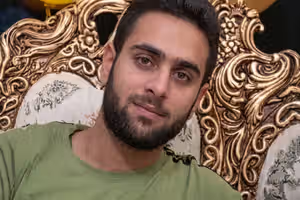
Ghazal Marzban, a transgender woman held in Tehran’s Evin prison, says she was raped after being detained by Iran’s Intelligence Ministry in 2023 and later threatened into silence, according to a letter published by the HRANA human rights news agency.

Marzban said she was arrested on May 17, 2023, while walking in a park, when two men and a woman approached her and told her she was being detained. After she resisted, two more men arrived and forced her into a vehicle, she wrote.

She said she was blindfolded and driven for about an hour to a location she later learned was an Intelligence Ministry detention facility.

According to her account, a female officer took her to a room for a search and ordered her to remove all her clothes. She said she was then wrapped in a chador while naked and taken by force to a basement cell.

Less than 10 minutes later, Marzban wrote, a masked man entered the cell and raped her despite her resistance, screams and protests.

“Time felt like years,” she wrote. “I don’t know, perhaps half an hour; perhaps less or more.”

Marzban said she was left bleeding on the floor of the cell after the assault.

She said two masked women and another woman dressed as a nurse entered the cell several minutes later and treated her injuries.

  • Leak Reveals Inner Workings Of Rape Cover-Up By Iranian Regime

    Leak Reveals Inner Workings Of Rape Cover-Up By Iranian Regime

Marzban said several men subsequently told her she would be released that night if she remained silent about what had happened. She was blindfolded again, driven away from the facility and repeatedly warned during the journey about the consequences of speaking out, according to her letter.

She said she was eventually left near her home at around 7 p.m.

Silence and a second arrest

Marzban said she initially told no one about the assault, including her spouse, who she said had lived for years with advanced Parkinson’s disease.

“After this incident, I became isolated, distanced myself from others and stopped going to the park for walks,” she wrote.

She was arrested again around midnight on January 14, 2026, and taken to the same Intelligence Ministry detention facility, according to the letter.

Marzban said the greatest source of torment during the 22 days she spent there was the fear that she would be sexually assaulted again.

She said she repeatedly objected to men entering the women’s detention area and was met with hostility from officials.

Marzban, who converted to Catholic Christianity, was later transferred to Evin prison. She was sentenced by a Tehran Revolutionary Court in June to nine years and eight months in prison on charges including “propaganda against the system” and “assembly and collusion against national security.”

She said she tried several times during her later detention to file a formal complaint over the alleged 2023 assault, but officials prevented her from doing so and threatened her into silence.

Seven months after her latest arrest, she wrote, the sight of men still causes her anxiety.

  • Iran’s security agents gang rape two nurses detained for aiding protesters

    Iran’s security agents gang rape two nurses detained for aiding protesters

Previous allegations of sexual violence in detention

Marzban’s account adds to years of allegations by political prisoners and protesters who have described rape, sexual assault and other forms of sexual violence in Iranian prisons and detention centers.

Iran International reported in February that several women and girls detained during January’s protests said they had been sexually assaulted or raped in custody. Among them were a young woman and a 17-year-old girl who said they were raped at an unofficial detention facility operated by the Revolutionary Guards.

Twenty-two female political and religious prisoners at Evin also wrote that year demanding an investigation into what they described as sexual abuse during body searches.

A year-long Iran International investigation published in 2024 found evidence that security forces had used sexual violence against protesters across several provinces during the 2022 demonstrations.

Victims have often said fear of retaliation and distrust of Iran’s judicial system deterred them from filing complaints, while those who did pursue cases frequently said their complaints went nowhere.

Marzban said she was speaking publicly in the hope that others who had suffered similar abuse would feel able to tell their stories.

“I hope that one day the seeds of our suffering will sprout,” she wrote, “and the tree of our demand for justice will grow strong.”

Most Viewed

Tehran gas stations run dry as fuel price hike fears mount
1
VOICES FROM IRAN

Tehran gas stations run dry as fuel price hike fears mount

2

Iran campaign urges people to fund sacrifice of 10,000 sheep for Khamenei’s health

3
ANALYSIS

The unlikely return of European diplomacy in the Iran-US conflict

4

Trump says Hormuz open as reports point to weaker Iran control

5

A poem hailed as Khamenei's prophecy is an acrostic: Born of Satan

Banner
Banner
Banner
•
•
•
  • Weaponizing sexual violence: Iran's systematic abuse to suppress 2022 protests

    Weaponizing sexual violence: Iran's systematic abuse to suppress 2022 protests

Spotlight

  • Turkey’s gas pivot leaves Iran with fewer cards to play
    ANALYSIS

    Turkey’s gas pivot leaves Iran with fewer cards to play

  • With the war quieting, Iran's hijab crackdown gathers pace again

    With the war quieting, Iran's hijab crackdown gathers pace again

  • UAE trade halt threatens one of Iran’s remaining economic lifelines
    ANALYSIS

    UAE trade halt threatens one of Iran’s remaining economic lifelines

  • Can Iran's fragile economy survive Trump's 'Economic D-Day'?
    ANALYSIS

    Can Iran's fragile economy survive Trump's 'Economic D-Day'?

  • The unlikely return of European diplomacy in the Iran-US conflict
    ANALYSIS

    The unlikely return of European diplomacy in the Iran-US conflict

  • For Iranian journalists, exile can last a lifetime
    OPINION

    For Iranian journalists, exile can last a lifetime

More Stories

With the war quieting, Iran's hijab crackdown gathers pace again

Aug 21, 2026, 10:09 GMT+1
•
Maryam Sinaiee
100%

The men who spent the war demanding control of the Strait of Hormuz have returned to demanding control of women's clothing. As the fighting subsides, Iran's hardliners are pressing to revive a hijab law the state itself suspended for fear of new protests.

The push is coming from figures with real leverage, including inside the judiciary, and it has two aims: harsher enforcement of the dress code now, and an end to the suspension of Iran's strict Hijab and Chastity law.

Tehran Prosecutor Ali Salehi said on Monday the judiciary was preparing to move against cafes, restaurants and clothing stores for "committing acts contrary to public chastity and selling unconventional clothing."

On Thursday he went further, ordering judicial authorities to identify and confront what he called "organized and networked actors" promoting unveiling, whom he accused of spreading corruption in public places and offending public sentiment.

The closures were already underway. In recent weeks authorities have shut cafes, restaurants, shops and sports clubs in more than 15 cities, including Tehran, over hijab violations by customers or staff.

  • Iran seals dozens of businesses in renewed hijab crackdown

    Iran seals dozens of businesses in renewed hijab crackdown

Women have also been blocked from obtaining motorcycle licenses, despite a government decision sent to police in February.

The reformist daily Shargh wrote on Wednesday that the resistance appeared to have little to do with law or road safety, and everything to do with what women would be wearing on the bikes.

'Hijab is a flag'

The pressure is louder on the street and online than in the institutions.

Hijab has moved to the front of the placards and slogans at the nightly pro-government rallies, according to social media users who follow them. Those gatherings drew some unveiled women in the early weeks of the war. They are far smaller now, and the crowd is almost entirely hardline.

Their target is often President Masoud Pezeshkian, who has not submitted the Hijab and Chastity law to government bodies for implementation, and whom demonstrators accuse of letting unveiled women multiply.

Pezeshkian has not objected to the law itself. The decision to freeze it was taken above him, out of fear that enforcing it would set off a new wave of anti-government protests.

Female hardliners have held their own gatherings in cities including Isfahan and Mashhad. Outside the governor's office in Isfahan, one placard carried a line attributed to Israeli Prime Minister Benjamin Netanyahu: "Unveiled women are our free soldiers."

Online, hardliners have been circulating footage of women walking, exercising, dancing and singing in shopping centers, cafes and streets, demanding that the authorities act against women they call "naked."

"Do you see the widespread wave of hijab tweets? The message is completely clear: the authorities have made up their minds to put an end to this situation. I can't wait for the operational phase to begin as soon as possible," one hardline user wrote.

The argument they make for themselves is that the veil is not a rule but a banner. "Hijab is the flag of the Islamic Republic and must not be allowed to fall," runs a common formulation.

"Hijab is not merely a secondary religious ruling; hijab is a flag," a hardline cleric posted. "If there is leniency over it, it will lead to the destruction of the family and the weakening of other religious laws." His patience, he warned, and that of others like him, could run out.

Other users have been keeping score. One noted that the same voices who spent the war demanding control of the Strait of Hormuz, guaranteed revenues from the waterway and a seat at the table of global oil pricing had "returned to factory settings," their attention back on women’s clothing.

A law too dangerous to use

The Hijab and Chastity law, finalized in 2024, is harsher than anything before it, and includes provisions that would let civilian groups confront women over their clothing.

It has never been enforced. Implementation was suspended over fears it would set off protests on the scale of those that followed Mahsa Amini's death, and the Supreme National Security Council's decision still stands.

The freeze carries the late supreme leader's authority. Interior Ministry spokesman Ali Zeynivand said this month that it was decided under Ali Khamenei and has not changed, and that Pezeshkian, too, supports it.

Meanwhile, the streets have moved. Unveiled women are far more visible than a year ago, and many now dress in ways that would have been unthinkable in public not long before.

Women's rights activists warn against reading that as the end of compulsory hijab. Women employed in government offices and institutions are still held to the dress code, and unveiled women are still turned away from some buildings and services unless they cover their hair, arms and legs.

Some users see the easing as a product of the war rather than a change of policy, and expect it to end with the fighting. "If the situation becomes more stable, I doubt the authorities will refrain from bringing their repressive forces back onto the streets to enforce hijab on women," one wrote.

Even among those who support compulsory hijab, some think a crackdown now would backfire. Morteza Panahian, a young cleric who has also criticized the refusal to license women motorcyclists, wrote that anyone blaming the spread of unveiling on the law's suspension had evidently never read the law.

"This law is so impossible to implement that, if it is promulgated, the pace of unveiling will double," he wrote.

Iran's top university expels student over toy rat that mocked Ali Khamenei

Aug 20, 2026, 09:22 GMT+1
100%
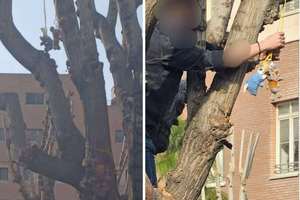
A stuffed rat is hung from a tree during protests at Sharif University in February 2026.

A student at Iran's most prestigious technical university has been expelled and banned from all universities for four years over a stuffed rat hung from a campus tree, a toy that carried the nickname protesters gave the late supreme leader.

Sharif University's student affairs office said the ruling against Reza Dalman, a 24-year-old master's student in computer engineering, was final. "The final ruling was communicated to the university for implementation on August 16," the office said.

Dalman was arrested on March 19 and released on bail about a month later. Student sources link his case to a stuffed rat that demonstrators hung from a tree during protests at Sharif in late February, before a Basij-affiliated student climbed up and took it down.

The toy was an insult with a name. Critics began calling Ali Khamenei "Moush-Ali," or Rat-Ali, after the late supreme leader largely vanished from public view during the 12-day war with Israel in June 2025, when reports said he had taken shelter in a fortified underground facility.

  • Khamenei ‘rat’ taunt spills from social media onto Iran’s campuses

    Khamenei ‘rat’ taunt spills from social media onto Iran’s campuses

  • 'Rat-Ali': Iran’s protest nickname targets Ali Khamenei’s time underground

    'Rat-Ali': Iran’s protest nickname targets Ali Khamenei’s time underground

Moush means mouse, or rat. The nickname spread from social media into chants at protests inside Iran and among the diaspora, a way of mocking a leader his opponents said had run for cover.

Dalman published an image of the final decision, stamped "confidential," on his X account. Among the points the university listed against him was that during his defense he showed "no expression of remorse."

The expulsion sits alongside a judicial case against Dalman and a widening series of disciplinary rulings at one of Iran's most prominent universities.

Expulsion orders reach 10

Three more Sharif students have received preliminary expulsion orders, bringing to 10 the number facing such rulings, the United Students group said on Wednesday.

The latest are Ariana Kouchaki, an industrial engineering undergraduate, Ali Alirezaei, a mathematics undergraduate, and Arash Hatami, a physics undergraduate. Kouchaki and Hatami were each barred from studying at any university in Iran for one year, while Alirezaei received a five-year nationwide ban, according to the group.

Seven other Sharif students had already received expulsion orders. Dalman's is the only case finalized by the Ministry of Science; the rest remain preliminary.

Iran executes fifth defendant over January protests in Isfahan

Aug 20, 2026, 07:20 GMT+1
100%

Iran executed Ghaem Hosseini, also known as Arian, on Thursday over his involvement in protests in the central city of Isfahan in January, making him the fifth person put to death in a case in which UN experts have raised concerns about the defendants' trials.

Iran's judiciary described Hosseini as a foreign national but did not say which country he was from. A source familiar with the case told Iran International earlier his month that Hosseini was a cousin of Golmohammad Mohammadi, an Afghan national who was previously executed in the same case, indicating Hosseini may also have been Afghan.

The judiciary's media center said Hosseini was executed on Thursday morning after his death sentence was upheld by the Supreme Court. It said he had been convicted of charges including moharebeh, or "waging war against God," and corruption on earth, as well as destruction of property and collusion to act against national security.

  • Iran executes two protesters amid heavy security in Isfahan

    Iran executes two protesters amid heavy security in Isfahan

Fifth execution in Ali-Khani Square case

Twelve people were sentenced to death in the Ali-Khani Square case, which stems from protests in Isfahan on January 8.

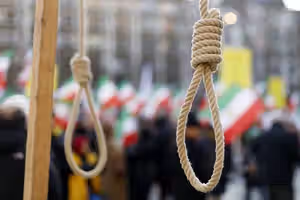
Iranian authorities executed Golmohammad Mohammadi and Erfan Esfandiari on July 19, followed by Amirhossein Safari and Abolfazl Sepahi on July 28. Hosseini's execution on Thursday brings the number of defendants put to death in the case to five.

Safari and Sepahi were hanged after an execution scaffold was erected at Ali-Khani Square, the site of the January protests. People gathered near the square overnight amid a heavy deployment of security forces and fears of imminent executions.

Iranian authorities have accused the defendants of involvement in the deaths of four security personnel, as well as arson and vandalism during the protests.

  • Iran executes 20-year-old protester as fears grow for other detainees

    Iran executes 20-year-old protester as fears grow for other detainees

Judiciary says Hosseini took part in violence

Iranian authorities said Hosseini was involved in unrest at Isfahan's Ali-Khani Square on January 8, where four members of the security forces were killed.

The judiciary said Hosseini admitted being present during the unrest and carrying a bladed weapon. It said he wore a jacket, hat and mask and switched off his mobile phone to avoid being identified or tracked.

The judiciary also accused Hosseini of taking part in the burning of the Amir al-Momenin mosque in Isfahan's Malekshahr district on the same night.

The authorities said Hosseini was convicted of drawing a weapon and "creating fear and terror," causing widespread insecurity, acting against national security, destroying public property and colluding to act against national security.

The judiciary said the Supreme Court reviewed Hosseini's appeal and upheld the death sentence before it was carried out on Thursday.

  • Iran executed at least 56 people since March, UN rights chief says

    Iran executed at least 56 people since March, UN rights chief says

UN experts questioned fairness of trials

Before the July 28 executions, UN human rights experts urged Iranian authorities to halt the executions of the remaining defendants in the Ali-Khani Square case.

"Sentencing 12 people to death in one hearing, in a closed courtroom and without clarity as to each defendant's individual responsibility violates established fair trial standards," the experts said.

The experts, led by Mai Sato, the UN Special Rapporteur on the situation of human rights in Iran, said the defendants, ranging from their late teens to their early twenties, had reportedly faced arbitrary detention, enforced disappearance and, in some cases, ill-treatment.

They also raised concerns that convictions relied heavily on confessions broadcast on Iranian state television, while Revolutionary Court hearings were held behind closed doors and the judgments were not made public.

Other rights groups have also raised concerns over access to independent lawyers and court files in the case.

  • Executions in Isfahan renew calls to end German city partnership

    Executions in Isfahan renew calls to end German city partnership

Executions rise after January protests

Hosseini's execution comes amid a broader rise in the use of the death penalty for national security-related offenses following Iran's January protests.

UN human rights chief Volker Türk said on August 5 that Iran had executed at least 56 people on national security-related charges since March 19, including 27 in cases linked to protests earlier this year.

Türk said more than 100 other people faced similar charges and the possibility of the death penalty. He urged Iranian authorities to halt executions and move toward abolishing capital punishment.

Pezeshkian admin says infiltration bill violates rights, could drive brain drain

Aug 19, 2026, 14:23 GMT+1
•
Niloufar Goudarzi
100%

President Masoud Pezeshkian's government has formally opposed a bill aimed at countering foreign intelligence infiltration, saying it violates citizens' rights, restricts academic ties and could accelerate the emigration of Iranian experts and researchers.

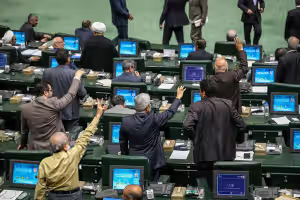
Iranian lawmakers on Sunday, August 16, approved the general principles of the "Plan to Counter the Infiltration of Intelligence Services and Foreign Governments or Institutions" by 183 votes in favor, four against and five abstentions.

The vote means parliament approved the proposal in principle but has not yet approved its individual articles or penalties. The publicly available version contains 19 articles, though lawmakers have said the details have not been finalized.

Majid Ansari, President Masoud Pezeshkian's vice president for legal affairs, said on Wednesday that the cabinet had reviewed the proposal in October last year, and sent its formal opposition to parliament because of what he described as fundamental problems in its provisions.

"The government's official position is opposition to this proposal," Ansari told the state-run IRNA news agency.

Government cites rights concerns

Ansari said the proposal conflicted with several constitutional principles covering citizens' rights, fundamental rights and individual freedoms, and in some cases was also inconsistent with Sharia law.

He said the measure would sharply restrict academic contacts between Iranian universities, researchers and specialists and institutions abroad.

"To achieve the country's important scientific goals, we must work to facilitate communication and the exchange of scientific information, but the provisions of this proposal will create serious restrictions on the country's scientific growth and development," he said.

Ansari said researchers, doctors and academics need ties with international institutions to prevent their work from becoming stagnant and warned that broad restrictions on contacts could push more specialists to leave Iran.

"If every type of contact and communication faces restrictions and is criminalized by law, naturally they will prefer to migrate and carry out their scientific and research activities in a free environment," Ansari said.

  • Iran’s new infiltration bill could make ordinary contact a crime

    Iran’s new infiltration bill could make ordinary contact a crime

Government says existing laws are enough

The Pezeshkian government said Iran already has laws and security agencies with powers to deal with foreign intelligence activity and does not need new legislation in its current form.

Ansari said any new legislation should instead be prepared with the participation of the government and judiciary and submitted as a government bill after legal, judicial, social and political review.

He called on parliament to remove the proposal from its agenda or subject it to a more detailed two-stage review, saying its broad criminal provisions required input from the judiciary.

Draft restricts foreign contacts

The publicly available draft extends beyond acts normally associated with espionage and covers a wide range of contacts between Iranians and foreign individuals and institutions.

One provision would require individuals, private companies and state bodies to notify authorities and receive written permission from the Foreign Ministry, or an Iranian embassy or consulate abroad, before contacts with foreign embassies, offices or non-Iranian organizations inside or outside Iran.

The draft provides limited exemptions for matters including civil registration and personal-status issues. Violations could result in fines and restrictions on social rights.

Another article would ban providing information, reports or statistics to foreign intelligence services, non-Iranian groups or institutions, or foreign nationals without permission from the Intelligence Ministry. It provides for prison terms and, in some cases, a permanent ban from the job through which the information was obtained or supplied.

  • Iran’s intelligence mocked by allies and foes over 'secret' Israel files

    Iran’s intelligence mocked by allies and foes over 'secret' Israel files

The draft would also make sending photographs, video, audio or other data to non-Iranian media or people engaged in media work outside Iran punishable by prison.

Interviews or other communication with some US- or Israeli-funded media would also be punishable by prison, while interviews with other foreign media would have to be reported to an Intelligence Ministry system.

Foreign visitors and academic ties

The proposal also contains restrictions affecting foreign nationals in Iran.

Foreigners who enter or remain in Iran without completing required legal procedures could be deported and fined the equivalent of 10,000 euros.

Foreign nationals who entered legally but carried out cultural activities deemed contrary to national security or the state's general policies could face the same penalties. Other offenses committed by foreign nationals in Iran could carry penalties one degree more severe than otherwise prescribed.

The Intelligence Ministry would also be required to publish each year a list of foreign governments, universities and institutions approved for scholarships, grants, academic agreements, conferences and other scientific cooperation.

Scientific cooperation with universities or institutions not on that list, as well as sending medical, research or archaeological samples to them, could result in a prison sentence.

Supporters say measure is needed after wars

Mohammad Saleh Jokar, a lawmaker from Yazd and head of parliament's Internal Affairs and Councils Committee, defended the need for stronger measures against infiltration but said the details of the proposal had not yet been finalized.

Jokar said Iran had suffered major damage from infiltration before and during what he called the 12-day war with Israel and the US last year and the 40-day war with the US this year, adding that foreign adversaries had used different channels to collect information.

He said the assassinations of a number of Iranian commanders and officials were linked to infiltration and said hostile networks inside Iran had used messages, money, weapons and other resources to pursue their objectives.

Jokar said parliament needed to identify and close routes used for infiltration, whether they involved a physical or virtual presence inside the country.

But he also said the proposal's individual provisions required detailed consideration by lawmakers and rejected suggestions that the currently circulating text had been finalized.

  • Iran’s ‘infiltration’ bill sparks backlash over sweeping reach

    Iran’s ‘infiltration’ bill sparks backlash over sweeping reach

Legal scholar warns of vague offenses

Mohsen Borhani, a prominent legal scholar and faculty member at the University of Tehran's law school, also sharply criticized the proposal.

Borhani said its wording was vague and could put the freedom of citizens, academics, political and social activists and artists at risk.

He pointed to language in the draft covering acts such as "showing a dark image of the country," promoting what authorities consider "anti-Islamic culture," taking part in courses deemed incompatible with Iranian culture and making policy proposals considered contrary to the state's fundamental interests.

The draft provides penalties for some cultural activity carried out under foreign direction, including permanent restrictions on some artistic work, and provides prison sentences for some educational courses and workshops involving specified foreign institutions.

Article 1 also provides lengthy prison terms for some policy or legislative proposals made under foreign direction if authorities determine they damaged national security, fundamental state interests, public trust or electoral participation.

Borhani said such broad wording could allow selective enforcement and urged the government, the Science Ministry, the Culture Ministry and other institutions to oppose the measure.

Criticism spreads on social media

Some Iranian social media users also reacted with alarm after parliament's Sunday vote, focusing on the proposal's restrictions on education, media contacts and links with the outside world.

"The biggest point in the proposal is that it lays the groundwork for closing off scholarships for Iranian students," one user on X wrote.

Another user described the measure as "cutting ties with the world on the path to turning Iran into North Korea," saying the proposal could bring media, scientific and civil contacts with foreign institutions under tighter security control.

"Welcome to the world's largest prison," another user wrote, pointing to proposed prison terms for interviews with some US media and restrictions on contact with foreign embassies without government permission.

The posts reflected concern among some social media users that the proposal could sharply restrict academic, media and civil contacts with organizations outside Iran. They do not represent a scientific measure of Iranian public opinion.

The draft remains subject to change. Parliament's vote on Sunday approved only its general principles, and lawmakers have not yet approved the individual articles or penalties contained in the publicly available text.


For Iranian journalists, exile can last a lifetime

Aug 18, 2026, 17:50 GMT+1
•
Niusha Saremi
100%
Farahnaz Espad

Journalists are not supposed to become the story. We are usually on the other side of it. Someone lives through an event and we write about it. Someone is gone and we report their passing. A crisis unfolds and we try to find the right words to tell its story.

But sometimes life reverses the roles. The narrator becomes the subject of the story.

Today, Farahnaz Espad, one of Iran International’s finest news anchors, died of cancer at the age of 37. Hearing the news, I found myself thinking of Reza Haghighatnejad, an editor at RFE/RL’s Radio Farda and one of Iran’s most accomplished political journalists, who also died of cancer in 2022.

Perhaps because I see a bitter similarity in their fates. Two Iranian journalists; two young, talented and hardworking people whose lives were deeply bound up with Iran — with its news, its people, their concern for what was happening to it, and their hope that perhaps tomorrow life for Iranians might be a little better than it is today.

Both developed cancer far from Iran, and both died far from home.

I remember Farahnaz for her calm. For a dignity that even illness could not take from her. There was an unassuming humility and kindness in the way she carried herself, the kind some people bring into every room without even trying. She was hopeful. She was calm.

She wanted to go back to work.

Perhaps “going back to work” sounds like a small wish. But for Farahnaz, work was not merely a job. She wanted to stand in front of the camera again, read the news from Iran, begin her day with Iran and end it with Iran. Illness had kept her away from the newsroom, but it had not severed the thread connecting her to her professional life.

Reza’s death a few years ago was a reminder of much the same thing.

Reza was one of those journalists for whom Iran was never merely the subject of his work. Iran was his abiding concern — something he read about, wrote about, researched and worried about. He lived in exile, but much of his mind and his work remained in the country where he could no longer continue his professional life.

Even after death, his fate remained bitter. Reza died of cancer in Berlin at the age of 45. His body was sent to Iran so he could be buried in the soil he came from. But security forces seized his body after it arrived, preventing his family from saying goodbye to him as they wished and from burying him in his hometown.

100%
Farahnaz Espad (Left) and Reza Haghighatnejad (Right)

Sometimes I think exile, for an Iranian journalist, is more than geographical distance.

One day, you begin working as a journalist in Tehran, Shiraz, Isfahan or another city, with the simple idea that you will write about the society in which you live. Then a day comes when, to continue doing that same work, you have to leave your country. Your desk moves. Your newsroom moves. The language spoken on the street you walk down every morning changes. Your home changes. Your friends scatter. Years pass.

But the subject of your work does not change.

It is still Iran.

You wake up in a city thousands of kilometers from Tehran, and the first thing you read is news from Iran. You spend your day immersed in the crises, protests, elections, prisons, hopes and disappointments of people you may not have seen in person for years. You talk about the future of a country when you yourself do not know when you will be able to return to it without fear.

It is a strange contradiction: sometimes you spend most of your years away from your homeland while devoting most of your professional life and your thoughts to that same homeland.

Farahnaz and Reza were like that. And I do not want to remember them only through their illness and death. Cancer was the final chapter of their lives; it was not the whole book.

What came before mattered more: curiosity, work, concern, hope, friendship, laughter, long hours in the newsroom, stories written and read, questions asked, and that essential belief every journalist carries — that knowing the truth, telling it and understanding it more deeply still matters.

But there is something in both their stories that I find deeply painful.

They were people who thought about Iran, worked on Iran and wanted a better life for the people of Iran. Yet they themselves were denied one of the most basic possibilities of an ordinary life: to live at “home,” to work there, to grow old there and one day, when the time came, to close their eyes in their own country, surrounded by family and memories.

That should not be something one has to wish for.

Staying in your homeland should not be a privilege.

Exile should not be the price of journalism.

No one should have to choose between their profession and their country simply for speaking and writing.

And perhaps that is why today, as I write the news of Farahnaz’s death, I am not grieving only the loss of a friend and colleague. I grieve for a generation of Iranian journalists who packed their bags, built homes in other cities, spoke about their homeland from distant studios and newsrooms, and spent years of their lives waiting for an Iran they might one day be able to return to freely.
Some of them never got to see that day.

Reza did not.

Neither did Farahnaz.

A journalist is meant to bear witness to history, not become a victim of geography. A journalist is supposed to tell the news, not have their illness or death in exile become a headline written by their colleagues.

But sometimes that is exactly what happens.

Today we read Farahnaz’s name in the news, just as we read Reza’s a few years ago. And behind those two names, for me, one simple wish remains:

That one day Iran will be a place where its journalists can stay; where they can ask questions, write, make mistakes, write again, live, grow old — and not be forced away from “home” to do the work they love.

A day when an Iranian journalist’s share of their homeland is more than having it as the subject of their stories.

Until that day, we are left with the memory of those who are gone — and with stories that, this time, contrary to our professional habit, we have to write about the storytellers themselves.

May the memory of Farahnaz Espad and Reza Haghighatnejad live on.