• العربية
  • فارسی
Brand
  • Iran Insight
  • Politics
  • Economy
  • Analysis
  • Special Report
  • Opinion
  • Podcast
  • Live TV
  • Iran Insight
  • Politics
  • Economy
  • Analysis
  • Special Report
  • Opinion
  • Podcast
  • Live TV
  • Theme
  • Language
    • العربية
    • فارسی
  • Iran Insight
  • Politics
  • Economy
  • Analysis
  • Special Report
  • Opinion
  • Podcast
  • Live TV
All rights reserved for Volant Media UK Limited
volant media logo

Islamic Republic asks public to identify opponents abroad

Hooman Abedi
Hooman Abedi

Iran International

Sep 15, 2026, 10:34 GMT+1Updated: 11:58 GMT+1
Photos published by Iran’s Alaj platform show Iranians abroad targeted by the project, which asks members of the public to help identify and report overseas opponents of the Islamic Republic.

The Islamic Republic has launched a platform asking citizens to identify and report opponents living abroad. Iranians met it with ridicule, pointing to how deeply the state's own security apparatus has been infiltrated.

The Alaj platform – whose name means “remedy” or “cure” in Persian – accepts information through its website, a Telegram bot and Iran's Bale messaging service.

“Alaj operates with the aim of safeguarding national security against anti-Iranian currents,” the Guards-affiliated Fars News Agency said in announcing the project on Monday.

State television also promoted Alaj, giving wider exposure to a system Iranian media had previously discussed but not promoted on the same scale.

Alaj says it has identified and monitored 1,600 people, including 600 identified through reports from members of the public, according to Iranian state media.

Its website publishes information about Iranians abroad, including names and photographs and, in some cases, national identification numbers, dates of birth and fathers' names.

The platform says it targets people outside Iran who act “against the country's interests and security,” including those advocating sanctions or military action and members of separatist groups.

Alaj also lists potential measures against people it identifies, including freezing assets and withdrawing access to consular and citizenship services.

The project's name carries a pointed connotation. Alaj translates as “remedy” or “cure,” framing the people targeted by the platform as a problem to be treated.

People ridicule campaign

Responses to the post promoting Alaj ranged from mockery of Iran's security establishment to explicit warnings that people who inform on opponents could themselves be identified and punished in the future.

One commenter predicted the platform would be hacked and the identities of those submitting reports made public, arguing that previous breaches of major Iranian institutions gave little reason to trust Alaj with sensitive information.

100%

Another suggested the government's turn could eventually come, writing that authorities appeared to have little hope left even of securing future amnesty.

Others portrayed the campaign as a tactic opponents of the Islamic Republic could use themselves. One user said supporters of the Revolutionary Guards and Hamas abroad had already been publicly identified by opponents and several had lost their jobs as a result.

Several responses contrasted the effort to identify ordinary Iranians overseas with Israel's apparent intelligence penetration inside Iran.

“Start with the infiltrators inside your own ranks,” one person wrote, arguing that Israeli intelligence appeared to have extensive knowledge of Iranian officials.

Another mocked the limits of Iran's controls over information, asking whether authorities intended to “nationalize the internet outside the country” to prevent overseas opposition activity.

Other comments were considerably more explicit, threatening revenge against people who cooperate with Alaj after any future change of government.

Pezeshkian targets Iranians abroad

The campaign coincides with sharper official rhetoric toward politically active Iranians overseas.

“Some Iranians abroad, aligning themselves with the enemy, seek to incite the public within the country,” President Masoud Pezeshkian said during a social event on Monday, according to state media.

Pezeshkian accused Washington of seeking “to cause social collapse through the problems and restrictions they have imposed,” and said preserving domestic unity would prevent Iran from yielding to US pressure.

Guards used similar model at home

Alaj follows a similar crowdsourcing project launched by the Revolutionary Guards Intelligence Organization in June to identify citizen journalists and social-media users inside Iran.

Known as Jasous-Yab, or “Spy Finder,” the project used channels on the Iranian Eitaa and Bale messaging platforms to ask members of the public to identify people photographing or filming missile strikes and other sensitive locations.

“This time, you identify the spies,” the campaign told users.

100%
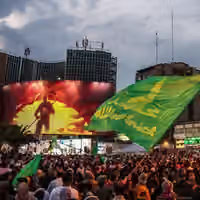
A large gathering of Iranians in Munich, Germany, in February 2026, with participants waving Lion and Sun flags.

People were instructed to scrutinize buildings, roads, sounds, distances and other details visible in photographs and videos to determine where material had been recorded and submit information to Revolutionary Guards intelligence.

The project also sought to identify social-media users opposing the Islamic Republic, extending its scope beyond people recording events on the ground.

Alaj takes that crowdsourcing model beyond Iran's borders, asking citizens to help identify overseas opponents and feeding the resulting information into a system that advertises consequences for those it identifies.

Overseas operations

Iranian intelligence activity targeting dissidents and journalists overseas has previously prompted criminal investigations, sanctions and warnings from Western governments.

Authorities in the United States and Europe have accused Iranian security bodies and people working on their behalf of conducting surveillance and plotting abductions or killings of opponents abroad.

Activities linked to Alaj could therefore face scrutiny under espionage, foreign-interference or transnational-repression laws in countries where targets live, depending on how information is gathered and subsequently used.

Most Viewed

US pilot rescue inside Iran draws mockery of Guards
1

US pilot rescue inside Iran draws mockery of Guards

2
VOICES FROM IRAN

Iranians say basic food slipping beyond reach as bread prices soar

3

Deadly ship strike deepens crisis over Strait of Hormuz

4

Eight women face execution in Iran, rights group warns

5
ANALYSIS

Foreign investment in Iran hits zero after war

Banner
Banner
Banner

Spotlight

  • Iran's Saudi leverage could become its liability
    ANALYSIS

    Iran's Saudi leverage could become its liability

  • Rushed trials, public hangings: Iran courts race to crush dissent
    INSIGHT

    Rushed trials, public hangings: Iran courts race to crush dissent

  • Israeli envoy says no victory until Islamic Republic falls

    Israeli envoy says no victory until Islamic Republic falls

  • Russia may fill Iran gap if support for Yemen Houthis falters
    ANALYSIS

    Russia may fill Iran gap if support for Yemen Houthis falters

  • Bid to oust Pezeshkian exposes rift among Iran conservatives
    INSIGHT

    Bid to oust Pezeshkian exposes rift among Iran conservatives

  • Iran’s hardliners bet on escalation as options narrow
    ANALYSIS

    Iran’s hardliners bet on escalation as options narrow

  • Iran International journalists face escalating threats from Tehran - Forbes

    Iran International journalists face escalating threats from Tehran - Forbes

  • Iran uses embassies abroad for surveillance and subterfuge, ex-staff say

    Iran uses embassies abroad for surveillance and subterfuge, ex-staff say

  • Western powers condemn Iran over targeting opponents abroad

    Western powers condemn Iran over targeting opponents abroad

•
•
•

More Stories

Xi’s BRICS peace call sparks debate in Iran over China’s role in war

Sep 15, 2026, 08:38 GMT+1
•
Maryam Sinaiee
100%
Chinese President Xi Jinping speaks during a meeting with India’s Prime Minister Narendra Modi on the sidelines of the BRICS Summit in New Delhi, India, September 12, 2026.

China’s call for a collective BRICS role in restoring peace in the Persian Gulf and Middle East has triggered debate in Iran over whether Beijing is preparing to mediate between Tehran and Washington.

Chinese President Xi Jinping said on Saturday that Beijing was willing to work with other BRICS members to help restore peace and stability in the Persian Gulf and the Middle East, offering a four-point proposal aimed at reducing tensions, ending hostilities and promoting peace.

Xi’s remarks at the opening of the 18th BRICS summit in New Delhi marked China’s first public signal since the Iran-US war began six months ago that it was willing to take an active role in addressing the crisis through a coordinated BRICS effort.

Beijing has so far stopped short of directly involving itself in mediation over the conflict. It has condemned attacks on Iran, issued a broad four-point proposal during Xi’s visit to Cairo in April and called on the parties to return to negotiations. Some analysts have also said China has quietly supported mediation efforts by Pakistan and Qatar in recent months.

Mixed reactions in Iran

Former Iranian foreign minister Mohammad-Javad Zarif welcomed China’s offer on Sunday in a post on X, describing it as an opportunity to reduce tensions.

He said the move provided a “timely opportunity to ease tensions” and added that multilateral diplomacy was the only viable path to achieve peace.

Ramin Mehmanparast, a former Iranian foreign ministry spokesman, told Donya-e Eqtesad that China had clear economic and strategic interests in stability in the Persian Gulf.

“China, in addition to seeking a role in the balance of power in the world, certainly sees stability in the Persian Gulf and the Strait of Hormuz as being in line with its long-term economic interests and views tensions and conflict in this region as contrary to its interests,” he said.

He added: “The Chinese are expected to become more seriously involved and, certainly, they have the necessary capacity to exert influence.”

Rahman Ghahremanpour, a senior Middle East researcher, also said Xi’s initiative was unlikely to have been made by chance.

Xi’s comments about BRICS efforts to promote peace in the Middle East should be taken seriously, he told Donya-e Eqtesad. China has both the diplomatic capacity and the incentive to act, he said, given its concerns that a prolonged crisis could harm its economic interests and regional standing.

Ghahremanpour also wrote on X that if reports of China’s willingness to mediate were accurate, they would represent a significant development that was probably not announced without coordination with Tehran.

He suggested that US President Donald Trump’s comments about an end to the war after the US midterm elections could potentially be connected to reports of China’s interest in mediation.

But not all Iranian reactions were positive.

Heshmatollah Falahatpisheh, a former chairman of parliament’s National Security and Foreign Policy Committee, accused Xi of seeking closer alignment with Washington.

“By presenting a plan for negotiations, Xi Jinping is trying to please Trump and, in return, obtain concessions from the United States over new trade tariffs,” he told Nameh News.

Reformist politician Abbas Akhoundi, who views the US-Iran war partly through the lens of US-China competition over resources transported through the Persian Gulf, argued that Tehran would ultimately need to engage with Beijing over regional security.

“I believed, and still believe, that achieving a security regime in the Persian Gulf can be achieved through dialogue with China,” he wrote on X. “Between the lines of Mr Xi’s recent positions, I understand that if we do not move towards a mechanism for the security of the Strait of Hormuz in coordination with China, we will come under pressure from China and conditions will become harder for the Iranian government and people.”

Was Xi offering to mediate?

Some Iranian media outlets and analysts have cautioned against interpreting Xi’s remarks as a formal offer to mediate between Tehran and Washington.

They argue that Xi did not explicitly refer to mediation between Iran and the United States. Instead, he stressed cooperation among BRICS members in efforts to restore peace and stability in the Persian Gulf and Middle East.

Hamed Vafaei, a professor of Chinese literature at the University of Tehran and a China researcher, said the interpretation of Xi’s remarks as a Chinese offer to mediate was “a free interpretation” of his comments.

In a note titled “What did Xi Jinping say in India and what did we hear in Iran?” he published on X, Vafaei said the remarks should not be regarded as a sudden development or an official announcement by Beijing that it would mediate between Tehran and Washington.

Rather, he said, they should be viewed as part of a gradual evolution in China’s West Asia diplomacy that began in the early stages of the 12-day war and has continued since.

“Xi Jinping’s position today, for experts who have closely monitored and analysed Beijing’s positions over the past months, contains only one important signal, several emphases and, in his own words, a kind of pioneering declaration of responsibility for the times — not a new position announcing mediation between Iran and America,” Vafaei wrote.

Why Beijing is cautious

Ghahremanpour said China was likely to proceed cautiously because it faced risks on both sides.

“On the one hand, the Chinese are concerned that Iran may not accept their demands, and on the other, they are worried that the United States may not welcome their initiative, and therefore they are acting very cautiously,” he told Donya-e Eqtesad.

“If China tries to mediate but the problem is not resolved, differences between Iran and the countries of the region will intensify and China will be regarded as one of those responsible,” he said. “If it also enters at the global level and faces a negative response from either Iran or the United States, its credibility will be called into question.”

Canada-based analyst Shahir Shahid-Saless said Xi’s caution was understandable given the need to simultaneously manage China’s relations with the United States and Israel while preserving its important strategic and economic relationships with Iran and the Arab states of the Persian Gulf.

A failed Chinese mediation effort, he said, could impose a significant political and reputational cost on Xi personally and seriously damage his credibility.

“By placing the issue within BRICS, Xi spreads the responsibility and avoids making China, and himself, the sole owner of a possible failure,” he wrote.

“There is also a fundamental obstacle: it is difficult to imagine Washington entrusting negotiations over the Iran war to BRICS, an organization increasingly presented as an alternative to Western-led institutions and one in which Iran itself is a member,” he added.

Iran's Saudi leverage could become its liability

Sep 15, 2026, 03:28 GMT+1
•
Negar Mojtahedi
100%
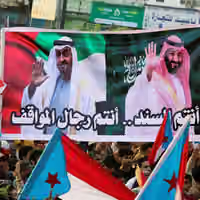
People hold a banner with images of the Emirati President Sheikh Mohamed bin Zayed Al Nahyan and Saudi Crown Prince Mohammed bin Salman during a rally organised by Yemen’s Southern Transitional Council in Aden, December 21, 2025.

Iran has gained leverage over Saudi Arabia as Houthi advances and attacks put pressure on the kingdom’s territory and oil routes. But Riyadh is responding more forcefully, raising the risk that Tehran’s advantage could provoke a military backlash that ultimately weakens it.

Saudi Arabia is taking a harder military posture after efforts to defuse tensions with Tehran stalled. Riyadh had sought de-escalation, wary that a wider conflict could threaten the regional stability on which its economic ambitions depend.

A meeting planned for Monday between Iran and several Persian Gulf states over arrangements for the Strait of Hormuz was postponed after Saudi Arabia requested a delay, amid Riyadh’s growing frustration over attacks by Iran-aligned groups.

That leaves Riyadh with options, none of them ideal.

Saudi Arabia does not want an all-out war. But the Houthis may be testing how long the kingdom can afford to avoid one.

Saad bin Tefla Al Ajmi, Kuwait's former information minister, said Saudi Arabia has so far exercised patience but its military options remain open.

That restraint reflects what the kingdom has at stake. Saudi Arabia has spent years trying to avoid being dragged back into direct conflict with the Houthis, while its economic transformation depends heavily on regional stability.

"There is no stability, there is no development. There is no stability, there is no prosperity," Al Ajmi told Iran International.

But Houthi attacks on Saudi territory and advances along Yemen’s Red Sea coast are making that restraint increasingly difficult to maintain. The Saudi-led coalition said Houthi missile and drone attacks on Khamis Mushait, Abha and Taif on Monday injured 13 civilians.

Al Ajmi believes some of the Houthis' recent territorial gains could be reversed, particularly if Saudi Arabia decides to deploy its overwhelming advantage in air power. He described Houthi forces operating along the flat Tihamah coastal plain as "sitting ducks."

Saudi Arabia led a military intervention against the Houthis beginning in 2015, with direct hostilities largely subsiding after a UN-brokered truce began in 2022. Years of bombardment failed to eliminate the movement, and Riyadh subsequently spent years trying to avoid being pulled back into a full-scale Yemen war.

The question now is whether the Houthis are pushing that restraint too far.

Houthis risk overplaying their hand

The battlefield in Yemen remains fluid. The Houthis have seized Mokha, Dhubab and Perim Island and expanded their control along Yemen’s Red Sea coast, while Saudi-backed government forces have regrouped and vowed to retake lost territory. That leaves open the question of how durable the Houthis’ gains will prove.

"The Houthis fought the Saudis and the Saudi militias for years. They also have a history of being overextended," Alberto Fernandez, a former senior US diplomat, told Iran International.

Fernandez said the Houthis may have pushed too far.

"I think we could see them lose some of the territory that they've gained," he said.

"They're arrogant. Yes, they're motivated by ideology. And when you're motivated by ideology and you're arrogant, you tend to sometimes overextend," Fernandez said.

But the Houthis are also betting on reluctance from both Saudi Arabia and the United States to become drawn more deeply into the conflict.

Saudi Arabia's attempt to remain outside the wider Iran war has already "certainly backfired on them," Fernandez said.

The uncertainty over how much the kingdom can rely on its allies only complicates its options.

Fernandez described the relationship between Washington and Riyadh as increasingly complicated. The Saudis, he said, felt blindsided by the United States launching the Iran war, while Washington in turn felt unsupported by Riyadh.

That strain has become more visible as Crown Prince Mohammed bin Salman sought direct US military action against the Houthis, while Trump declined requests for US strikes and Washington limited its support to intelligence and targeting assistance.

That uncertainty also extends to the Makkah Joint Defense Agreement, signed by Saudi Arabia, Turkey and Pakistan on August 7. The pact says an armed attack against any one of the three countries will be regarded as an attack against all.

"So far [it] has turned out to be a paper tiger," Fernandez said, joking that the arrangement appeared to have the equivalent of a health insurance "pre-existing condition clause."

Saudi Arabia looks elsewhere for help

As Washington hesitates, Saudi Arabia is looking elsewhere.

British Prime Minister Andy Burnham is considering Saudi requests for diplomatic and military support to counter the Houthis, Bloomberg reported Monday, as London grows increasingly concerned about the economic consequences of another expanding front in the Iran war.

The requests come as Britain has backed Saudi Arabia’s right to defend itself against Houthi attacks and stressed the importance of protecting freedom of navigation and global trade through the Red Sea.

The widening conflict has raised the stakes beyond Yemen. Houthi gains along the Red Sea coast and around Bab el-Mandeb, combined with attacks on Saudi energy infrastructure, are putting pressure on westward export routes that have become more important while shipping through the Strait of Hormuz remains constrained.

The Houthi offensive and attacks on Saudi energy infrastructure have added further pressure to oil markets already strained by the Iran war. Brent crude climbed above $108 a barrel Monday after attacks shut down Saudi Arabia’s East-West pipeline, a crucial alternative export route while shipping through the Strait of Hormuz remains constrained.

"It gets to push up oil prices a little more," Fernandez said.

"For them, every dollar that prices go up, for them they see that as a plus for the regime, putting a little more pressure on the Americans and the Europeans."

The paradox for Tehran is that the greater the disruption caused by the widening conflict, the stronger the incentive may become for governments outside the region to help Saudi Arabia contain the threat.

Iran does not need to control the Houthis

"The broader strategic danger is that Iran does not need to control the Houthis completely to benefit from their actions," Mohamed Fahmy, a journalist and Middle East political analyst, told Iran International.

"It only needs the movement to retain sufficient military capability, autonomy and motivation to pressure critical maritime routes while Tehran maintains distance from the confrontation."

Fahmy cautioned against reducing the Houthis to an Iranian proxy.

They are "an intensely nationalist movement with their own domestic agenda and deeply rooted local interests," he said.

Their relationship with Tehran is nevertheless exceptionally close. Iran has provided weapons, military technology, intelligence and other support, Fahmy said, while the strategic interests of the two sides increasingly converge.

That convergence has become particularly consequential around the Red Sea and Bab el-Mandeb.

"One of the Houthis' strategic objectives is to exert control over Yemen's Red Sea coast and the northern Red Sea, where they can increasingly influence who is permitted to transit and who is not," Fahmy said.

For Tehran, the Houthis therefore provide an additional source of pressure on its adversaries without requiring direct Iranian military involvement.

But Saudi Arabia's military answer is not straightforward.

Fahmy pointed to Saada, the Houthis' traditional stronghold and geographical heart of their power, which has been repeatedly targeted by Saudi forces since the intervention began in 2015. Despite years of Saudi-led bombardment and military pressure, the Houthis survived and retained significant military capabilities.

"A limited campaign of additional strikes is therefore unlikely to fundamentally diminish their ability to threaten shipping or project power across the Red Sea," Fahmy said.

That leaves Saudi Arabia confronting a difficult choice.

Continued restraint risks allowing the Houthis to impose greater costs on the kingdom and giving Tehran additional leverage. But a renewed military campaign carries risks Riyadh knows well after years of fighting failed to eliminate the movement.

Iran has gained leverage as the war reaches Saudi Arabia. But the more Houthi attacks raise the costs for Riyadh, the greater the risk that Tehran’s leverage provokes the response that ultimately erodes it.

Resistance born from Mahsa Amini’s death endures, UN rapporteur says

Sep 14, 2026, 16:35 GMT+1
100%
The front page of Iranian newspaper Jahan-e Sanat shows a portrait of Mahsa “Jina” Amini over a map of Iran.

UN Special Rapporteur on Iran Mai Sato said the movement born from Mahsa “Jina” Amini’s death in Iran’s morality police custody remains alive four years on, despite another deadly crackdown and continued enforcement of mandatory hijab rules.

Sato said the Woman, Life, Freedom movement brought together women and men across Iran’s ethnic groups and provinces to demand equal rights for women and girls.

Authorities responded with lethal force in 2022 and again during the nationwide protests of December 2025 and January 2026, she wrote on X.

She said mandatory hijab enforcement had also continued despite the suspension in December 2024 of the Law on Protecting the Family through the Promotion of the Culture of Chastity and Hijab. Cafes, restaurants and shops are still being closed when employees or customers appear without hijab, with arrests reported in some cases.

Mahsa “Jina” Amini, a 22-year-old woman from Saqqez, was detained while visiting Tehran with her brother on Sept. 13, 2022, for allegedly wearing her headscarf improperly. She collapsed after being taken to a morality police detention center and died in hospital three days later.

Iranian authorities denied that she had been beaten and attributed her death to an underlying medical condition, a claim rejected by her family. A UN fact-finding mission later concluded that Amini’s death was unlawful and caused by physical violence while she was in state custody.

Medical documents obtained by Iran International showed skull fractures, hemorrhaging and brain swelling consistent with severe trauma.

Protests began at Amini’s funeral in Saqqez on Sept. 17 and spread to more than 160 cities and towns, with women burning their headscarves and demonstrators chanting “Woman, Life, Freedom.”

At least 551 protesters, including 68 children, were killed, hundreds suffered blinding eye injuries and more than 20,000 people were arrested. The UN mission found that parts of the crackdown, including killings, torture, rape and other sexual violence, amounted to crimes against humanity.

Women continued appearing unveiled in public after the protests subsided, prompting authorities to turn to surveillance cameras, drones, vehicle impoundments and the Nazer reporting application. A 74-article hijab law introducing heavier fines, prison terms and other severe punishments was due to take effect in December 2024 but was halted following widespread opposition.

The next nationwide protest wave began over the collapsing rial and rising prices in late December 2025 before becoming an anti-government uprising.

Documents reviewed by Iran International showed that more than 36,500 people were killed during the crackdown on Jan. 8 and 9, while authorities acknowledged 3,117 deaths. A communications blackout and restrictions on independent reporting complicated verification.

Ahead of Mahsa’s fourth anniversary, people in Isfahan, Rasht, Fouman, Mashhad and Neyshabur told Iran International that morality police, hijab enforcers and plainclothes agents had returned to the streets.

Reports included women being detained for appearing without headscarves and vehicles being stopped or having their license plates removed.

“Four years on, the resistance Jina’s death gave rise to has not been extinguished,” Sato said. “Those rights will not stay deniable forever.”

IAEA raises alarm over Iran access as Hormuz tensions mount

Sep 14, 2026, 13:23 GMT+1
100%
Pedestrians walk past a billboard promoting Iran’s nuclear program in Tehran.

Concern over Iran’s nuclear program intensified on Monday as the UN nuclear watchdog said it had conducted almost no inspections in the country for more than six months, while tensions surrounding Hormuz deepened and Yemen’s Iran-backed Houthis claimed another attack on Saudi.

The developments centered on the loss of international oversight of Iran’s nuclear material, mounting restrictions and threats involving shipping through Hormuz, and a new round of regional military activity that prompted Saudi emergency alerts and high-level talks with the head of US Central Command.

IAEA warns of serious proliferation concern

The International Atomic Energy Agency has carried out no in-field verification activities in Iran for more than six months, except for an inspection of the Bushehr nuclear power plant in June, Director General Rafael Grossi said at the agency’s General Conference in Vienna.

Grossi said the IAEA withdrew its inspectors after renewed attacks on Iran in late February, worsening a decline in oversight of Tehran’s nuclear program during 2026.

The agency has also lacked continuity of knowledge for more than a year regarding Iran’s previously declared inventories of low- and highly enriched uranium, including material enriched to 60% purity, at nuclear facilities affected by attacks in June 2025.

“The Agency’s lack of information about this nuclear material and access to facilities to verify it is a matter of serious proliferation concern and needs to be addressed with the utmost urgency,” Grossi said.

He called a return to diplomacy and negotiations over Iran’s nuclear program “imperative,” warning that the situation had consequences for the wider global non-proliferation system.

The remarks came as Iran summoned Austria’s chargé d’affaires over Vienna’s failure to issue a visa to Mohammad Eslami, the head of the Atomic Energy Organization of Iran. Foreign Ministry spokesperson Esmail Baghaei called the decision “completely unjustified” and said Tehran had formally protested.

Bloomberg reported earlier that Austria denied Eslami entry after pressure from the Trump administration, preventing him from addressing the IAEA conference. A US official cited by Bloomberg said Washington had urged Austria not to grant a UN-requested sanctions waiver that would have permitted the visit.

Iran threatens restrictions against 77 vessels

Maritime tensions also escalated as Iran’s Persian Gulf Strait Authority published an updated list of 77 vessels it accused of violating Iranian protocols governing passage through the Strait of Hormuz.

The authority warned that the vessels could face restrictions on future passage, including fines, detention or confiscation. Ships cooperating with vessels on the list would also be added, it said, while companies and other entities were warned not to provide services to them.

  • Hormuz diplomacy stalls as attacks deepen pressure on Persian Gulf oil routes

    Hormuz diplomacy stalls as attacks deepen pressure on Persian Gulf oil routes

Iran’s Foreign Ministry said Tehran would continue taking what it considered necessary measures for as long as the United States maintained its maritime blockade.

Baghaei said security in the Strait of Hormuz was a matter for Iran and Oman as the two coastal states and blamed US actions for instability in the waterway. He said an understanding between Tehran and Muscat establishing safe shipping routes had been reached after weeks of negotiations while preserving the sovereign rights of both countries.

But a wider regional meeting planned in Oman had been postponed. Baghaei said it could have provided even a small step toward dialogue between Tehran and Persian Gulf countries, describing its postponement as a missed opportunity.

“Israel is the only beneficiary of tensions between Iran and Persian Gulf countries,” he said, calling on neighboring states to set aside past disputes and pursue regional dialogue.

Saudi Arabia had sought amendments to the Omani-Iranian proposal over concerns that its language could establish an unacceptable new status quo in the strait, Axios reported, citing a senior regional official.

The United States, meanwhile, said its forces had redirected 101 commercial vessels while enforcing the blockade against Iran as of September 13.

Shipping traffic through Hormuz remained sharply reduced over the weekend. Only four commodity vessels exited the Persian Gulf and 10 entered, Reuters reported, citing preliminary tracking data. Daily traffic fell to single digits, compared with a 10-day average of 14 vessels, although the figures excluded ships operating with their tracking transponders switched off.

The IRGC also said that it had detected and destroyed an advanced MQ-1 drone over the Strait of Hormuz using a new Aerospace Force air-defense system. It did not identify the drone’s operator, and the statement was not independently verified.

Houthis claim Saudi air-base attack

Yemen’s Iran-backed Houthis said they attacked an air base in Khamis Mushait in southwestern Saudi Arabia on Monday. Saudi authorities did not immediately confirm that a strike had occurred.

Saudi Arabia’s Civil Defense initially issued emergency alerts warning of potential danger in Khamis Mushait and nearby Abha, but announced shortly afterward that the danger had passed in both locations.

Saudi Crown Prince Mohammed bin Salman met US Central Command chief Admiral Brad Cooper to discuss the latest regional developments.

Elsewhere, missiles struck three camps belonging to Iranian Kurdish opposition groups east of Sulaimaniya in Iraq’s Kurdistan region early Monday, two security sources told Reuters. No casualties were reported, and the sources did not identify who carried out the attacks.

The latest round of tensions has added to pressure on energy markets and regional shipping. Brent crude rose more than $3 to above $108 a barrel at the opening on Monday following fresh strikes on Saudi Arabia and vessels in the Persian Gulf over the weekend.

Pressure was also evident in Iran’s currency market with the US dollar trading at 2.34 million rials, the euro at about 2.7 million rials and the British pound at 3.16 million rials by around midday Monday.

US pilot rescue inside Iran draws mockery of Guards

Sep 14, 2026, 12:06 GMT+1
•
Hooman Abedi
100%
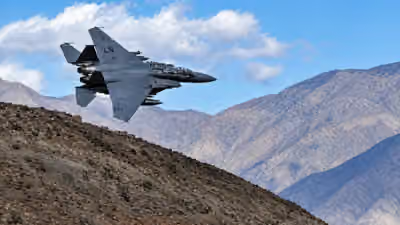
A US Air Force F-15E Strike Eagle flies over mountainous terrain.

A newly disclosed US operation that sent more than 90 American troops into Iran to rescue an airman shot down during the war drew ridicule from Iranians online over the Revolutionary Guards’ failure to find him before his extraction in April.

The operation, detailed by CBS News’ 60 Minutes on Sunday, involved two separate rescue missions after an F-15E was brought down by an Iranian shoulder-fired missile near Isfahan, forcing its two-man crew to eject.

“With this video, maybe the Revolutionary Guards can finally figure out where the pilot was,” one Iranian wrote sarcastically on X after footage and details of the operation were released.

Another user addressed supporters of the Islamic Republic after learning of the scale of the US deployment.

“More than 90 American personnel entered Iranian territory to rescue him,” the user wrote. “Come and tell us we’re a regional power.”

The reactions followed the first extensive public account of the operation, which US commanders described as one of the most complex combat search-and-rescue missions undertaken by the American military.

Two airmen down inside Iran

The F-15E was flying a mission near a mountainous area south of Isfahan on April 2 when it was struck by an Iranian shoulder-fired missile, according to the US account.

The aircraft had been assigned to strike industrial facilities connected to Iran’s drone and missile programs, US Central Command chief Admiral Brad Cooper told 60 Minutes.

The two crew members, identified for security reasons by the call signs Alpha and Bravo, ejected after determining that they could not save the aircraft.

Alpha landed safely, but Bravo’s parachute was damaged. Bravo estimated that he hit the ground at between 70 and 100 miles per hour, breaking his back, an arm and a shoulder.

The two men landed about five miles apart.

Iranian media published images of the wreckage, while videos circulating online showed armed men searching the area for the airmen. Iranian forces at one point came within several hundred meters of Bravo, according to US military sources cited by CBS.

American forces recovered Alpha about six hours after the aircraft went down in a daytime operation during which US helicopters came under fire.

The first rescue force could not locate Bravo and withdrew.

Bravo, despite his injuries, moved away from his landing site and climbed toward a roughly 7,000-foot ridgeline, where he remained hidden as Iranian forces searched for him.

“Never let a lack of motivation put you on Iranian TV,” Bravo told 60 Minutes, describing what drove him to keep moving despite his injuries.

More than 90 US troops enter Iran

Bravo remained inside Iran for roughly two days with little food or water before the United States launched another operation to retrieve him.

The CIA played a central role in the second rescue, using a deception campaign to confuse Iranian forces searching for the airman and classified technology to locate him, according to the CBS account.

US bombers and drones then struck Revolutionary Guard forces near the area where Bravo was hiding to clear the way for the rescue force.

More than 90 US service members entered Iran on the ground during the operation, the first American troops to do so in 46 years, Cooper said.

Several hundred personnel were involved in the air and several thousand others supported the operation, according to the US account.

The rescue force arrived aboard two large search-and-rescue aircraft that landed on a makeshift desert airstrip inside Iran. Smaller Little Bird helicopters were then launched to reach Bravo several miles away on the ridgeline.

Bravo was recovered around 50 hours after being shot down.

But the US personnel encountered another problem before they could leave. The landing gear of the two larger aircraft became stuck in the desert sand, leaving more than 90 US troops stranded on the ground.

A clandestine US Air Force unit was brought in to extract them. American forces destroyed the two stranded aircraft, each worth about $100 million, along with the Little Bird helicopters to prevent the technology from falling into Iranian hands, according to CBS.

Iranians mock security failure

The disclosure that such a large American force had operated on Iranian territory without the airmen being captured prompted a stream of sarcastic reactions from Iranian social-media users.

One user mocked Iranian authorities for apparently failing to detect the scale of the rescue operation.

“To rescue the second F-15 pilot who crashed in Iran, two C-17 aircraft landed in Iran and around 100 military personnel disembarked,” the user wrote. “The sacred system didn’t even realize where they were, when they arrived or when they left.”

Another joked that Revolutionary Guard personnel were still searching the mountains for the American airman.

“In the Islamic Republic’s legends, the clerics and their friends, wearing plastic slippers and carrying chips and yogurt, are still searching the mountains for the American pilot,” the user wrote.

Other reactions contrasted the US military’s ability to locate and extract its injured airmen inside Iran with the hours-long search for the helicopter carrying President Ebrahim Raisi and other senior officials after it crashed in mountainous terrain in May 2024.

“Did you see the documentary about the rescue of the American pilots?” one user wrote, mocking the search for Raisi’s helicopter.

Iran sought international assistance after its own teams struggled to locate the wreckage in heavy fog and difficult terrain. Turkey dispatched an Akinci drone, which detected a suspected heat source and relayed coordinates to Iranian authorities before rescue teams reached the wreckage, where Raisi, Foreign Minister Hossein Amir-Abdollahian and six others were found dead.

Iran’s armed forces later disputed the extent of the Turkish drone’s role, saying its coordinates were several kilometers off and that Iranian teams ultimately located the crash site.

Another reaction distilled the operation into a more direct criticism of the Islamic Republic’s military capabilities.

“They came right into Iran, picked up their pilot and took him away,” the user wrote.