• العربية
  • فارسی
Brand
  • Iran Insight
  • Politics
  • Economy
  • Analysis
  • Special Report
  • Opinion
  • Podcast
  • Live TV
  • Iran Insight
  • Politics
  • Economy
  • Analysis
  • Special Report
  • Opinion
  • Podcast
  • Live TV
  • Theme
  • Language
    • العربية
    • فارسی
  • Iran Insight
  • Politics
  • Economy
  • Analysis
  • Special Report
  • Opinion
  • Podcast
  • Live TV
All rights reserved for Volant Media UK Limited
volant media logo

US seeks $61 million in cryptocurrency tied to Iran oil sales

Sep 15, 2026, 09:34 GMT+1

US prosecutors are seeking the forfeiture of about $61 million in cryptocurrency that came from black-market sales of sanctioned Iranian crude oil and petroleum products and was intended to finance Iran's government and military, including the Revolutionary Guards.

The US Attorney's Office for the Southern District of New York said on Monday it had filed a civil forfeiture complaint over the assets, which prosecutors said were linked to a network that moved more than $1.5 billion in proceeds from Iranian oil sales.

The IRGC is designated by the United States as a terrorist organization.

Prosecutors target oil payment network

"Today's action demonstrates our determination to deprive the Government of Iran and its terrorist proxies of the illegal money they rely on to threaten the lives and safety of the citizens of the United States and elsewhere," Deputy US Attorney Sean S. Buckley said.

Buckley said Iran relied on black-market sales of sanctioned crude oil to fund its military and other activities.

"As alleged in the complaint filed today, the Government of Iran used a network of cryptocurrency actors in China and elsewhere to launder more than $1.5 billion in illicit oil money intended to benefit the Iranian military and the terror-designated IRGC," he said.

Chinese companies named in complaint

The complaint said two Chinese companies, Blessed Trust and Hexa Whale, used accounts at cryptocurrency exchange Binance in the United Arab Emirates to move proceeds from Iranian oil sales.

Prosecutors said Blessed Trust presented itself as a wealth management or virtual asset custodial services firm but received and transferred proceeds from Iranian crude oil and petroleum product sales. They said it also helped convert traditional currency into cryptocurrency, including through US-based cryptocurrency issuers.

Hexa Whale presented itself as a commodities broker but provided similar services and worked with Blessed Trust and related entities, according to the complaint.

More than $1.5 billion moved through addresses

The complaint said a group of linked, unhosted cryptocurrency addresses identified as "Entity A" received and distributed more than $1.5 billion in proceeds from Iranian oil sales.

Prosecutors said the addresses sent funds to money services businesses and cryptocurrency addresses linked to the IRGC, as well as to an Iranian cryptocurrency exchange.

They said transactions involving Blessed Trust, Hexa Whale and people associated with the companies were structured to conceal the source, ownership and nature of the funds. The complaint also said the two companies used the US financial system to send or receive tens of millions of dollars.

FBI says action cuts funding

"Today's complaint demonstrates the FBI's ability to follow the money, root out illicit schemes, and halt the stream of cryptocurrency to any government attempting to evade sanctions or committing terrorist activities," said James C. Barnacle Jr., assistant director in charge of the FBI's New York field office.

"By cutting off funds raised by the black-market sale of crude oil, the Iranian military and terrorists are weakened," Barnacle said.

The US Attorney's Office said a civil forfeiture complaint contains allegations that money or property was involved in, or represents proceeds from, a crime. The allegations have not been proven, and a court must rule in favor of the United States before the assets can be forfeited.

Most Viewed

US pilot rescue inside Iran draws mockery of Guards
1

US pilot rescue inside Iran draws mockery of Guards

2

Iranians buy bread on credit, queue for chicken scraps

3
VOICES FROM IRAN

Iranians say basic food slipping beyond reach as bread prices soar

4

Deadly ship strike deepens crisis over Strait of Hormuz

5

Eight women face execution in Iran, rights group warns

Banner
Banner
Banner

Spotlight

  • Iran's Saudi leverage could become its liability
    ANALYSIS

    Iran's Saudi leverage could become its liability

  • Rushed trials, public hangings: Iran courts race to crush dissent
    INSIGHT

    Rushed trials, public hangings: Iran courts race to crush dissent

  • Israeli envoy says no victory until Islamic Republic falls

    Israeli envoy says no victory until Islamic Republic falls

  • Russia may fill Iran gap if support for Yemen Houthis falters
    ANALYSIS

    Russia may fill Iran gap if support for Yemen Houthis falters

  • Bid to oust Pezeshkian exposes rift among Iran conservatives
    INSIGHT

    Bid to oust Pezeshkian exposes rift among Iran conservatives

  • Iran’s hardliners bet on escalation as options narrow
    ANALYSIS

    Iran’s hardliners bet on escalation as options narrow

  • Secret documents expose new network selling sanctioned Iranian oil

    Secret documents expose new network selling sanctioned Iranian oil

  • Iran’s oil exports near zero as Persian Gulf flows recover

    Iran’s oil exports near zero as Persian Gulf flows recover

  • Iran loses ground on trade as war hits oil and non-oil exports

    Iran loses ground on trade as war hits oil and non-oil exports

•
•
•

More Stories

Iran's Saudi leverage could become its liability

Sep 15, 2026, 03:28 GMT+1
•
Negar Mojtahedi
100%
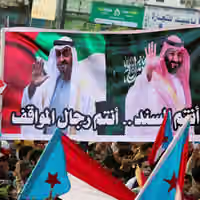
People hold a banner with images of the Emirati President Sheikh Mohamed bin Zayed Al Nahyan and Saudi Crown Prince Mohammed bin Salman during a rally organised by Yemen’s Southern Transitional Council in Aden, December 21, 2025.

Iran has gained leverage over Saudi Arabia as Houthi advances and attacks put pressure on the kingdom’s territory and oil routes. But Riyadh is responding more forcefully, raising the risk that Tehran’s advantage could provoke a military backlash that ultimately weakens it.

Saudi Arabia is taking a harder military posture after efforts to defuse tensions with Tehran stalled. Riyadh had sought de-escalation, wary that a wider conflict could threaten the regional stability on which its economic ambitions depend.

A meeting planned for Monday between Iran and several Persian Gulf states over arrangements for the Strait of Hormuz was postponed after Saudi Arabia requested a delay, amid Riyadh’s growing frustration over attacks by Iran-aligned groups.

That leaves Riyadh with options, none of them ideal.

Saudi Arabia does not want an all-out war. But the Houthis may be testing how long the kingdom can afford to avoid one.

Saad bin Tefla Al Ajmi, Kuwait's former information minister, said Saudi Arabia has so far exercised patience but its military options remain open.

That restraint reflects what the kingdom has at stake. Saudi Arabia has spent years trying to avoid being dragged back into direct conflict with the Houthis, while its economic transformation depends heavily on regional stability.

"There is no stability, there is no development. There is no stability, there is no prosperity," Al Ajmi told Iran International.

But Houthi attacks on Saudi territory and advances along Yemen’s Red Sea coast are making that restraint increasingly difficult to maintain. The Saudi-led coalition said Houthi missile and drone attacks on Khamis Mushait, Abha and Taif on Monday injured 13 civilians.

Al Ajmi believes some of the Houthis' recent territorial gains could be reversed, particularly if Saudi Arabia decides to deploy its overwhelming advantage in air power. He described Houthi forces operating along the flat Tihamah coastal plain as "sitting ducks."

Saudi Arabia led a military intervention against the Houthis beginning in 2015, with direct hostilities largely subsiding after a UN-brokered truce began in 2022. Years of bombardment failed to eliminate the movement, and Riyadh subsequently spent years trying to avoid being pulled back into a full-scale Yemen war.

The question now is whether the Houthis are pushing that restraint too far.

Houthis risk overplaying their hand

The battlefield in Yemen remains fluid. The Houthis have seized Mokha, Dhubab and Perim Island and expanded their control along Yemen’s Red Sea coast, while Saudi-backed government forces have regrouped and vowed to retake lost territory. That leaves open the question of how durable the Houthis’ gains will prove.

"The Houthis fought the Saudis and the Saudi militias for years. They also have a history of being overextended," Alberto Fernandez, a former senior US diplomat, told Iran International.

Fernandez said the Houthis may have pushed too far.

"I think we could see them lose some of the territory that they've gained," he said.

"They're arrogant. Yes, they're motivated by ideology. And when you're motivated by ideology and you're arrogant, you tend to sometimes overextend," Fernandez said.

But the Houthis are also betting on reluctance from both Saudi Arabia and the United States to become drawn more deeply into the conflict.

Saudi Arabia's attempt to remain outside the wider Iran war has already "certainly backfired on them," Fernandez said.

The uncertainty over how much the kingdom can rely on its allies only complicates its options.

Fernandez described the relationship between Washington and Riyadh as increasingly complicated. The Saudis, he said, felt blindsided by the United States launching the Iran war, while Washington in turn felt unsupported by Riyadh.

That strain has become more visible as Crown Prince Mohammed bin Salman sought direct US military action against the Houthis, while Trump declined requests for US strikes and Washington limited its support to intelligence and targeting assistance.

That uncertainty also extends to the Makkah Joint Defense Agreement, signed by Saudi Arabia, Turkey and Pakistan on August 7. The pact says an armed attack against any one of the three countries will be regarded as an attack against all.

"So far [it] has turned out to be a paper tiger," Fernandez said, joking that the arrangement appeared to have the equivalent of a health insurance "pre-existing condition clause."

Saudi Arabia looks elsewhere for help

As Washington hesitates, Saudi Arabia is looking elsewhere.

British Prime Minister Andy Burnham is considering Saudi requests for diplomatic and military support to counter the Houthis, Bloomberg reported Monday, as London grows increasingly concerned about the economic consequences of another expanding front in the Iran war.

The requests come as Britain has backed Saudi Arabia’s right to defend itself against Houthi attacks and stressed the importance of protecting freedom of navigation and global trade through the Red Sea.

The widening conflict has raised the stakes beyond Yemen. Houthi gains along the Red Sea coast and around Bab el-Mandeb, combined with attacks on Saudi energy infrastructure, are putting pressure on westward export routes that have become more important while shipping through the Strait of Hormuz remains constrained.

The Houthi offensive and attacks on Saudi energy infrastructure have added further pressure to oil markets already strained by the Iran war. Brent crude climbed above $108 a barrel Monday after attacks shut down Saudi Arabia’s East-West pipeline, a crucial alternative export route while shipping through the Strait of Hormuz remains constrained.

"It gets to push up oil prices a little more," Fernandez said.

"For them, every dollar that prices go up, for them they see that as a plus for the regime, putting a little more pressure on the Americans and the Europeans."

The paradox for Tehran is that the greater the disruption caused by the widening conflict, the stronger the incentive may become for governments outside the region to help Saudi Arabia contain the threat.

Iran does not need to control the Houthis

"The broader strategic danger is that Iran does not need to control the Houthis completely to benefit from their actions," Mohamed Fahmy, a journalist and Middle East political analyst, told Iran International.

"It only needs the movement to retain sufficient military capability, autonomy and motivation to pressure critical maritime routes while Tehran maintains distance from the confrontation."

Fahmy cautioned against reducing the Houthis to an Iranian proxy.

They are "an intensely nationalist movement with their own domestic agenda and deeply rooted local interests," he said.

Their relationship with Tehran is nevertheless exceptionally close. Iran has provided weapons, military technology, intelligence and other support, Fahmy said, while the strategic interests of the two sides increasingly converge.

That convergence has become particularly consequential around the Red Sea and Bab el-Mandeb.

"One of the Houthis' strategic objectives is to exert control over Yemen's Red Sea coast and the northern Red Sea, where they can increasingly influence who is permitted to transit and who is not," Fahmy said.

For Tehran, the Houthis therefore provide an additional source of pressure on its adversaries without requiring direct Iranian military involvement.

But Saudi Arabia's military answer is not straightforward.

Fahmy pointed to Saada, the Houthis' traditional stronghold and geographical heart of their power, which has been repeatedly targeted by Saudi forces since the intervention began in 2015. Despite years of Saudi-led bombardment and military pressure, the Houthis survived and retained significant military capabilities.

"A limited campaign of additional strikes is therefore unlikely to fundamentally diminish their ability to threaten shipping or project power across the Red Sea," Fahmy said.

That leaves Saudi Arabia confronting a difficult choice.

Continued restraint risks allowing the Houthis to impose greater costs on the kingdom and giving Tehran additional leverage. But a renewed military campaign carries risks Riyadh knows well after years of fighting failed to eliminate the movement.

Iran has gained leverage as the war reaches Saudi Arabia. But the more Houthi attacks raise the costs for Riyadh, the greater the risk that Tehran’s leverage provokes the response that ultimately erodes it.

US sanctions Russia’s VTB Bank over Iran ties as financial crackdown widens

Sep 14, 2026, 20:03 GMT+1
100%
The image shows the sign for Russia's VTB Bank at its representative office located at the Vira Building in Tehran, Iran.

The United States on Monday imposed new Iran-related sanctions on Russia’s VTB Bank on Monday, accusing the already heavily sanctioned lender of helping Tehran evade restrictions through banking relationships and payment arrangements.

The Treasury Department’s Office of Foreign Assets Control designated VTB under Executive Order 13902 for operating in Iran’s financial sector, expanding Operation Economic Outcast to one of Russia’s largest banks. The action follows measures targeting banking channels in Turkey and the United Arab Emirates.

Treasury said VTB established correspondent relationships with sanctioned Iranian financial institutions over the past three years, took steps to move billions of dollars in frozen Iranian assets and created a settlement system using rial- and ruble-denominated accounts to increase trade between Russia and Iran.

VTB has also had a presence in Tehran since 2023, when it became the first Russian bank to open a representative office in Iran. The bank stressed at the time that the Tehran operation was a representative office rather than a full branch. Treasury said VTB began taking steps in January 2025 to expand its presence in the Iranian capital.

“Under Operation Economic Outcast, Treasury will continue to target and disrupt those who provide material, technological, or financial support that allows the Iranian regime to sustain its terrorist enterprise,” Treasury Secretary Scott Bessent said.

“Treasury will not tolerate any support to the regime and will continue to identify, expose, and isolate Iran’s enablers,” he added.

VTB sanctioned again

Monday’s action does not mark the first time Washington has sanctioned VTB.

The bank was subjected to US sectoral restrictions in 2014 following Russia’s actions in Ukraine and was fully blocked by OFAC in February 2022 under Executive Order 14024 following Russia’s invasion of Ukraine. Treasury also designated VTB in January 2025 under Executive Order 13662. The new action adds an Iran-specific sanctions authority targeting its activities in Iran’s financial sector.

Treasury said the Iran designation creates additional sanctions exposure for foreign financial institutions conducting certain transactions with VTB and urged institutions that continue dealing with the Russian lender to sever those relationships.

The move was foreshadowed by Bessent on September 10, when he said Washington would sanction an unidentified “large bank” on Monday as it continued ratcheting up pressure on Iran.

“We are just going to continue with this process until everyone stops dealing with this regime,” Bessent told Real America’s Voice.

“We will make it so unprofitable that if you want to risk an extinction-level event for your company or for your person, your personal finances, then have at it. But we are coming for you,” he said.

Bessent had earlier warned financial institutions on X after Washington sanctioned Turkey’s Golden Global Bank on September 4.

“Financial institutions continue to find out the hard way that we are serious about Operation Economic Outcast,” he wrote, adding: “We know who you are, we know where you are.”

Economic D-Day

Bessent launched Operation Economic Outcast on August 24, describing it as an economic “D-Day” aimed at severing the remaining financial lifelines sustaining Iran.

The initiative goes beyond imposing restrictions on Iranian entities themselves by threatening foreign companies and financial institutions with loss of access to the US market and financial system if they continue doing business with Tehran.

The VTB action follows two significant moves against foreign banking channels used by Iran.

On September 4, Treasury sanctioned Turkey’s Golden Global Bank and two subsidiaries, alleging the lender facilitated tens of millions of dollars in transactions for the Revolutionary Guards’ Quds Force and helped move Iranian oil revenue from China into Turkey, where money exchangers could convert funds into cash and gold. Golden Global denied the allegations.

On August 28, US authorities took a different approach against the UAE operations of Egypt’s Banque Misr. The Financial Crimes Enforcement Network proposed cutting the branches off from US correspondent banking after identifying them as a “primary money laundering concern.”

The measure was not an OFAC asset-freezing sanction and applied to Banque Misr’s UAE operations rather than the Egyptian parent bank more broadly.

FinCEN estimated that Banque Misr UAE processed approximately $1.8 billion between January 2024 and June 2026 for 103 companies potentially connected to Iranian shadow-banking networks.

Iran’s overseas banking network

An Iran International investigation published September 2, however, found that Iran’s overseas banking network extended considerably beyond the institutions Washington had targeted.

Based on leaked Bank Parsian correspondence and transaction records spanning November 2022 to May 2023, the investigation identified 15 banks in the UAE and China through which Iranian financial institutions conducted international transactions. Thirteen had faced no publicly recorded US penalties or enforcement action over their involvement at the time of publication.

  • US crackdown leaves much of Iran’s shadow banking untouched

    US crackdown leaves much of Iran’s shadow banking untouched

The records included 33 payment instructions worth roughly $36 million. One showed Bank Parsian directing Bank Shahr to transfer 3.06 million UAE dirhams purchased from Iran’s central bank from a trustee account to an account at Banque Misr.

Iran International found no evidence that the UAE and Chinese banks knowingly helped Iran circumvent US sanctions.

Iranians say basic food slipping beyond reach as bread prices soar

Sep 14, 2026, 10:06 GMT+1
100%
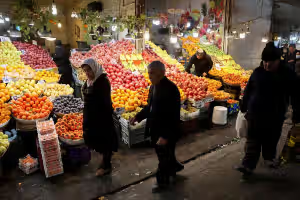
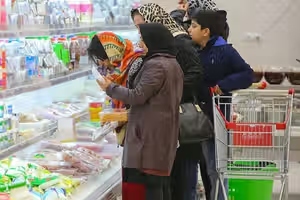
Shoppers walk through a crowded bazaar in Iran.

Iranians are struggling to afford basic food as bread prices rise sharply and citizens describe soaring costs for vegetables, snacks and other everyday purchases, according to an local media report and messages sent to Iran International on Monday.

Bread prices in the Iranian capital have risen sharply without official authorization, putting even bread and cheese beyond the means of some workers, labor-focused ILNA news agency reported.

“Things are very bad with bread, and the unofficial increase in bread prices has become staggering. There was a time when a worker could at least count on bread and cheese, but today they can no longer afford even that,” Ali Torkashvand, executive secretary of the Workers’ House, told ILNA.

The pressure comes as Iran’s official minimum wage stands at about 166.3 million rials per month, equivalent to roughly $72 at the open-market exchange rate.

  • Iran is living through America’s 2022 inflation shock almost every month

    Iran is living through America’s 2022 inflation shock almost every month

Messages sent separately to Iran International describe sharp increases across basic food and household purchases. One citizen said several kilograms of vegetables had cost 25 million rials, equivalent to about 15% of the monthly minimum wage.

“Damn the Islamic Republic for making people suffer this much. We really can’t afford to buy anything anymore,” the citizen said.

A packet of meat-flavored instant noodles cost 900,000 rials, another citizen said.

“I bought a few food and hygiene products and it came to 20 million rials,” another citizen told Iran International, a sum equivalent to about 12% of the monthly minimum wage.

Bread moves beyond reach

ILNA linked the rising cost of essentials to repeated currency depreciation and increases in energy prices, saying shocks to fuel and foreign-exchange costs feed through to food, medicine, housing and other necessities.

Wages and pension payments had failed to keep pace with rising prices, leaving workers struggling to meet basic household expenses, Torkashvand said.

The latest pressure follows the government’s decision to double Iran’s third-tier gasoline price to 100,000 rials per liter from September 8.

Higher gasoline prices could drive up the cost of other goods and services through increased transportation and production expenses, Torkashvand said.

Iran’s economy has come under mounting pressure from international sanctions and restrictions on trade and finance, the economic fallout from war and US efforts to block Iranian oil exports and other revenue streams, alongside declining investment and domestic economic mismanagement.

Workers were struggling with rising prices even before the latest gasoline increase, Ali Zamiri, a labor activist, told ILNA.

“Under the present circumstances, there is no longer any clear order or pattern to prices, while workers’ incomes have not changed in line with these rising costs,” Zamiri said.

Food prices outpace wages

Prices for some staples have risen far faster than overall inflation, with rice increasing by more than 200% and cooking oil by more than 300%, Majid Rahmati, a member of Tehran province’s Islamic Labor Councils board, told ILNA.

Rahmati called for increased food subsidies and higher wages and benefits during the second half of the Iranian year to offset some of the loss in purchasing power.

  • Iranians buy bread on credit, queue for chicken scraps

    Iranians buy bread on credit, queue for chicken scraps

The strain has also forced some families to seek credit for basic food. ILNA reported on Sunday that people in poorer areas of Tehran were asking neighborhood stores to let them buy groceries, meat, prepared meals and even bread on credit.

Shopkeepers themselves were finding it increasingly difficult to continue extending credit as their own costs rose, according to ILNA.

Foreign investment in Iran hits zero after war

Sep 13, 2026, 20:55 GMT+1
•
Dalga Khatinoglu
100%
A view from Bushehr port in southern Iran

Foreign investment in Iran has effectively come to a halt following the war with Israel and the United States, with no new foreign investment recorded so far this Iranian year, a senior industry ministry figure said.

No foreign investment has been made so far in the current Iranian calendar year, which began on March 21, Tahmoures Lahouti, Deputy Industry Minister and head of Iran’s Small Industries and Industrial Parks Organization, told the Iranian Labor News Agency (ILNA).

“Given the sanctions and restrictions in place, foreign investment is not taking place,” Lahouti said.

Domestic investment in industrial development has also declined compared with last year, with exchange-rate volatility, inflation and weakening household purchasing power weighing on businesses, Lahouti added.

The Iranian year began about three weeks after Israel and the United States launched military operations against the Islamic Republic on February 28.

Lahouti did not provide figures for the decline in domestic investment or specify whether his assessment of foreign investment covered all sectors of the Iranian economy.

The rial has lost roughly 60% of its value against the US dollar since the beginning of the Iranian year, increasing the cost of imported equipment and other inputs for businesses. High inflation and uncertainty over future prices have further complicated long-term investment decisions.

Industrial employment declines

The deterioration in investment has coincided with significant job losses in industry.

About 630,000 industrial jobs were lost in the first quarter of the current Iranian year compared with the same period a year earlier, according to figures from Iran’s Statistical Center.

Separate labor-market data have also shown a sharp decline in the number of workers making social-security contributions.

The contraction adds to longer-running problems facing Iranian manufacturers, including sanctions, restrictions on international banking, inflation, currency depreciation and recurring energy shortages.

Foreign investment falls as capital outflows surge

Data from the United Nations Conference on Trade and Development (UNCTAD)shows that Iran was already struggling to attract foreign direct investment well before the war.

  • 100 days after carnage: Iran economy reels from war, inflation, unemployment

    100 days after carnage: Iran economy reels from war, inflation, unemployment

In 2016 and 2017, following the implementation of the nuclear deal and the temporary easing of international restrictions, Iran attracted an average of about $4.2 billion in foreign direct investment (FDI) annually. After the United States withdrew from the nuclear deal and reimposed sanctions in 2018, the trend reversed, with annual FDI subsequently falling to around $1.5 billion.

At the same time, Central Bank data point to a sharp increase in capital outflows. Iran’s capital-account deficit widened from $6.77 billion in 2017 to $19.62 billion in 2025, nearly tripling over the period.

Overall, Iran attracted about $12.7 billion in foreign direct investment between 2018 and the end of 2025, while cumulative capital-account deficits approached $120 billion over the same period.

The gap illustrates that Iran’s problem extends beyond its difficulty attracting foreign capital. The country is also recording substantial capital outflows.

Iran falls further behind regional rivals

UNCTAD data for 2025 show the scale of the investment gap between Iran and some of its regional competitors.

Saudi Arabia attracted $32.6 billion in foreign direct investment last year, while the United Arab Emirates received about $48.2 billion.

The figures underscore Iran’s difficulty competing for foreign capital after years of sanctions and restrictions on international banking and trade.

Lahouti’s comments show that those constraints have now choked off an already limited flow of foreign investment. At the same time, depreciation of the rial, inflation, economic uncertainty and persistent capital outflows have made it more difficult for domestic investors to fill the gap.

  • Iran’s economy is a powder keg. Tehran is preparing for the spark

    Iran’s economy is a powder keg. Tehran is preparing for the spark

Foreign investment falling to zero this year is therefore part of a longer trend. Iran was struggling to attract foreign capital well before the latest war, while substantial capital outflows added to the pressure on investment at home.

Iranians buy bread on credit, queue for chicken scraps

Sep 13, 2026, 10:59 GMT+1
•
Hooman Abedi
100%
A baker prepares flatbread at a bakery in Iran. Rising prices have led some customers to ask to buy bread on credit.

Iranians are increasingly buying basic food on credit and lining up for chicken scraps, with shopkeepers and residents describing shrinking purchasing power under rapidly rising prices in a report published Sunday.

“The wheels of the economy in the margins and dilapidated parts of major cities have long fallen out of rhythm, giving way to a struggle for daily survival,” Iran’s labor-focused ILNA news agency wrote.

The report documented growing hardship in southern districts of the capital where shopkeepers said customers increasingly ask to postpone payment for groceries, meat, and even bread.

  • Iran is living through America’s 2022 inflation shock almost every month

    Iran is living through America’s 2022 inflation shock almost every month

Many businesses can no longer afford to extend credit because the cost of replenishing their stock continues to rise, added ILNA. Signs asking customers not to request purchases on credit have increased in shops.

Bread becomes a purchase on credit

“You sell something today and its price goes up tomorrow. There is no money left to replenish the stock,” a supermarket owner told. “Many customers ask for credit, but I have to refuse. Many come in, ask the price and leave empty-handed.”

Bakeries are also receiving requests for bread on credit, according to ILNA, which described them as a final fallback for low-income households.

One baker said many customers have been unable to repay what they owe for bread, but that he continues extending credit because of their financial circumstances.

100%
A baker serves a customer at a bakery in Iran. Rising prices have led some customers to buy bread on credit.

Butchers described a similar contraction in spending. “We get more requests for credit than you can imagine,” a butcher said. “I don’t want to send these poor people away empty-handed, but several times I sold on credit and the money never came back.”

Hundreds of people have also told Iran International that rapidly changing prices have made it difficult to plan even their near-term spending, with financial pressures increasingly affecting food, education, transportation and other routine expenses.

One person said 15 eggs and a small container of yogurt cost 5.5 million rials.

Iran’s basic monthly minimum wage for the current Iranian year is about 166 million rials, equivalent to roughly $70 at that exchange rate.

Another person said a brand of canned tuna had risen from 1.7 million rials to 2.5 million rials in a month. Within weeks, the price had climbed again to 2.9 million rials.

Education and transport costs bite

Education costs are also consuming a growing share of household income.

One person said a school bag now costs 20 million rials, equivalent to roughly 12% of the basic monthly minimum wage. Buying food for children to take to school and paying for English-language classes had also become increasingly difficult, the person said.

  • War or government failure? Record inflation fuels political battle in Iran

    War or government failure? Record inflation fuels political battle in Iran

A 19-year-old earning 150 million rials, or about $64, a month questioned how he could continue his studies when tuition at Azad University in Kermanshah had reached 250 million rials, or about $106, per semester.

Everyday transportation costs are adding to household expenses. One person said a routine monthly service for a pickup truck on Friday cost 45 million rials, or about $19 – more than a quarter of the basic monthly minimum wage.

A retiree receiving the minimum pension said the rising cost of living had left him unable to meet the personal needs of his three daughters.

Residents queue for chicken scraps

The hardship becomes more visible in the southern neighbourhoods of the capital, where people searching garbage bins outside shops for leftover food has become a common sight, ILNA wrote.

100%
A man looks at packaged chicken at a food market in Iran.

Residents line up at one shop selling chicken carcasses and scraps, according to the report.

A dairy shop owner said prices had at least doubled over the past year while his sales had fallen to one-quarter of their previous level.

“Dairy sales have practically fallen to zero, while the shop’s electricity bill has gone from 4 million rials to 18 million rials,” the shopkeeper said. “Where am I supposed to get the money to pay it?”

“New goods arrive, but the previous stock still hasn’t sold and is left on our hands. Prices rise so quickly that customers cannot afford to buy,” the shopkeeper added.

Inflation tests household finances

Iran’s economy has faced years of high inflation and currency depreciation alongside international sanctions, restrictions on trade and finance, corruption and economic mismanagement.

The rial has continued to lose value, increasing the cost of imported goods and adding to the pressure on households whose incomes have failed to keep pace with prices.

The economic pressure is increasingly testing Iran’s ability to withstand financial and trade restrictions, analyst Mohsen Modir-Shanechi told Iran International.

100%
Customers buy chicken and eggs at a food market in Iran.

“Countries subjected to this kind of severe economic encirclement gradually but continuously become weaker,” Modir-Shanechi said. “It reaches a point where the country’s political and economic institutions begin to come apart from within.”

Modir-Shanechi said Washington was relying heavily on financial and trade restrictions to constrain the Islamic Republic, comparing the approach with economic pressure previously applied against the Soviet Union, Iraq, Yugoslavia, Cuba and Venezuela.

Inflation is a key measure of Iran’s ability to withstand such pressure, Modir-Shanechi said, pointing to sharp price increases experienced by other economies subjected to prolonged financial and trade restrictions.