The contradiction is hard to miss. A government that has demanded ideological conformity from Iranians appears willing to overlook Namjoo’s past transgressions at a time when the Islamic Republic is under extraordinary military, economic and domestic pressure and is openly seeking to encourage some prominent Iranians abroad to return.
Rather than a sign of moderation, his return may reveal how flexible the Islamic Republic can become when its own rules are no longer useful.
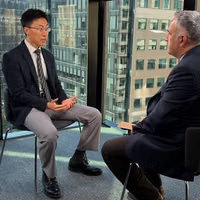
Siavash Rokni, an expert on Iranian popular culture, and historian Shahram Kholdi told Iran International’s Eye for Iran that the apparent opening serves several purposes. It can distract from executions and political prisoners, project an image of a more tolerant Iran and send a message to the diaspora that even former critics may be able to return — although the state still decides who gets through the door.
“Diversion. I’m going to make this quite simple,” Rokni said.
Kholdi questioned whether the rules were really changing at all.
“Are they bending their own rules and principles?” he asked. “Or are they temporarily deactivating them?”
Namjoo is an extraordinary figure around whom to test that question.
The Mashhad-born musician left Iran in 2007 and was later sentenced in absentia to five years in prison for “insulting sanctities” over his use of Quranic verses in his music. It remains unclear publicly what became of that sentence before his return. Outside the country, he continued to ridicule religious and political symbols, including former Supreme Leader Ali Khamenei.
He has also faced multiple allegations of sexual misconduct and abuse, which he denies.
And yet he has been allowed home.
His return was also highlighted by Iranian state media, which praised what it described as his “patriotic” opposition to US and Israeli attacks. Namjoo himself said he had encountered considerable kindness since returning.
Who gets to break the rules?
The contrast is particularly stark when Namjoo’s treatment is compared with that of female musicians inside Iran.
Singer Parastoo Ahmadi drew international attention after performing without the compulsory hijab in an online concert in 2024. She was briefly detained after the performance. In June 2026, she and members of her production team were reported to have been sentenced to 74 lashes, along with two-year bans on travel and artistic activity.
Rokni also pointed to Hiva Seyfizadeh, another female singer who was arrested during a live performance in Tehran in 2025.
The juxtaposition gets to the heart of the controversy surrounding Namjoo. A male musician known for ridiculing symbols the Islamic Republic considers sacred — and who has faced sexual misconduct allegations abroad can return, while women continue to face state pressure over their clothing and their voices.
“Why are female singers not able to sing and an alleged sexual abuser is back, is invited back to the country?” Rokni asked. “What is this double standard happening in this country?”
Namjoo’s return has generated precisely the kind of attention such a contradiction might be expected to produce. Iranians have argued over his decision to return, his past and what his presence in Tehran means.
That noise may itself be useful.
Rokni described the use of popular culture as part of a sophisticated communications strategy capable of shifting attention away from far more damaging issues for the state — among them executions, political prisoners, economic hardship and the repression of women.
“Namjoo is not, in my opinion, an important subject of conversation,” he said.
The point is not that his return is insignificant. It is that the spectacle surrounding one musician can swallow up the conversation about thousands of people who do not have the luxury of choosing whether to engage with the Islamic Republic.
An invitation with conditions
Namjoo’s homecoming also carries a message beyond Iran.
If someone who mocked the Quran and the country’s former supreme leader can return, other members of the diaspora may reasonably wonder whether the rules have changed for them too. That question is no longer hypothetical. Culture Minister Abbas Salehi has said his ministry compiled a list of more than 100 cultural, artistic and intellectual figures abroad whose return it wants to facilitate.
But the door does not open equally.
“Returning to one’s country has become a game of preferential treatment,” Rokni said.
The Islamic Republic effectively retains the power to determine which Iranians can come home, which critics can be forgiven and what compromises are required to make that possible.
History gives reason to be wary of assuming that an open door will remain open.
Kholdi recalled the experience of writer and dissident Saidi Sirjani, a prominent critic of the Islamic Republic. Following the death of its founder, Ruhollah Khomeini, Sirjani believed a different political era might be emerging and encouraged other Iranian intellectuals abroad to consider returning, Kholdi said.
Sirjani was arrested in 1994 and died in custody later that year under circumstances that remain disputed.
Kholdi also pointed to Iranian-Canadian scholar Ramin Jahanbegloo, who was arrested in Tehran in 2006 and detained for months before eventually leaving the country.
“I would not consider such moves a sign of the fact that they have become more moderate,” he said.
The history even gives Kholdi reason to worry about Namjoo himself.
“As a human who deserves the security and safety of life like any other normal person, I am worried for his safety,” he said.
Today’s welcome, in other words, does not guarantee tomorrow’s protection.
The power of an open door
That uncertainty carries particular weight for millions of Iranians abroad who still have family, professional and emotional ties to the country.
Kholdi said he was warned as a young academic that outspoken criticism of the Islamic Republic could cost him access to Iran, its archives and the field research needed for his career.
The threat did not have to be explicit. Access itself became leverage.
The same calculation can apply to artists, journalists, academics and ordinary diaspora Iranians who want to see parents or relatives. The state controls the door, and the possibility of losing access can shape behavior long before anyone attempts to cross the border.
Namjoo’s return makes that door appear wider.
It also gives the Islamic Republic a useful image to present to the outside world: a former critic who once violated some of its most sensitive taboos is back in Iran. How intolerant can the system be if someone like him is allowed to return?
Kholdi warned that there is another side to that calculation. Iran has repeatedly detained dual and foreign nationals who later became subjects of negotiations or prisoner exchanges, a practice critics of Tehran describe as hostage diplomacy.
The same state that can invite people in retains the power to prevent them from leaving.
That is why Namjoo’s return matters less as a story of one controversial musician coming home than as a glimpse of how the Islamic Republic behaves when under pressure.
It can enforce religious morality against a woman who sings without a hijab while overlooking the past of a man who mocked the Quran. It can imprison critics while advertising the return of another. And it can present selective tolerance as evidence of change without surrendering the power to reverse that tolerance later.
Namjoo’s return also appears to be part of a broader effort to selectively reopen the door to prominent Iranians abroad while the state retains the power to decide who may return and under what conditions.
The Islamic Republic’s red lines have not disappeared.
What Namjoo’s return exposes is that those lines were never equally rigid for everyone and that when the regime sees an advantage in moving them, even the principles it calls sacred can suddenly become negotiable.