• العربية
  • فارسی
Brand
  • Iran Insight
  • Politics
  • Economy
  • Analysis
  • Special Report
  • Opinion
  • Podcast
  • Live TV
  • Iran Insight
  • Politics
  • Economy
  • Analysis
  • Special Report
  • Opinion
  • Podcast
  • Live TV
  • Theme
  • Language
    • العربية
    • فارسی
  • Iran Insight
  • Politics
  • Economy
  • Analysis
  • Special Report
  • Opinion
  • Podcast
  • Live TV
All rights reserved for Volant Media UK Limited
volant media logo

Trump predicts gas below $2 after US victory over Iran

Sep 8, 2026, 01:45 GMT+1

US President Donald Trump wrote in a post on Truth Social that oil prices would fall sharply after a US victory in the war with Iran, predicting gasoline prices could drop below $2 a gallon.

“Oil prices will drop precipitously ... when we WIN the war with Iran,” Trump wrote Monday. “Three Dollars a gallon, but ultimately, below Two Dollars a gallon.”

Trump said the decline would happen quickly and added that Iran would “never have a Nuclear Weapon.”

Most Viewed

Iran, where eggs are a better bet than cash
1
PODCAST

Iran, where eggs are a better bet than cash

2

Iran oil workers protest pay conditions at offshore platforms, Assaluyeh

3

US carried out covert four-month Hormuz mine-clearing mission - FT

4
ANALYSIS

Starlink next door could loosen Iran’s grip on internet

5

Iran doubles gasoline price amid fears of renewed unrest

Banner
Banner
Banner

Spotlight

  • Europe’s third-way ambitions on Iran give way to alignment with Washington
    ANALYSIS

    Europe’s third-way ambitions on Iran give way to alignment with Washington

  • The gamble behind US attacks on Iran’s oil tankers
    ANALYSIS

    The gamble behind US attacks on Iran’s oil tankers

  • Iran, where eggs are a better bet than cash
    PODCAST

    Iran, where eggs are a better bet than cash

  • Starlink next door could loosen Iran’s grip on internet
    ANALYSIS

    Starlink next door could loosen Iran’s grip on internet

  • Satellite images show Iran’s key ports falling quiet under US blockade
    EXCLUSIVE

    Satellite images show Iran’s key ports falling quiet under US blockade

  • Iran's appliance industry is collapsing, and so is the market it was built for
    INSIGHT

    Iran's appliance industry is collapsing, and so is the market it was built for

•
•
•

More Stories

Canada vows action against transnational repression after Iran threats

Sep 8, 2026, 01:06 GMT+1
•
Mahsa Mortazavi
100%
Abolfazl Shekarchi, senior spokesperson for Iran’s armed forces, who has threatened Persian-language journalists abroad with being included on a list of military targets.

Canada says its security and intelligence agencies are using a full range of tools to counter foreign interference and transnational repression after a senior Iranian military spokesman threatened Persian-language journalists abroad.

In a response to Iran International, Public Safety Canada said authorities continuously monitor such threats and can respond through investigations, criminal charges and disruption activities.

“Canada takes allegations of foreign interference, including transnational repression, extremely seriously,” the department said, adding that protecting Canadians, safeguarding democratic institutions and defending the country’s national interests remain top priorities.

The response came after Abolfazl Shekarchi, senior spokesperson for Iran’s armed forces, accused Iran International, BBC Persian and Radio Farda of links to foreign intelligence services and described their journalists as “soldiers of Israel and the United States.”

He said journalists working for the outlets could be included in a “bank of military targets” because Tehran did not regard the organizations as media outlets.

Public Safety said Canada remained vigilant against transnational repression “by any state” and that the RCMP investigates reports of foreign interference regardless of their country of origin. Canada’s security and intelligence agencies, it said, employ “a full range of tools” to protect people in Canada and Canadians abroad from threats including terrorism, organized crime, foreign interference and transnational repression.

The department pointed to measures taken against Iran in recent years, including the designation of the Revolutionary Guards as a terrorist entity under the Criminal Code, sanctions and Iran’s continued designation as a state supporter of terrorism.

Canada has also expanded its legal framework for countering foreign interference. The Countering Foreign Interference Act, adopted in 2024, strengthened authorities under the Canadian Security Intelligence Service Act and updated offences related to foreign interference and sabotage.

A foreign influence registry established under separate legislation came into force in August, requiring greater disclosure of certain activities undertaken on behalf of foreign principals.

Global Affairs Canada earlier condemned Shekarchi’s remarks in a separate response to Iran International, saying journalists must be able to work without fear of reprisals, political interference or intimidation.

“Journalists, activists, and media workers are the cornerstone of fair, strong, and vibrant societies and must be free to do their work without fear of reprisals, political interference, or intimidation,” Global Affairs said.

The government said it would continue informing the public and supporting communities that may be disproportionately targeted by transnational repression.

Fiancée of slain protester, father of another die by suicide in Iran

Sep 7, 2026, 21:08 GMT+1
100%
From left to right: Ayda Heydari, her fiance Abolfazl Soleimani, Danial Karimi, and grave of his son Amir-Mohammad Karimi

The 25-year-old fiancée of a protester killed in Iran’s January crackdown and the father of another slain demonstrator have died by suicide within days of each other, sources familiar with the cases told Iran International.

Aida Heydari, whose fiancé Abolfazl Soleimani Alamouti was killed on January 9, died on September 3, about eight months after his death. The couple had planned to marry this month, according to the family.

Abolfazl was killed by gunfire during demonstrations in Zibashahr, Qazvin province.

Danial Karimi, the father of 19-year-old Amir-Mohammad Karimi, also died by suicide on September 6. His son, a former member of Iran’s national junior taekwondo team, was shot dead during protests in Marvdasht on January 9.

The 19-year-old was later buried in the nearby village of Joonjan.

Karimi’s death prompted reactions from opposition figures and Iranians on social media. The office of Reza Pahlavi said seeking justice for Amir-Mohammad, his father and others killed in the protests was a “national and collective duty.”

“Let us stand by the families seeking justice and, with care and empathy, be a refuge and support for one another,” his office said.

In an earlier case, Farahnaz “Atefeh” Roozfarah, the mother of slain protester Saman Ebrahimpour, died by suicide on July 16 after months of mourning. The 38-year-old was buried in Shaft, Gilan province.

The suicides come amid mounting reports of severe psychological distress among relatives of protesters killed during the January uprising.

Maryam Shokrani, a journalist based in Iran, recently reported that Tahereh Jangjoo, the mother of slain protester Raha Bohloulipour, had developed severe depression and had survived at least one suicide attempt following her daughter’s death.

Documents reviewed by Iran International show more than 36,500 people were killed in a systematic crackdown on the January protests.

If you or someone you know is struggling with suicidal thoughts, seek help from a trusted medical professional or crisis service. In Iran, the Social Emergency hotline can be reached at 123. In the United States, the Suicide and Crisis Lifeline can be reached at 988.

Baghdad urges action after Iraqi students attacked in Iran over assault claim

Sep 7, 2026, 20:50 GMT+1
100%
Screengrabs from videos shared on social media from the attack on Iraqi students in Semnan on Sept. 6, 2026.

Iraq’s Foreign Ministry called for legal action against those behind an attack on Iraqi students in Iran’s Semnan province after a confrontation reportedly triggered by unconfirmed allegations that several Iraqi students assaulted an Iranian woman.

Iraq’s Foreign Ministry said Monday it was following the attack by “a group of Iranian citizens” with “utmost concern” and was coordinating with Iranian authorities to investigate the incident. Foreign Minister Fuad Hussein ordered the Iraqi embassy in Tehran to examine the circumstances surrounding the violence.

Iranian judicial authorities said two people involved in the confrontation had been identified, while investigations were continuing to identify others.

Baghdad Today, citing its correspondent in Semnan, reported that more than 150 people attacked accommodation used by Iraqi students at Semnan University, entered the compound and beat students, leaving several seriously injured.

[@portabletext/react] Unknown block type "telegram", specify a component for it in the `components.types` prop

The outlet said some Iraqi students remained inside the building as the crowd prevented them from leaving. Police arrived and sought to stop the violence but made no arrests, according to the report.

Videos circulating on social media showed disturbances inside the residence and a crowd gathered outside.

Conflicting accounts of what triggered violence

Iranian news website Rouydad24 said some local reports claimed the confrontation began after Iranian students alleged that several Iraqi students, described in those accounts as affiliated with Iraq’s Popular Mobilization Forces, or Hashd al-Shaabi, had forcibly taken an Iranian woman into the residence.

Social media users also alleged that several Iraqi students had sexually assaulted an Iranian female student, triggering the attack on their accommodation.

No official source has confirmed the allegation, and neither Iranian nor Iraqi authorities have said that sexual assault caused the confrontation.

Semnan University said the incident occurred outside a privately operated residence housing international students and that authorities were investigating its origin.

“There was no confrontation or clash between Iranian students and international students in this incident,” the university said.

Iraq’s ambassador to Tehran, Yasser Abdulzahra, described the episode as a “misunderstanding and verbal altercation” involving Iraqi students that escalated into an assault, according to Iraq’s state news agency.

He said an embassy delegation was sent to the university and stressed that Baghdad would not tolerate attacks on Iraqi students. He also urged Iraqi students to respect Iranian social norms and demonstrate “discipline, academic awareness and mutual respect.”

The Iraqi Foreign Ministry welcomed measures taken by Iranian authorities to protect the students and transport them safely to their university for examinations, but called for legal action against the attackers and safeguards to prevent similar incidents.

Iranian judiciary identifies two people

Mohammad Sadegh Akbari, chief justice of Semnan province, said two people involved in the confrontation had been identified and summoned by police.

He described the incident as a clash between “a number of citizens and some Iraqi students” and said judicial and law enforcement authorities were continuing their investigation.

Akbari also accused what he called “hostile media” of publishing accounts inconsistent with preliminary findings but did not say which claims he was disputing.

The incident comes amid broader debate over the growing number of foreign students in Iran. Science Minister Hossein Simayi Sarraf said in August that more than 50,000 Iraqis were studying at Iranian institutions, more than 95% of them at postgraduate level.

On Saturday evening, Semnan’s Friday prayers leader, Morteza Motiei, said the presence of large numbers of foreign students in the province should not be treated solely as an academic matter and called for a “cultural framework” to accompany it.

He said economic and social issues associated with foreign students had created challenges across Semnan province and required a broader approach.

In 2024, the University of Tehran announced an increase in the admission of members of Hashd al-Shaabi, the Iranian-backed Shiite militia in Iraq, without the need for entrance exams.

The influx of the Hashd al-Shaabi members into Iranian universities, particularly the University of Tehran where admission for Iraqis has doubled, is part of a broader plan, the University’s president said at the time.

Tensions over Iraqi students have surfaced before. In October 2025, students and residents in Hamadan protested after an Iraqi student was accused of harassing a female student at Bu-Ali Sina University. Protesters also complained about students they said were affiliated with Hashd al-Shaabi.

Iranian security forces later prevented another planned gathering, while Hamadan prosecutors described the harassment allegation as unproven and warned protesters against unauthorized demonstrations.

Iran oil workers protest pay conditions at offshore platforms, Assaluyeh

Sep 7, 2026, 17:35 GMT+1
100%
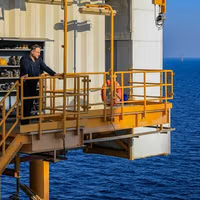
Oil workers protesting their pay conditions on an offshore platform on Sept. 7, 2026.

Employees of Iran’s oil industry held protests Monday at offshore platforms operated by Pars Oil and Gas Company and in the southern energy hub of Assaluyeh, demanding changes to pay, taxes and benefits as US economic pressure weighs on Iran’s oil exports and wider economy.

Afkar-e Naft, a Telegram channel which reports on issues affecting permanent oil industry employees, said the demonstrations were part of protests held every Monday.

Images published by the channel showed workers at several offshore installations holding placards calling for the removal of salary caps, full payment of wages and benefits, fairer compensation and changes to the tax system for offshore employees.

“Full payment of wages and benefits,” read one placard, while another said, “Fair pay is our right, not an extra privilege.”

Other signs called for an overhaul of the wage system for operational oil workers and the removal of what protesters described as “unfair restrictions” on salary payments.

1 / 5
100%
1 / 5

Several workers also highlighted the conditions under which oil production has continued during the war. One placard read, “Uninterrupted production in a war zone,” while another referred to “uninterrupted production in border areas.”

The protesters are also seeking payment of outstanding compensation under Article 10 of the law governing the duties and powers of Iran’s Oil Ministry.

The so-called Article 10 back pay refers to accumulated payments employees say they are owed following implementation of provisions governing compensation and employment conditions for Oil Ministry personnel.

The protests come as Iran’s economy faces mounting pressure from the regional war and a US maritime blockade that was reimposed in mid-July. Satellite imagery reviewed by Iran International shows a sharp decline in visible vessel activity at Shahid Rajaee and Imam Khomeini, two of the country’s most important commercial ports, since the blockade resumed.

  • Satellite images show Iran’s key ports falling quiet under US blockade

    Satellite images show Iran’s key ports falling quiet under US blockade

The impact has been particularly severe on Iran’s oil trade, a crucial source of government revenue and foreign currency. Kpler tanker-tracking data reviewed by Iran International showed Iranian crude loadings averaging about 287,000 barrels per day in August through Aug. 21, compared with roughly 2 million barrels per day before the war — a fall of about 85%.

Washington has simultaneously intensified its financial campaign against Tehran. On Aug. 24, the US Treasury launched Operation Economic Outcast, dubbed an “Economic D-Day,” saying it aimed to sever Iran’s remaining financial and commercial connections and increase the risks for foreign banks and companies doing business with Tehran. The campaign has since targeted financial channels in countries including the United Arab Emirates and Türkiye.

The pressure has coincided with a steep deterioration in household purchasing power. Iran’s rial has fallen to a record low of about 2.2 million to the US dollar this month, compared with roughly 958,000 a year earlier.

Official figures for July showed average annual inflation at around 62%, year-on-year inflation at 82% and food inflation at 134%, adding to the pressure on wages and living standards.

Europe’s third-way ambitions on Iran give way to alignment with Washington

Sep 7, 2026, 16:00 GMT+1
•
Clément Therme
100%
کارمندی پرچم‌های اتحادیه اروپا و آمریکا را در مقر کمیسیون اروپا در بروکسل مرتب می‌کند؛ ۱۱ نوامبر ۲۰۱۳.

The Trump administration may be overstating Europe’s formal role in its “Economic D-Day” campaign against Iran, but years of economic and political convergence have increasingly aligned Europe with Washington.

The European Union has welcomed additional economic pressure on Tehran, including through the US-led Operation Economic Outcast, but has not formally endorsed every element of Washington’s strategy.

Yet the distinction over formal alignment conceals a more consequential reality: since the United States withdrew from the nuclear agreement in 2018, Europe has increasingly behaved as Washington’s junior partner on Iran.

This alignment predates the current war. Since the late 2000s, Europe has increasingly substituted declaratory diplomacy for autonomous action, defending multilateralism and dialogue while adapting in practice to US policy.

This gap became particularly evident after Trump’s withdrawal from the JCPOA and reimposition of US sanctions on Iran in 2018: despite European opposition, the blocking statute and INSTEX failed to sustain meaningful trade, as almost every major European company abandoned Iran to preserve access to the US market.

This choice was economically rational. The US market and financial system are vastly more important to European companies than Iran. The international dominance of the dollar enables Washington to impose sanctions with effects far beyond US territory.

European banks, insurers, shipping companies and industrial groups remain highly exposed to US regulators and financial markets. Whatever the official position of their governments, companies have overwhelmingly prioritized continued access to the United States over commercial opportunities in Iran.

The weakness of direct EU-Iran trade should not obscure Europe’s remaining economic significance. According to the European Commission, trade in goods between the EU and Iran amounted to €3.7 billion in 2025, comprising €2.97 billion in EU exports to Iran and €760 million in imports from Iran.

This left the EU a significant trading partner for Iran, even though Iran accounted for only around 0.1 percent of EU exports.

These figures also underestimate indirect commercial links. European products reach Iran through Türkiye and, above all, the United Arab Emirates, which serves as a crucial platform for re-exports.

Stronger US pressure on Ankara, Dubai-based traders, logistics companies and regional banks would therefore affect European-origin goods even when European firms have no direct contractual relationship with an Iranian buyer.

“Economic D-Day” is not directed solely against Iran: it is designed to force Iran’s remaining commercial intermediaries to choose between Tehran and access to the US financial system.

Europe’s gradual alignment also has a political and diplomatic dimension. In August 2025, following unsuccessful talks with Tehran, France, Germany and the United Kingdom triggered the UN “snapback” mechanism with US support.

UN sanctions were restored on September 28, prompting the EU to reimpose its own nuclear-related economic and financial restrictions the following day.
The EU formally reimposed those measures on September 29.

After the deadly repression of the January 2026 protests, the EU went further, formally designating the Islamic Revolutionary Guard Corps as a terrorist organization in February and imposing additional sanctions targeting human rights violations, Iran’s missile and drone programs, and Iranian operations on European soil.

This convergence has since extended to the multilateral arena. In September 2026, the United States and the E3 began pressing for an International Atomic Energy Agency Board of Governors resolution reporting Iran to the UN Security Council for the first time in 20 years.

The push has further deepened the confrontation over inspections: IAEA Director General Rafael Grossi said on September 7 that Tehran had told the agency it would not cooperate until there was progress in broader political negotiations, while Iran warned it would take reciprocal action if the resolution was adopted.

Grossi said the agency was receiving no information and had been told Iran would not cooperate without progress in broader political negotiations.

The proposed referral would mark a significant escalation in the nuclear standoff and further narrow the space for Europe’s long-standing ambition to pursue a third way between Washington and Tehran.

The war launched by the United States and Israel on February 28, 2026 initially generated considerable European frustration. European leaders had not been consulted or even properly warned by their principal ally, despite their earlier coordination with Washington over the snapback process.

They called for restraint and respect for international law while expressing concern about the regional and economic consequences of the offensive.

But this dissatisfaction did not produce an autonomous European strategy. Europe lacked the military capabilities, economic leverage and political unity needed to shape the conflict.

The decisive talks involved Washington, Tehran and regional intermediaries such as Pakistan, Oman and Qatar. European governments remained largely peripheral, even as they condemned Iranian attacks against neighboring countries and commercial vessels.

The current hardening of the European position should therefore also be understood in the context of transatlantic relations and the war in Ukraine. For European leaders, preserving US support for Ukraine and preventing a strategic rapprochement between Washington and Moscow remain overriding priorities.

Iran offers them a potential means of demonstrating their usefulness to the Trump administration. By cooperating with Washington on sanctions, nuclear restrictions and regional security, Europeans hope to facilitate dialogue with an administration whose disengagement from Ukraine is their greatest strategic fear.

This calculation resembles the strategy adopted by several European governments at the beginning of Trump’s second presidency: concede or cooperate on secondary issues to preserve US engagement on the issue considered existential for European security. Iran is thus treated partly as a bargaining instrument within the transatlantic relationship.

This does not mean that European and US objectives are identical. Most European governments remain wary of regime-change strategies, uncontrolled military escalation and the humanitarian consequences of comprehensive sanctions.

They continue to emphasize diplomacy and international law and have not formally subscribed to Washington’s campaign of total isolation. The Trump administration is consequently overstating Europe’s political endorsement.

Yet the practical difference is narrower than European rhetoric suggests. Europe’s declaratory autonomy cannot compensate for its financial dependence, limited military capabilities and reliance on the United States for its own security.

Nor can European governments fully control the commercial decisions of private companies, which overwhelmingly prioritize access to the US market and the dollar-based financial system over limited opportunities in Iran.

Washington may therefore be exaggerating when it says that Europe has joined “Economic D-Day.” But since 2018, the structural alignment it describes has become increasingly difficult to deny.