Iran plans new university hijab directive as hardliners press for enforcement
File photo shows a confrontation between Iranian hijab enforcers and a woman not wearing the mandatory head covering.
Iran is preparing to issue a new compulsory hijab directive for universities, a senior official said Tuesday, as hardliners intensify pressure on women over mandatory veiling ahead of the anniversary of Mahsa Amini’s death in morality police custody.
Saeed Karami, deputy for cultural and political affairs at the Office of the Supreme Leader’s Representative in Universities, said the directive had been drafted and would soon be issued by the ministries of Science and Health, which oversee most universities and medical schools.
Karami told the semi-official Mehr news agency that existing regulations on hijab were “very good” and only needed renewed attention.
Asked whether universities would receive a “hijab charter,” Karami said “directive” was a more appropriate term. He did not give details of the measures it would contain or specify when they would take effect.
“We will certainly not witness the bitter incidents that we sometimes see on the streets at universities,” he said, without elaborating.
The planned directive comes amid a renewed push by hardline officials, clerics and government supporters to strengthen enforcement of compulsory hijab, four years after the death of Mahsa Jina Amini in morality police custody triggered the Woman, Life, Freedom uprising.
Women appearing in public without headscarves have since become commonplace in Tehran and other major cities, making rejection of compulsory hijab one of the most visible social changes to survive the 2022 protests.
Pressure has increased in recent weeks as hardliners demand implementation of the stalled Hijab and Chastity Law and criticize President Masoud Pezeshkian’s government for what they describe as a retreat on the issue.
Hardline lawmaker Mohammad-Taghi Naghd-Ali said Tuesday the government had backed down over hijab and accused it of failing to implement the legislation, describing compulsory veiling as one of the “foundations of the revolution.”
The more sweeping Hijab and Chastity Law remains suspended after the Supreme National Security Council instructed parliament not to promulgate it, Parliament Speaker Mohammad-Bagher Ghalibaf disclosed last year. The decision was widely seen as reflecting fears that aggressive enforcement could trigger renewed unrest.
Other signs of renewed pressure have appeared across Iran. The commander of the Revolutionary Guards in North Khorasan said this week that groups tasked with verbally warning women over their clothing were being revived, while pro-government gatherings demanding stricter hijab enforcement have been held in Qom, Birjand and Isfahan.
Iran International found last month that authorities had sealed at least 42 cafés, restaurants, shops, sports clubs and other businesses in 17 cities within three weeks over alleged violations of hijab rules and other Islamic norms.
Authorities have increasingly used business closures, judicial warnings and economic pressure rather than relying solely on the large-scale morality police patrols associated with enforcement before the 2022 uprising. Reports from inside Iran have nevertheless also pointed to renewed street warnings and patrol activity in several cities.
Universities have long been a particular focus of hijab enforcement and political control. Campuses became major centers of protest during the Woman, Life, Freedom uprising, and female students were among those who openly removed their headscarves in defiance of the state.
In April 2023, the Science Ministry said universities would not be required to provide educational, welfare and other services to students who refused to comply with hijab regulations. Female students were subsequently barred from campuses, summoned to disciplinary committees and in some cases suspended or expelled from dormitories.
At the University of Tehran, authorities later deployed women with seminary backgrounds to monitor students’ clothing, while students at several other institutions reported being photographed, having their student IDs recorded or being denied entry over their clothing.
At Tehran’s Amir Kabir University of Technology, students boycotted classes in 2024 after reports that more than 200 students had been barred from campus amid stricter dress-code enforcement. Similar pressure was subsequently reported at Tehran North Islamic Azad University.
Signs of renewed tension have emerged again this year. The Student Basij at Iran University of Science and Technology recently protested the presence of unveiled female students at an event attended by senior officials from the Science Ministry.
Despite successive enforcement campaigns, many Iranian women continue to appear without mandatory hijab in streets, cafés, shopping centers and other public spaces, maintaining a form of civil disobedience that has persisted since the Woman, Life, Freedom protests.
A mounted machine gun deployed in Khorramabad, western Iran, on Monday, September 7, ahead of a fuel price increase.
Iranian security forces deployed around fuel stations and on streets across the country as a gasoline price increase took effect, with people warning of further pressure on household budgets and rising prices for other goods and services.
Messages, videos and accounts sent to Iran International described deployments of police, special units and Basij forces in Tehran, Mashhad, Shiraz, Karaj, Isfahan, Tabriz, Birjand, Khorramabad, Khomein, Abadan and Qeshm.
Reports of slower internet connections also emerged from several cities, including Tabriz and Babol.
Petrol prices doubled on Monday for drivers buying fuel outside their monthly subsidised quota, rising from 50,000 to 100,000 rials a litre, about 2.3 to 4.5 US cents. The government announced the increase two days earlier.
Monthly subsidized allocations remain unchanged. Motorists can buy 60 liters at 15,000 rials per liter, about 0.7 cents, and another 50 liters at 30,000 rials, about 1.3 cents.
The dollar figures are negligible. The wages are the point. Average monthly pay in Iran is around 250 million rials, about $113 at Tuesday's rate, and many workers earn closer to 200 million, or roughly $90 a month.
Security forces gather around fuel stations
Several residents of Mashhad told Iran International that security forces appeared around petrol stations on Sunday, hours before the new price took effect.
“On Monday evening, I passed three gas stations. Several police vehicles were stationed outside each one, and at one station there were large numbers of Basij motorcyclists and special unit forces,” one resident said.
Another Mashhad resident described police and special units positioned at fuel stations across the city.
Video sent to Iran International from Khorramabad in western Lorestan province showed security personnel, vehicles and motorcycles deployed around the city, including what appeared to be a mounted machine gun.
Fuel supplies had already faced disruptions over the previous three weeks in areas including Razavi Khorasan, South Khorasan, Tehran and Alborz provinces.
Citizens in early September reported station closures, long lines, restrictions on purchases and waits of about two hours to obtain 10 liters of gasoline.
A Birjand resident said some filling stations had closed and displayed notices blaming “technical problems,” while police were positioned at others.
Similar deployments were described in Shiraz, where a local reported a large security presence around Maali-Abad early Tuesday, and in Karaj, particularly Fardis, Gohardasht and Mehrshahr.
A resident of Khomein in Markazi province also described a long line and numerous police officers at a fuel station on Shohadaye Daneshjoo Street.
Special units deploy in Tehran
Several Tehran residents reported increased security deployments from Monday evening, including in Shahr-e Rey and Salsabil neighborhoods.
“The station was heavily secured. Special units and the Basij were constantly moving around, and the streets were crowded,” a resident who visited a fuel station near Ferdowsi Square in central Tehran around midnight said.
Another who went to a station on Pirouzi Street in the east described long vehicle lines with special units positioned nearby.
People in Isfahan and Abadan also reported armed police at filling stations. In Qeshm, a resident said armed personnel were deployed around major squares on Monday evening and that a confrontation occurred at the entrance to a filling station in Dargahan.
Two messages from Tabriz described a large security presence alongside deteriorating internet service.
“The city of Tabriz is full of special units. The forces are armed, and heavy equipment can also be seen,” one said.
A Babol citizen also reported slower mobile and fixed internet connections, though the reason for the disruption could not be established.
Gasoline prices carry particular political sensitivity in Iran. A sudden increase and rationing in November 2019 triggered demonstrations across dozens of cities that quickly expanded into nationwide anti-government protests.
Security forces killed around 1,500 people during the crackdown, according to a Reuters tally at the time. Thousands were arrested and authorities imposed a nationwide internet shutdown.
Government defends higher gasoline price
First Vice President Mohammad Reza Aref defended the new rate, arguing that even 100,000 rials per liter remains far below the government's cost of importing gasoline.
Imported gasoline costs the government more than 700,000 rials per liter, equivalent to about 30 cents, Aref said. Imported fuel would gradually be sold at prices closer to its cost, he added.
The government's figures for what petrol costs to produce have not held up well to examination. In November 2025, after officials put the cost at 340,000 rials a litre, about 15 cents at current rates, Iran International went through the refineries' own financial statements. They showed operating costs, excluding the value of the crude going in, of around 35,000 rials a litre, roughly 1.6 cents, a tenth of the official figure.
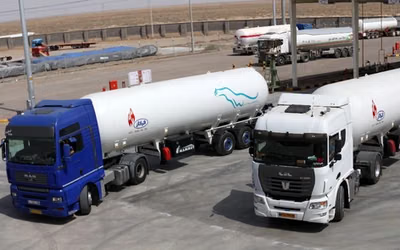
A general view of a gas station in Iran
Economist Mousa Ghaninejad has estimated actual gasoline consumption inside Iran at about 70 million liters a day and argued that much of the remainder recorded as consumption is smuggled out of the country.
Iranians warn of knock-on price increases
Thousands of people responding to an Iran International question about the fuel increase focused on its potential impact beyond filling stations, warning that transportation costs could push up food prices, fares and other everyday expenses.
“100,000 rials for a liter of gasoline may just be a number for some people, but for people it means another step toward making life harder,” one respondent wrote.
Another said petrol was not the problem on its own, and pointed to food. A five-liter container of cooking oil that used to cost 22 million rials, about $9.90, now sells for 40 million, roughly $18.
On a monthly wage of 200 million rials, that is a fifth of a month's pay for one container of oil.
“We buy everything at expensive dollar-linked prices, but our base salary is only $100. Where in the world can you see something like this?” one person wrote.
Another said wages would have to rise alongside prices, since households could not absorb repeated increases on incomes that had barely moved.
For younger respondents the loss was smaller and more particular. "The feeling of going on a trip is gone. Going out for a 10-minute drive is gone. We young people said goodbye to small pleasures a long time ago," one wrote.
A general view of the Australian Senate chamber at Parliament House in Canberra.
Four senior Australian opposition politicians have backed a role for Reza Pahlavi in a political transition in Iran and urged closer engagement with the exiled prince, telling Iran International they have invited him to visit Australia.
The Coalition politicians said they supported peaceful political change in Iran and planned to meet Pahlavi virtually. No date has been announced for the meeting or a possible visit.
“We want to see peaceful political change in Iran. We don't support the current regime,” Senator Dave Sharma, Shadow Assistant Minister for Citizenship and Multicultural Affairs, told Iran International.
“We think it's done immense harm not only to its own people, but to the neighbourhood, the region, and even to the world here in Australia.”
Iran International also spoke to Senator Andrew Bragg, Shadow Minister for Environment; Senator Jessica Collins, Chair of the Senate Foreign Affairs, Defence and Trade References Committee; and Julian Leeser, Shadow Minister for Education.
Coalition seeks engagement with Pahlavi
Engagement with Pahlavi is one of the Coalition's most important foreign policy objectives because of the role it believes he could play during a transition, Bragg said.
Senator Andrew Bragg, Australian Shadow Minister for Environment
“For the coalition, having a meeting with the Crown Prince is one of the most important foreign policy objectives that we have, because we believe that meeting with this key transitional figure is the best way to move the conversation on to a new government for Iran,” Bragg told Iran International.
Bragg described the Islamic Republic as “probably the worst government and the worst regime on the planet” and accused it of crimes against Iranians and sponsoring terrorism abroad, including in Australia.
The senator argued that political change would be difficult without serious international engagement with an alternative.
“This government will never be moved on unless we engage seriously with an alternative, and the alternative that we have as a transitional figure is the Crown Prince,” Bragg said.
Collins also described Pahlavi as “an important symbol of anti-regime and pro-democracy” and said the Coalition would continue engaging with him and hearing about the challenges facing Iranians.
The four lawmakers plan to hold a virtual meeting with Pahlavi ahead of a possible visit to Australia. The Coalition has extended an invitation for the visit, but no date has been announced for either the talks or the trip.
Peaceful political change
Pahlavi is an influential voice in Iranian politics, with many Iranians around the world looking to him for leadership, Sharma said.
The Coalition’s outreach aims to build a clearer picture of events inside Iran and support political forces seeking change, said Sharma, a former Australian ambassador to Israel.
“I think having the Crown Prince visit Australia will help show the Australian people that there are prospects for a brighter political future in Iran,” Sharma said.
“There are many Iranian people who want this to happen, and that he will play an important part in any transition.”
Senator Dave Sharma, Australian Shadow Assistant Minister for Citizenship and Multicultural Affairs
A visit could also renew Australian public attention on Iran following the authorities' deadly suppression of nationwide protests in January, Sharma said.
Leeser said the invitation was intended to give Australian politicians an opportunity to hear Pahlavi's assessment of conditions inside Iran and his vision for the country's future.
“The coalition has decided to invite Reza Pahlavi to Australia at this time because Reza Pahlavi has been advocating for freedom and democracy for the people of Iran, and we want to hear his perspective of what's happening on the ground and his hopes for the future of Iran,” Leeser told Iran International.
Leeser drew parallels between the invitation and Australia’s past engagement with figures in overseas political struggles, including Archbishop Desmond Tutu and Winnie Mandela during South Africa’s anti-apartheid struggle, and Xanana Gusmão and José Ramos-Horta during East Timor’s campaign for independence.
Julian Leeser, Australian MP and Shadow Minister for Education
“Reza Pahlavi would come to Australia in that tradition to provide us with his perspective and to provide us with important information that will help us develop our foreign policy in this area,” Leeser said.
Support for Iranians
All four politicians used the interviews to express support for Iranians seeking political change.
Collins said the Coalition shared what she described as the fundamental values sought by protesters, including “freedom, liberty and security.”
“We stand with you all the way, and I want you to know, I want all the Iranian people in Australia to know, and around the world, that we stand with you,” Collins said.
Chair of the Australian Senate Foreign Affairs, Defence and Trade References Committee
Sharma echoed that view, saying the Coalition’s engagement with Pahlavi reflected its support for Iranians seeking democratic change.
“The message this will send to the people of Iran is that you are not alone, that your fight for freedom and democracy is a fight that we share and that we are equally committed to, and that your success is our success,” Sharma said.
Trash bins block a street during protests in Tehran’s Naziabad neighborhood in January 2026.
A 34-year-old protester shot in the Iranian city of Qazvin on January 8 has undergone five major operations and months of largely secret medical care as doctors work to save and reconstruct his badly damaged leg.
“The bullet severely destroyed the bone in his right lower leg, and the lower part of his leg was almost attached to his body only by tissue and skin,” the protester’s brother told Iran International.
The protester was shot on Khayyam Street in Qazvin on the evening of January 8, according to information obtained by Iran International. The shot was fired from a Kalashnikov rifle at a distance of about 100 meters.
The shooting took place during nationwide protests that began in December 2025 amid worsening economic conditions and a sharp fall in Iran’s currency, then grew into broader opposition to the Islamic Republic.
Security forces killed tens of thousands of Iranians during the January 8-9 crackdown, making it the deadliest two-day protest massacre in history, according to documents reviewed by Iran International’s Editorial Board.
After initial attempts to stop the bleeding failed, the family sought help from an acquaintance to move him secretly to a hospital in Qazvin, his brother said.
The family has had to keep much of his treatment secret for fear he could be identified and detained, his brother said.
Iran International has documented similar cases since the January protests, in which wounded demonstrators avoided medical facilities or sought treatment in secret for fear of identification and arrest.
A photo provided to Iran International shows the wounded protester’s surgically treated leg alongside an X-ray showing an external fixation device used during months of treatment after he was shot in Qazvin on January 8.
Sources in Mamasani, in Fars province, previously confirmed that some wounded protesters there avoided medical centers because they feared their identities could be exposed and they could face prosecution.
Secret hospital exit after seven-hour surgery
The hospital in Qazvin was among those willing to admit wounded protesters despite the risks, his brother said.
Staff placed the 34-year-old in a darkened room with several other wounded people and cut power to parts of the hospital to stop surveillance cameras from recording patients’ movements, his brother said.
He lost consciousness after severe blood loss and underwent surgery at about 3 p.m. on January 9. The operation lasted roughly seven hours.
After surgery, hospital staff warned the family that he needed to leave quickly through a rear exit, fearing security forces could arrive and detain him, according to the family.
About an hour later, relatives and hospital staff moved him out of the building, before he had fully regained consciousness, and took him to a home to recover.
Iran International has previously documented the scale and severity of injuries inflicted during the January crackdown.
A specialist in a northern Iranian city said he and his son operated on dozens of wounded people on January 9 and 10. His son removed more than 270 pellets from the eyes of about 130 protesters, the doctor said.
Severe infection complicates recovery
Deep wounds and extensive damage to the protester’s lower leg complicated his recovery after the first operation, with large amounts of fluid draining from the wound each day, his brother said.
The family changed his dressings at home with help from a doctor they knew. As the infection worsened, they contacted the surgeon who had performed the first operation. He continued treating the protester at his private practice.
The family was told that the bullet had shattered a large section of his shinbone, leaving a gap that prevented the remaining ends from joining on their own.
The surgeon referred him to a colleague in Tehran for specialist treatment.
For months, the family has taken him from Qazvin to Tehran roughly every two weeks. He has undergone more than five major operations on his leg, his brother said.
Iran International has received other accounts of doctors secretly helping protesters wounded in January. In one case, a Tehran doctor treated dozens of wounded protesters free of charge and arranged for their radiology fees to be waived, sources said.
Surgeons remove 12 centimeters of bone
Surgeons eventually had to remove about 12 centimeters of damaged bone from his lower leg and make a surgical cut in the bone near his ankle.
They then fitted an Ilizarov apparatus, an external frame of metal rings, rods and wires used to gradually move sections of bone. The technique can help repair extensive bone damage and replace missing bone.
Doctors hope to use the device to gradually close the gap between the healthy sections before performing a bone graft, according to the family.
He faces a prolonged recovery, with no immediate prospect of regaining normal mobility or returning to work.
An X-ray provided shows extensive damage to the lower leg of a 34-year-old protester who was shot in Qazvin on January 8.
Treatment costs strain family
Months of surgery, medication, wound care and travel between Qazvin and Tehran have put the family under growing financial pressure, his brother said.
From left to right: Ayda Heydari, her fiance Abolfazl Soleimani, Danial Karimi, and grave of his son Amir-Mohammad Karimi
The 25-year-old fiancée of a protester killed in Iran’s January crackdown and the father of another slain demonstrator have died by suicide within days of each other, sources familiar with the cases told Iran International.
Aida Heydari, whose fiancé Abolfazl Soleimani Alamouti was killed on January 9, died on September 3, about eight months after his death. The couple had planned to marry this month, according to the family.
Abolfazl was killed by gunfire during demonstrations in Zibashahr, Qazvin province.
Danial Karimi, the father of 19-year-old Amir-Mohammad Karimi, also died by suicide on September 6. His son, a former member of Iran’s national junior taekwondo team, was shot dead during protests in Marvdasht on January 9.
The 19-year-old was later buried in the nearby village of Joonjan.
Karimi’s death prompted reactions from opposition figures and Iranians on social media. The office of Reza Pahlavi said seeking justice for Amir-Mohammad, his father and others killed in the protests was a “national and collective duty.”
“Let us stand by the families seeking justice and, with care and empathy, be a refuge and support for one another,” his office said.
In an earlier case, Farahnaz “Atefeh” Roozfarah, the mother of slain protester Saman Ebrahimpour, died by suicide on July 16 after months of mourning. The 38-year-old was buried in Shaft, Gilan province.
The suicides come amid mounting reports of severe psychological distress among relatives of protesters killed during the January uprising.
Maryam Shokrani, a journalist based in Iran, recently reported that Tahereh Jangjoo, the mother of slain protester Raha Bohloulipour, had developed severe depression and had survived at least one suicide attempt following her daughter’s death.
Documents reviewed by Iran International show more than 36,500 people were killed in a systematic crackdown on the January protests.
If you or someone you know is struggling with suicidal thoughts, seek help from a trusted medical professional or crisis service. In Iran, the Social Emergency hotline can be reached at 123. In the United States, the Suicide and Crisis Lifeline can be reached at 988.
Screengrabs from videos shared on social media from the attack on Iraqi students in Semnan on Sept. 6, 2026.
Iraq’s Foreign Ministry called for legal action against those behind an attack on Iraqi students in Iran’s Semnan province after a confrontation reportedly triggered by unconfirmed allegations that several Iraqi students assaulted an Iranian woman.
Iraq’s Foreign Ministry said Monday it was following the attack by “a group of Iranian citizens” with “utmost concern” and was coordinating with Iranian authorities to investigate the incident. Foreign Minister Fuad Hussein ordered the Iraqi embassy in Tehran to examine the circumstances surrounding the violence.
Iranian judicial authorities said two people involved in the confrontation had been identified, while investigations were continuing to identify others.
Baghdad Today, citing its correspondent in Semnan, reported that more than 150 people attacked accommodation used by Iraqi students at Semnan University, entered the compound and beat students, leaving several seriously injured.
[@portabletext/react] Unknown block type "telegram", specify a component for it in the `components.types` prop
The outlet said some Iraqi students remained inside the building as the crowd prevented them from leaving. Police arrived and sought to stop the violence but made no arrests, according to the report.
Videos circulating on social media showed disturbances inside the residence and a crowd gathered outside.
Conflicting accounts of what triggered violence
Iranian news website Rouydad24 said some local reports claimed the confrontation began after Iranian students alleged that several Iraqi students, described in those accounts as affiliated with Iraq’s Popular Mobilization Forces, or Hashd al-Shaabi, had forcibly taken an Iranian woman into the residence.
Social media users also alleged that several Iraqi students had sexually assaulted an Iranian female student, triggering the attack on their accommodation.
No official source has confirmed the allegation, and neither Iranian nor Iraqi authorities have said that sexual assault caused the confrontation.
Semnan University said the incident occurred outside a privately operated residence housing international students and that authorities were investigating its origin.
“There was no confrontation or clash between Iranian students and international students in this incident,” the university said.
Iraq’s ambassador to Tehran, Yasser Abdulzahra, described the episode as a “misunderstanding and verbal altercation” involving Iraqi students that escalated into an assault, according to Iraq’s state news agency.
He said an embassy delegation was sent to the university and stressed that Baghdad would not tolerate attacks on Iraqi students. He also urged Iraqi students to respect Iranian social norms and demonstrate “discipline, academic awareness and mutual respect.”
The Iraqi Foreign Ministry welcomed measures taken by Iranian authorities to protect the students and transport them safely to their university for examinations, but called for legal action against the attackers and safeguards to prevent similar incidents.
Iranian judiciary identifies two people
Mohammad Sadegh Akbari, chief justice of Semnan province, said two people involved in the confrontation had been identified and summoned by police.
He described the incident as a clash between “a number of citizens and some Iraqi students” and said judicial and law enforcement authorities were continuing their investigation.
Akbari also accused what he called “hostile media” of publishing accounts inconsistent with preliminary findings but did not say which claims he was disputing.
The incident comes amid broader debate over the growing number of foreign students in Iran. Science Minister Hossein Simayi Sarraf said in August that more than 50,000 Iraqis were studying at Iranian institutions, more than 95% of them at postgraduate level.
On Saturday evening, Semnan’s Friday prayers leader, Morteza Motiei, said the presence of large numbers of foreign students in the province should not be treated solely as an academic matter and called for a “cultural framework” to accompany it.
He said economic and social issues associated with foreign students had created challenges across Semnan province and required a broader approach.
In 2024, the University of Tehran announced an increase in the admission of members of Hashd al-Shaabi, the Iranian-backed Shiite militia in Iraq, without the need for entrance exams.
Theinflux of the Hashd al-Shaabi members into Iranian universities, particularly the University of Tehran where admission for Iraqis has doubled, is part of a broader plan, the University’s president said at the time.
Tensions over Iraqi students have surfaced before. In October 2025, students and residents in Hamadan protested after an Iraqi student was accused of harassing a female student at Bu-Ali Sina University. Protesters also complained about students they said were affiliated with Hashd al-Shaabi.
Iranian security forces later prevented another planned gathering, while Hamadan prosecutors described the harassment allegation as unproven and warned protesters against unauthorized demonstrations.